Jon Favreau talks about “Chef” at Tribeca Film Festival

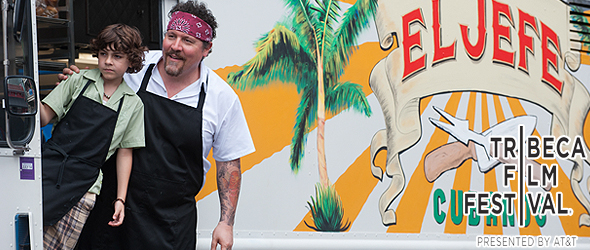
Chef, the new film from Jon Favreau held its premiere on Tuesday in New York. The hugely successful director of “Iron Man” and “Elf” hasn’t directed an independent film since 2001’s “Made” and was excited to debut the comedy, which he also wrote and stars in, at the Tribeca Film Festival.

In the film, Favreau plays Carl Casper, a chef whose embarrassing confrontation with a food critic goes viral on the web causing him to lose his job at a successful restaurant and start from scratch with a food truck and a road trip with his son. Favreau spoke on the red carpet about the inspiration for this story: 

Favreau: “When you write something like this, you’re not really sure where it comes from. I wanted to write something about a chef and something about being a dad and this is the film that came out. And the fact that I’m at the point in my career where if I have an idea like this, I could get it made and have such great friends who would come together and be part of the cast so I found myself very fortunate.”

Luckily for audiences, Favreau’s friends include Robert Downey Jr who plays Marvin. It’s a small but pivotal role as Marvin provides Carl with his new food truck.

How was it working with Robert Downey Jr. without having him playing Iron Man?
Favreau: “I love working with Robert and it was great for him to be on my movie. Because on the Iron Man movies, I feel like I was really there to help support him and make the character look good and make the story make sense and you know, be there in a supportive role. Here, he came on board my movie to do whatever he could to elevate the film.”

As the story concerns a man frustrated working for a successful business while being artistically unfulfilled, I couldn’t help but wonder if coming off of studio films, the story was at all autobiographical, but Favreau maintains this isn’t the case:

Favreau: “No, I’ve been very lucky, I work on big movies and small movies and I really am very proud of all of them. As a matter of fact, I’m going to do “The Jungle Book” [for Disney] after this which is much bigger than “Chef” so unlike the character in the movie, I really like mixing it up a bit. I think the character I play is a little more confused with what drives him. But I really did have a good time doing a small movie like Chef which is similar to how he feels in the film.”

Favreau was joined on the carpet by his onscreen son, the talented, 10-year-old Emjay Anthony, who had nothing but good things to say about his veteran cast:

Anthony: “Sofia Vergara is just drop dead gorgeous, and [John Leguizamo’s] kind of a ladies’ man and so am I, so there was a little contest there. And then Jon Favreau is just such a great actor.”

As for any upcoming projects for the young Anthony, he told us not right now, but “I’m open for business if anybody wants me!”

“Chef” opens in the US on May 9th.

William Shatner talks about his one-man show “Shatner’s World”

Photo Credit: Manfred Baumann

You might know William Shatner as Captain Kirk from “Star Trek: The Original Series”, or Denny Crane from “Boston Legal”, either way the man is a legend in the business. At age 83, he is still going strong and has tackled everything from acting to theatre to being an author. In 2012, he returned to the stage on Broadway with his one-man show, “Shatner’s World”. Since then he took the show on tour and now it will be playing in movie theaters for a special engagement on April 24th through Fanthom Events. Media Mikes had the special privilege to chat with Mr. Shatner about the show and his outstanding career.

Mike Gencarelli: You took “Shatner’s World” from Broadway, then touring and now to cinemas; what has been the highlight for you this journey?
William Shatner: The highlight is at the end of the evening…I think I am safe in saying that at every performance that I have done, the audience had stood up and applauded at the end. The emotion that comes over the footlights between me and the audience has moved me to tears many times. The audiences affection at the end of the evening is palpable and that is truly the highlight for me, Mike. And for the price of a movie ticket, you can see a Broadway play in theaters. This is a live capture of the Broadway play and it will be released in 700 theaters and you can see it for the price of only a movie ticket. So you can’t beat that.

MG: “Shatner’s World” calls back to your roots starting off in theatre; how was it returning back to that setting?
WS: I have been asked for years, since the last time I was on Broadway, to come back and do a play and in some cases a musical. But they needed to get at least a six month commitment and I didn’t have that time available. So I thought “I guess that’s it for me and Broadway”. But within months of saying that came an opportunity to go back to Broadway with this show and I even was able to go to the the exact theater where I was for my last Broadway play. So the irony of that, or the beautiful or symmetry of that is not lost on me.

Photo Credit: George Qua-Enoo Photography

MG: What was the the name of that last Broadway show?
WS: It was “A Shot in the Dark” with Julie Harris…many years ago.

MG: In “Shatner’s World”, you mentioned several struggles on your career early on; what would you say is your defining moment?
WS: I have the kind of career that was a slow build. Every time something sensational was going to happen it didn’t work out that way it was suppose to. There was this slow wave of attention and activity that I think actually climaxes in this one-man show. To go on stage alone for an hour and a half to two hours and hold an audience and get the kind of reaction I’ve been am getting, that is the cumulation of years of experience and attention. It didn’t happen suddenly, there was no defining moment. Instead, there was a series of small wavelets as apposed to a tsunami.

MG: Having such a full career, what were some of the hard decisions you had to make to cut out in order to get this show down to an hour and a half?
WS: There were many parts that didn’t make it, especially getting the show ready for Broadway. I had to sharpen and refine and reduce it to it’s supreme moments, if you will, where it epitomizes everything that I wanted to say. Not only stories but also extraneous words, so it is a difficult process. The core of this show was to say “Yes” to life. To give this idea, this concept, that life is precious and needs to be embraced with both ears and smothered by you because it is over so quickly. So the stories that went along with that core were the stories that I kept.

MG: I loved the energy that you brought to the stage; how do you channel all that energy running around on stage and still while being funny and charming?
WS: It is part of the entertainer’s magic, I guess, but that is my energy and it comes from my core. That is what I bring to you on stage, you being the audience. I feel that there is a magical link between me and the audience. I feel it and you feel it. I am there for you. We are having a love affair, the performer and the audience. I actually feel the embrace and perform to that and that is energizing to me.
MG: I have to honestly say that from just watching the show, I felt pumped and I didn’t even see it in person, so congrats on that as well for being very effective.
WS: I am so glad to hear you say that, thank you. That is a lovely compliment and I appreciate you saying it.

MG: You bet!, what would you say is biggest challenge doing a one-man show?
WS: There is a number of challenges. You are talking continuously for two hours and trying to remember the words. It is not unlike musicians doing a set and having the set numbers in front of them. They have clues as to what is next. So that is what I had but it still had to remember those words. So now that I haven’t done this in many months I am going to be in Las Vegas at the MGM Grand on June 19th, 20th, 21st doing the one-man show, which is what a thrill let me say, so I am going to have to re-learn the lines now. So that is a challenge but not only that but I am going to have to teach the show to an individual on how to work that software for the electronics and the media. So that is going to be a challenge in Las Vegas. Then I am going on a tour for a few selected dates in January and have to re-do that again. So the dint of the words and the expenditure of energy that is so orgasmic [laughs] and you have to be ready for it, so those are challenges also.

MG: You mentioned your musical career in the show; do you have any plans to go down that road again?
WS: Well, I have been asked to do a cover album…and I just may do that. I love music. I can’t sing or sustain a note but what I do have is the musicality of the language. Many languages, English among them, has an intrinsic melody and rhythm that needs to be sought out, if you will. It is one thing to speak like we do but another to find the heart of the language and I love that. So my ability to be able to combine that musicality of the words with a melody line that comes in behind it, it became a signature thing. I just love doing it and I am anxious to do it again, so whether it is an album or live. I did perform my newest album, which is called “Ponder the Mystery”. I did it three times with Billy Sherwood’s group in the Los Angeles area last year and it got a great response and I would love to repeat that.

MG: From being an actor, author, spokesperson etc; what is left on your bucket list that you want to do?
WS: Oh my goodness. I haven’t done anything in life. I feel unaccomplished and I feel like I have done nothing [laugh]. Being a performer, once the performance is over…it is gone. It is in the ether. It may have just as well not happened. The next night is the next challenge. It is a challenge of many kinds. It is a challenge of redoing that performance that only you can remember. The challenge is also that if there will be an audience for that performance. I am feeling that way right now. Doing all this publicity is an attempt to fill that gap that I hope that 700 theaters will be filled up with people coming to see the show on April 24th. There is so much to do and so little time left to do it.

Ralph Steadman talks about his work with Hunter S. Thompson and film “For No Good Reason”

Ralph Steadman is a British Gonzo artist that is best known for his work with American author Hunter S. Thompson, author of “Fear and Loathing in Las Vegas”. After meeting each other in 1970 to cover the Kentucky Derby, Steadman and Thompson formed a long-time relationship. Steadman’s did the artwork for Thompson’s books over his career. He is also an author himself having written numerous books focusing on his drawings…or as Hunter would have called it his “filthy scribblings”, according to Ralph. This April, “For No Good Reason” makes its U.S. debut in NYC, which is a documentary on Ralph’s career. Media Mikes had a chance to chat with Ralph about the film and his work with Hunter S. Thompson.

Mike Gencarelli: Tell us about how you got approached for the documentary “From No Good Reason”?
Ralph Steadman: The director Charlie Paul initially came down to see me, then the producer Lucy Paul. This was over a period of twelve years, you know. They would stay for lunch, we would talk and then we would carry on. So over twelve years, we made this film. It just seems so long ago from when we first started it. They got Johnny Depp involved, which was good because he has become a personal friend of mine over the years. He is such a great guy, easy going, warm, genuine and terrific fellow…
MG: I loved Johnny’s narration in the film as well, very nice touch.
RS: Oh yeah, it was lovely. I agree.

MG: How did you feel about having a documentary about your life done?
RS: I first thought “For God’s sake…why?” “For no good reason”…that is what Hunter would have said. I used to always ask “Why are we doing this Hunter?” and he would always say “For no good reason, Ralph” [laughs].

MG: How was it seeing some of your drawings brought to life and illustrated in the film?
RS: That was quite interesting. I couldn’t be an animator in old Disney way when they used to draw one picture and then other but slightly different and then you would put them together like a flip book and they would actually move. The only thing I liked like that was doing something simple like a dot or a splat and putting it in a book form and flipping it and watching it move, that to me was magic. I like doing that kind of thing. But seeing my drawings in the film was really great.

MG: I find it so interesting that you said in the film that your work is unprofessional and “it is as unexpected to me as it is to anyone else”; can you talk about this aspect?
RS: Yeah, that is because I don’t do any pencil work. I never plan anything. I just begin and the drawing becomes what it becomes. My reaction every time is “I don’t know how I did that”. I am always amazed. “How the fuck did I do that?”, I usually say. It’s like Ludwig Wittgenstein’s idea that only thing of value is that thing that you cannot say but you can see it. I like that a lot.

MG: So how did your splatter technique come about then?
RS: Oh that was clumsiness. I was clumsy. I said “Oh shit” when I flicked my wrist with my pen but I realized it made this beautiful sweep of blots. I thought to myself them “Oh I like that, it’s quite nice” So I started to use it more deliberately. I would spill ink all over the place. I liked the idea of putting a sheet of paper on the studio floor taking a bottle of ink high on a ladder and dropping it. Not all of it…but just enough. It would make terrific, radiating splatters of different designs. Then you look and think “Hmm, it could be a spider” and I would go from there.

MG: Looking back at the film now, how do you feel that it has come together?
RS: I was amazed by it actually. After twelve years, it was nice to see it all come together. They did cut out a few things that I would have liked them to keep in like my art teacher, Leslie Richardson. This was a pity since I really wanted him in it. What they were after was the notoriety including the fame of Johnny Depp. So poor Leslie Richardson, who is now 93, was left out. But he still goes around kicking old ladies and children in the streets [laughs].

MG: Tell us how you originally crossed paths with Hunter Thompson?
RS: When I was planning to come to New York in 1970, I had some friends that invited me to stay with them in the Hampton’s. They were soon to be married, so I felt a little uncomfortable saying with them for a long period of time. So after staying a little while, I was going to leave for the city and I was about to leave when there was a cal from a guy named J.C. Suarez. He was an editor from Brooklyn. He wanted me to come to Kentucky and meet an ex-Hells Angels, who just shaved his head. I asked why did he do that and he said “Why? Because he’s a Hells Angels. He is a rebel”. So I asked “What for?” He told me that he was not only looking for a photographer but for an artist and they saw my book of pictures called “Still Life with Raspberry”, which was my first book of collected drawings. Don Goddard was the foreign editor of The New York Times and he had found the book in England and then came back and said that they need to put me with Hunter Thompson. So that is how it happened.

MG: Do you feel that your career would have been different if your path’s didn’t cross?
RS: As far as I was concerned, meeting Hunter and going to Kentucky was a bulls eye for me. For all the people that I could meet in America, he would be the one…go figure. Meeting Hunter was the best thing for me in terms of making a career. What we did for journalism was that we became the story and that became know as gonzo journalism. That was really what was so good about it. One day, this guy Bill Cardoso told us that the Kentucky Derby piece we did was “pure gonzo”. Hunter never heard the word before and it really stuck. He used to say “Don’t do those filthy scribblings”. He used to call my drawings filthy scribblings [laughs]. He used to also tell me “Don’t write Ralph, you will bring shame on your family”. But he always loved to sort of go against you but on purpose because he would know that it would provoke me and my work would benefit.

MG: “Fear and Loathing in Las Vegas” is one of my favorite books and the movie is great as well…
RS: The thing is people get too sniffy about the movie and things like that. They say that it is not quite this or quite that. No! It is a version of the book. I didn’t mind it, especially since the whole damn thing, “Fear and Loathing in Las Vegas” was a crazy idea to begin with.

MG: Do you recall how long it took you to complete the illustrations for the “Fear and Loathing in Las Vegas” book?
RS: I think I did nine pictures in a week and it was done. The rotten thing was that I ended up selling all of the originals since I was told it would be a good career move. I think I got $75 dollars each for them. Can you imagine what they are worth now?

MG: Has your drawings been affected since the death of Hunter S. Thompson?
RS: No, not really. I have been doing bird drawings for the last few years. I don’t like drawing politicians any more, I can’t be bothered. They are so awful. I don’t feel so bitter about it. I do not feel like I am trying to change the world. I have changed the world enough since I started and it is worse now than when I started [laughs]. So good, I have done what I had meant to do [laughing]

MG: Yeah, you start off the film saying you set out to “change the world”; I was going to ask if you felt that you have accomplished that goal?
RS: We’ll you look around, I have done my part but bloody computers have changed everything.The business and also people in general. You can’t walk down a side street without somebody passing you by and they are not looking at you or around them, they are looking down at their phone. I had to go on a train recently to Halifax for a show of my drawings and there was this woman on the train that was a good example. She had red hair which was long down one side and shaved on the other side. I have a drawing of it in my book here. She was so awful, I had to draw her. But she had her makeup out in one hand and her phone in the other from the moment she got on the train. That is the problem about the invasion of the computer, like Twitter. Everyone wants to tweet you now. So that is very weird to me.

MG: Tell us about your latest book “Proud Too Be Weirrd”?
RS: I collected together a bunch of things that I never had no good reason to use [laughs]. I thought I would start with the first page and go through my studio finding this and finding that and just building the book from there and that is how I worked on it. This guy Steve Crist from AMMO Books got in touch with me about doing it. He used to work at TASCHEN. Benedikt Taschen rang me after the book was made and said he was actually very disappointed because he wanted to do the book, but at the time I didn’t know this. He did my book with Hunter, “The Curse of Lono”. Steve Crist used to work with Benedikt and that’s where he began. He sort of adopted the style of big book like TASCHEN did. I really like the title “Proud Too Be Weirrd” and it is a great book

MG: What are some of the artists that inspire you?
RS: I love Picasso. He is such an inspiration for me. There is a film called “The Mystery of Picasso” that is really worth seeing if you can get a copy. It is fascinating for me to watch him at work. The director, who made the film, was allowed to by Picasso to be in the studio with him. This is what Charlie did with me as well for our film. Picasso would set things up for him including painting on glass and having him film from the other side. This is amazing work and it really continues to inspire me.

MG: Are you working on anything else new currently?
RS: I got a new book of creatures that I am working on right now. These are completely made up creatures for example instead of a pelican; you do a pelicant [laughs]. You have to keep doing something otherwise what is the point. I guess I am taking advice from my father, who couldn’t bear to just sit about. I am also learning how to etch steel plates as well. So I suppose I should continue to carry on.


Related Content
Goo Goo Dolls’ Robby Takac talks about the band’s acoustic tour

Robby Takac is the bassist and a founding member of the rock band the Goo Goo Dolls. In June of 2013 the group released their tenth studio album titled “Magnetic” to rave reviews. The group is currently out on the road performing acoustically and Media Mikes had the chance to talk with Robby about the special run of shows and this summer’s upcoming tour with “American Idol” alum Chris Daughtry.

Adam Lawton: Can you tell us about the current acoustic tour you guys are out on?
Robby Takac: That was something John has been talking about doing for awhile now. Occasionally we get asked to do one off acoustic shows and they end up being a lot of fun and something we wanted to do more of. We just finished a Canadian tour run and have a little bit of time before our next tour starts to go out and do this acoustic run. It’s a great opportunity for us to go back out and do some shows that are a little different. There’s times during these shows where we have 11 people up there performing.

AL: With the acoustic element aside what do you find to be the biggest difference between these shows and the band’s traditional shows?
RT: When we are doing an electric show there are a lot more bells and whistles. We bust out all the stops when we are performing electrically. With the acoustic shows we are playing in much more intimate venues. I think the largest room we have booked on this tour is maybe 400 seats.  There is a different form of communication happening between the band and the listeners in this smaller setting. The shows are going great and I have a feeling that we will be more of them in the future.

AL: How does song selection play out from night to night?
RT: After putting out a number of acoustic songs we have a good catalog to choose from. We also do a bunch of our hit songs that we have reworked. A lot of the songs have been orchestrated so doing those on our own without that backing has been a little different. We thought about having things laid out ahead of time but it ended up working better when we just go off the cuff. We go out tell some stories and play some songs and it’s just a great time.

AL: Can you tell us about the bands recent video for the song “Come to Me”?
RT: I think when you do a video you are looking for something that accompanies the song. We tend to do videos that go along with the songs as the song is the most important thing. We shot the newest video up in the hills outside of Los Angeles and we feel it goes great with the song.

AL: What are the plans for the band after the acoustic tour run?
RT: We have a summer tour coming up with Daughtry that is going to be amazing. I think he has done a really great thing being able to change from what he did on “American Idol” and transforming it to what he is doing now. He had the ears and eyes of American during the time he was on that show and he has managed to keep them. We are going to have a great time this summer with Daughtry and Plain White T’s who will also be part of the tour.

AL: Can you tell us a little bit about the record label you have been working on?
RT: Good Charamel Records is the name of the label and we put out a lot of 7 inch Japanese punk rock albums.  Bands like Shonen Knife and Pinky Doodle Poodle are on our label. My wife and I actually manage Shonen Knife who has a great new album coming out soon.

DoryDrive’s Mathieu Nevitt talks about debut album “Here’s to You”

Mathieu Nevitt is the lead vocalist for the MidWest based rock group DoryDrive. The group has just released their debut full length album titled “Here’s to You” via First Launch Records and the single of the same name is currently working its way up the rock charts across the country. Media Mikes had the chance recently to talk with Mathieu about the group’s formation and the recording process for the new album.

Adam Lawton: Can you tell us about the formation of the band?
Mathieu Nevitt: The band was started out of me joining a preexisting band that the rest of the guys had performing with for quite some time. My previous band Echovalve was touring with them and we were both looking for something different. I wasn’t interested in joining something that had history already nor was I looking to do heavy music. We ended up coming together to start DoryDrive which is a departure from the guy’s previous material but I think we are all happy with what we are doing now.  From there we started recording together as a band in Nashville, TN. After a couple recording session there we though it would be cool to name the band after the street that the studio was on.

AL: What can you tell us about the group’s new album?
MN: The album is titled “Here’s to You” and working on the album was a very enjoyable process for us. We got to work with two different producers which was really cool. We were able to grow with our music and as a band I think that is what really gave us a chance to strength our bond. We like to have a good time when were in the studio and the writing process was a lot of fun.

AL: Was it difficult in any way working with two different producers?
MN: They each had their own philosophy. The guy we worked with in Nashville was much more militant about the guitar sounds. When we started working with the other producer who helped finish the record things felt much more inviting which I feel was beneficial. Both instances were beneficial for us but we really opened up more towards the end of the process.

AL: Can you tell us a little bit about the two music videos which have been released thus far?

MN: That’s a love/hate relationship for me. Shooting these can be very hectic and you never feel like you have enough time to do everything. There is always a question mark surrounding things. You just have to not second guess yourself and do whatever it is that needs to be done. The newest video is for our single “Here’s to You”. I was really happy with how it turned out and I think we are growing in front of the camera each time we work on a new video.

AL: Can you tell us about the bands current tour?
MN: This tour is our headlining tour. We will be following the radio markets that have picked up our single recently. We will be utilizing that radio play and our promotions company to really hit as many places as possible. We are also actively pursuing some other options as well for when this run of shows end. We are hoping to jump on a really great tour this summer.


Related Content

White Chapel’s Phil Bozeman talks about new album “Our Endless War”

Phil Bozeman is the lead singer for the heavy metal group White Chapel. On April 29th, they will release their 5th full length studio album titled “Our Endless War”. Media Mikes had the chance to speak with Phil recently about the creation of the new album which is probably the most diverse record we have heard from the band yet and also about the group’s upcoming headlining tour with Devil Driver.

Adam Lawton: Can you give us some background on the new album?
Phil Bozeman: We have grown as musicians and are chemistry as a band has certainly gotten better. We were very focused on writing the heaviest and best music we could. We are a heavy metal band but we wanted to incorporate as many of our own influences as we could to help make a diverse record.

AL: Did you find it hard to explore those influences and still stick to the sound and style the band is known for?
PB: It was a bit difficult at times to try something different while still keeping the elements that appeal to our fans the same. I think we are able to get away with everything we did as we paid close attention to make sure that things were still fitting our style.

AL: In a recent press release you stated that the band felt held back when working on the previous albums. Can you tell us a little bit about that and what creative process you took this time around?
PB: We have always worked the same way from record to record. We generally start out by just sitting down and discussing everyone’s different ideas. We all want to take chances and do different things however we don’t want to look bad while doing those things. I think that’s where the bands chemistry really shows as we all work together to put out a great product and it is something we are all happy with. As far as being held back goes in the past there had always been time constraints which limited us a bit. We never had disagreements or anything like that but we always seemed to be under a deadline.

AL: Can you tell us about the bands upcoming tour?
PB: We just finished up a short ten day run as part of the New England Metal Fest. We have a couple shows in Mexico scheduled before we start our headlining tour with Devil Driver. That will take us through the summer.

AL: When you guys are putting together a headlining tour how do you go about choosing which bands will be going out with you?
PB: We always start out by just looking at the bands we like and who we feel would be good to bring out. On a tour like the ones that’s coming up bands submit offers to be considered for a spot and we either accept them or pass.


Related Content

Social Distortion’s Jonny Wickersham talks about debut solo release “Salvation Town”

“Salvation Town” is the debut solo release from Social Distortion guitarist Jonny “Two Bags” Wickersham. Produced by David Kalish the album is an interesting departure from Wickersham’s previous body of work as the album is packed full of acoustical performances. Media Mikes had the chance to talk with Jonny recently about the album and what it was like working with Jackson Browne.

Adam Lawton:Can you give us a little background on your new solo album?
Jonny Wickersham: I started recording the album awhile back and it’s probably been 3 years now since we first started working on it. At the time when I started Social Distortion was very busy promoting and touring behind the “Hard Times and Nursery Rhythms” album. I didn’t initially have a lot of time to work on things. When I went in to record the first track it ended up being more than just working on the song but it was a chance for me to work with one of my idols, Pete Thomas who was Elvis Costello’s guy on drums. Once we finally got started things moved along pretty well and the whole experience was just great. I was really inspired by all the people who were willing to work with me on this album.

AL: What do you think was the main reason you waited until now to release a solo album?
JW: My good friend David Kalish who produced the album was always on me about doing a solo record. I kept putting it off because I didn’t think it was something I could do. I had always written songs however I never had any other vehicle to do them other than with the bands that I was in. I would write material and whether it was Mike Ness or the Cadillac Tramps or Duane Peters they would take what they liked from what I had brought in and then add their own parts especially, when it came to lyrics. I had never really learned to sell one of my songs or perform it. There’s a big difference between being in the recording studio and singing a song and being up in front of a crowd and playing. Then those two things are completely different from me sitting in my living room with an acoustic guitar performing for my cat. (Laughs)

AL: Can you tell us about some of the guest performers that appear on the record?
JW: The guest performers were something I didn’t put a lot of thought in to beforehand. Things just sort of happened off the cuff. I was certainly a fan of everyone involved and really worked out on a song to song basis. We did this record differently than what I am used to. I am used to working up songs as a band, demoing them and then going down to the studio to record the tracks. The bass and drums lay down a foundation and then everything else is built on top of that. There is a process to the whole thing. With “Salvation Town” it was much different. We laid down some acoustic guitar to a click track and then usually just Dave and I would go back and add a simple drum beat and bass line. From there we would try and think ahead of what the song could be. We would just have these ideas of about who might be able to add something really cool to the tracks. We ended up getting David Hidalgo from Los Lobos and his two sons David Jr. and Vincent, Gaby Moreno who was just so great and of course Jackson Browne. The song Jackson appears on is one that I have had for quite some time. It started out as straight ahead punk sounding song but with this being a different record I wanted to give it a different style. As we were working on it I said to David that I thought it could be Jackson Browne song. I never thought Jackson would be a possibility but David called me the day after mentioning and said that Jackson was down for it. I couldn’t believe it when a few weeks later Jackson came in to do his parts. Everything happened very organically. Having Jackson Browne and David Lindley on my album is just gnarly! (Laughs)

AL: Was there any point during the three years of working on the album that you got discouraged?
JW: There were so many discouraging times that I can’t even count. I am a stickler and very detail oriented. I am also one of those guys that have to exhaust every possibility so I was driving David crazy with this thing however; I think we balanced each other out perfectly in the studio. I wanted to make a good record that shows where I am at in my life while reflecting my influences. I didn’t want things to be over produced but at the same time I didn’t want it to sound like a demo. There were times where I wasn’t sure what was going to happen. That’s when I would get sketchy. It was all new to me. Fortunately over the years I have learned that you have to let things take their course.

AL: Do you have any plans to tour behind the release?
JW: Yes! As much as possible. We just recently played at South by South West. With the exception of the aweful tragedy that happened outside of the venue where we were playing the show was really great. It was trip being out there front and center. Every night I am always worried about how I am going to sound. (Laughs)

Erin Darley and Kai Winikka talk about their film ‘Killer Pizza’

“Jimmy and Sam are two college graduates who return home and find themselves working at a small pizza shop that pops up out of nowhere. It doesn’t take long for them to suspect that they’re working for two cosmic freaks with more sinister intentions than simply delivering pie. What is happening at the Killer Pizza shop? What is behind their secret recipe?”

That is the synopsis of ‘Killer Pizza’, the definitive feature-length picture about growing up, getting jobs, and surviving a Killer Pizza monster invasion.

Today I sat down and talked with the creative team behind the film: co-writer/director Kai Winikka and co-writer/producer Erin Darley. Both filmmakers live in Lawrence, Kansas and are graduates of the University of Kansas.

B.C. Allen: How was it that you two first met?
Erin Darley: When I was a Freshman at K.U., Kai was one of the Presidents of Film Works.
Kai Winikka: I ran a Cult Movie Night, once every month during my Senior Year, through Film Works. Film Works was an extra-curricular for freshman whom weren’t able to get into some of the production classes. It was more of a student-driven organization. Erin was a cult-film enthusiast, and it was always a big thing to get girls to show up. I always made more of a point to reach out to Erin since she was really into it. I’d tell her, “Ya know, we’re showing ‘Breakin’’ and ‘Jaws 4’, you have to come: bring your friends!”
ED: It was just a bunch of nerds coalescing, keeping each other motivated.
KW: It was a group of dinguses getting together to make movies.

BCA: What previous projects have you worked on together?
ED: “Porn & Pudding” was a thing. Everyone loved that. And that spawned a club. There is a “Porn & Pudding” club, and it was actually pretty serious. Kai is shaking his head because he is ashamed that I’m telling everyone this.
KW: That’s YOUR film, that’s not my film. (laughs) Our first real collaboration was probably
“Bustin’ Out”, where we both co-wrote and co-directed. It was for the 48-Hour Film Festival about superheroes, so naturally we made a Women-In-Prison movie. It was about a woman whose evil twin imprisoned her with a bunch of other women – whom were played by men — ED: Chicks with d*cks in chains.
KW: And there was an amulet that allowed her to shoot lasers out of her breast-icles.
ED: And then there was “Nanny Goat” which starred my sisters.
KW: And my basement in K.C.K.

BCA: What the origin of the idea for ‘Killer Pizza’?
KW: “Nanny Goat” was originally Plan A for the 48-Hour Film Festival, and if it didn’t work out, Plan B was “Killer Pizza”, but it was a lot sillier at the time. “Nanny Goat” did well and ended up winning the Audience Award. It was originally going to be about a babysitter, so naturally they order pizza; and of course the pizza ends up killing them.
ED: I always say that it goes back to standing there and deciding whether “Nanny Goat” was going to work and Kai just said, “If it doesn’t work out we’ll just order a pizza and we’ll throw it on your sisters and it will be eating them. And then at the end of the movie it crawls up to the camera, looks at the camera, and belches.”
KW: It’s come a long, long way from there. Although “Killer Pizza” is about a Killer Pizza and has Ron Jeremy in it, I’d like to say that this is a legit horror movie. It’s not campy at all.

BCA: You mention Ron Jeremy, how is it that he became attached to this project?
KW: I did a documentary in 2008 called “XXX in the Midwest” and Ron came to Washburn University in Topeka, Kansas to do a debate. So we waited in a long line afterward to meet him and he did the interview, had no issues, and signed the waiver like it was nothing. It left an impression, like he’s someone who is down for anything. He’s known as the hardest working man in show business, and he doesn’t say no, well, if it’s the right project.
ED: I came back from Colorado last year and Kai said that if I helped him write “Killer Pizza” then we’d get Ron Jeremy to be in it and we’ll put it on Kickstarter.com. So we wrote a part for him. And when we thought we were done with the script – which was three drafts ago – we knew it was time to contact Ron Jeremy. We sent him a letter, not knowing how long we’d have to wait to hear back from this guy. I went off to work, at a restaurant, and I was checking my e-mail obsessively, and he e-mailed us back within thirty minutes, and he said “Yes.” And I still have the letter, which started, “Dear Hedgehog,…”

BCA: What would be the biggest hurdle for this production?
KW: The biggest challenge I think will be the effects, that’s what I anticipate it being. There are a lot of them and they are elaborate; and there is a lot of testing that has to go down beforehand. And they can still go wrong, like on set, the day of. Also making sure we can make our day and keep the production sailing.

BCA: What makes you want to use practical effects as opposed to digital effects?
KW: It has more charm. There is more heart to it. I am a big believer in visual effects when they are combined with practical, but this movie doesn’t really call for that.
ED: I think C.G. is trying to be realistic, but it doesn’t always work. Regular effects don’t always look super real, but the suspension of disbelief takes care of a lot of that for us; but it’s more fun, I would say.
KW: It’s the heart. C.G. comes close, but not close enough.

BCA: Do you have a specific look you are going for with this film?
KW: It’s going to be a really dark film, so the idea is to go in and bring the black way, way down, and taking a lot of the color out. That idea is really appealing to me. The look of the film “976-EVIL” is the kind of look I am going for.

BCA: When was it that you started to write, or realized you wanted to be storytellers or filmmakers?
KW: In high school, a group of guys and myself were making “Jackass”-type videos. We were doing it every week, and then every day; and it got to a point where I was telling them they’d have to do it again because it wasn’t good enough, and my friends told me I was taking all the fun out of it. It grew from there.
ED: I made high school movies, too. But I didn’t discover my writing ability until college. I’ve just always done it as a fun, personal thing. I write poetry, and short stories. Screenplays are great, but there’s no one who is going to tell you that screenplays are literature. They are great if you think in terms of images. Screenplays are awesome if you think of a great story; you can just bang out a series of images and dialogue and say “That’s done.” And if you want to you can go back to it and add the prose later.

BCA.: What is the endgame for “Killer Pizza” are there any specific festivals you are looking at?
KW: I think the best festival out there for this genre would be Fantastic Fest. And of course, show it locally at the Kansas City Film Festival.
ED: I defer to Kai on that. I want to see this movie, and that’s all I am thinking about. I figure I’ll just make this movie to watch it myself, and then take it from there.

Killer Pizza is a feature-length weird horror film to be shot Summer of 2014 in Lawrence, Kansas.
Kai and Erin are currently crowd-sourcing the funding for “Killer Pizza” with a Kickstarter campaign.

Martin Freeman talks about his role on FX’s new series “Fargo”

Martin Freeman is known best by some as Tim Canterbury in BBC’s “The Office”. Some know (and love) him from “Love Actually. He has also donned the hat of Dr. John Watson in BBC’s “Sherlock”. Or if none of those ring a bell, he is also in a (quite unknown, rather small) trilogy called “The Hobbit” where he plays a young Bilbo Baggins. Either way, Martin has had such a diverse and incredible career to date and though his latest role could also be his best. He is making his U.S. television debut with FX’s “Fargo” playing the role of Lester Nygaard”. The show is an adapation of the 1996 cult classic movie. Media Mikes had a chance to chat with Martin about the show, working with Billy Bob Thornton and his character.

Mike Gencarelli: What attracted you to the role of Lester Nygaard in FX’s “Fargo”
Martin Freeman: Well, just the fact that it’s well written. The script itself is well written, the whole thing, the whole first episode, which is what I based my decision on. It was a lovely episode. And with Lester I just got the feeling that this was going to be a role where you could give rein to a lot of stuff, to play a lot of stuff. Even within that first episode the range that he goes between is really interesting and so I knew that was only going to grow and expand in the next nine episodes and so it proved to be. In all the 10 episodes I get to play as Lester pretty much the whole gamut of human existence and human feeling. He does the whole lot and that’s exactly what you want to do as an actor. Noah [Hawley] treads that line very well between drama and comedy and the light and dark. I like playing that stuff.

MG: Talk to us about your character’s relationship with Billy Bob Thornton’s character in the show and how it developed over the 10 episodes?
MF: Well, yeah, again it was those initial scenes with Billy that really, really attracted me to doing the role because I thought they were just mesmeric. I really loved that it was like little doing plays, little two-handed plays. It develops without kind of saying too much and a lot off-screen. There are moments of on-screen development, but throughout the series it’s sporadic. But Lorne Malvo, I suppose, is a constant presence in Lester’s life because of the change that Lester has undergone as a result of meeting him. So, everything that Lester does, every way that he develops as a character, for good and bad, you could say is kind of down to that initial meeting with Lorne Malvo. So, there is a development. We don’t get as much screen time as I would like. I think we both really, really loved sharing actual space together and doing work together and we don’t get to do as much of that as we would want, but there is more to come.

MG: Did you do anything specific research about Minnesota or Minnesotans in preparation to play Lester?
MF: Not specifically, no. Ideally, what I would have wanted to do was spend some time there pre-filming because what I wanted to do was not, definitely not do a caricature and definitely not do something that was just comic or a way of going, oh, aren’t these people funny kind of thing. So, in an ideal world I would have spent a couple of weeks hanging out in bars or just speaking to people. The ideal world doesn’t exist and I wasn’t able to do that. But I worked very hard on the accent because, as I said, I didn’t want it to be like a comedy sketch. I wasn’t playing an accent. I was playing a character who happened to speak like that and to be from that place. So, not specific research. I listened to a lot of Minnesotans, put it that way. I listened to a lot of actual Minnesotans in an audio sense, I mean a visual sense. That’s why I didn’t really go back and watch the initial film with Fargo, love it as I do, because I wanted to, for my research of accent-wise, I wanted it to be actual Minnesotans and not actors playing Minnesotans. Any more than I would expect an actor who wants to play a Minnesotan should study me. They shouldn’t study me, they should study a Minnesotan. So, that was the kind of extent of my homework on that. So, rather than thinking what is it that makes Minnesotans different or specific or whatever, I think Lester is pretty universal. There are “Lesters” everywhere in every race and walk of life and country. There are people who are sort of downtrodden and people who are under confident and all that, so that was more a case of tapping into that in myself really.

MG: You’re no stranger to shorter TV series formats, like “Sherlock”; so what did you enjoy most about having “Fargo” be a limited series of 10 episodes?
MF: Well, I think my general outlook on life is that things should be finite and things are finite. You know, we all die. Everything ends. And so for me the idea of things going on and on and on, I don’t always find very attractive. But if it’s a show that I love and it keeps going on and it retains its quality then I’m delighted to be a viewer of it. But I’ve never done things that have gone on and on. Again, like you say, “Sherlock” is a finite job. We spend a limited time of the year doing that. It’s not even every year. “The Office” was 14 episodes totally by design because precisely of what I’m talking about, the attitude of retaining quality and leaving people wanting more rather than leaving people wanting less. This 10 episodes was kind of a clincher for me. When my agent sent it to me it was with the understanding that she said, you know, “You don’t go out for American TV because you don’t want to sign on for something for six or seven years, but this is 10 episodes. See what you think”. So, that was a big attraction. And then I read it, of course, and thought, well, man, this is going to take up four or five months of my life rather than seven years and I’m in. I like moving on, I like going on to the next thing. I like having something else to look forward to as well. I do have a low boiling pressure. I just want to do other things. I think that’s basically why it is and I want to leave something, hopefully, leave something behind that people go, oh, that was great, as opposed to, oh, why did they carry on with this? It was good for the first three seasons and then it all went wrong. I’m well aware that some things don’t go wrong after three seasons. Some of my favorite things are fantastic for a long time. But, yeah, for me personally, I like the hit and run approach. I love doing this for a bit and then doing something else for a bit and then doing something else for a bit. That’s the way I’m hardwired I think.

Matthias Clamer/FX

MG: Lastly, was there anything about Lester that you added to this character that wasn’t originally scripted?
MF: I suppose, yeah, because I think there always is and I don’t even know what is specific, what I could answer to that. But my job I feel is to take a good script and somehow make it better. And that’ every department’s job. It’s the camera department and the design department, you know, to make this script, which is hopefully very good, to make it even better. So an actor’s job is to put flesh on the bones of the character because even though it’s fantastically written you don’t just see the script up on screen. You know, that would be quite boring if you just read the script. You have to flesh it out and just the physicality, the placement of the voice, yeah, I mean all of that stuff can only be done by an actor. Sp yes, the answer is I hope I would have brought a lot to it, but specifics, I don’t really know. But I mean everything that you see on screen, some of that’s Noah and some of it’s me.

The Oak Ridge Boys’ Richard Sterban talks about new live album “Boys Night Out”

Photo Credit: Jarrett Gaza

Richard Sterban is best known as the bass singer for the country and gospel quartet The Oak Ridge Boys since 1972. He started off his career singing with the King of Rock and Roll, Elvis Presley. Going 40+ years strong, the band is currently touring around 150 days a year and shows no signs of slowing down. On tax day, April 15th, the band is releasing their first live album “Boys Night Out”. So if you have any money left over, I would highly recommend checking it out. Media Mikes had the privilege to chat with Richard about the live album, singing with Elvis and non-stop touring.

Mike Gencarelli: Tell us about the new album “Boys Night Out” and why a live album now?
Richard Sterban: This is something that our fans have wanted for a long time. Our fans always tell us that they love our studio albums but that live and in person we are so much more exciting. So we decided that it was time to capture that excitement on a CD. It seemed like every time we were going to try and record a live album, we would get an opportunity to do a new studio album whether it would be a new country album, Christmas album or Gospel album. So we always put the live album on the backburner, so to speak. Last year, we just decided we were going to record some of our shows live. We ended up recording eleven live shows and between all of those we chose out what we thought were the best cuts that would describe a live Oak Ridge Boys show. I think it turned out really well.

MG: How much planning when into picking the playlist for this album?
RS: There were certain songs that we felt had to be included, “Elvira” for sure and “Thank God for Kids” was another. Then we listened to the input of Cleopatra Records, who we just recently signed with. It was a combination of their input and what we wanted. We just put our heads together and came up with fourteen songs. I feel that it is really a great example of a boys night out with The Oak Ridge Boys.

MG: What was it like starting your career singing with Elvis? How do you top something like that?
RS: I have had a pretty excited life and career. For two years prior to joining The Oak Ridge Boys, I sang with JD Sumner and the Stamps Quartet and I had a chance to sing with the King of Rock and Roll, which was really exciting. I got a call one day that the bass singer from The Oak Ridge Boys” was leaving and they wanted me to take the job. So I had to make a very important decision. I loved singing with the King of Rock and Roll…lip-singing with Elvis but I joined the Oak Ridge Boys and I have gone on to bigger and better things with them.

MG: I know that you also have a book out that also covers your early years with Elvis and through your amazing career with The Oak Ridge Boys.
RS: Yes, I do have a book out called “From Elvis to Elvira”. It is my life story and is filled with tons of great stories. It is available on my personal site RichardSterban.com, Amazon.com or catch up with us at a show and I will have them with me to sell and sign if like.

MG: Over 40 years with The Oak Ridge Boys, what continues to drive you?
RS: I think it is several things but the most important is that even after 41 years we still enjoy doing what we do. We look forward every night to getting up on that stage and taking our music live to our audiences. We are still having fun doing this and I think that is the most important. We also love the creative process of going into the studio and creating new music. So that is what keeps us going.

MG: Why do you think that generations of fans are still following you guys today?
RS: We pride ourselves on that. There is no question that we have gotten older and our core audience has aged along with us. But we are really considered family entertainment. There is something for every family at our shows whether you are a grandpa/grandma or a young kid. We encourage parents to bring their kids to their show as well. Our shows are definitely fun for the whole family.

MG: Which of your songs really gets you going the most when you are on stage?
RS: Naturally, I would have a tendency to levitate to “Elvira”. That is our biggest song and everyone has to hear “Elvira” at our shows. We have tons of other really great songs. I think one of the most meaningful songs that we ever recorded is “Thank God for Kids”. We do that song every night and we look out in the audience and see parents hugging their kids and people holding hands. It is pretty emotional. Now at our age, when William Lee Golden sings this song at the end he says “Thank God for Grandkids too!” [laughs] We are all grandparents now and I hate to admit this but last week I became a great grandfather as well, so that is definitely something amazing.

MG: Can you reflect on music today in the age of Facebook, Twitter and other social media?
RS: We try to pay attention to that. Duane Allen is on Facebook all day and keeps the fans posted there. Joe Bonsall, our drummer, is on Twitter all day. There is an advantage to being in a group since you can spread the responsibility out. I am not a big social media guy. I am on Twitter though. I spend my time doing the old fashion thing, like we are doing right now. I talk to

Photo Credit: David Bean

newspapers and radio stations all the time. So that is the function that I serve. In this day and age, we have a lot of ways to get the news out and we are really embracing it.

MG: You guys never seem to rest; tell us about your non-stop touring this year?
RS: We average about 150 days a year on the road. You can tell by looking at our schedule this year going to be no exception, in fact probably more. But it is what we love doing. We look forward to each night and sharing our music with our fans and that is why we are still going strong. Touring is a big thing for us and we love getting out there and doing it. Health is probably the key to our future. I think as long as the four of us continue to enjoy good health then we are going to keep getting out there and touring.

Eddie Bakshi talks about producing “Last Days of Coney Island” and this year’s Kansas City Film Fest

If you’re a fan of classic animation you surely are a fan of Ralph Bakshi. In his five decade career he has created such seminal animated features as “Fritz the Cat,” “Heavy Traffic,” “Wizards,” “The Lord of the Rings,” “Cool World” and many more. This week at the Kansas City Film Fest a retrospect of his work will be shown, featuring screenings of “Heavy Traffic,” “Coonskin” and “Wizards,” culminating in a Q&A Skype session with the director after Saturday’s screening of “Coonskin.”

Introducing the films this week will be another filmmaking member of the Bakshi family, Ralph’s son, Eddie. Eddie caught the filmmaking bug at a young age and is finishing up his animated producer’s debut, “Last Days of Coney Island.” While waiting for the Fest to begin, Eddie Bakshi spoke with Media Mikes.:

Mike Smith: Can you give the readers a little inside introduction to the upcoming retrospect of your father’s films at the Kansas City Film Fest?
Eddie Bakshi: The festival is presenting screenings of three of his films: “Heavy Traffic,” “Coonskin” and “Wizards.” There will also be samples of the original art – the original animation cells used to make the film. They will be on display and some will also be available to purchase. In addition, he will be Skyping in to the festival after the Saturday evening screening of “Coonskin” for an audience Q & A. The audience will have a chance to ask him a question about any of his films, be it “Coonskin” or his latest film, “Last Days of Coney Island.” He’s currently editing that film right now and will actually be Skyping in on the same computer he’s editing on.

MS: Can you talk a little about “Last Days of Coney Island?”
EB: “Last Days of Coney Island” is a project that we’re both working on. He’s directing and I’m producing. We’re currently in the middle of editing it. It’s an eighteen-minute featurette. When we announced it on Kickstarter we had said it would be a five to seven-minute short but now it’s a bit longer. Actually, we may continue the project and turn it into a full length feature film. If we can get the funding we would like to tell the entire “Coney Island” story, which takes place in the 1960s and involves cops and a whole lot of seedy characters…the inhabitants of Coney Island. It will be a classic Bakshi film in the vein of “Heavy Traffic.” It has a lot of strange characters and they’re all interlinked. He’s very happy with what he has done now but he would love to turn it into a feature. He’s very happy with the story and how it’s going. He’s been very involved the past several months lengthening the story to eighteen-minutes. The art style is very interesting.

MS: You will be offering some of his original art and cells to the public?
EB: Yes. It’s a great way for his fans to own a piece of his work.

MS: Is this retrospect a way to introduce his work to new fans as well as letting old fans know about his newest project?
EB: It’s a new way to promote Bakshi Productions. It’s really the first real chance people will have to ask him about the project directly. There has been a real spike in the increase of interest in his work since the advent of outlets like Twitter and Instagram. Many new fans are being exposed to his work. An outlets like Facebook these fans are finally getting to see the images from his films and it generated a lot of interest in the new film. We’ve been getting offers from all over the country to attend film festivals to not only talk about “Last Days of Coney Island” but to show his older films as well. It’s kind of like a bundle package. Once “Coney Island “ is ready we can take that to festivals, or show a trailer for it with some of the older films.

The Kansas City Film Fest runs through April 13. For more information go to www.kcfilmfest.org

Slipknot’s Corey Taylor talks about his work on tribute album “Ronnie James Dio: This is Your Life”

To celebrate one of rock’s most powerful voices the “Ronnie James Dio: This is Your Life” tribute album is being released and garners an all-star group of Ronnie’s friends and fans performing 13 of their favorite tracks from various era’s of Ronnie’s career. Slipknot/Stone Sour vocalist Corey Taylor is one of those friends/fans who appear on the record and Media Mikes was fortunate enough to talk with Corey recently about his involvement in the project and about some of his fondest Dio memories.

Adam Lawton: What was your first exposure to Dio?
Corey Taylor: I got in to Dio when I was still quite young. I remember seeing the video for “Rainbow in the Dark” on MTV. That was my first taste of Dio. It wasn’t until years later that I realized he had this whole career with Rainbow and Black Sabbath and even going back to Elf. When I saw that video it instantly became one of my favorite songs. There was just so much power and clarity in Ronnie’s voice. It was like he could sing anything. When I went back years later and really explored his catalog I found his voice to be just so vibrant and he really became one of my favorite singers.

AL: Did yours and Ronnie’s paths ever cross?
CT: They did. I actually met and got to spend time with him shortly before he passed away. We met at the Golden God Awards as we were both up for best vocalist. I never really root for myself at these things so I was rooting for Ronnie like crazy. I wanted to him to win really badly and he did. I was back stage doing an interview and Ronnie walked up so we in a sense hijacked him in to this interview. Ronnie was everything I wanted him to be. He was just so cool and gracious. Even at the end he was fighting. It was really awesome to feel that from him. There was a mutual respect that he didn’t have to put out there. I told him I was a big fan and he replied “Like Wise”. That lit me up like the fourth of July. It was very cool. I had seen him perform live a handful of times but to get to meet him like that meant the world to me. I was just crushed when he passed.

AL: How did you get involved with being a part of the tribute album?
CT: I was asked though Jay Ruston who was the overall project director on this album. He and I have worked together in the past and are good friends. I was actually at his place writing when he mentioned his involvement with the project and that Ronnie’s wife Wendy wanted me to be involved. I was instantly in! I didn’t really want to go through the channels of selling either band on it so I decided I would put together a band full of my friends. Once I got the ok to do that I made sure I had enough time to work on the project and that we were doing this in the right spirit. Being a huge fan of Ronnie and of his music I wanted to make sure I paid proper tribute to him.

AL: How did the song selection for the album play out?
CT: That was all my call basically. (Laughs) I looked on the call sheet to see if it was still available and it was. From then on it was mine and I had a real vision for the song. The guys I chose to play with were all obviously my friends but they are great players as well. I had to step up my game vocally.

AL: After the initial recording of the track were you involved in any of the post production?
CT: Really just for balance. Jay has such a great ear especially when it comes to rock and metal music. That’s the reason I used him on “House of Gold and Bones”. Whether he’s working with Steel Panther or Anthrax his stuff is always great. I knew with Jay I was in good hands and that he would do his thing. When I mentioned trying something he knew right away what I was talking about. Jay works with bands he is a fan of so when that happens a natural energy happens and that really shows in the finished product. We were very lucky to have Jay involved.

AL: What do you feel is the biggest factor in Ronnie’s ongoing appeal?
CT: I think it’s a lot of different things. He was so good at fitting in with ever who he was playing with. He had his own style but I think he was able to elevate the music to another level. Ronnie’s material has a natural life to it which is something a lot of music from that same time period is missing. Not to say that some of those bands aren’t great but Ronnie had this consistency to take things to that next level and put it over. I think that’s why people keep coming back and rediscovering Ronnie’s work. I don’t think we will ever see an end to his legacy.

AL: Can you give us any updates related to the new Slipknot album?
CT: All I can say is that Slipknot is working on an album. I will be doing a couple one off shows with Stone Sour this summer but after those are done it will be pretty much all go and no quite with Slipknot.

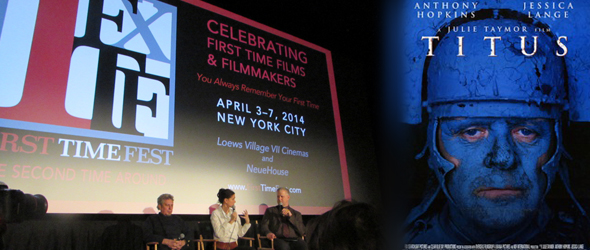
Julie Taymor Talks “Titus” at New York’s First Time Fest


April 7 – Tonight the First Time Fest will be honor director Julie Taymor with the John Huston Award for Achievement in Cinema. This will be her first film award after directing four features: The Tempest, Across the Universe, Frida and first film, Titus.

Made in 1999, Titus is an adaptation of Shakespeare’s violent revenge tragedy, Titus Andronicus. It stars Sir Anthony Hopkins as the titular Roman general whose murder of the sons of an enemy Queen (Jessica Lange as Tamora) leads to the destruction of his entire family. Taymor joined festival goers this week, along with composer Elliot Goldenthal for a screening and discussion of the film. It screened as a part of the fest’s First Exposure series highlighting successful director’s first features.

Even though Taymor had already produced the play “very simply and inexpensively” in a church in 1994, the film version did not come about until after her wildly successful production of The Lion King on Broadway.

“I came off The Lion King and what do you do next?” she told the audience, “I had to go to the opposite end of the spectrum–I mean I know that’s considered Hamlet–but really I think that I just didn’t want to be put into a box of any sort. And also I really wanted to work with the greatest writer in the English language…and I had loved the play when we did it.”

Taymor maintained it was her favorite Shakespeare play despite the popular opinion that it’s not one of Shakespeare’s best works saying it presented “a young man’s anger…before he got refined and self-reflective” and later adding “no contemporary movie compares to the bravado of that play. That you think Titus is going to be the good guy and then he kills his daughter! And then he kills his sons! And then Tamora and she says ‘cruel, irreligious piety’, her sons are taken away–you should understand everything that she does. And then look what she does.”

Along with her passionate discussion of the play itself Taymor offered additional trivia about the film itself including:

  • Al Pacino was in consideration for the lead role before Anthony Hopkins signed on.
  • Taymor initially planned to shoot the film in Las Vegas rather than Rome but after visiting Rome on the advice of production designer Dante Ferretti, changed her mind.
  • Many of the cast members including Jessica Lange, Jonathan Rhys Meyers and Laura Fraser had never performed Shakespeare before the film.
  • Anthony Hopkins insisted a scene in which he has one of his hands chopped off be done in one take because, as Taymor recalled him telling her “ I know myself and what I’m gonna do, if i do it again, I will have a heart attack.”

Styx’s Lawrence Gowan talks about the band’s “Soundtrack of Summer” 2014 tour with Foreigner & Don Felder

Lawrence Gowan is the lead vocalist/keyboardist for the legendary rock band. Earlier this year, they announced their 2014 summer tour titled “Soundtrack of Summer”, which will feature a co-headline with Foreigner and former Eagles guitarist Don Felder. Media Mikes had the chance to speak with Lawrence Gowan about their upcoming tour, creating new music and his thought’s on being a member of Styx for 15 years.

Adam Lawton: Can you give us some info on the bands upcoming tour?
Lawrence Gowan: We will be out this summer with Foreigner and Don Felder. We have toured the states with Foreigner in some time. We did some shows with them over in England and we realized that the pairing of the two bands was just really great. We wanted to add a little more to the bill like we had done last summer bringing Ted Nugent out with this. This year were brining Don Felder formerly of the Eagles. It’s a great night of entertainment when you can add a third element that takes things over the top. We had done a show last year with Don and it was fantastic. The fact that he has written so many of those Eagles classics that people know is great but he also has an amazing band as well. We added him to the mix and now fans will get 3 hours of music that they know all the words to. The tour is being call the “Soundtrack to Summer” tour and I think that is very fitting. It definitely describes our experiences from playing in the U.S. and Canada. I think people will probably be tired from singing after it’s all over.

AL: The last tour featured Styx performing the “Pieces of Eight” and “Grand Illusion” albums in their entirety. Will the band be picking different albums to perform for this tour?
LG: I don’t think it will be this time. The evening is very much hit driven so I think people will be hearing all the songs they know. Having performed albums in their entirety I have found this to be a curious thing. The big thing is that audiences seem to keep getting younger and younger. So many people seem to have discovered classic rock in the last 10 years. At our shows we see younger people enjoying the experience of hearing some of our albums in their entirety. They seem to share their enthusiasm for both our hits and other tracks from the various albums that don’t get as much play. One of those tracks is “Man in the Wilderness”. That song was never released as a single and it has become a huge favorite. Of course we will be playing “Come Sail Away”, Blue Collar Man” and Renegade” as they are some of our corner stone’s but we can change our set a little to hit some of those more obscure songs which have become peoples favorites over the years. There’s going to be diversity in the night with an element of cohesiveness among the three bands.

AL: Being this is not the bands first time out in a multi-band tour format how do you go about keeping the shows fresh and new from year to year?
LG: That’s our task. It just so happens that we are band who is up to that challenge. We love hearing from fans that the show was even better than the last time they saw us. We are always trying to figure out ways to elevate the show and play the songs better than we have before. A song is a living thing. It’s not stagnant piece of music that stays the same. Every time we play one of our songs it’s going to be a little different. Each night songs take on new meaning for us when we play them. Each day is new and it’s another opportunity to try and get the song right. There is a lot more going on with the music than just being a collection of notes. There are feelings and emotions that need to be navigated every time you play a song. That’s our challenge. In addition to that Styx is a band of 5 front men. Everyone on stage is a great entertainer and musician. I think that’s why the audience is so engaged in what we do. We have a tremendous connection with the audience and we are certainly aware of that. The combination of the band, the song and the audience is infectious. We love what we do and constantly want to do it better.

AL: As an artist I am sure you always want to be creating new material however, does the fans wanting to hear the bands previous catalog make it tough to introduce new material?
LG: There is definitely a balance. We did a full album about 10 years ago that we are still trying to play as much as we can. It hard to squeeze a song in to the set but when we have the chance we will do that. We also had a cover album come out where we did a cover of “I am the Walrus” and that ended up being a big hit with classic radio stations. We try and get that one in there whenever we can. We have been trying to put out some new pieces when we can. We also have re-recorded some of the classic Styx songs and added new pieces to those. We always look for the opportunities to add something new. We also have to try and grapple with the reality of the music industry right now. The one thing that can’t be downloaded or replicated in any way is the live experience. That’s what people are drawn to.  Every show is different
and its own separate experience.

AL: This May will mark your 15th year as a member of Styx. When you first joined the band did you ever envision being where you are today?
LG: I have had a really fortunate career. I had a successful solo career in Canada prior to joining Styx and was able to garner a big enough audience to where I could one day perform with Styx in 1997 when they came to Montreal. That led to the second half of my career where I get to be a part of this legendary band. Not many people can make a claim like that. My career has gone backwards in that I had the long solo career and then a lengthy band career. I really have enjoyed the whole thing. There is always something more you want to accomplish but when I am beating myself up about that I look at where I am and see how fortunate I am. It’s a very unique situation and I am so grateful to be part of this.

Charlie Daniels talks about latest album “Off the Grid – Doin’ it Dylan”

Charlie Daniels is best know for delivering the world with the hit song “The Devil Went Down to Georgia” and numerous others. Today on April 1st, 2014, The Charlie Daniels Band is releasing their first album in 7 years called “Off the Grid – Doin’ It Dylan”, which is a tribute of songs to the great Bob Dylan. Charlie has been in the business since the early 1950s and shows no signs of slowing down.I know it is April 1st but no this is not an April Fool’s Joke, Media Mikes had a chance to chat with the legendary singer/songwriter about the new album and what we can expect.

Mike Gencarelli: This is your first album since 2007, tell us about how “Off the Grid – Doin’ it Dylan” came about?
Charlie Daniels: Actually, it came about in an rather offhand way due to a TV show called “Hell on Wheels” that takes place back in the 1800’s. We were asked to do some music for this show and we had these instruments that were around the 1800’s, which were acoustical instruments. We had never done any acoustic work before. We always used electric instruments in one degree or another. We were so impressed with the different sounds that came out of the band that we decided that we should do a whole album of acoustics. Well, we taught what better well to draw on than the Bob Dylan catalog since you can never run out of material that way. I am a big Bob Dylan fan and I just wanted to pay homage to Bob and some of his music in our way. We tried to pick songs that we could put our mark on. We didn’t want to copy anyone else’s arrangement or something. As a result we get “Off the Grid – Doin’ it Dylan”.

MG: How did you end up choosing these specific ten songs (and only ten songs) from Dylan’s library to cover?
CD: Well, we went through the common process of trying to do songs that we felt we could do totally different than they have been done before. We didn’t want to copy “Mr. Tambourine Man” like The Byrds did it or other people’s recordings of his songs. We were looking at his songs and seeing if we could make a CDB song out of it. We simply approached it like it was new music like we were doing for these songs for the first time. We came across one that we felt that we couldn’t get far enough away, which was “Lay Lady Lay”. I really wanted to do that song but we could not find a way to do it that would take us away from the version on “Nashville Skyline”, so we decided to leave it alone. The great thing about it though like I said is that with Dylan, you can never run out of material.

MG: Did you have a plan upfront to add your unique style of music to Dylan’s songs or did it just happen in the studio?
CD: Yeah, we had a plan. We knew that they were Dylan songs but we wanted them to come out as CDB songs, if you will. It’s not that they still weren’t Dylan songs after but we wanted to have people to realize that it was a Dylan song but it was Charlie Daniels Band re-doing it.

MG: You previously recorded “Country Pie” on Dylan’s album “Nashville Skyline” in 1969; how was it getting to record this song again?
CD: Yeah I recorded “Country” Pie” with Dylan back on “Nashville Skyline”. I was also worked on his albums” Self Portrait” and “New Mornings” as well. I had fun recording that song both times though [laughs]. It is such a great song.

MG: Why do you think that these songs are still so relevant in today’s times?
CD: Well, they are classics and a classic is a classic. Half the time we don’t know what Dylan is talking about anyway [laughs]. We all can draw our own conclusions for some of them. “Time They Are a Changin'” and songs like that are very clear. But there are some that he leaves up to us to find out what they are about…and that is a beautiful thing. Everyone in this generation can find their own meanings.

MG: Was there any order to the composition of these songs?
CD: No, we didn’t anything chronological or genre-wise for this album like let’s pick one from the 60’s and then from the 70’s, nothing like that. We just went through his catalog and picked the songs that we were capable of doing that, like I said, we could put our mark on. Our main criteria was to make them CDB songs.

MG: Did you find that any of these songs were more difficult to cover than another?
CD: Well some of them were to an extent. Dylan writes his songs in his own way. Some of his songs have longer verses than others. I tried to make them basically the same length. I actually cut out some stanzas in order to make that work. I did it though without violating what the song was about. It didn’t affect the tune at all. But I also did it so that the song sounded our way, which was the goal.

MG: Having been in the business for 50+ years; what inspires you to continue making music?
CD: I love what I do. I am in LOVE with playing music and entertaining people. I just love it. It is just a blessing from God that I have been able to make a living doing something that I love so very much. I can’t imagine doing anything else.

MG: Do you have any plans to tour for this album this year?
CD: Oh yeah, I am on tour right now. As I speak with now, I am in Pennsylvania. So stay tuned because we have a lot of dates scheduled in the upcoming months.


Related Content

Copyright: MediaMikes.com © 2014 · Powered by: nGeneYes, Inc. · Login

All logos and images used on this website are registered trademarks of their respective companies. All Rights Reserved. Some of the content presented on our sites has been provided by contributors, other unofficial websites or online news sources, and is the sole responsibility of the source from which it was obtained. MediaMikes.com is not liable for inaccuracies, errors, or omissions found herein. For removal of copyrighted images, trademarks, or other issues, Contact Us.