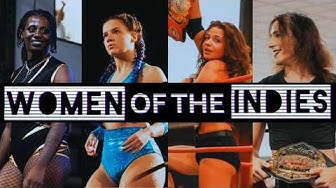
Content Creators/Film Makers Briesbe and Eh Jeh Discuss Their Debut Film “Women of the Indies”

Described as “Four Women. Four stories. One love of wrestling.” Women of the Indies is the debut documentary from content creators Briesbe and Eh Jeh Keez. Together the duo take you behind the curtain of independent wrestling providing a fresh look through the eyes and stories of four up and coming female wrestlers. The films balance of candid interviews and all access footage makes this a fun watch for fans of wrestling both new and old.

We had a chance recently to talk with the films creators about the creation of the project,  

Watch “Women of the Indies” https://www.youtube.com/watch?v=LULK2UiNwjI

Find out more about Briesbe  @briesbe   and Eh Jeh @eh_jeh_keez


A Conversation with Oscar nominated filmmker Agnieszka Holland


Clearing Up Kafka: Agnieszka Holland on Franz

Since the 1990s, Polish director and screenwriter Agnieszka Holland has made a wide variety of films since the 1970s, but she has a string of movies about people who had lives that seemed a little to weird to be real.

But they were.

Europa Europa, for example, told the story of Solomon Perel (Marco Hoffschneider), a Jewish German teenager who survived the Holocaust by living as a Hitler Youth. The real Solomon Perel appears at the end if you think story sounds unlikely.

She’s also responsible for Shot in the Heart, which documents how writing Mikal Gilmore (Giovanni Ribisi) had the unenviable task of convincing his brother, convicted killer Gary Gilmore (Elias Koteas) to withdraw his demand that the State of Utah execute him for his crimes.

Her most recent Oscar nomination came from In Darkness, where she recounts the story of sewer inspector and petty thief Leopold Socha (Robert Wieckiewicz), who saves the lives of Jews hiding under the Polish city of Lvov, despite having formidable prejudices of his own. In most situations, he’s probably steal their possessions instead of saving their lives.

Holland’s own life has had its surprises. While born in Warsaw, she went to college at Prague’s FAMU and studied literature under Milan Kundera (The Unbearable Lightness of Being). She took part in the Prague Spring and wound up being imprisoned for it. She later had to start her career over in France when martial law was declared in Poland. Despite some formidable struggles, she’s also a three-time Oscar nominee and attended a retrospective of her work at the Motion Picture Academy in Los Angeles.

Her latest movie Franz is a look at the Czech writer Franz Kafka (Idan Weiss), and her off center approach might be ideal for telling the life of the man who gave us The Metamorphosis, about a salesman waking up to find himself turned into a giant insect and The Trial, about a fellow who is constantly dragged from one place to another unsure of what crime he is supposed to have committed.

Franz tells both his life and how his perspective and his stories seem uncannily modern despite the fact that he died at age of 40 in 1924. Holland and screenwriter Marek Epstein (Holland’s Charlatan) eschew a conventional time and show how Kafka, who was Jewish and wrote in German, has now become Prague’s most famous citizen despite the fact that few of his stories were published during his lifetime.

The movie is playing in theaters and will be coming to Blu-Ray next month through Kino-Lorber. In a recent Zoom conversation, Holland, whom I’ve known for several years talked about how Kafka’s stories of absurdity and Sisyphean struggles have reached an audience he may never have imagined.

DAN LYBARGER:  You referred to the time that you had been held by Soviet authorities as your Kafka period. Why did you feel that?

AGNEISZKA HOLLAND:   Because any kind of authoritarian regime which uses legal power over you, illegal violence, somehow resonates as Kafkaesque situation.

Because mostly it’s not personal violence, it is bureaucratic violence. It is some kind of the machinery which dehumanizes you and makes you the victim of some guilt, which you don’t feel. So that is the typical situation which the people are thinking about Kafka. Of course, his work has several other layers and is also more metaphysical than only political somehow. But those feelings are metaphysical as well, or existential maybe.

And it’s not the accident that Kafka was a god to existentialist writers like Jean-Paul Sartre or Albert Camus. He was a model to them. He was like prefiguration of their own philosophy somehow.

You had directed a version of Kafka’s novella The Trial yourself. But from watching your movie, I can now see that the more you study him, the less you feel like you know him, because there are huge gaps in the record about him.

With even the records, not so much, because, you know, practically it’s very few artists who are so well described by themselves, because he had that, you know, multi-volume diaries when he described every movement of his soul and every event of his days. There are tons of letters, especially to his fiancée or to other women, and a lot of statements, especially of Max Brod and other friends, not speaking about his work, his literary work.

So you have impressions that you know everything about him, and the more you know about him, the less you know about him. But I think that it’s like that with every single rich interior human being. And I think that we ourselves, we think that we know a lot about ourselves, but in reality we don’t. And I think that the human being is a constant mystery. What is fascinating with the fiction or with the literary or filmmaking work about the real people or about invented people, it doesn’t matter so much. It is that constant search for the new aspect of the human soul.

When you and screenwriter Marek Epstein were coming up with this, I noticed that you don’t quite do a standard biopic because you change chronology, and you also show us what it is like to walk through Prague now that Kafka is very much in the city as if he is alive.

Yeah, it is. I thought that it will be troublesome to make a regular, you know, linear biography about Franz Kafka. It is more like the puzzles, like the pieces, fragments, you know, in the little kaleidoscopic way. And gathering so many, so many like scenes and situations and images and sounds together, I think it gives us some chance to touch some kind of the truth, at least subjective truth. It’s my truth.

But in the same time, it is a bit like that every viewer can make his own way through that maze of images and scenes and construct his own image of Franz Kafka. When I was talking to the different audiences of different aged, different knowledge of his work, non-knowledge at all, and in different countries, I received a lot of feedback and it was not always the same kind of feedback. I’m not speaking about the judgment, I’m speaking about the experience. And it was planned like that, that it’s a little— that you can make your own Franz out from the elements I’m giving you.

Because there’s one sequence I saw where you have him in the apartment, and it was similar to a scene in Orson Welles’ adaptation of The Trial, where Josef K (Anthony Perkins) is in an enclosed area, and you see little girls’ faces looking in at him from a wall. In your film, you see people looking in at him from windows, and it turns out they’re actually looking at him from today’s Kafka museum.

In the beginning of The Trial, Josef K. sits suddenly sees that the neighbors because we wanted it to express exactly how he feels like. Only later, after the movie was finished, I found someplace the description in some of his friends was writing about it, that he was in reality living in the room like that.

Yeah, I just think it’s funny that both you and Welles got that same sensation. It’s kind of dangerous to examine someone who is long dead because a lot of times it’s medical, and you can’t If someone is dead, you can’t go, “He is schizophrenic, or he is on the spectrum.”

Yeah, sure. It’s impossible to give the exact diagnosis. You can have some intuitions. And when the real character becomes the hero of the fictional work, because that is not a documentary, it is some some subjective vision of his persona and his life. You can have the different hypothesis, but I didn’t push it so far.

But several people who, especially younger people who watched the film, they took it very personally. They took that as that they are like Franz, you know, and they’ve been mostly the people in some kind of the spectrum, neurotypical, and they felt that the fact that they are considered of being different or odd, it’s a bit like it was with Franz and that his behavior and his tics or his different kind of reaction to the reality, he became close to them by that. I think it’s okay, I think it’s good. Like the first viewer, it means first Q&A I had after the film was ready was in Warsaw.

And the first person who asked the question was a young man who said, “You made the film about the most famous autistic person in the world. Are you one of us?”

It touched me somehow, you know? Because, the people identify with the film or the subject of the film or the character of the film for very different, very subjective reasons. And to give them that opportunity for the identification, it’s good. It’s like why also you are writing or filming fiction, that you give to people the alternative of the life they can connect to.

Of course, one thing I thought was kind of intriguing is some way your Kafka is astonishingly prescient because when everyone else at the dinner table is getting excited about asbestos, We understand his indifference because we know it’s going to go badly. Or when they have the meeting at the insurance company and he’s laughing because I would not want to deal with an insurance organization that can’t even keep their own building from having water leaks.

Yeah, it’s a lot of details like that. I appreciate that you noticed.

Hermann Kafka, Franz’s father comes off as greedy and cruel, but at the end of the film you feel for him because he’s lost his son.

Yeah, I also feel for him. And when I was doing that contemporary scenes of the tourist business, in Prague, which explode after the revolution when the— before Kafka was practically unknown in communist Czechoslovakia. But when the free market came, they realized how good of brand he is and how it’s possible to make the business out of that. And I was going often to Prague.

I was doing several films there. And I was following quite often, you know, the tours, which sometimes were very funny because the guides have been telling, you know, bullshit.

Oh, yes, like the Kafka burgers.

Holland: And I was asking myself, what will happen if Franz wakes up? What will be his reaction? And I knew only one thing, that the reaction of Hermann will be the pure happiness.

It’s so funny to me that both the communists and the Nazis hated him.

He was like clairvoyant. He’d seen the mechanism of the arbitrary and authoritarian bureaucracy, which has to dehumanize the people and change them to the numbers. And everything becomes non-relevant. And if you are guilty or not, it doesn’t matter. You are guilty. And all that situations we know from Stalinist trials or from the concentration camps.

All that, it echoes to what Franz Kafka several decades before described without even imagining. He wasn’t political. It means he was not thinking in that terms. He had some kind of the very clear intuition about where the world is right now and where it’s heading.

Lybarger: You’ve done biopics before, but you had to do it differently simply because he’s somebody everybody thinks they know, but because it’s, as you said, he’s heavily documented, but there are still mysteries about him.

Holland: It means everything, the most important things were happening in his head and between his head and his hand. And that is very difficult to tell the story about it. You have to find another language to try to reach the truth or some subjective truth, but authentic truth about himself.

Yeah, because I was reading The Metamorphosis again, and I just thought I can see why you chose The Penal Colony as a story of his to illustrate versus The Metamorphosis, because 90% of that is in Gregor Samsa’s head.

Absolutely.

You know, I don’t know if you know the story when The Metamorphosis had been published, one of his rare writings which was published during his life. It was published by a famous Berlin publisher, and the famous designer was supposed to do the cover, and he wanted to put the insect on the cover, and Franz reacted in a very, very strong way that he’s very much against it, that you cannot show the insect, because the insect is not the insect. The insect is how Gregor feels of being.

The difference, right? So you cannot— you can, of course, shoot The Metamorphosis, but only if you will be shooting it only from his point of view. We cannot see him. We cannot see him as a human being because after, no one will understand.

The film is somehow primitive medium. You believe in what you see. And in The  Metamorphosis, everything is in the head. You don’t see it. And The Penal Colony, it is what it is. It means you have to see what is described. It’s very graphic, and it’s very matter-of-fact. And at the same time, it was considered after the Second World War, like the most premonitory, clairvoyant writing until our days. That is obligatory reading in the German high schools. So it had incredible impact, political impact on the generations of people, and especially German people after the Holocaust, after the Second World War.

And the reaction of when he read one of the first novels he read in public was what we show in the film. It was the people have been outraged and, you know, and shocked and, you know, and leaving massively, you know, the room. And we wanted to have a similar kind of reaction from the theater audience, which is not so easy because in our days, the people are blasé with the violence.

But still, we had a lot of very, very violent reactions from the audience. So we’ve been happy, you know, that we somehow translated well what he, what he was telling.

In the preface for my personal copy of The Metamorphosis, David Cronenberg acknowledges the debt The Fly owes to Kafka, but he admitted there’s a huge difference with what he did with The Fly. He may have been inspired by The Metamorphosis, but he had to completely take a different story and use Kafka motifs.

Yeah, but David Cronenberg, he likes realistic language. I’m much more realist than Franz was. It means everything, which is described. I analyzed The Trial really very well because I adapted it for Polish television after we directed it together with my ex-husband (Laco Adamik). And I think it was a very successful adaptation because I think it was very close to him. And it was very matter-of-fact. We didn’t use any kind of special tools. Everything had been not overblown.

And at the same time, it felt that it’s exactly what is— not exactly. It’s some key. We found some key, I think, to that adaptation, which I felt that it’s relevant with what Franz had in his head. But, of course, you never know. Maybe somebody has a different key, and that different key can be as good as my key.

It must be gratifying that some of your more recent films have been really strong like Green Border, Charlatan, and Mr. Jones. You’re still making worthwhile stuff.

Holland: Well, I’m kind of proud of those films, you know. especially all you mentioned, I think are important somehow and especially with the— when doing Green Border and Franz, I felt that I finally achieved the freedom which I always wanted to have.


This is a movie that seems to be resonating with younger people. Are people surprised that you are in your 70s and you’re making this kind of movie? Kafka didn’t get to live very long himself.

Holland: Many artists in that time were dying young. Tuberculosis was that special sickness of the sensitive people. So many poets, also Frédéric Chopin or Anton Chekhov or— poet Heinrich von Kleist or writer Georg Büchner. So many of great people died in the age between 30 and 40, and the intensity of their work have been like if they lived for 70 or 80 years. So finally, We are living in the times when it’s possible to live intense life and live long. As a humanity. It’s also why some films I did, I felt that I have to do it, like Mr. Jones or Green Border, even if I know that one film is not changing the world.
Hallmark Channel’s stars Jen Lilley and Dan Jeannotte talks about their new film, A Royal Setting

Jen Lilley and Dan Jeannotte return to Hallmark Channel with their new film “A Royal Setting”. The two have previously starred in the Hallmark Original Paris, Wine & Romance back in 2019. Media Mikes had a chance to chat with them about their new film and what they have planned next.

Official Premise: Ruby, a world-renowned gemologist, is hired by Prince Luca to restore the crown jewels and design his crown. This challenges tradition and complicates his relationship with his mother, the queen.

Hallmark Stars Janel Parrish & Chris McNally talks about latest film “Two for Tee”

Hallmark Stars Janel Parrish & Chris McNally are the stars of the latest film “Two for Tee”. Janel has starred in close to a dozen Hallmark films, “Pretty Little Liars” and “The Masked Singer”. Chris McNally also has starred in many Hallmark films as well as their TV series “When Calls the Heart” as Lucas Bouchard.

Media Mikes had a chance to chat with these stars about the new film and also what else they have coming up.

The film follows Tee, a Chinese American pottery artist who meets new community center handyman Will. As she learns about her family’s traditions through art, can she and Will save the center from closure?

Brit Floyd’s Damian Darlington talks their new tour, The Moon, The Wall and Beyond, and 2026 lineup

Damian Darlington is the founding member of Brit Floyd, while also providing the guitar and vocals for the band. The Moon, The Wall and Beyond is the name of the band’s 2026 tour.

The Moon, The Wall and Beyond is our latest monumental new production, honoring two of the most legendary albums in rock history — The Dark Side of the Moon and The Wall. This spectacular show recreates the spirit, sound, and scale of Pink Floyd with stunning detail, combining state-of-the-art lighting, lasers, video projections, inflatables, and theatrical staging.

Epic in scope and immersive in experience, The Moon, The Wall and Beyond is our most ambitious production yet — an unforgettable event for devoted fans and a powerful introduction for a new generation. The 2026 world tour will journey across North America and beyond, bringing this extraordinary celebration of Pink Floyd to audiences worldwide.

Damian took out some time to chat with Media Mikes about this year’s tour and also the band’s 2026 lineup.

Oded Fehr talks about new film “Grizzly Night” and hints to “The Mummy 4”

Oded Fehr is known for his role of Ardeth Bay in “The Mummy” franchise. He has a new creature feature called “Grizzly Night”. The film is a dramatization of the 1967 “Night of the Grizzlies” attacks in Glacier National Park. Media Mikes had a chance to chat about the film with Oded and also get a sneak peak at “The Mummy 4”.

Hallmark Channel’s Jaicy Elliot and Rafael de la Fuente talk their latest film, “Love on the Amazon”

Jaicy Elliot and Rafael de la Fuente are some of the hottest stars at Hallmark and they are celebrating their latest film, “Love on the Amazon”, which premiere 1/17/26 at 8pm EST. The duo took out some time to chat with Media Mikes about the movie and what it was like filming in the real Amazon.

Here is the premise from the film “Claire travels to Brazil and hires Danny, a riverboat captain, to help her deliver an important message for her sister Amelia, a marine biologist studying pink dolphins on the Amazon River.”

Here is our interview with the stars:

Here is a trailer for the film:

Interview with Actor Robert Carradine


Actor Robert Carradine comes from an amazing family of actors.  His father, John, was a star during Hollywood’s Golden Age, appearing in such films as The Grapes of Wrath, The Ten Commandments and Around the World in 80 Days.  He also appeared in several westerns alongside John Wayne: Stagecoach, The Man Who Shot Liberty Valance and what would be Wayne’s last film, The Shootist.   His brother, David, is probably best remembered for his starring role in the television series “Kung Fu,” while another brother, Keith, won on Oscar for Best Original Song for his song “I’m Easy” from the film Nashville and went on to star on Broadway in “The Will Rogers Follies.”


Mr. Carradine earned praise for his powerful portrayal of doomed soldier Bill Munson in the Oscar winning film Coming Home.  He is probably best known for his role as Lewis Skolnick in the 1984 comedy Revenge of the Nerds and it’s sequels, as well as Sam McGuire, the father of the title character on the television series “Lizzy McGuire.”

His other films include Mean Streets, Joyride, The Big Red One, The Long Riders, and Django Unchained.  He also hosts his own Podcast, called “Party Nerds Popcast.”


On Friday, October 24th, Mr. Carradine will be appearing in Omaha, Nebraska at the Omaha Community Playhouse for a special screening of his first feature film, The Cowboys.  He kindly took some time out this week to talk to MediaMikes about his career.


With Jon Voight in “Coming Home”


Mike Smith:  Acting certainly runs in your family.  Did your father encourage you and your brothers to pursue the craft?


Robert Carradine:  Not directly.  I do remember that he did say if we had an interest in pursuing acting that we needed to get a literary education.


MS:  Your father was such a great speaker.  A true orator.  Such an amazing gravitas.  Was that acting or did he always speak like that?


RC:  That’s how he spoke all the time.  He took a great deal of pride in his diction and his vocabulary.  He did have gravitas when he spoke.


MS:  The first film I saw you in was Joyride, which starred a second generation of Hollywood talent (NOTE:  besides Mr. Carradine, the film starred Desi Arnaz, Jr, Melanie Griffith (daughter of Tippi Hedren) and Anne Lockhart (daughter of June Lockhart).  Was the casting intentional?


RC:  That was totally planned.  They wanted that so they could use it in their advertising.


MS:  You’re appearing this week in Omaha for a special screening of The Cowboys.  Any good John Wayne stories?

As Slim Honeycutt in “The Cowboys”


RC:  The one story that gets people is when I was on location.  It was about the fourth day of a ten week shoot.  I’m seventeen-years old and we’re shooting a scene where each one of the cowboys has to ride a bucking bronco.  After the fourth kid tries, A. Martinez, the actor that played Cimaron, rides into the ring, jumps on the bucking horse, rides all the rough off of her and makes her back up.  He basically breaks the horse.  He rides the horse up to the fence where we’re all sitting, hands the reigns to the next kid and says, “here boy…maybe you can ride her now.”  The kid jumps off the fence to fight Cimaron, and I jump off the fence to protect the kid, because he’s a little kid.  John Wayne breaks it up and he pulls me away from the fight.  He says, “you.  Get back on that fence where you belong.”  He’s then supposed to curse Cimaron.  But before he can say his line, I say, “excuse me, Mr. Wayne.  I don’t think you should tell me to get back on the fence where I belong.  I think you should just tell me to get back on the fence.  Because I’m the head kid.”


That did not go over well!


MS:  Wayne and your dad both starred in The Man Who Shot Liberty Valance.  Did he know who you were?


RC:  Oh yeah.  He definitely knew the name.


MS:  You later went on to star in “The Cowboys” television series and, later, “Lizzy McGuire.”  Do you enjoy doing television?


RC:  I love doing it.  The thing that’s great about television is that you tend to not get behind.  Things run on time.  When you get a call sheet with the day’s work on it you can pretty much count on the fact that you’re going to get to everything.  There’s a certain comfort in knowing that the work’s going to get done.

With brothers Keith and David in “The Long Riders”

MS:  Here’s a Long Riders question that I asked James Keach. What was it like working with your brothers?  And were you competitive with the other groups of brothers?  (NOTE:  Walter Hill’s 1980 Western The Long Riders co-starred Mr. Carradine and his brothers, David and Keith, as well as Stacy and James Keach, Dennis and Randy Quaid and Christopher and Nicholas Guest)


RC:  There was a joking competitiveness.  One of the things that became quite competitive was seeing who could get out in front of the hotel first in the morning when we had to get picked up.  It got to the point where people began showing up fifteen-minutes early. (laughs)

As Lewis Skolnick in “Reenge of the Nerds”

MS:  Time for the obligatory Revenge of the Nerds question.  Did you have a sense while filming that the film would have the success that it did?


RC:  No.  But I do remember that we had an incredible time making the film.  It was a lot of fun.  And I think that the camera records how you actually feel and, the fact that we were on fire, for lack of a better phrase, the camera recorded that.  That was one of the things that made that film work on a massive level.


MS:  You’ve worked with some amazing filmmakers, among them Hal Ashby, Martin Scorsese and Quentin Tarantino.  You’ve also directed for television.  Any thoughts of tackling a feature film from behind the camera?


RC:  I have two feature films currently on the back burner at the moment because, as I’m sure you can imagine, it’s terribly difficult to raise the funds to make a feature film.  But we have people that do that who are currently working on raising funds and we’ll see if that comes to fruition.


MS:  You’ve sung in a few films.  Any thoughts of taking a shot at musical theatre like Keith did?


RC:  It’s funny you should ask.  I had the opportunity to do some musical theater where I would have had to dance.  I would have had to sing.  I’m not really a singer, and there was a lot of dialogue.  I took a long look at it.  Initially I said “yes” but as I started to get into it I realized I was in over my head, so I had to back out.

MS:  What do you have coming up?


RC:  I just finished a movie in Canada called Sorority Shark Attack.  And that title tells you everything you need to know!


If you’re interested in attending the screening of The Cowboys, you can order tickets by calling (402) 350-8000.


You can listen to the Party Nerd Popcast HERE.


Renny Harlin talks about the “The Strangers: Chapter 2” and what we can expect for “Chapter 3”

Renny Harlin is the director of classic films like “Die Hard 2”, “Cliffhanger”, “Nightmare on Elm Street 4” and “Deep Blue Sea”. He recently took on the task of rebooting “The Strangers” franchise into three chapters. Renny spoke with Media Mikes about the “The Strangers: Chapter 2” and what we can expect for “Chapter 3”

Director of “The Descent” & “Dog Soldiers”, Neil Marshall talks about his film “Duchess”

Neil Marshall is the director behind films like “The Descent”, “Dog Soldiers” and “Hellboy” (2019). Media Mikes had a chance to chat with Neil about his movie “Duchess”, check it out!

The film stars Charlotte Kirk and follows a tough, working-class, petty criminal who morphs into an anti-heroine to be reckoned with in a murky underworld, in the treacherous world of diamond smuggling.

X-COPS’ Casey Orr talks about their first new album in 25 years, “XCAB”

Q: It’s been nearly 25 years since “You Have The Right To Remain Silent”, which was previously the only album released from X-Cops; what makes the original Bad Boys of Law Enforcement return to the spotlight?

I’ll ask the questions around here! Oh, wait… you’re asking the questions. Ok. Yeah, so when we formed XCOPS and released YHTRTR it was a different climate. Hard Rock had been replaced by Heavy Metal, which was replaced by Glam Metal, which was replaced by Grunge, which was replaced by Nu Metal. But through it all there was one common denominator: kids on drugs with lots of money… and, of course, drugs. We finally had enough of just sitting back and doing nothing while this great nation fell prey to the temptations of Satan. We wanted our cut. So we started a band, put out a record, toured the world, and made millions of thousands of hundreds of dollars. The IRS got wind of this and defunded the shit out of us! After that there were a series “unfortunate instances” with a couple of the boys and we sort of went our separate ways for a bit. Laying low, so to speak.

So why have we returned after all this time? Why now, you ask? Because this country is falling apart! We’re witnessing the fall of Democracy and the rise of a totalitarian fascist state. The people are about to install the worst possible piece of shit this country has ever seen, as it’s first King, and that means more power for the police and military. And that means full immunity and military grade toys for us! But mostly it’s because the kids are still on drugs with lots of money… and, of course, drugs.

Q: How has the X-Cops today changed since 1995?

Spiritually and philosophically speaking, I’d say not much. We’re still out here fighting the good fight. Well, it’s pretty good for us anyway. We have had a few personnel changes, though. Our former bass player, Cobb Knobbler, was killed while working a “private contracting job” somewhere in the Middle East. Details are sketchy, and there are conflicting reports on the hows and whys. I’ve heard everything from “friendly fire” to something about being beheaded for giving head, or while giving head, I don’t know. He was a complicated man. Our new bass player is working out great! His name is Ed Banger, we met him at a Halloween party. I think he said he used to work the strip club beat or some shit.

Our original drummer, Billy Club, stopped taking steroids and joined a cult. I heard he has 18 kids and owns an appliance store now. We’ve had a hard time keeping a drummer lately, we’ve had to resort to forcing inmates to play drums for us with a gun to their head for inspiration. Unfortunately they seem to all have short lifespans. Very susceptible to “lead poisoning”, if ya catch my drift.

Q: “You Have The Right To Remain Silent” is such an amazing album, I have been spinning it for 25 years straight now – “Cavity Search” has always been my favorite! – why do you think the album still stands the test of time today with fans?

You know, once every decade or so, a record comes out that simply touches the soul of the entire world, taking on a life of its own, propelling it up the charts and into the hallowed halls of rock and roll history, and the very pinnacle of this business we call “show”. But for the rest of us it’s completely up to the fans, who, whether by force or voluntarily, still keep coming to the shows and buy the records and merch. It doesn’t hurt that the songs on that album come from a place of raw, naked realism. A mugshot in time. A real slice of American fucking pie! Plus that shit rocks, right?

Q: Out of the five new songs on the new EP, which is your favorite? and why?

I’m gonna have to say “Light ‘Em Up” because I sing it and it’s a really funny story! Like I always say – Texas throws the best BBQs!

Q: Your songs are loaded with satire and are flat out hilariously offensive tracks; are you afraid of going too far in today’s “cancel” world?

Nah, we may be XCOPS, but once a cop, always a cop! Cops get away with anything they want and everyone knows it. Ain’t nothing new. Besides, this is about to become a police state and you’ll never be able to cancel “law enforcement” ever again!

Q: You are touring with GWAR all Summer long; what has been the highlight so far? Any crazy road stories from this run?

Man, those cats are weird. It’s nothing but sex, drugs, and Buck Owens in their dressing room. It’s exactly the same in our dressing room, but smaller. They’re obsessed with Dolphin Rape Caves. I had to Google it. Sick shit. The bass player is cool as shit, though!

Q: I know that XCAB is being released on Vinyl format; what can we do to get “You Have The Right To Remain Silent” released on vinyl as well?

It was re reissued on vinyl through Brutal Planet Records last year and there are plans for GWAR’s label, Pit Records to re issue it real soon.

Q: Is this the beginning of more to come for the X-Cops? What else can we expect?

I’d like to think this is the beginning of the middle of a 4 part trilogy. If you’re lucky, Trump won’t win in November and XCOPS will just keep on rocking. Do some touring, make some records, ya know? If he is elected, however, we’ll most likely be pressed back into service to beat down protesters and journalists and free thinkers.

Adam Green talks about Hatchet: The Complete Collection Limited Edition Blu-ray Steelbook

Old-school American horror is back as Adam Green’s iconic Hatchet series returns in a blood-soaked, fully Unrated collection, uniting all four films for the first time. Unleashed at a time when the fun of 80s slashers had all but disappeared from the cinematic landscape, Hatchet ushered in a new era of terror with its unapologetic brutality and introduction of Victor Crowley, the modern bogeyman, who ruthlessly hunts those who dare tread into his swamp. With each installment, the stakes escalate, delivering bigger, bloodier scares and a relentless barrage of inventive kills. So gather all your pieces, because it’s time to return to his swamp and learn once and for all that some legends truly never die.

Media Mikes had a chance to chat with Adam about Hatchet, it’s past and future. Check it out and purchase the set here: https://selects.darkskyfilms.com/products/hatchet-complete-collection

Director Chuck Russell talks about his remake of the 1986 film, “Witchboard”

Chuck Russell is the director of such classic films like “A Nightmare on Elm Street 3: Dream Warriors”, “The Blob” remake and “The Mask”. His latest film is a remake/reimagining of the 1986 film “Witchboard”. Media Mikes had a chance to chat with Chuck about this new film and what drew him back to the horror genre.

Artist Paul Booth Discusses his Upcoming Headlining Appearance at the 2025 Inkcarceration Festival.

World-Renowned artist/tattooer Paul Booth has been announced as the Tattoo Headliner for the 2025 Inkcarceration Festival which is scheduled for July 18-20th at the Ohio State Reformatory in Mansfield, OH. Media Mikes Presents had the chance to speak with Paul recently about the upcoming appearance, his 30 plus years of tattooing and his newly released signature coffee blend “Devil’s Pact”.

Click Photo For Interview:


https://inkcarceration.com

https://www.paulboothart.com 

Sam J. Jones talks about his appearance at Tampa Bay Comic Convention August 1-3, 2025 and 45th anniversary of the Flash Gordon movie

Sam J. Jones is known best for his role in the 1980 action hero film FLASH GORDON. The film has been inspiring fans for 45 years. He also has over 75 films and numerous television shows to his credit. Other than FLASH GORDON, Sam has THE SPIRIT, THE HIGHWAYMAN, SG-1’s The Bounty Hunter and his memorable comedic performances in TED and TED 2. As an Actor-Producer for 47 years and a Marine for 53 years (once a Marine always a Marine), Sam brings a rare and unique quality to the film industry, as well as to the public speaking circuit, or as Sam would say “To the human condition circuit”.

Media Mikes had a chance to chat with Sam J. Jones about his upcoming appearance at the Tampa Bay Comic Convention, which happens on August 1-3, 2025 in Tampa Bay, FL and also 45th anniversary of the film and the 90th anniversary of the character Flash Gordon.

Here is our first interview with Sam dating back to August 2013!!!

Copyright: MediaMikes.com © 2025 · Powered by: nGeneYes, Inc. · Login

All logos and images used on this website are registered trademarks of their respective companies. All Rights Reserved. Some of the content presented on our sites has been provided by contributors, other unofficial websites or online news sources, and is the sole responsibility of the source from which it was obtained. MediaMikes.com is not liable for inaccuracies, errors, or omissions found herein. For removal of copyrighted images, trademarks, or other issues, Contact Us.