
Film Review: “Pokémon: Detective Pikachu”

Starring: Ryan Reynolds, Justice Smith and Kathryn Newton
Directed By: Rob Letterman
Rated: PG
Running Time: 104 minutes
Warner Bros. Pictures

“Are you Pokémon savvy?” That’s a question I was asked after the screening of “Pokémon: Detective Pikachu,” since I’m one of a handful of Millennials who shows up to screenings to review a film in the Kansas City area. I told them, “Yes. And the movie still bad.”

The film begins with a lot of heavy-handed fan service that’ll put a smile on fans faces. I know this because during the Pokémon craze of the late 90s, I watched the animated show, collected the battle cards, and played the various Gameboy games that were increasingly cranked out during its peak in America. But I’m not a die-hard. My interest waned and I inevitably moved on to the next pop-culture video game fad, although I did download Pokémon Go when that was a thing. So for those who aren’t “Pokémon savvy” or have any kind of knowledge, you’ll want to avoid this movie at all costs or else you’ll be demanding your money back at the ticket counter after five minutes. So as a casual fan and critic, where do I think it all go wrong as a movie?

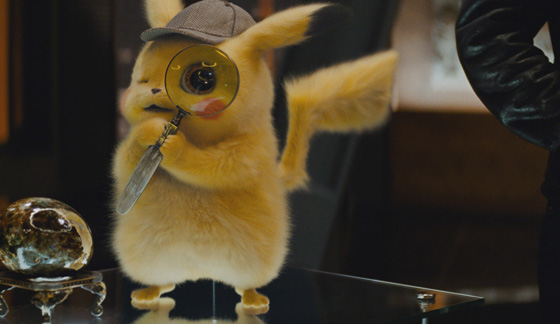
I give credit, “Detective Pikachu” sets up an interesting world where humans and Pokémon live together and interact in various ways. It’s not quite on the intricate levels of a movie like “Zootopia” where every scene is littered with clever sight gags and visuals, in the foreground and background, of how this world, while like ours, is incredibly different. The scenes of underground Pokémon battles and the hustling, bustling marketplace are an interesting mix of futuristic noir and cutesy animals. But the filmmakers seemed to be more focused on making the sidekick, Detective Pikachu, voiced by Ryan Reynolds, the focus of nearly every scene after his introduction. His dialogue is either expositional or quips that are more miss than hit.

The main character, and human counterpart to Pikachu, is Tim Goodman (Smith). He encounters Pikachu while rummaging through his father’s apartment in Ryme City, the epicenter of this world. Goodman believes his father to be dead, but Pikachu believes that Goodman’s father is missing, since they were partners on the Ryme City Police Force. But Pikachu doesn’t quite remember the circumstances behind what caused Goodman’s father to go missing and can’t quite fully confirm that he’s even still alive. The one element to all this, which is heavily shown in the film’s trailers, is that Goodman can understand Pikachu. For those who don’t know, a Pokémon’s language is their name. So while everyone else hears Pikachu saying “Pika Pika Pikachu,” Goodman hears Pikachu’s bad “Deadpool” jokes.

For the majority of its runtime, “Detective Pikachu” bumbles and stumbles around looking for any kind of meaning or purpose. The special effects artists have built this visual feast, but the film never seems to stop and take it all in, nor does it seem interested in the nuances of this universe, instead opting for big, loud, obnoxious action sequences that have no reason to exist. In fact, when the movie does decide to expand upon the story, it over explains, over shows, and does a bad job at disguising the bad guy of the film who clearly shows up 10 minutes into the film.

Not to be a dead horse, or in this case, a dead Ponyta, I can understand how none of this film makes any sense to anyone outside the fanbase because of how poorly the ideas are conveyed. It takes it another step further though, by dumbing down everything so much; it forgets to actually explain what’s happening to our characters while over explaining minor details that spoils the twists of the final act of the film. The four screenplay writers tangled up an otherwise simple buddy-cop film that might have been enjoyable to the fanbase, and those idling on the outside of it. Because even if you remove the Pokémon and replace them with any kind of bizarre creatures or popular franchise, the movie is still an utter mess.

The film moves at such a frenetic pace, it’s sometimes easy to lose yourself in it and forget that you’re bored. But that’s just it. It’s boring. After the movie you realize what transpired could have been told in a singular episode of television and that you have no exciting set pieces or gags to take home with you. Reynolds is charming, but it’s hard to stretch that smug, likeable voice over what is inherently a lengthy advertisement for the Pokémon brand. When you scrape off the gunk that builds up over time in this film, there’s something genuinely interesting. The animated “Pokémon” show is set in an era before phones, social media and the 21st century. Bringing Pokémon into the future could have been a novel idea, where Pokémon actually help humans solve crimes. Instead, the film tosses in the laziest villain and the most nonsensical sinister plot he could concoct, and slaps it on the big screen for the fans that will devour it.
Film Review: “Long Shot”

Starring: Seth Rogen, Charlize Theron and O’Shea Jackson Jr.
Directed by: Jonathan Levine
Rated: R
Running Time: 125 minutes
Lionsgate

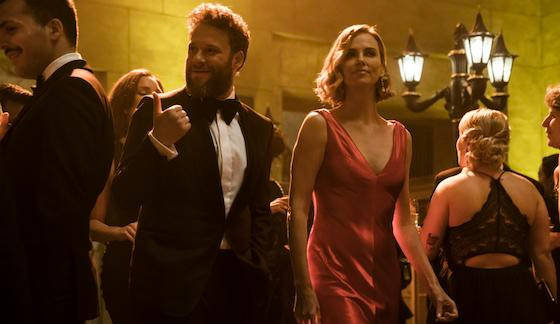
I’ll give a smidgen of credit to Hollywood for attempting to change up the tired trope of the average guy getting a woman who is way out of his league. The “Long Shot” follows in line with other movies before it, like “Knocked Up,” “Superbad,” etc. So it’s no surprise that Seth Rogen, the go-to as of late for the down on his luck schmuck, gets paired with Charlize Theron for “Long Shot,” a movie that’s better than it’s supposed to be, but not as good as it thinks it is.

Fred Flarsky (Rogen) is a journalist, who has decided to quit instead of being let-go or continuing to work after his small time paper is bought by a media conglomerate. Through the most bizarre and unlikely of circumstances, Fred becomes reacquainted with Charlotte Field (Theron, his first crush, when she used to babysit him. Charlotte is now one of the most powerful people on the planet, the U.S. Secretary of State. But she has higher aspirations, especially after the President, played briefly, yet incredibly well by Bob Odenkirk, relays to her that he has no plans of seeking re-election. Sparks and complications arise when Charlotte hires Fred on to punch up her speeches as she gets ready to hit the campaign trail.

Whether you like “Long Shot” or not is based solely on the chemistry between Rogen and Theron. The odd couple matching work surprisingly well because Rogen tones down his frat boy antics and Theron demonstrates the comedic timing she’s shown flashes of previously on “Arrested Development” and in “A Million Ways to Die in the West.” Outside of the pull and tug of their contrasting personalities, they manage to have their characters do a bit of soul searching and learning along the way, which elevates the humdrum plot. The comedy is hit or miss, with the hits being crude and the misses being the stereotypical “fat man fall down go boom.”

There’s an underlying smugness to “Long Shot,” but luckily it stops itself from reveling in liberalism for too long in the film’s third act. Granted, I agree with a lot of the film’s political and social insights, but I and others don’t need it being delivered to us in such a ham-fisted fashion. It’s about as politically ferocious as a middle school class president election debate. Although I’d gladly watch a TV show of Rogen and Theron on the campaign trail, munching on the political landscape because it once again plays into the character’s complimentary personas.

“Long Shot” is an average rom-com, where the performances elevate the mundane story. A handful of riotous moments keep the film from dragging during its two-hour runtime, although those with an easily upsettable nature may find the film too crass. It’s hard to ignore the charm of the on-screen duo, even if you find yourself rolling your eyes when the film falls back on rom-com clichés.  

Film Review: “The Chaperone”

THE CHAPERONE

Starring: Haley Lu Richardson, Elizabeth McGovern

Directed by: Michael Engler

Rated: Not Rated

Running Time: 1 hr 43 mins

PBS Distribution 

Period drama “The Chaperone” is a delightful little film that’s as much about a married woman seeking out who she is as it is a study about the early life of iconic dancer/actress/writer Louise Brooks (1906-85). A native of Cherryvale, Kansas, Brooks moved to Wichita in 1919 where she began a dance career that would lead her to the legendary Denishawn School in New York City. It’s during that transitionary period that we meet her as well as the older woman who chaperones the then 16-year-old on her journey.

Based upon the 2012 novel of the same name by American author Laura Moriarty, “The Chaperone” takes us back to a time when modern dance was still establishing itself. This newfangled artform is alien to the folks of Wichita who have difficulty appreciating its artistry. That is except for Norma Carlisle (Elizabeth McGovern), the clearly unhappy wife of prominent lawyer Alan Carlisle (Campbell Scott) and the adopted daughter of a Kansas farm family who claimed her when she arrived aboard an orphan train from New York City.

Norma may be straight-laced, but she is more cosmopolitan in 1922 than her neighbors, some of whom casually talk about joining the KKK at dance recital to maintain purity. Revolted by such sentiment and looking for an adventure, Norma jumps at the chance to chaperone Louise (Haley Lu Richardson, “Five Feet Apart,” “Split”) to New York City, where Norma hopes to learn who her birth mother was. Her traditional values and quiet nature are a stark contrast to Louise who struts around like she is the greatest thing since sliced bread.

Louise becomes a fast-rising star at Denishawn, which only feeds her free-spirited, sometimes petulant attitude, played with unmistakable charm by Richardson. Director Michael Engler, who has helmed episodes of “Empire” and “Downton Abbey,” insures Louise doesn’t become too unlikable by harnessing the tangible chemistry between McGovern and Richardson to reveal to us just how damaged the young dancer was. McGovern’s infuses her character with subtle bravery and humility, making Norma that much more admirable as she becomes a source of encouragement for Louise, not to mention an inspiration as she tracks down her past and finds new love. Famous for her bob haircut, Brooks, whose actual first name was Mary, is resurrected on the silver screen with wonderful flair as Richardson not only captures the look of the famous Kansan, but also her sexual complexities even at such an early age.

Although filled with marvelous period costumes, “The Chaperone” does fail to go into real depth about the social conditions and inequalities of the era, and is therefore a missed opportunity by the filmmaker. Still, “The Chaperone” provides a nice change of pace from commercial epics involving caped heroes and purple-skinned villains.

TFF Film Review: “Ask Dr. Ruth”

ASK DR. RUTH
Starring: Dr. Ruth K. Westheimer
Directed by: Ryan White
Running time: 100 mins.
Hulu/Magnolia Pictures

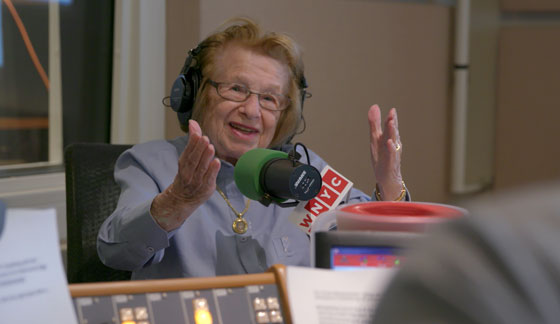
Dr. Ruth Westheimer–or as the world knows her simply “Dr.Ruth”–is an icon of modern pop culture both for broadening the discussion of sexuality in the mainstream as well as her larger than life personality. At just 4’7″, the diminutive German radiates a warmth and sense of humor that easily draws people to share their deepest personal concerns with her. Dr. Ruth has been on the world’s radar since her debut radio show “Sexually Speaking” in 1980 but at ninety years old, there is so much more of her story to be told. Fortunately for film goers, director Ryan White has chosen to take a thorough look into this extraordinary woman’s history. This internationally loved figure survived the Holocaust and time as a sniper in war-torn Jerusalem all before she reached Ellis Island to begin life in America as a single mother at a time when that was far from the norm. And then she took the media by storm. The documentary itself is as accessible and often light-hearted as its titular sex therapist while not shying away from her tragic beginnings.

Dr. Ruth was born in 1928 as Karola Ruth Siegel to Orthodox Jewish parents in Germany. As WWII was brewing, Karola saw her father arrested and she was sent away by her grandmother as part of the Kindertransport to an orphanage in Switzerland. The small Karola did not know she would not see her parents again but she kept up writing letters with them as long as they could in addition to her detailed journals. Dr. Ruth’s own records are a boon to this doc and her diligence in conserving them is rewarded with some lovely animation work that White introduces to bridge the time before she came to the public eye (though White’s choice of an unaccented young American woman reading her diaries is at times jarring). The film also has a nice blend of her home movies chronicling her life as she finally reached America.

There’s no doubt that the strength of this documentary is owed to its magnetic subject. Watching Dr. Ruth query an Amazon Alexa in her uber-thick accent (and it takes a few tries for the electronic helper!) is a pure delight. Fortunately for White, Dr. Ruth also surrounds herself with equally well-spoken company. Her two grown children, her quartet of grandkids and even her first “boyfriend”, a fellow Holocaust survivor, are welcome additions to rounding out her life off-camera. Finally and naturally, White doesn’t skimp on emphasizing her media impact. There’s highlights from the times she embraced a certain kitsch take on her pop persona–I am guilty of first being aware of her as a kid due to that cheesy ‘sex-noises’ Herbal Essences ad from the 90s–as well as the more critical role she played in the conversation during the AIDs crisis. There is so much of the human experience packed into Dr. Ruth’s tiny frame that this documentary is an embarrassment of riches.

Ask Dr. Ruth has its New York premiere tonight as part of the 2019 Tribeca Film Festival. Fest screenings will be followed by a limited theatrical release on May 3rd and will debut on Hulu on June 1st.

Film Review: “Avengers: Endgame”

AVENGERS: END GAME
Starring: Robert Downey, Jr, Chris Evans and Chris Hemsworth
Directed by: Anthony and Joe Russo
Rated: PG 13
Running time: 3 hrs 1 min

I think it’s ironic that the 22nd film in the Marvel Cinematic Universe (MCU) is opening the same week that the 25th James Bond film is announced.  James Bond first hit the screen in 1962 with “Dr, No.”  The MCU began in 2008 with “Iron Man,”  And while some of the Bond films have been hit or miss (I’m looking at YOU, “A View to a Kill”), I don’t think I’ve ever given an MCU movie a rating less than four stars.  Sadly, our rating system only goes up to five, because otherwise I’d give “Avengers: Endgame” six!

NOTE:  THIS WILL BE A SPOILER FREE REVIEW

“Endgame” picks up where “Avengers: Infinity War” ended…with half of the world’s population vanishing in a literal puff of smoke after the evil Thanos (a superb Josh Brolin) has donned his gauntlet, studded with the Infinity Stones, and snapped his fingers.  Unfortunately half of the people eliminated included some popular figures from the MCU, including Black Panther and Spider-man.  Those that have survived mourn their lost colleagues, with Tony Stark (Downey Jr, the backbone of this franchise) taking the loss of Peter Parker badly (I will say that, of all the characters that were lost in “Infinity War,” the loss of Parker hit me he hardest – Tom Holland has really inhabited the character).  The remaining Avengers gather and try to figure out how to return their world to the way they knew it.

I really can’t share any of my favorite moments for fear of giving away a plot point.  I will say this; you will laugh.  And you will cry.  And you will go through every emotion in the middle.  For the last eleven years we have met, and grown with, these characters.  We are as protective of them as we know they would be of us.  And the final chapter of this saga is one for the ages!

Film Review: “Family”

FAMILY
Starring: Taylor Schilling, Brian Tyree Henry, Kate McKinnon, Allison Tolman, Bryn Vale
Directed by: Laura Steinel
Rated: R
Running time: 85 mins
The Film Arcade

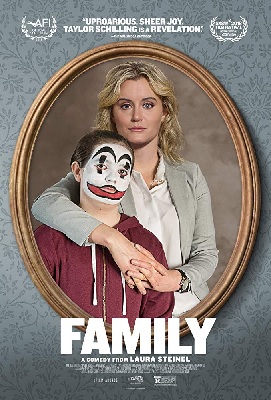
At the start of Laura Steinel’s Family, we find hedge fund manager Kate (Taylor Schilling) getting beaned in the head with a bottle of orange soda at the Gathering of the Juggalos. It’s an ambitious and fitting start for a film whose primary appeal is celebrating outcasts. As it turns out, Kate is hunting for her niece, Maddie (Bryn Vale), a middle school oddball who was entrusted with her aunt for the week while her parents dealt with grandma’s hospice care. Overworked city-dweller Kate is not the least suited for childcare but winds up being the kind of outside perspective that Maddie needs in her life while her hover-parents are distracted. Though it strays unnecessarily at times, at its best moments Family works as a well meaning tribute to letting your freak flag fly.

Kate is some sort of financial guru who’s climbed the corporate ladder by presumably shirking personal attachments and steadily getting drunk with important clients. It’s the kind of movie where office drones scramble over gaining or losing “THE IMPORTANT SOUNDING NAME ACCOUNT!” but you never know what they’re actually doing because it doesn’t matter. If that set up makes you roll your eyes, I get it, I’m really reluctant when it comes to the “cold career woman softens up with a kid” trope. That said, Schilling does well by leaning into how honest and awkward Kate can be. She says what’s on her mind without the finesse demanded by social mores and even if she’s right–and she sometimes is!–her coworkers ostracize her. I sympathized with Kate despite some of her callousness because Schilling can be so funny and charming and it rings absolutely true that a woman in this environment can more easily fall off the tightrope that is the line between “speaking your mind” and being pegged as a bitch. Her work life is interrupted when her brother calls on her for babysitting duties and she’s saddled with 14 year old Maddie. Kate is supposed to be picking her niece up from ballet but finds her instead in an adjacent karate studio where she’s been secretly studying under sensei Pete (Brian Tyree Henry, just one of a number of strong supporting cast here) for weeks. And that’s just the tip of the iceberg for the disconnect between how Maddie’s parents are raising her and where her actual interests lie.

Kate and Maddie’s relationship is definitely the strong point of the film. Bryn Vale brings a frankness to Maddie that allows Kate to open up to her. Maddie knows who she is, she knows why the other kids mock her and while she might avoid them, she is not even attempting to conform to them. Instead, Maddie takes a shine to fellow weirdos at a convenience store who introduce her to the Insane Clown Posse despite Kate trying to shoo them away. An ill-fated attempt at a makeover from Aunt Kate is a standout sequence. There’s also something very endearing about this awkward niece looking at Kate hopefully when in actuality she’s falling apart inside her business-attired exterior. The trouble comes when Steinel’s script attempts to go off on tangents with Kate–a random meetup with her father in rehab, a tacked on subplot with a nosy neighbor (Kate McKinnon)–when she should have stuck with the Maddie-Kate relationship. It’s as if Kate has to make amends with literally everyone in her life before the credits roll instead of allowing her to simply have her heroic juggalo transformation for the love of her niece.

 
Related Content

Film Review: “The Aftermath”

THE AFTERMATH
Starring: Keira Knightley, Jason Clarke
Directed by: James Kent
Rated: Rated R
Running Time: 1 hour 48 minutes
Fox Searchlight

I can still vividly recall the first art-house film I reviewed professionally – the 2000 British drama/comedy “Topsy-Turvy” at the Tivoli Cinemas in the Westport area of Kansas City, MO. Sadly, the Tivoli, an arthouse institution in our fair city for nearly 40 years, has permanently closed its doors. So, it was poetic that the last film I reviewed there would be another period British drama, “The Aftermath.” While it has its share of flaws, “The Aftermath” proved to be a decent swan song before the proverbial final curtain came down at the Tivoli.

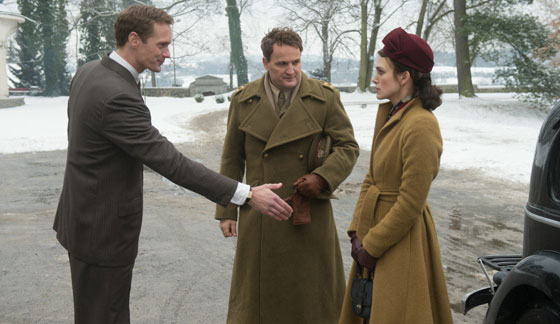
Directed by James Kent (“Testament of Youth”) and based upon the 2013 novel of the same name by Welsh author Rhidian Brook, “The Aftermath” is set in Germany just months after the end of World War II. With the ruins of Hamburg as a backdrop, where an estimated 40,000 civilians died in a firestorm created by ten days of heavy Allied bombardment, Rachael Morgan (Keira Knightley) arrives at a train station to meet her husband, British Colonel Lewis Morgan (Jason Clarke). It’s a subdued meeting at best and we can instantly tell that something is amiss between the two.

Colonel Morgan has been assigned to command British forces in Hamburg who are tasked with keeping the peace and helping to rebuild the city. Similar to how the British Empire forced American colonists to house their soldiers, Colonel Morgan and Rachael commandeer the home of widower Stephen Lubert (Alexander Skarsgrd), a former German architect with no love lost for the defeated Nazis. However, the British see all Germans as the enemy just as much as Stephen’s teenage daughter sees all Brits as villains. Colonel Morgan, much to the dismay of Rachael, invites the Luberts to remain in the upper story of their home to avoid sending them to a tent camp in the middle of winter.

Rachael is desperate to have her husband again, but he remains mostly stoic despite the pain he carries with him. In addition to his emotional distance, Colonel Morgan is often called away to deal with Germans protesting over how little there is to eat and increasing guerrilla warfare violence carried by the SS’s, young Germans still devoted to Hitler’s cause. Increasingly starved for affection, the two wounded souls belonging to Rachael and Stephen become drawn to one another despite their differences. The question then becomes can Colonel Morgan save his marriage before Rachael runs away with Stephen.

In a partially successful effort to create suspense, and to give Colonel Morgan something to do besides having awkward conversations with Rachael, the script presents the aforementioned side story of young German men, presumably former members of the Hitler Youth, brandishing the number 88 burned into their arms. “The Aftermath” never goes too in-depth about it, but these 88s are an allusion to a real-life military organization the Nazi hierarchy tried to create towards the end of World War II with a program called “Werewolf.” While the goal was for trained soldiers to commit acts of sabotage behind Allied lines during the war, and to keep up the fight even after it was over, the Werewolf never amounted to anything more than just a lot of propaganda. The members of Werewolf were improperly supplied and more importantly, had little stomach to continue fighting once Nazi Germany had officially surrendered.

The dramatic presentation of the SS in “The Aftermath” murdering British soldiers in a last-ditch effort of defiance is a fallacy. While films do sometimes have to take dramatic license to make a story more entertaining for the masses, the mis-telling of history often leads to misperceptions of actual events and therefore can cause ignorance on a broad scale. I would make the argument that filmmakers who choose to play fast and loose with historical facts in order to liven up a story should state at the end of their creation that what the audience has seen is historical fiction. At least it would be more honest than giving lip service that it has been “inspired by/based upon true events.”

The overall performances are entertaining and there is solid chemistry between Knightley and Clarke. The latter delivers the most powerful scenes of the film playing a man sick of death and destruction. Kent’s pacing is a little choppy at times, but it all leads to a conclusion the audience can savor. “The Aftermath” deserves praise for at least exploring a time frame rarely done before as war movies are usually all about blood, guns and guts. For a refreshing change, we get a tale involving what happens in the aftermath.

Thank you, Tivoli Cinemas. It was a pleasure seeing art-house films there for the past 18+ years. Hopefully the aftermath of your ending won’t be as despairing.

 
Related Content

Film Review: “Penguins”

PENGUINS
Narrated by: Ed Helms
Directed by: Alastair Fothergill and Jeff Wilson
Rated: G
Running time: 1 hr 16 mins
Disney Nature

I don’t know what it is about penguins that make them so damn cute!  Is it the way they walk?  The fun they obviously have when they slide across the frozen tundra of the Arctic?  The excessive fuzziness of their young?  I really don’t know but I’m pretty sure they could do an all-penguin remake of THE EXORCIST, complete with projectile vomiting and self-gratification with a crucifix and people would go “awwwww.”   Which is exactly the sound I made many times during a recent screening of “Penguins.”

Steve is an Adelie penguin looking for love.  He and the other males in his colony are on a trek to find a mate.  But the road to love isn’t easy.  Especially when your pals are stealing parts of your nest in order to attract that special gal.  And what are you supposed to do when you finally meet her?

A beautifully shot (over an almost three year period) film that manages to be both heart-warming and thrilling, “Penguins” gives the audience the “birds-eye” view of life in Antarctica.  And it’s a pretty chilly one.  Whether it’s having to walk miles upon miles to find food or teaching your chicks how to play dead when a leopard seal tries to eat them, it’s a hard knock life.  Yet, it’s also one full of love and adventure. 

Like “March of the Penguins” before it, “Penguins” is a film the entire family can enjoy.  Kids will love it for the penguins; parents for the story.  Nature is on full display in this film and it’s one I highly recommend.

Film Review: “The Haunting of Sharon Tate”

THE HAUNTING OF SHARON TATE
Starring: Hillary Duff, Jonathan Bennett, Lydia Hearst
Directed by: Daniel Farrands
Rated: R
Running time: 1 hr 34 mins
Saban Films

As a child of the 60’s, I grew up in a time full of tragedies.  Some of these events (among them, the assassinations of JFK and RFK) intrigued me to the point of learning everything I could about them.  Another were the murders of Sharon Tate and her friends at her home in August 1969.  Which really made me want to see the new film, “The Haunting of Sharon Tate.”

In 1969, Sharon Tate was on her way to becoming a movie star.  With roles in films like “The Fearless Vampire Hunters,” where she was directed by her future husband, Roman Polanski, and “Valley of the Dolls” she proved to be a very beautiful woman whom the camera loved.  A year earlier, during an interview, Sharon Tate spoke of a premonition she had of her death, one that was very disturbing. 

After a brief clip from the aforementioned interview, the film picks up in August 1969, when Sharon Tate (Duff) returns from London, where she is visiting her husband while he prepares for his next film.  8 ½ months pregnant, Sharon is happy to be home, surrounded by her best friend, Abigail Folger (Hearst), Folger’s boyfriend, Wojceich Frykowski (Pawei Szadja) and family friend (and Sharon’s former lover) hair stylist Jay Sebring (Bennett).  One day a knock on the door reveals a small, bearded man asking to speak to “Terry.”  Despite being told that Terry no longer lives there, the man drops off a package and leaves.  Sharon is told that the man and his friends has been coming by constantly, looking for the former owner of the home, record producer Terry Melcher.  That night, Sharon has a vision of a very violent encounter with the mystery man, one that continues to grow in violence and intensity.

I’m completely torn in how to review this film.

On the plus sign, I give much credit to writer/director Daniel Farrands, who has done an incredible amount of research and ensured that everything noted in the film, from the red mailbox at 10050 Cielo Drive to the name of Sharon’s dog (Dr. Sapesrstein) is faithful.  There were a few factual errors but, creative license being what it is, I’m not going to quibble.  The performances are also strong.  Though Hillary Duff looks nothing like Sharon Tate (while Ms. Duff is certainly attractive, I can honestly say that, at the end of the 1960s, Sharon Tate was one of the most beautiful women in the world), she gives a fine performance of a woman slowly descending into a nightmare she cannot prevent.  The supporting cast is also well cast and deliver good work. 

On the negative side, the film is horribly violent.  A quick intro using actual news and crime scene footage opens the film, and the murder scene including Sharon Tate’s body is shown, though her body has been retracted from the image.  However, as Sharon’s vision continue to grow, so too does the violence.  In the real attacks, Ms. Folger was stabbed almost 30 times…Mr. Frykowski over 50…and you get to witness almost every one of them.  That and the fact that Ms. Tate was pregnant make the violence horrific to watch.  Eventually you become numb to the violence being inflicted, taking away from the horror of the situation.

So I’ll leave it up to you, the reader.  If you’re looking for an interesting take on a very familiar story, you might want to check this film out.  If you’re not a fan of multiple murders, repeatedly depicted, you may not.  Or, like me, you’re just waiting for Quentin Tarantino’s upcoming take on the story, “Once Upon a Time in Hollywood.”

Film Review: “The Mustang”


THE MUSTANG
Starring: Matthias Schoenaerts, Bruce Dern
Directed by: Laure de Clermont-Tonnerre
Rated: Rated R
Running Time: 1 hr 36 mins
Focus Features
 
Robert Redford is no stranger to being involved with projects that explore the American West (“The Horse Whisperer,” “Jeremiah Johnson”) or the hardships of prison life (“Brubaker,” “The Last Castle”). It’s no wonder then that the Hollywood icon, under the title of “executive producer,” is prominently featured for the new prison drama, “The Mustang.” It makes perfect sense as a means to market the film, but this occasionally emotional story proves to have legs strong enough, thanks to its lead actor, to not need Redford’s name as a carrot.
 
In a powerful, career-defining performance, Belgian actor Matthias Schoenaerts (“Far from the Madding Crowd”) plays Roman Coleman, a convict in a rural Nevada prison who prefers solitary confinement over being with the general population. Roman admittedly does not play well with others as his inner rage often gets the best of him. A caring psychologist (a drastically underused Connie Britton) sees him as a challenge and decides to give him a second chance, whether he likes it or not, by providing him a rare opportunity to rehabilitate.
 
Roman finds himself thrust into a program in which wild mustangs are saddle broke and then sold, something that’s currently done in real life at several prisons throughout the West. A grizzled horse trainer named Myles (“shockingly” played with grit by Bruce Dern) offers Roman a deal to move up from being a manure shoveler to a trainer. The catch is that Roman must stay in the ring with a mustang that’s as seemingly untamable as Roman. It’s a tall order yet the outcome is predictable.
 
Despite guidance from a veteran, horse training prisoner (Jason Mitchell, “Straight Outta Compton”), Roman’s achievement is short-lived as his temper rears its ugly head and he treats his mustang as a punching bag. Back to solitary Roman goes while at the same time his estranged, pregnant daughter is trying to get him to sign over some property so she can use it to start a new life. A storm as fierce as Roman and his mustang unexpectedly rolls in, giving Roman a second chance at redemption, but as expected, nothing comes easy in this tale.
 
As the first, feature-length film by Laure de Clermont-Tonnerre (“Rabbit”), “The Mustang” captures the essence of the Western landscape and the power, and even grace of the wild horses who populate it. It also presents an all-too brief glimpse at a prison system that in general has no intention of rehabilitating criminals. It’s only rare exceptions like the mustang program that a chance is given, but those seem to be skating on thin ice as they are poorly funded and snickered at.
 
Schoenaerts is a revelation. His performance is fueled with tangible fury against the world and himself. It covers a pain he gradually comes to face and Schoenaerts fleshes it out with nothing short of perfection. However, Clermont-Tonnerre beats us over the head with the whole, Roman-and-the-horse-are-reflections-of-each-other thing. Events within the story are also often foreseeable so don’t expect any genuine surprises or originality where that’s concerned.
 
In the end, “The Mustang” is worth the ride because of Schoenaerts’s performance alone.

Film Review: “Shazam!”

Starring: Zachary Levi, Mark Strong and Asher Angel
Directed By: David F. Sandberg
Rated: PG-13
Running Time: 132 minutes
Warner Bros. Pictures

While I have yet to watch “Aquaman” at the time of this review, it’s safe to say that “Shazam!” is the most endearing and feel-good of the new batch of DC films, known as the DC Extended Universe. Instead of brooding, cries of pain, and mothers named ‘Martha,’ all it took was a little heart, humor and family for “Shazam!” to solidify itself as a top tier superhero film. Not only is it a solid origin story, it also manages to remain serious despite being light in tone, and keeps things simple while building a fresh new DC world around its title character.

When we meet Billy Batson (Angel), he’s been arrested and sent to child services after committing a petty crime. He’s been in and out of foster homes dozens of times ever since he was separated from his mom at a carnival. While most adults who encounter him view him as a wasted youth, those who see past his troubled past see a compassionate orphan who’s afraid of being abandoned and hurt again. One day he finds himself transported to the Rock of Eternity where a wizard, played by Djimon Hounsou, crowns him as a new champion of good, Shazam (Levi).

The film doesn’t begin with his origin story though; it begins with the villain’s origin story. An adolescent Thadeus Sivana in 1975 (Ethan Pugiotto) is offered a chance at becoming Shazam, but instead shows the wizard that his heart can be easily corrupted. Statues of the Seven Deadly Sins, perched nearby at the Rock of Eternity, tempt him. When Thadeus is banished back to reality, he’s resentful that he wasn’t given the ultimate power. Now as an adult, Thadeus (Strong) doesn’t specifically seek the powers of Shazam, but the powers of those seven deadly sins who once whispered promises of vengeance in his young ears.

The juxtaposition of Billy and Thadeus isn’t lost on the audience. Both deal with their own childhood traumas. Billy is lost in the worst possible way by his mother and Thadeus is emotionally and verbally ridiculed by his uncaring father. In two tales of abandonment, we see how two different circumstances can lead to two different outcomes. In that regard, “Shazam!” speaks more about the human condition than nearly any other contemporary DC film, save for “Wonder Woman.” Not everything is peachy about “Shazam!” though.

It’s not that it’s too long, but it’s just that some of the middle of the film sags a bit as opposed to the beginning and end. There’s a lot of odd editing and set changes, along with some odd choices on how exactly Billy learns about the true meaning of being a superhero. There are also some stylistic choices that I could have done without, like the handful of horror scenes that don’t quite mesh with the family friendly tone of the film. These are just some nitpicky things, in an otherwise wholesome movie that’s sorely needed.

The character of Shazam is a blend of childhood innocence, teenage curiosity, and the more G-Rated elements of other superheroes like Deadpool or the Guardians of the Galaxy. Even with those influences, Levi and Angel propel Shazam to another level, not only creating a physical superhero force that could physically go toe-to-toe with Superman, but also a relatable man-child that’s equally harmless and adorkable. It’s hard not to love Shazam as he becomes acclimated with his power, but it’s when the audience watches him mature and open up his heart that we as an audience welcome him into ours.

It’s safe to say that Warner Bros. and DC have officially washed their hands of the bleak, overly dark Zack Snyder comic book vision. Snyder’s name doesn’t even appear under the producing credits of this film. After a morose beginning to the DC Extended Universe, “Man of Steel,” “Batman V. Superman,” and half of the “Justice League” film, it appears that the secondary characters of this universe may end up salvaging it. It also might be a realization, especially after “Avengers: Infinity War,” that fans will only warm up to a dire and tragic storyline after years of sugary visual goodness and uplifting storylines.

Film Review: “The Wind”

Starring: Caitlin Gerard, Julia Goldani Telles and Miles Anderson
Directed By: Emma Tammi
Rated: R
Running Time: 86 minutes
IFC Midnight

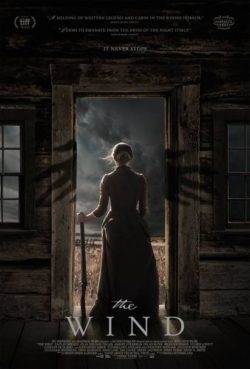
When it comes to horror in the Old West, there aren’t a lot of great examples, or even average examples. That’s peculiar because of how isolated people were in those times, complimented by the fact that urban legends and tales of the unexplained permeated the landscape. That brings me to “The Wind,” a film that doesn’t take long to introduce the audience to Lizzy (Gerard), who’s alone and distant from any signs of civilization. She only has one neighbor and they’re several miles away, far enough away in fact that she can barely see their cabin dot the horizon. Compounding her isolation is the fact that her husband is constantly gone, weeks at a time. She also suspects she isn’t alone.

“The Wind” is told, sometimes wordlessly, in a nonlinear fashion, forcing the viewer to piece together a tragic sequence of events involving Lizzy’s failed pregnancy, failing marriage, and the possibility that her mental health is deteriorating. Or maybe there is something howling with the wind at night. The nonlinear storytelling choice can be confusing, even for astute viewers. The single setting and bland landscape sometimes fail to help highlight at what point in time we’re at in the story. Some of the only signs that we notice we’re in the past is when Lizzy is sporting a soon-to-be miscarriage. On top of that, the film leaves various breadcrumbs surrounding the supposed evil entity lurking in the empty prairie lands surrounding her cabin, as well as what exactly has transpired to where Lizzy has found herself in such a precarious situation. It’s difficult to reveal too much in a short film that builds towards a harrowing final few minutes.

Since actress Gerard is left alone in many scenes, just like Lizzy, it’s up to her to pull off a solo performance that’s not only captivating, but also keeps the plot moving forward, and she nails it. Gerard does a magnificent job at handling both the fear and frustration that Lizzy is surely enduring. Even though she is relatively alone and without a life preserver in the great unknown, Gerard never paints Lizzy as a damsel in distress or shows any signs of helplessness. Instead Gerard beefs up that steely reserve that Lizzy must muster to overcome whatever comes at her, supernatural or not.

There’s an underlying commentary about how women have been mistreated, and not just in the 19th century. Lizzy is constantly ignored and her concerns are mocked. Instead of lending an ear and/or investigating her claims of something sinister stalking her cabin at night, she’s told to be quiet and to keep up with her wifely duties. It’s also implied she’s treated worse after losing her child. While the written story doesn’t hit the right notes, the visual story on screen is masterful. Director Emma Tammi, in her feature film debut, shows a knack for building a dread-filled atmosphere through hair-raising cinematography. This is the kind of freshman outing that promises better films down the pipeline.

 
Related Content

Film Review: “Dumbo”

Starring: Colin Farrell, Michael Keaton and Danny DeVito
Directed By: Tim Burton
Rated: PG
Running Time: 112 minutes
Walt Disney Studios

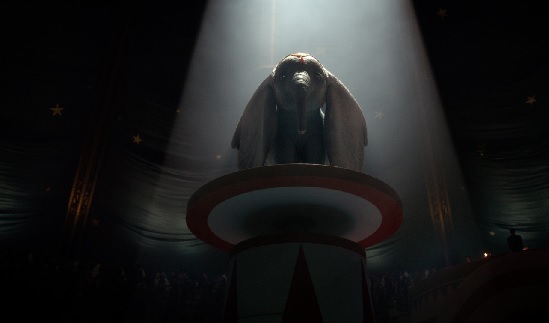
My recollection of “Dumbo” is incredibly brief and simple, and may even be a false memory. I believe I watched the 1941 classic when I was four- or five-years-old. I’ve never had an interest in rewatching it even though it is a relatively short animated classic, clocking in at barely over an hour. That’s a lot easier to digest than this Burton-ized remake, which has ballooned to nearly two hours, relies heavily on green screen and CGI, and has removed the talking animals element. Instead the story of Dumbo is told with the help of the humans around him at the circus.

Ringmaster Max Medici (DeVito) has recently purchased a pregnant elephant, believing that a baby animal could draw curious eyes to his traveling circus which has currently set-up shop in Joplin, Missouri. Much to his dismay, the baby elephant is a “freak.” Max believes the oversized ears will draw laughs instead of affectionate, “Awhs,” and he’s not wrong. Believing in the blue-eyed baby elephant though is Milly (Nico Parker) and Joe (Finley Hobbins), the children of Holt (Farrell), a WWI veteran returning home without an appendage and attempting to adjust to his sad new life as a widow. Milly and Joe also know about Dumbo’s talent as a flying animal.

There’s actually a lot to like about “Dumbo,” but it fails at doing two vital things, connecting emotionally with the audience and telling a story about acceptance. The components are there, but they never come together. Since the animals can’t talk, we’ll never know what Dumbo is actually thinking, but Burton does an odd thing. He never really shows pain, frustration, or loneliness etched across Dumbo’s face once he’s separated from his mother. Instead he has the human actors state how they think Dumbo is feeling. There are a few moments between Dumbo and his mom, but nothing on the level of the original.

As for accepting others for their differences, it feels more like a theme that’s left to simmer on the film’s backburner. Instead of hammering that point home through allegory, the film feels more interesting in introducing ancillary characters and distracting viewers with visual effects. It’s an odd observation because director Tim Burton is known for allowing his weird to overtake his more normal productions, as he fights for the voice of the bullied or marginalized hero. This might be his least weird movie, settling for a cookie cutter style, instead of his usual gothic imagery juxtaposed against mainstream aesthetics.

But like I said, there’s a lot to like in this movie. Despite its PG rating, it’s perfectly safe for kids of all ages and there’s nothing really terrifying. The children at my screening appeared to adore it. It may be nearly two hours, but it never feels boring or dull. It never stoops down to an Illumination level of humor and has several legitimate jokes. The green screen is very impressive considering and every adult actor manages to gnaw on that green screen while the child actors are believable most of the time in their roles. I just don’t see children rewatching this over the years and eventually showing it to their kids one day.

There’s one interesting part of the movie that I really enjoyed and it even gave me pause as to where or not Disney executives watched the final product. I say this because Burton seems to take a subtle jab at the Disney media conglomerate through the film’s villain, V.A. Vandevere (Keaton). He’s an “entrepreneur” that buys up other unique entities so that he can expand his amusement park empire called Dreamland. He has several rides and attractions that feel very reminiscent of Disneyland/Disney World properties. It’s almost as if Burton isn’t just commenting on Disney’s recent purchases of Marvel, “Star Wars” and Fox, but also their current trajectory of buying popular brands to financially exploit instead of giving a voice to fresh, young animators and filmmakers. Or maybe Burton realized that he’s become Hollywood’s tolken weirdo for oddball franchises (“Alice in Wonderland” and “Miss Peregrine’s Home for Peculiar Children”) and wanted to remark on what’s become of the film industry. The intentional/unintentional metaphor certainly won’t be lost on adults in theaters who’ve spent a pretty penny on Disney’s “reimagining” that falls short of living up to the original.

Originality is no longer valued at the Walt Disney Company. The last original movie was under their Pixar brand, the film “Coco.” That was November 22nd, 2017. The next original idea? That isn’t until March 2020, another Pixar film. So in between this two-and-a-half year amount of time, one of the largest companies in the world is going to throw out every sequel and remake they can think of at moviegoing audiences, because that’s all that can guarantee the company billions of dollars. Maybe I shouldn’t be voicing my frustration about that in this review of a children’s film, but I find it necessary for you to be prepared for my and other’s annoyance at the litany of live-action remakes and sequels that continue to pour out of the Disney factory like a river spilling over its banks. Back in 1941, the House of Mouse took a brave attempt at something new and unique. That’s no longer the case.

 
Related Content

Film Review: “The Hummingbird Project”

THE HUMMINGBIRD PROJECT

Starring:  Jesse Eisenberg, Alexander Skarsgard and Salma Hayek

Directed by:  Kim Nguyen

Rated: R

Running time:  1 hr 51 mins

The Orchard

There’s a great scene towards the beginning of “Something About Mary” which features Ben Stiller and Harlan Williams talking about William’s idea for a video entitled “7 Minute Abs.”  Stiller shoots down his idea by commenting that someone may try to better him with a video entitled “6 Minute Abs.”  The new film “The Hummingbird Project” offers the equivalent of “5 Minute Abs!”

Vincent Zeleski (an excellent Eisenberg) and his cousin, Anton (an equally good Skarsgard) are employees at a high tech communications firm, writing code and making the boss rich.  But they have come up with an idea.  One that will make them rich beyond their wildest dreams.  And all they have to do is dig a tunnel from Kansas to New Jersey.

A well written (by director Nguyen) and directed thriller, the film introduces us to the Zeleski cousins as they begin to hatch their scheme.  Their plan is to build an underground optical fiber system that can intercept stock buying and selling transactions on their way to New Jersey, allowing them to get their orders in first and profit off of their information.  Their goal is to have a signal that reaches the Garden State from the exchange in Kansas in less than 16 milliseconds.  17 is too slow. 

It is so nice to see Eisenberg in a role that he can inhabit.  While I thought he was OK as Lex Luthor in the recent “Justice League” themed films, it’s been a long time since I’ve seen the “The Social Network” Eisenberg, one who deservedly earned an Oscar nomination for Best Actor.  Here he is the idea man…the fast talker who won’t take “no” for an answer.  As cousin Anton, Skarsgard is an odd bird with a good heart and a great mind.  He’s the kind of person who will tell you “it’s a secret” than draws up a hand-written non-disclosure form for you to sign because he just explained the entire project to you.  As the boss who feels hurt by her employee’s betrayal, Hayek is, as always, beautiful and firm.  And it’s so nice to see “Breaking Bad” star Michael Mando (Nacho) in a good role playing a genuinely good person.

Film Review: “Us”

  • US
  • Starring:  Lupita Nyong’o, Winston Duke and Elisabeth Moss
  • Directed by:  Jordan Peele
  • Rated: R
  • Running time:  1 hr 56 mins
  • Universal Pictures

It used to be that, when I thought of Jordan Peele, I thought of his character, Raffi, the baseball player who used to over congratulate his teammates by yelling “Slap Ass!” and whacking them on the backside.  Then he won an Oscar.  Which means when I sat down to watch Peele’s newest creation, “Us,” my expectations had been raised.  And, wow, was I not disappointed.  In this reviewer’s humble opinion, Peele has created a new horror masterpiece.

1986.  A time of movies on VHS tapes and Hands Across America (which I actually participated in).  It’s a beautiful night on the boardwalk as little Adelaide Wilson (Madison Curry) and her parents take a stroll.  Her mother excuses herself, reminding her husband to watch the little girl.  He doesn’t and the little girl wanders down to the beach, where she enters a house of mirrors.

Not the best place to lose yourself.

There is so much I want to tell you about this film, but to do so would spoil one hell of a night at the movies.  Like his Oscar-winning debut film, “Get Out,” Peele has found a way to combine drama, humor and horror in such a perfect way that I found myself, literally, on the edge of my seat during the screening.  I haven’t done that since I was 16 and snuck into a re-issue of “The Exorcist.”

To even go into slight detail about the performances would be a major spoiler so I will just say that, like “Get Out,” Peele has assembled an amazing cast with much to do and many ways to do it.  Peele’s direction is fluid, keeping the story moving at an almost breakneck pace.  During the end credits he thanks many of the filmmakers he admires, including Steven Spielberg, whose work obviously influenced some of the shots in the film.  And, if I could, I’d give the film an extra star for dressing one of the characters in a JAWS shirt!

Don’t walk, run to the theatre to see “Us.”  And be prepared to run some more!

Copyright: MediaMikes.com © 2019 · Powered by: nGeneYes, Inc. · Login

All logos and images used on this website are registered trademarks of their respective companies. All Rights Reserved. Some of the content presented on our sites has been provided by contributors, other unofficial websites or online news sources, and is the sole responsibility of the source from which it was obtained. MediaMikes.com is not liable for inaccuracies, errors, or omissions found herein. For removal of copyrighted images, trademarks, or other issues, Contact Us.