

Film Review: “Dr. Seuss’ The Grinch”

Starring the Voice of: Benedict Cumberbatch, Rashida Jones and Kenan Thompson
Directed By: Scott Mosier and Yarrow Cheney
Rated: PG
Running Time: 90 minutes
Universal Pictures

“Dr. Seuss’ The Grinch” is a moderately safe viewing experience for children. I say this because the past several films churned out by Illumination have been less than stellar with questionable ethics, and they were more about selling toys than they were about telling a genuine story. Illumination has managed to create a crowd pleaser for kids new to the story. But while its super sugary goodness may satisfy kids, it’ll certainly give their parents a toothache.

“The Grinch” is fairly similar to the book and the television special that followed, give or take a few creative liberties that are equally distracting or amusing. Benedict Cumberbatch voices the furry green creature that loathes Christmas, and honestly does a spectacular job. He’s likeable, yet cruel, as well as casually dorky, yet firm with his voice. The rest of the voice talent, Kenan Thompson, Rashida Jones, and others, feel like they were only given a few hours to rehearse and read their lines.

When taking into account, the films based on Dr. Seuss’ work, “The Grinch” stands firmly near at the top by default. It’s not gross and obnoxious like the live-action “Cat in the Hat” or a complete misfire like “The Lorax,” another Illumination film. It’s possible the studio learned from those mistakes, catering towards fans of the original work while making sure they didn’t make it to obnoxiously modern with pop-culture references.

The criticisms of commercialism aren’t lost on the 2018 update on Dr. Seuss’ classic tale. “The Grinch” spends several moments touching upon how the title character is transfixed on the buying, receiving and gluttony of the holidays. It’s the viewpoint of a curmudgeon who’s spent his life loathing a holiday that’s beloved by all. You probably know the story by now about how the cynic softens and how his heart grows multiple sizes by the tales end. It’s hard to take that message at face value when Illumination’s only reason for retelling this tale is for financial reasons.

There are several attempts by the creative team to inject some original, unique ideas into the timeless tale, but only one seems to actually stick. The idea that the Grinch is an orphan, whose deep-seated dislike for Christmas stems from his parentless childhood and the PTSD that follows helps bring everything around in a more complete circle. Other subplots brought in to help the movie don’t resonate at all, like a group of kids in town plan on capturing Santa or Cindy Lou Who’s mom who’s in desperate need of some R&R.

Just like Ron Howard’s film in 2000, this film doesn’t hold a candle to the 1966 television classic. But with television sliding to the wayside with the rising of streaming services, “The Grinch” actually has a legitimate shot at replacing that hand drawn classic. “The Grinch” is bright, flashy and silly; a perfect combination for young children who’ve had their parents read them the Dr. Seuss’ book throughout their young life during the holidays. Honestly, there’s nothing wrong with that. That’s the kind of comment that could get a critic crucified in the domain of public opinion, but anytime Dr. Seuss’ works are adapted for TV or screen, it’s a cash grab regardless of how good and wholesome the final product is.
Film Review: “Mid90s”

Starring: Sunny Suljic, Lucas Hedges and Katherine Waterston
Directed By: Jonah Hill
Rated: R
Running Time: 84 minutes
A24

I’m not sure who this movie is for. Sometimes coming-of-age films ring true for everyone because it speaks specifically to those who lived the generation it represents and still manages to slip in some universal truths. “Mid90s” seems specifically niche: stoner skateboarders who grew up on “Ren and Stimpy” cartoons and played NES video games. It’s not necessarily a bad thing because the film manages to stretch outside those confines, painting a broad picture of children who’ve come from single parent homes or troubled living conditions. You just have to squint a little hard to see it.

The film focuses on 13-year-old Stevie (Suljic), who actually looks a lot more like he’s 10. He seems to take daily beatings from his older brother, Ian (Hedges), who’s just turned 18. Their single mother, Dabney (Waterston), loves them unconditionally, but seems to have taken a hands-off approach during their pubescent years. Ian and Dabney become background noise in Stevie’s life when he’s accepted into a group of rebellious young boys hanging out at a skateboard shop. This misanthropic brotherhood doesn’t seem to have much in common, but the glue that binds them is their status as outcasts at home, school and in life. The alpha dog of the group, Ray (Na-Kel Smith), also manages to keep them all in line, even when they’re at each other’s throats.

“Mid90s” is the kind of movie “Lords of Dogtown” wishes it was, even though the target audience might fight me on that unpopular opinion. “Mid90s” prevents itself from being overly dramatic and unrealistic thanks to Hill’s raw script which highlights the politically incorrect vernacular of the time while unflinching capturing troubled youth in Los Angeles. However, there are a lot of gaping flaws in how everything is presented. The comedy sprinkled throughout sometimes works, but also undercuts the seriousness of several situations. It also may not be funny for those uncomfortable with how carefree some slurs were used by teens in the 90s. There’s also one scene in particular that quickly goes from uncomfortable to borderline exploitive.

There are flashes of creativity with Hill’s directorial debut, but too often he limits his characters and the stories they have to tell. There’s an inventive subtleness to what Hill reveals about Stevie and his crew, but too often we’re left with more questions than answers. The scope is so narrow that the average moviegoer may find “Mid90s” to be too brash and at times, a bit derivative. But underneath its crass nature, are good-intentions and a unique perspective on growing up that we’ve rarely seen.

Film Review: “Bohemian Rhapsody”

BOHEMIAN RHAPSODY
Starring:  Rami Malek, Lucy Boynton and Joseph Mazzello
Directed by:  Bryan Singer
Rated: PG 13
Running time:  2 hrs 14 mins
20th Century Fox


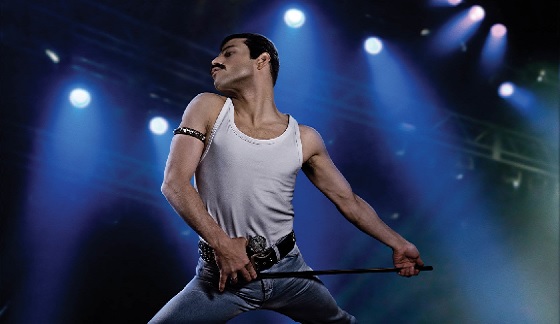
I’m going to confess something here.  On my list of life regrets, one of the ones near the top has to do with the fact that I had a few opportunities in my lifetime to see the band QUEEN live in concert and never went, always telling myself, “I’ll see them the next time they come around.”  Sadly, on November 24, 1991 that statement became moot, as the world mourned the death of the bands flamboyant lead singer, Freddie Mercury (music trivia purists will also note that Eric Carr, the 2nd drummer for KISS, also passed away on that date).  Director Bryan Singer’s new film, “Bohemian Rhapsody,” containing an amazing star-making performance from Rami Malek, lets the world know that Freddie isn’t dead!

London, 1970.  When we meet Farrokh Bulsara (Malek) he is unloading luggage at Heathrow Airport.  He is not happy in his work, especially when his co-workers refer to him as “Paki.”  “I’m not Pakistani,” he constantly reminds them (he was actually Parsi, having been born on the island of Zanzibar before his family moved to England).  While his mother and sister dote on him, he knows his father is ashamed of him, scolding him for going out late at night and imploring him to follow his father’s words of “Good Thought.  Good Words.  Good Deed.”  Farrokh has the opportunity to meet a band who has just lost their lead singer and he soon gets the gig.  A few changes, including the name of the band (and its lead singer) and QUEEN, as well as Freddie Mercury, are on their way.

Full of the music you will fondly remember and featuring one of the most immersive performances by an actor EVER, “Bohemian Rhapsody” is a musical masterpiece.  And while the film is definitely designed around the flamboyant Mercury, the other band members – Brian May (Gwilym Lee), Roger Taylor (Ben Hardee) and John Deacon (Joseph Mazzello) – are given ample screen time, allowing their characters to be as fleshed out as possible.  They enjoy the musical ups (concert tours and success) and downs (the head of the record company hate’s their music and concepts, critics hate the song “Bohemian Rhapsody”) together, as a family.

However, anyone familiar with the QUEEN story knows this may not be a family you or I would like to be a part of.  Besides the “getting better through science” fast track that Freddie s drug abuse puts him on, there is the same kind of in-fighting and arguments between the members of the group.  There is also the subject of Freddie’s sexuality.  He meets the “love of his life,” Mary (Boynton) but she understands that there will always be an unsaid “thing” between them that will keep them apart.

The film follows the band through their appearance at 1985’s LIVE AID.  It is here that they cemented themselves as one of the greatest bands of all time.  Four decades later, they still hold that distinction.

Confession number two:  I’m old enough to say that my first concert was Elvis Presley (Valentine’s Day – 1977) so when I say I’ve seen them all, I’ve seen them all.  And I’ve said for years that the greatest front man EVER was Freddie Mercury.  If you care to disagree, drop me an email and we’ll talk about it.

Film Review – “Halloween”


HALLOWEEN

Starring:  Jamie Lee Curtis, Judy Greer and Will Patton
Directed by:  David Gordon Green
Rated:  R
Running time:  1 hr 46 mins
Universal


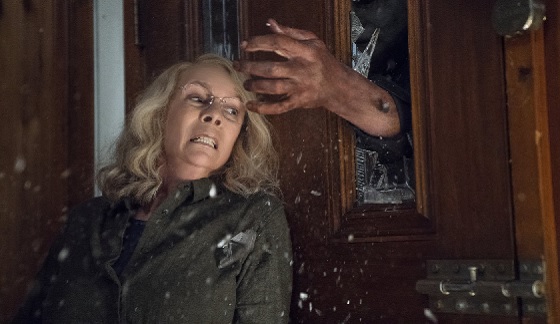
There are a handful of films that can be pointed to and described as “game changing” in Hollywood history.  “Citizen Kane” broke all the rules as to how a film is made.  “Jaws” gave us the summer blockbuster.  “Star Wars” ensured that sci-fi fans would always have a voice.  And where do you start when you talk about the Marvel Cinematic Universe?  In 1978, another film arrived and changed the face of the horror genre’ forever.  That film was “Halloween.”

We “meet” Michael Myers as an adult, standing alone in a squared-in area of a state-run mental institution.  He is being visited by a film crew working on solving a mystery:  why did 6-year old Michael stab his sister to death on Halloween night, 1963 and why, after escaping from captivity, did he return to his hometown 15 years later and kill again?

One thing to note here for fans of the series, or just those that are interested.  Despite a plethora of “sequels” to the 1978 original, they are treated here as non-existent, making THIS film a continuation of the original.  And I’ll say here that the film, with some tongue in cheek references to other films, works well.  The scares are legit and the performances, led by the amazing Jamie Lee Curtis, are well delivered.

I was surprised to learn that this film was co-written by the always funny Danny McBride.  Good job.  The script is solid, with some nice set-ups inter-spliced with some emotional family moments between Curtis’ Laurie Strode and her estranged daughter and granddaughter.  But you go to these films to see the boogeyman get his comeuppance.  So, what are you waiting for?

Film Review: “Beautiful Boy”

BEAUTIFUL BOY
Starring: Steve Carell, Timothee Chalamet, Amy Ryan, Maura Tierney
Directed by: Felix Groeningen
Rated: R
Running Time:  2 Hours
Amazon Studios

Felix Van Groeningen spins a pair of true life father and son memoirs about the latter’s struggle with drug addiction into two really touching turns from both Steve Carell and Timothee Chalamet in Beautiful Boy. The film opens in limited release today and despite some heavy-handed technical choices, succeeds on the authenticity of Carell and Chalamet’s performances.

Steve Carell is instantly sympathetic as David Sheff, who we meet in the midst of his son Nic being missing for a few days—a not unusual occurrence as it turns out. I was relieved when early on his wife (Maura Tierney, bringing a lot to a smaller role) gave him a hug because you can just read on his face such a high level of fragility. He’s worn down by Nic’s habits and tired but also terrified and barely holding it together, he needs that hug! Meanwhile Chalamet suppresses any temptation to overact Nic’s drug addled tics. Instead he keeps all the manic energy behind his eyes and in his slightly unbalanced physicality. Some of the strongest scenes come when Nic is desperately trying to deny that he’s relapsed to get money from an unbelieving David. The film’s greatest strength is resisting the temptation to come down hard on either side of this struggle. “Relapse is part of recovery” becomes David’s mantra when Nic disappoints but that doesn’t mean he’s wrong when he needs to refuse Nic for his own sake. At these moments Carell is almost painfully affecting (frankly, I wanted to hug him too) and I felt my heart racing at times when he, understandably, has to snap and really argue with Chalamet.

There are number of choices Van Groeningen makes however that jar you right out of the story in drastic ways. The music over the opening of the film when we’re introduced to Dave and young Nic’s relationship is so overwrought I felt as though we’d dove right into the climax instead of the titles. These heavy-handed musical interludes occur over and over either in instrumental or lyrical form but I only felt emotionally touched—because how can you not be?—by the titular John Lennon tune which Carrell sweetly sings to young Nic as he tucks him in.

And while I’m discussing Young Nic, besides Chalamet—who, at most is meant to play Nic in his twenties—not just one, but three other boys are deployed to play a younger Nic in flashbacks. It’s distracting not only for the quantity of actors but because the first young Nic is none other than It‘s Jack Dylan Glazer. Glazer himself is fast becoming as recognizable A Name as Chalamet, so when he also gets replaced by still younger models it starts not to feel like the same character. More like props for David. The film is a vital story for a time when America is seeing an epidemic of young people overdosing but in these odd choices, the film gets in the way of itself. When it backs off and let’s the actors take control, A Beautiful Boy shines.

Film Review: “Blaze”

BLAZE
Starring: Ben Dickey, Alia Shawkat
Directed by: Ethan Hawke
Rated: R
Running Time:  2 hrs 9 mins
IFC
 
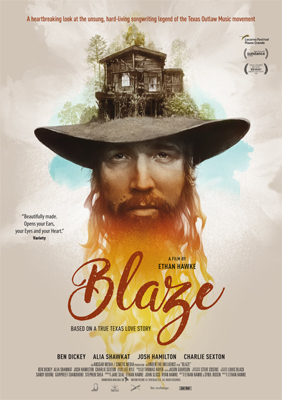
Having grown up listening to the music of country artists like Johnny Cash, Merle Haggard, Waylon Jennings, Willie Nelson, etc., I was surprised I had never heard of Blaze Foley (1949-89). After watching the biopic of the obscure yet influential Austin-based singer/songwriter, I felt saddened that he did not realize the full potential of his artistry. “Blaze” is a tragic tale that flows like a sad country song with little in the way of silver linings. Based upon the 2008 memoir “Living in the Woods in a Tree: Remembering Blaze” by Foley’s ex-wife Sybil Rosen, “Blaze” features a powerful breakthrough performance by musician Ben Dickey in an emotionally complex role. Unfortunately, writer/director Ethan Hawke’s endeavor is so draggy at times that it makes a meandering creek look like a raging river.
 
Hawke bravely chose to tell his tale from three different time lines – sometime after the death of Foley within the confines of a radio booth interview; the night of Foley’s death; and the beginnings of his life as an artist when he meets Rosen (Alia Shawkat, “The To Do List”). The interview portion is entertaining as we watch Hawke, who never exposes his face, interview Foley’s friends – singer/songwriter Townes Van Zandt (Charlie Sexton), who had his own demons to deal with, and Zee (Josh Hamilton). Van Zandt embellishes to the point where you don’t know if he is telling the truth or creating the lyrics to another lonely country song.
 
The portions involving the night of Foley’s death are rather lackluster. Of course, some of the edge is taken off because we know what’s coming, but Hawke fails to make us feel like we are dancing along a razor. It plays more like a Hank Williams, Jr. tune that never made the final cut in the editing room. Dickey still manages to be a steady presence on the silver screen, but it’s the story of his innocent beginnings with Rosen that truly grab our attention and leave the most lasting impression.
 
Much of the story’s focus, and rightfully so since Hawke heavily used the real Rosen’s novel, is on the years when Foley and Rosen met, and lived for a time in a tree house. Dickey towers in these sentimental scenes like a seasoned veteran of the acting craft. While he sometimes forgets to maintain the limp Foley had, Dickey appears to capture the man’s essence with breathless ease. He hits every note with perfection as he portrays a man who fell hard from carefree joy and blossoming artistry into a dark haze of alcohol and drugs that cost him everything – love, career and life.
 
“Blaze” is a tragic story, yet if you subtract Dickey from the equation it feels stuck in neutral while cameos by a pair of stars, one a recent Oscar winner, feel contrived and over the top. Overall, it’s a story that could have used a lot tightening up and more cohesivity. Otherwise, Hawke’s effort falls short of his other tragic-musician tale in the form of 2015’s fantastic “Born to Be Blue.”
 
Having grown up listening to the music of country artists like Johnny Cash, Merle Haggard, Waylon Jennings, Willie Nelson, etc., I was surprised I had never heard of Blaze Foley (1949-89). After watching the biopic of the obscure yet influential Austin-based singer/songwriter, I felt saddened that he did not realize the full potential of his artistry. “Blaze” is a tragic tale that flows like a sad country song with little in the way of silver linings. Based upon the 2008 memoir “Living in the Woods in a Tree: Remembering Blaze” by Foley’s ex-wife Sybil Rosen, “Blaze” features a powerful breakthrough performance by musician Ben Dickey in an emotionally complex role. Unfortunately, writer/director Ethan Hawke’s endeavor is so draggy at times that it makes a meandering creek look like a raging river.
 
Hawke bravely chose to tell his tale from three different time lines – sometime after the death of Foley within the confines of a radio booth interview; the night of Foley’s death; and the beginnings of his life as an artist when he meets Rosen (Alia Shawkat, “The To Do List”). The interview portion is entertaining as we watch Hawke, who never exposes his face, interview Foley’s friends – singer/songwriter Townes Van Zandt (Charlie Sexton), who had his own demons to deal with, and Zee (Josh Hamilton). Van Zandt embellishes to the point where you don’t know if he is telling the truth or creating the lyrics to another lonely country song.
 
The portions involving the night of Foley’s death are rather lackluster. Of course, some of the edge is taken off because we know what’s coming, but Hawke fails to make us feel like we are dancing along a razor. It plays more like a Hank Williams, Jr. tune that never made the final cut in the editing room. Dickey still manages to be a steady presence on the silver screen, but it’s the story of his innocent beginnings with Rosen that truly grab our attention and leave the most lasting impression.
 
Much of the story’s focus, and rightfully so since Hawke heavily used the real Rosen’s novel, is on the years when Foley and Rosen met, and lived for a time in a tree house. Dickey towers in these sentimental scenes like a seasoned veteran of the acting craft. While he sometimes forgets to maintain the limp Foley had, Dickey appears to capture the man’s essence with breathless ease. He hits every note with perfection as he portrays a man who fell hard from carefree joy and blossoming artistry into a dark haze of alcohol and drugs that cost him everything – love, career and life.
 
“Blaze” is a tragic story, yet if you subtract Dickey from the equation it feels stuck in neutral while cameos by a pair of stars, one a recent Oscar winner, feel contrived and over the top. Overall, it’s a story that could have used a lot tightening up and more cohesivity. Otherwise, Hawke’s effort falls short of his other tragic-musician tale in the form of 2015’s fantastic “Born to Be Blue.”


Related Content

Film Review: “A Star is Born”

A STAR IS BORN
Starring:  Lady Gaga, Bradley Cooper and Andrew Dice Clay
Directed by:  Bradley Cooper
Rated:  R
Running time:  2 hrs 15 mins
Warner Bros.

To quote “Beauty and the Beast,” it’s a tale as old as time.  Big star on the way down meets rising star on the way up.  They fall in love.  One embarrasses the other and their love is tested.  The tale is so old that it’s already been told, very well, three times before.  But the fourth time may be the best!

Jackson Maine (Cooper) is a popular singer who has lived his life on the road.  Once enjoying his time on stage, now he gets by with alcohol and drugs, showing up, plugging in then hurrying off-stage to the seclusion of his limo.  One night, while looking for a place to stop, he ends up at a drag club, where he gets the chance to listen to a young woman named Ally (Lady Gaga – I was just going to put “Gaga” but I’m not sure how the first name/last name thing works here.  I guess I could have put “Stefani Joanne Angelina Germanotta” but that would probably confuse you even more.  Ally does an old Edith Piaf song and soon Jackson is mesmerized by her voice.  He invites her out with him, where they buy some beer and talk about music.  When he drops her off at home she figures that’s the last time she will see him.  It isn’t.

A familiar story with enough new twists and turns to keep it fresh, “A Star Is Born” is a triumph.  Much of this praise must go to my rival Bradley Cooper.  (I know my wife loves me, but if Bradley Cooper came knocking I would be just a memory J).  As a first time director, especially in a film starring himself, there is an opportunity to make everything BIG and LOUD and, worse of all, put yourself front and center.  Cooper directs with a restraint that is almost unheard of with newbies.  He frames the story almost as if he’s shooting a documentary, and that close, inside look draws you into the story.  As an actor, Cooper is equally up to the task here.  His voice low and gruff (there’s a great line in the film where Sam Elliott, who plays his brother and who was also a musician, accuses Jackson of “stealing my voice”), he gives quite possibly the best performance of his career, which is saying a lot for a man who has already been nominated for the acting Oscars already in his career.

As Ally, Lady Gaga is outstanding.  We already know she can sing.  I haven’t heard a lot of her songs but I still include the night she showed up at the Academy Awards and sang “The Sound of Music” as one of my favorite all-time Oscar moments.  Not only is she in great voice, she has incredible acting chops.  Both the 1937 and 1954 versions of the film earned Oscar nominations for its stars.  The 1976 version swept the Musical Film Category and I’m predicting that both Lady Gaga and Cooper get nods for their work here.  Great supporting work from Andrew Dice Clay, Sam Elliott and Dave Chappelle make the film even more enjoyable.

Film Review “Malevolence 3: Killer”

Director: Stevan Mena
Starring: Katie Gibson, Scott Decker, Adrienne Barbeau, Kelsey Deanne, Lela Edgar
Release Date: October 12th
MPAA Rating: R
Studio: Mena Films

Our Score: 4 out of 5 stars

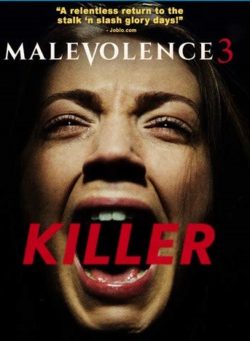
I have known Stevan Mena for over 15 years, dating back to his first film “Malevolence”. I had a feeling then that this guy was going to be a director to watch out for. Fast forward to today Stevan has finally been completed his planned “Malevolence” trilogy , which also included the second film, “Bereavement”, which starred Michael Biehn (“Aliens”, “Terminator”) and gave Alexandra Daddario (“Baywatch”, “Texas Chainsaw 3D”) her first big break. “Malevolence 3: Killer” has not had an easy road to getting made, including the tragic death of a major cast member which caused a big road bump. With all that being said, I was a little nervous what to expect with the third film…but holy cow was I wrong. “Malevolence 3: Killer” is easily the best in the trilogy.

I don’t think Stevan Mena has received the full credit that he deserves for these films. You can tell that he wears a lot of hats on these productions. They have no budget yet show a much higher production value. I feel like he really gets the horror genre and knows how to setup a shot for a great scare. The scares in “Malevolence 3: Killer” are so effective. Honestly, I feel like a lot of horror films these days don’t get the scares right. I always feel like they are actually afraid to make you scared and these movies waste these opportunities. Mena doesn’t disappoint and has the timing down perfectly. I would have loved to seen “Malevolence 3: Killer” in a theater. Credit should also go to the film’s fantastic score as well for helping achieve that incredible suspense.

This trilogy takes it all back to the beginning following Martin Bristol, the boy who was kidnapped 10 years ago (in the first film), but he is not the same boy anymore. After being tortured and abused by his captor, Graham Sutter (in the second film), Martin is out on a rampage now and is not able to be stopped. Special Agent William Perkins and his team try and hunt down Martin as he heads back to his hometown to brings down a wave of terror down on it. Looking back on these three films, I do feel that this one ties it all together so well. I almost even feel like you can get by with watching this one and not having seen the previous films.

Like I mentioned above with, Alexandra Daddario in “Bereavement”, Stevan Mena really has an eye for talent. This film’s lead actress Katie Gibson is a another fine example. She is a very talented actress and I see her going places! Scott Decker, who died during production, played Agent Roland and was great as well. I am sure it wasn’t an easy task to complete this film with losing one of the leads but it came together well. Horror icon, Adrienne Barbeau, shows up for a little bit as well and her cameos is a great treat for us hardcore horror fans!

Now that this trilogy is completed, I would like to see what Stevan Mena has planned next. Given that “Malevolence 3: Killer” hasn’t had an easy road to release, i really feel like it ended up being a very effective horror film with some great scares, gory kills and solid acting. Horror fans need to see this film for sure! It is our job has fans to get the word out on this film and get people to see it because I don’t think that they are going to be disappointed.

Film Review: “Night School”

Starring: Kevin Hart, Tiffany Haddish and Rob Riggle
Directed By: Malcolm D. Lee
Rated: PG-13
Running Time: 111 minutes
Universal Pictures

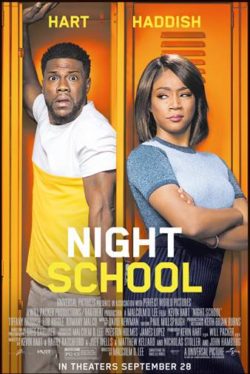
It’s difficult to digest a new Kevin Hart movie without first re-evaluating where one currently stands on the stand-up comedian turned actor. My opinion on him was actually quite positive after last year. His trademark high-pitch scream and short stature served the “Jumanji” sequel/reboot well and my prior frustrations with him melted away in “Captain Underpants.” But Hart is back to his old uninteresting shenanigans in “Night School.”

Teddy (Hart) believes he needs one thing to keep his life on track, a GED. The recently engaged man has lost his BBQ grill sales job and is hard-pressed to get an ideal replacement gig because he never completed high school. His fiancée, Lisa (Megalyn Echikunwoke), is oblivious to the fact that Teddy is a high school drop out because he’s a decent liar. Despite their years of dating, he’s managed to convince her that he’s successful, and not drowning in debt or uneducated. However she did always know he sold grills for a living.

So to keep up this charade, he gets a minimum wage job, takes the bus daily after wrecking his car, and begins to attend night school. These are all things he doesn’t tell Lisa, despite their recent engagement and step forward in their relationship. Even when she does begin to suspect something is amiss; Teddy unflinchingly goes along with her suspicion that he’s getting cold feet about their marriage. If it seems like I’m focusing too much on Teddy, that’s because this movie focuses way too much on him and his night school cohorts.

It’s a really unfortunate fact, especially consider that the other star of this film is Tiffany Haddish, who plays Teddy’s night school teacher, Carrie. Haddish, who burst into the mainstream last year with “Girl’s Trip,” has some solid quips and one liners, but is relatively declawed in this film. Carrie also represents a strong female personality that fits well into the film’s mold about overcoming adversity, but there are a lot of scenes where Carrie’s persona and approach leaves a lot to be desired.

I actually wanted to like “Night School.” It began on a solid promise that Hart, Haddish, and the surrounding cast could unearth some unexpected comedy gold. There are chuckles to be had, but not enough, mainly due to the fact that “Night School” is stretched thin by its runtime and lack of comedic imagination. Even with two comedians that have more than proven to be a comedic force behind the mic and on-screen, “Night School” gets a failing grade.
 

Related Content

Film Review: “Where Hands Touch”


WHERE HANDS TOUCH
Starring: Abby Cornish, Christopher Eccleston
Directed by: Amma Asante
Rated: PG-13
Running Time: 2 hrs 2 mins
Vertical Entertainment
 
The historical drama “Where Hands Touch” glances upon a subject that has been largely overlooked – the persecution of German citizens with African descent by the Nazi government. While their pre-World War II numbers were relatively small (less than 30,000), the Nazis still sought to isolate them socially and economically. They also implemented a barbaric plan of sterilization that was perpetrated against many African Germans. Much of this is brought to light in “Where Hands Touch,” but unfortunately the film, despite its’ horrifying subject matter, is often clunky and lacks the emotional impact of say a “Schindler’s List” or even “Defiance.”
 
We are introduced to Leyna (Amandla Stenberg, “The Hunger Games”), the daughter of an unnamed French African soldier and a German mother (Abbie Cornish, “Three Billboards Outside Ebbing, Missouri,” “Bright Star”), in the Spring of 1944 in the German Rhineland. She has recently turned 16 years old and the Gestapo, Nazi Germany’s secret state police, has taken an interest in her. Desperate to keep her daughter out of harm’s way, Leyna’s mother flees to Berlin with both her and Leyna’s younger half-brother where she mistakenly believes they can disappear.
 
Leyna’s aunt and uncle don’t want her around nor does the school she briefly attends. All the while, Leyna catches the eye of Lutz (George MacKay, “Captain Fantastic”), a teenage boy who is an active member of the Hitler Youth and whose father (Christopher Eccleston (“Doctor Who,” “Thor: The Dark World”) is an officer in the Nazi SS. As she begins to fall under increased scrutiny, Leyna and Lutz develop a romance, much to the chagrin of Leyna’s mother who warns her it will only lead to their ruin. The budding teen romance, which becomes sexual, is suddenly halted when Lutz is called up to the Russian front by increasingly desperate Nazi regime and Leyna is hauled off to a concentration camp.
 
Historically speaking, writer/director Amma Asante (“Belle,” “A Way of Life”) does a sound job of portraying the ever-looming danger African Germans had to endure. Through Leyna’s terrified eyes we also see the atrocities committed against anyone else the Nazis deemed not human, best epitomized in a shocking execution scene. However, the damage caused by the bombing of Berlin by the Allies during the winter of 1943-44 is barely reflected on camera and the concentration camp scenes misfire.
 
Cornish delivers a performance that deftly captures a mother’s desperation and Eccleston shines as a father who makes a ghastly decision. Beyond that, the acting is mediocre at best and downright clumsy at worst. It often feels like an overly long, bad stage play, with uninspiring camera work in the beginning despite Asante’s good intentions. “Where Hands Touch” is certainly a work cinema brimming with good intentions as it’s a story that should be told amidst a myriad of Holocaust-related stories which should never be forgotten. Unfortunately, the quality of work is less than average.

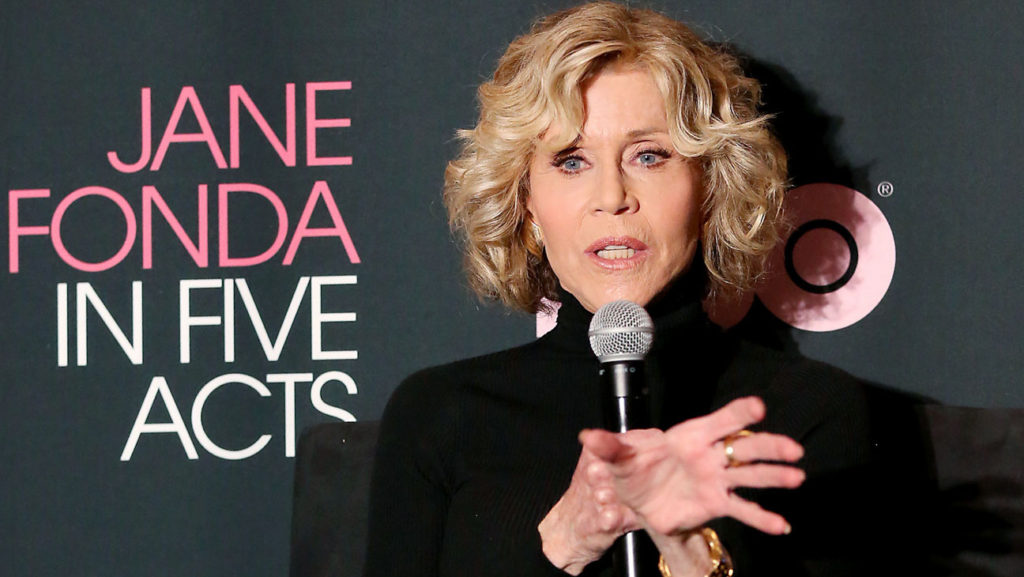
Film Review: “Jane Fonda in Five Acts”


JANE FONDA IN FIVE ACTS

Starring:  Jane Fonda, Robert Redford and DickCavet

Directed by:  Susan Lacy

Rated:  Not rated

Running time:  2 hrs 13 mins

HBO Films


Here is my Jane Fonda story.  In 2005, Ms. Fonda was in Kansas City to promote a book she had written.  I had been able to get my name on the press list in the off chance of getting a few minutes with the Oscar winning actress for a quick interview.  I can’t remember what, but something came up last minute and I was unable to attend.  Imagine my surprise the next morning when my phone began wringing.  It seems that while she was greeting people in line, a former Vietnam War veteran named MICHAEL SMITH spit tobacco juice on her.  Somehow, my name and contact info was discovered on the press list and people assumed it was me.  I received over 1,000 emails, some thanking “me” and others condemning “me.”  I even was invited to address an upcoming Marine Corps reunion in California.  After about two weeks the furor died down, but it was pretty exciting there for a while.


It was almost exactly 47 years ago (September 19, 1971) that President Richard Nixon, on one of his many tape recordings, asked an aide, “What in the world is wrong with Jane Fonda?”

The honest answer?  Not a damn thing!


“Jane Fonda in Five Acts” takes a look back at the actresses life and career, beginning when she was just known as Henry Fonda’s daughter.  Along with James Stewart, no other actor so embodied the image of the normal American male than Henry Fonda.  He was, according to his daughter, “a national monument.”  But behind that image was a man who could not express emotions unless he was in front of a camera.  Ms. Fonda is shown a photo of the family at a picnic, to which she explains that the image is staged.  The smiles forced and phony.  She can tell by the look in her mother’s face that she is not happy (Ms. Fonda’s mother dealt with many mental issues and would eventually kill herself.  She and her brother, Peter, were told she’d had a heart attack.  It wasn’t until years later, when Ms. Fonda read about it in a movie magazine, did she learn the truth).


As a young woman in her early 20s, she makes her way to the home of famed acting teacher Lee Strasberg.  He accepts her into his classes and, after a couple of months, puts her on the stage.  He recognizes her talents and encourages her to pursue them.  She begins to do small parts on television and in film while also modeling.  Tired of always doing the “cheerleader” roles, she heads to France, where she meets director Roger Vadim.  What follows is marriage, a child and a career changing role as the title character in “Barbarella.”


Back in America, she accepts a role in what she calls her first “real” movie, Sydney Pollack’s “They Shoot Horses, Don’t They?<” earning her first of seven Academy Award nominations. (NOTE:  I didn’t see “They Shoot Horses, Don’t They?” until the mid 1980s at a tribute to Sydney Pollack.  If you haven’t seen it, I strongly suggest you do).  Just as she is being taken seriously as an actress she does two things:  cuts her hair and visits Vietnam.

Fonda, shown here with Roy Scheider, won her first Academy Award for her role in the film “Klute.”

Depending on the age of the people you speak with, Fonda is either “a great actress” or “Hanoi Jane.”  There doesn’t seem to be a middle ground.  She was one of the first major celebrities to speak out against the United States’ involvement in Vietnam.  If there is any criticism now it is some of the ways she spoke out.   In the late 1980’s she apologized to the veterans and their families if her actions make things tougher for them.  A chance meeting with former vet and anti-Vietnam activist Ron Kovic gives her the idea for the film “Coming Home,” which would win her her second Oscar.


Now married to activist Tom Hayden, she puts together films that speak to her beliefs.  Many people scoffed at “The China Syndrome,” a film that dealt with a fictional melt-down at a nuclear power plant.  However, two weeks after the film opened there was a real incident at Three Mile Island.  Nobody was scoffing then.  In one of the most emotional moments of the documentary, Ms. Fonda talks about the only film she did with her father, “On Golden Pond.”  She recalls how, during a scene in the film, she surprised her father with a slight touch of his arm, causing the actor to cover his eyes to hide the tears welling up in them.  This would be Henry Fonda’s last film and it earned him his first Academy Award.


As the years progress we learn more about the actress and her life.  Needing to raise money for an organization she and her husband had founded, she produced her own workout video, which today remains the most popular home video ever made.  We follow her through her divorce from Hayden and her marriage to media mogul Ted Turner.  She speaks highly of all three of her ex-husbands.  We also meet some of her children, who explain that growing up was not all limos and mansions.  However, in the end, you end up with an amazing story of an amazing person.  At age 80, Jane Fonda is still going strong.  Here’s to act number six!
 

Related Content

Film Review: The Sisters Brothers

THE SISTERS BROTHERS
Starring: John C Reilly, Joaquin Phoenix, Jake Gyllenhaal, Riz Ahmed
Directed by Jacques Audiard
Runtime: 121mins
Rated R
Annapurna Pictures

Jacques Audiard’s The Sisters Brothers opens up with its  many company credits appearing from the bottom of the screen and appearing upwards. It’s an off-kilter way to read them but absolutely fitting when what follows is a distinctly off-kilter western. Set in 1851 during the US gold rush, Audiard’s film has all the pieces of a traditional western–the horses, the saloons, the canned beans– but through its four strong leads is able to explore so much more.

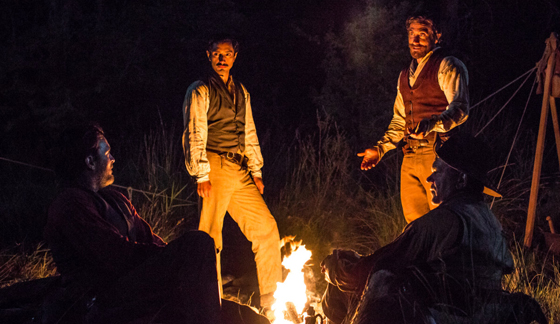
Ostensibly The Sisters Brothers is about Eli (Reilly) and Charlie (Phoenix) Sisters, a pair of assassins in the old west who are on a hit job on behalf of their wealthy client, the Commodore (a blink-and-you’ll-miss-him Rutger Hauer). The Commodore is after a gold seeker, Hermann Warm (Ahmed), whose chemical formula reveals gold just by pouring it into the water. A game changer for treasure hunters. Jake Gyllenhaal’s John Morris has been tailing Warm as he makes his way to San Francisco and leaving breadcrumbs for the Sisters to follow. Trouble is Hermann and Morris turn out to be oddly kindred spirits and Morris’s designs on Warm’s death start to wane. While Morris wrestles with his duties to the Sisters and Warm’s idealism, the Sisters cope with their own infighting. Eli is grasping at a world where they are free of needing to take on this dirty work to survive while Charlie can see no other purpose for himself than drinking and killing. The setup is relatively simple but in campfire chats and detours, mines a deep well of complex themes at play in this unforgiving environment. There’s an air of tragedy around all the leads that undercuts the masculine bravado that so often drives gunslingers in westerns.

If there are John C Reilly-philes out there–and really, why wouldn’t there be?–these next couple months will be providing them with a wealth of his screen time. Obviously there’s the big Disney sequel with Ralph Breaks the Internet, the more familiar comedy pairing with Will Ferrell in Holmes and Watson and soon after that the UK will see him in the biopic Stan & Ollie. But I will go out on a limb and say that his work here for Jacques Audiard’s contains his most interesting performance of the bunch.  As the older brother Eli, he is the more physically imposing presence of the two but continually reveals more and more layers of sensitivity as the film goes on. He has a token of a past romance in the form of a shawl he treats with reverence, he’s open to trying these newfangled tooth brushes that are going around. Most of all he carries the weight of having to take care of his damaged younger brother who would likely drink himself into oblivion without Eli nearby—not least of all because of their shared troubled childhood. It’s by far the quietest performance of the quartet but it’s extremely touching. The long and winding road that this small family unit takes is at every point unpredictable and where Audiard ultimately goes was unexpectedly affecting. A beautiful and unique entry into the genre.
 

Related Content

Film Review: “The House with a Clock in its Walls”

Starring: Jack Black, Cate Blanchett and Owen Vaccaro
Directed By: Eli Roth
Rated: PG
Running Time: 104 minutes
Universal Pictures

Did Eli Roth finally direct a decent movie? I kid. But I do wonder how much of his childhood is on screen. I begrudgingly wonder if what makes “The House with a Clock in its Walls” work has a little something to do with the crass director of “Cabin Fever” and “Green Inferno.” However, I’m more likely to praise Black’s infectious energy, Blanchett’s subdued charisma, and the writer of the hit TV show “Supernatural,” Eric Kripke. S

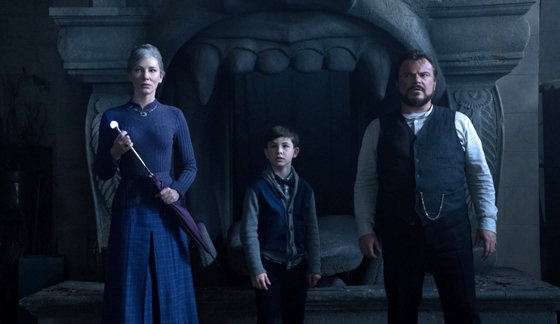
The movie does a fine job establishing Lewis (Vaccaro) and the crummy situation he’s been put in. The 10-year-old boy has uprooted his life after the death of both of his parents. He moves into his uncle’s otherworldly home in New Zebedee, Michigan. Uncle Jonathan (Black) hasn’t connected or talked to his nephew in years, if at all. The unlikely duo are often visited by Jonathan’s lifelong friend and neighbor, Florence (Blanchett). Lewis is an astute lad, and quickly picks up on the fact that Jonathan and Florence aren’t all they seem; Jonathan is a warlock and Florence is a witch (a good one).

I walked into “The House with a Clock in its Walls” having the most basic understanding of what I was in for. I read the book it’s based on in elementary school. The memory of it is so hazy, I can’t quite remember what grade it was or even the nuts and bolts of the book. I do remember our teacher used it as an excuse to bake the cookies that are frequently seen throughout the story. Even with just the faintest of knowledge of what Jonathan and Florence were all about, I still found myself caught up in the film’s gothic tapestry and wizarding hijinks.

Jonathan’s home is a character in and of itself. The stain glass windows change frequently to drop messages or hints to characters in the home, the furniture and lawn decorations act like household pets, eerie clocks and sinister dolls are spread across the home like jump-scare landmines, and there’s an ominous noise at night that sounds like a doomsday clocking chiming to an unfortunate inevitability. The humans inside the house are delightfully quirky as well.

The film builds a lot of momentum, but constantly shoots itself in the foot with juvenile humor, that I can only hope wasn’t in the book it’s based on. Urine, vomit, and poop are not off limits for this film, which is unfortunate because the film itself displays a bit of intelligence that’s sure to put a smile on the faces of adults and kids alike. It really doesn’t need to cheapen itself by undermining its own wit. The film also mishandles the tone of the final act, which involves blood magic, demons and the apocalypse.

The film stays afloat thanks to its delightfully creepy scenery, that’s constantly being chewed on by Black and Blanchett. This is the kind of film that could be cherished by younger audiences for generations, and honestly if it sends a few kids to a library in search of the book, that’s always a bonus. The calendar says September, but “The House with a Clock in its Walls” brings Halloween early for those with a spooky bone in their body.

Film Review -“Life Itself”

LIFE ITSELF
Starring:  Oscar Isaac, Olivia Wilde and Antonio Banderas
Directed by:  Dan Fogelman
Rated:  R
Running time:  1 hr 58 mins
Amazon Studios

If only all movies could begin like “Life Itself.”  A single camera shot but one that is narrated by Samuel L. Jackson in all his glory!  You can’t help but laugh during the first five minutes of this film.  Which is a good thing, because you’re probably going to be crying for the other113 minutes!

We meet Will (Isaac) and Abby (Wilde) in the middle of what seems to be an incredible relationship.  Living happily together with their dog (a dog with the greatest name ever used in film), it seems like their life together will be perfect for all time.  That is until fate steps in.

A well written but slowly paced film, the “Life Itself” poster tells us the movie is written and directed by the man who created the popular television show “This is Us.”  I haven’t watched it but my wife does religiously and, judging from the amount of Kleenex she goes through each week, I assume it’s a weep-fest.  This movie certainly is.  The film jumps around in time, showing the audience how Will and Abby met, their life together and their all too soon separation.  In between the vignettes you get to spend time with Will’s parents, played by Jean Smart and Mandy Patinkin.  It is their relationship with their granddaughter that makes up the second act of the film.  Act three is the longest – and the most drawn out.  It deals with characters who are peripheral to other two stories, though we are not at first sure how.  It takes place in Spain, where a wealthy land owner (Banderas) falls in love with the wife of one of his workers.  The various extended scenes not only begin to drag, they are delivered in Spanish, which means it’s going to be a long night reading subtitles!

As I mentioned, the film is well written.  I can see why it found itself on the 2016 list of the best unmade screenplays in Hollywood.  There are a few laughs, among them Isaac comparing the vocal stylings of Bob Dylan to the co-pilot of the Millennium Falcon. Of course it’s even funnier to laugh if you know that Isaac is also a recurring character in the “Star Wars” film series.  And the rest of the cast are equally endearing.  The ending comes across as a little too far-fetched but still pretty well thought out.  But be warned, make sure you bring your Kleenex with you, because “Life Itself” makes “Manchester by the Sea” look like the second coming of “Airplane!”

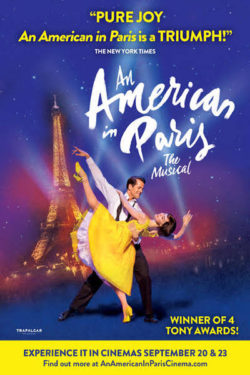
Film Review “An American in Paris – The Musical”

Starring: Robert Fairchild and Leanne Cope
Directors: Christopher Wheeldon, Ross MacGibbon
Producer: Stuart Oken
Trafalgar Releasing
Running Time: 2hr 40mins
Release date: September 20, 2018

Our Score: 4 out of 5 stars

In the mid 90’s, I was working at a old school mom and pop video store, which is where I also happened to meet my wife, I remember us having Gene Kelly binge fests before binging was a thing. We rented all of this movies including “An American in Paris”, the 1951 movie. The dancing! The music! This film was always a favorite of ours and it still stands the test of time. When the play was set to open a few years ago in Paris December 2014. I knew I had to see this production for sure. I was able to catch it on a National Tour and it was unforgettable. This live taping was filmed during the award-winning musical’s London run and features original stars Robert Fairchild and Leanne Cope. If you haven’t had a chance to see this on a stage, I would say make that a priority but this filmed version is also so beautifully done and packs the magic that was brought from the stage performance. Worth checking out!

Official Premise: This breathtakingly beautiful Tony® Award-winning Broadway musical, inspired by the Oscar® winning MGM film, tells the impassioned story of discovering love in the ‘City of Light’. Featuring the gorgeous music and lyrics of George and Ira Gershwin (including the classic hits ‘S Wonderful and I Got Rhythm), stunning designs, and show-stopping choreography. With a record-setting 28 five-star reviews from critics, An American in Paris is coming from London’s West End to a cinema near you. 

One of the items on my bucket list is to definitely catch a play in West End. This recording came from a 2017 performance there and even though I couldn’t make it, we are able to still enjoy it at your local theater. I have been noticing that the recording of stage shows have been show in theaters much more commonly like last year “Disney’s Newsies” was released also in the same fashion. This production is simply beautiful. I have seen A LOT of shows on Broadway in NY and quite a few in Orlando, FL area also. But London is on point and really delivered such an beautiful magical journey with this play.

Honestly, I am just happy that the memory of people like Gene Kelly are still being preserved in today’s time where the old timers are fading away.  The music is so wonderful and I love how the songs are perfected for the musical format. The stars, Robert Fairchild and Leanne Cope, have great chemistry together and what talent actors they are! If you don’t catch a chance to see this musical, I have feeling it is not going away anytime soon. Hopefully, a Blu-ray release will follow these screenings and I have a feeling we are going to have several more tours and revivals over the years for this musical. Experience the Broadway hit An American In Paris in cinemas September 20 & 23. Click here.

Copyright: MediaMikes.com © 2018 · Powered by: nGeneYes, Inc. · Login

All logos and images used on this website are registered trademarks of their respective companies. All Rights Reserved. Some of the content presented on our sites has been provided by contributors, other unofficial websites or online news sources, and is the sole responsibility of the source from which it was obtained. MediaMikes.com is not liable for inaccuracies, errors, or omissions found herein. For removal of copyrighted images, trademarks, or other issues, Contact Us.