
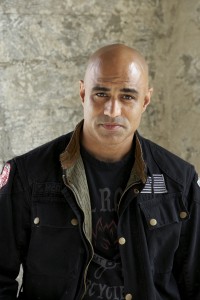
Faran Tahir talks about roles in “Elysium” and “Escape Plan”

When both you’re mother and father are well known in the theater it’s almost guaranteed that you will follow in their footsteps. Faran Tahir was born in Los Angeles while both of his parents studied acting and directing at UCLA. After completing their studies the family returned to their native Pakistan where they both established prominent careers. His father, Naeem, currently serves as the Director General of the Pakistan National Council of the Arts. Returning the America at age 17, Tahir attended the University of California at Berkley, where he graduated with a BA in Theater. He later earned his Graduate Degree at Harvard.

He made his feature film debut in Disney’s live action telling of “The Jungle Book” and is best known for his roles in “Iron Man” and J.J. Abrams re-boot of “Star Trek.” He also has a recurring role on TNT’s new incarnation of the popular television drama “Dallas.” Later this year he will be seen opposite Sylvester Stallone and Arnold Schwarzenegger film “Escape Plan.” This week he stars as the President alongside Matt Damon and Jodie Foster in Neill Blomkamp’s “Elysium.” I recently spoke with Mr. Tahir, touching on his new films, his love of science-fiction and working with his parents.

Mike Smith: You’ve done a lot of sci-fi/fantasy genre’ projects: “Lost,” “Star Trek,” “Warehouse 13” and now “Elysium.” Is that something you enjoy? Do you intentionally seek out those projects?
Faran Tahir: I do enjoy it. It’s a lot of fun. I think it’s thought provoking. I think it tickles the imagination. And I like the fact that those kind of stories have very high stakes. Part of it is because I come from a theater background. If you’ve done any theater…any Shakespeare or Greek tragedy…the stakes are as high. I like the theatricality of science fiction. Do I seek it out? Yes, I do seek it out but not at the expense of other genre’s or other kinds of stories. I try not to get too complacent. If I do too many bad guys I try to play a good guy. If I do too much science fiction I try to do something else. I try to keep as much of a balance as I possibly can. I have “Elysium,” which is science fiction. I have “Escape Plan,” which is an action movie. I have two independent features coming out. One is an emotional drama about two families losing their children in a mall explosion (“Torn”). I play the father of one of the families. The other is a supernatural thriller (“Sara’s Cell”). So yes, I do like science fiction but I also need to make sure that I don’t get pigeon holed in just that genre.

MS: Can you talk a little bit about your role in “Elysium?”
FT: Sure! Elysium is a space station. A Utopian space station where all good things happen. Cancer is cured. The temperature never goes above 75. All of that good stuff. All of the grunt work to support Elysium happens on Earth. So the people on Earth desire to get up to Elysium while the people on Elysium don’t want the people from Earth coming over. I play the newly elected President of Elysium. My character is a politician. He’s nuanced. He’s very careful about how he deals with issues. He doesn’t want to hurt his base supporters both on Elysium and on Earth. The counter to him is the secretary of defense, played by Jodie Foster. She has a totally different idea on how to deal with these issues. There’s a nice, dynamic tension between these two characters of how they’re going to deal with the issue of the Earth people trying to come in and what are the resolutions to the situation.

MS: Where you a fan of Neill Blomkamp’s previous film, “District 9?”
FT: I’m actually a fan of Neill! You can sense that he’s a very bright guy. What I love about his work, and it’s true for both “District 9” and “Elysium,” is that he takes a hot-button issue and then he just slightly bases it in the fictional zone. But not so far in the fictional zone where you lose connection to it. “District 9” was a statement on apartheid. “Elysium” deals with other hot-button issues, like elitism and immigration. You can swap the words “Elysium” and “Earth” for “Developed Country” and “Under-developed Country.” You can say “the US” and “Mexico” and have the same dynamics. He works with some really great premises and presents them in a really fun way. I feel blessed that I got to work with him because he is really and truly a genius. He doesn’t push…you know exactly what he wants…but he never pushes his vision. He lets the actors get there organically. He trusts that you will get there with his guidance.

MS: A real change of pace role is Frank Ashkani on “Dallas.” Any chance of you coming back next season?
FT: (laughs) Here’s what I have to say about that. The story goes that anything is possible in science-fiction and on soap operas. So we’ll see what happens. (laughs) I could come back as the twin brother of the character…we’ll see. I really don’t know yet.

MS: Both of your parents are well regarded actors and directors in the theater. Have you ever performed with them?
FT: I have, actually. Back home the first television show I did was with my mom, which was kind of interesting. I’ve been directed by my father. And what I loved about it was that, although they were my parents, they were also consummate professionals. They would completely turn that side off and deal with me just as an actor when you were in a scene with them or being directed by them. All of the domestic issues could just wait. And it was a great thing to learn how to leave all of that behind when you’re working on something.

MS: You mentioned “Escape Plan.” Can you give us a quick preview?
FT: “Escape Plan” comes out in October. It’s a prison escape picture. The three of us…Stallone, Schwarzenegger and I…break out of a prison together. It was a lot of fun.

MS: Anything after that and the two independent projects?
FT: No. Right now I’m concentrating on those projects. After that we’ll see.


Michael Welch talks about new film “The Demented”

Michael Welch is probably best known for his role as Mike Newton in the super successful “Twilight” saga. Michael has also appeared in a number of other films and television series such as “Bones”, “Criminal Minds” and “CSI: NY”. Michael’s latest film “the Demented” was recently released on Blu-ray and Media Mikes had the chance to talk with him about his role in the film and what he likes most about working in the horror genre.

Adam Lawton: Can you tell us about your new film “The Demented”?
Michael Welch: The film has a pretty basic concept. A group of college friends take off on break to hang out at this really nice house. As the story progresses things start to happen and the house begins to be attacked by zombies.

AL: Can you tell us about your role in the film?
MW: My character is the exact character that I would want to play in a film like this. I play the rich kid whose house everyone goes to before the zombies start attacking. My character is just looking to have a good time. He is very charismatic in his own way but doesn’t appear to be a particularly good guy. He’s basically looking at getting laid and getting paid. (Laughs)

AL: What was it that interested you in the film?
MW: I had never played a character like this before and I also like new and different challenges. I think characters like this are a lot of fun to do as they are shameless. You get to explore the darker side of a personality. I found it to be a fun and different challenge that I was happy to be a part of.

AL: Were you allowed any creative freedoms with the role?
MW: I pretty much did what I wanted to do. That’s really how I approached this role. From the very first audition I knew how I wanted to play this role. I figured a character like this was going to have a lot of confidence that verged on cockiness. I went in to those auditions with my version of the character and lucky for me they liked it. As far as the dialogue went I think there were a few spots of improve that happened.

AL: What do you think was the most difficult part of the shoot?
MW: We shot the film in the middle of summer in the swamps of Louisiana. It was super muggy and the heat was just debilitating. To keep your energy and spirits up in that type of climate was very difficult.

AL: Having done a few other horror themed films. Are you a fan of the genre?
MW: I am a huge fan of film in general. I like good story telling. I love horror films! I don’t know why I like being scared but I just do. (Laughs) I also enjoy Sci-Fi which has gotten really good in recent years. Story telling is exploring about what is interesting about life. To be able to go to the extreme and see what’s really possible is something I like doing.

AL: Having appeared in both television and film features is there one direction that you see yourself leaning more towards recently?
MW: In the past things were pretty clear on how everything played out. You would start in television and hopefully if you were lucky you would make it to films. That’s not the case anymore. I think for the most part the best onscreen story telling that’s happening now is being done through television. There are a number of incredible shows out there right now. Ultimately it doesn’t matter to me. Be it film or television as I just want to contribute in my own unique way to the stories that people have to tell and to be able to make a living doing so.

AL: Can you tell us about some of your other upcoming projects?
MW: Earlier this year I appeared in a film titled “Hansel and Gretel get Baked” which has done very well for the most part via digital distribution and Redbox. The film has turned into somewhat of an underground hit so I am really happy about that. I also have two films coming out later this year. The first one is titled “Grace Unplugged” and the other is titled “All the Boys Love Mandy Lane” which is a slasher film I did about 6 or 7 years ago. I am very happy that the film is finally going to see the light of day. Things are going really well and I am trying to work as much as I can.


Related Content

Kevin Sean Michaels talks about indie film “Supernaturalz: Weird, Creepy & Random”

Imagine an indie horror movie with a big Bollywood ending.  I thought I’d seen it all until I watched, Supernaturalz: Weird, Creepy & Random on Amazon Streaming, a web hit. The movie goes where few movies have gone before. It is no surprise, then, that it comes from the mind of a former Troma Studios alumni, director Kevin Sean Michaels, who worked with Troma President Lloyd Kaufman on Poultrygeist: Night of the Chicken Dead.  He also directed two documentaries, Vampira: The Movie and The Wild World of Ted V. Mikels, which in fact was narrated by none other than John Waters himself. I caught up with the director to ask him why he made Supernaturalz: Weird, Creepy & Random.

Mike Gencarelli: What inspired Supernaturalz: Weird, Creepy & Random? Seems pretty bizarre!
Kevin Sean Michaels: It is! I grew up watching a lot of sitcoms, where for no reason there would be a serious episode.  Then back to comedy. The worst was Family Ties, where Alex Keaton (Michael J. Fox) actually lost his virginity at 17 and has to talk to his Dad about it.  Anyway, I thought it would be entertaining to mix horror and comedy like that.  But we decided not to put a laugh track.  As a result, no one is cued to laugh, they just do.

MG: What has been the reception?
KSM: Very intense because the movie plays like a practical joke, similar to the movie, “The Room” by Tommy Wiseau.  It’s like—how can this be a real movie? Are they serious? But the movie is like one of Ed Wood’s—it reads like a stage play gone wrong, but in this case the train-wreck is part of its charm. And totally planned out.  People seem to really connect with it on its level. And on its terms.

MG: I know you directed “Vampira: The Movie”.  Are you a fan of Ed Wood?
KSM: Of course! When I did Vampira: The Movie I was able to talk to some of the original actors like Conrad Brooks. He said Ed really put heart and soul into his films and that they were supposed to be funny.  Like the imperfections was the perfection. That’s why I look up to Ed Wood, too.  I read recently that Bobcat Goldthwait got a tattoo from Kat Von D, stating just that—Ed Wood was inspiration to filmmaking independence.

MG: What was the inspiration for the characters in Supernaturalz: Weird, Creepy & Random?
KSM: The Garter Snakes gang was funny.  I love the idea of a gang of girls, like in the biker movies.  Basically, for them to act like old Bowery Boys, Three Stooges with a dash of Happy Days.  There is love in the group, even if they all insult each other.  If Fonzie tells Potsie to “sit on it” he doesn’t mean “fuck you. “  And when the characters start dying in Supernaturalz: Weird, Creepy & Random, it comes down to how the gang reacts.  But it is goofy cartoon fun in the end.

MG: Some pretty harsh things happen to the gang…
KSM: (laughs) That’s the point.  It’s got an unreality to it.  It’s like the Nightmare on Elm Street movies.  Freddy can laugh at all of it and the audience is with him somehow.  Our villain is also our main character.  She goes through changes, but it’s the force of evil that is the real villain.  I’ve seen a few audience members jump out of their seats at some parts of the movie.

MG: Any advice for filmmakers doing their own special effects on a budget?
KSM: Yes, never put soap in your mixture for fake blood.  People slip on it.  That’s why I have never done it.

MG: What about the nudity in Supernaturalz: Weird, Creepy & Random? Especially the snake scene…
KSM: Yes, the snake scene is a stand-out.  I was always amazed by reading about the stir caused by the snake scene in The Devil in Miss Jones.  They cut the scene out so many times that it’s now legend.  Our scene is a homage to that.  The other thing is to play with nudity where it’s sexy but yet scary or weird at the same time.

MG: And the Paris Hilton scene?
KSM: Well, it’s not really Paris Hilton (laughs).  I like the idea that someone would be cruel enough to steal someone’s clothes as well as their car just to humiliate them, but also to follow their sexual fantasy.  In this case, Patti’s fantasy.  To strip the rich is sexy.  Our gang member Patti is a shoplifter and can’t seem to stop herself from going too far.  So our Paris Hilton-character is stranded like in Castaway, talking to her fuzzy handbag instead of a little dog.  People seem to really like the scene.

MG: Why the strong emphasis on Indian mythology and Bollywood dancers?
KSM: Something I haven’t seen in a movie like this and people don’t expect it. It really challenged us, too.  It’s very panoramic on the screen.  Indian mythology is very interesting and there is so much to it.   Even our character, The Mighty Sardar, isn’t mighty enough to handle it all.  He has to rely on his assistant.  The phallic symbols are a part of Hindu temples, so we have that as well. When you see the movie, we really made it twisted, so I hope there is no bad mojo because of it (laughs).

MG: Is horror and comedy a trend?
KSM: It’s always been there.  Comedy is always part of horror.  You can’t have dark without light.  I’d rather be in the light.

Like the movie on Facebook: https://www.facebook.com/supernaturalzthemovie

Website: http://www.supernaturalzthemovie.com/

Check it out on Amazon Streaming or DVD: http://tinyurl.com/mtwsagv


Related Content

David Mickey Evans reflects on the 20th Anniversary of “The Sandlot”

Even if I had never seen 1993’s “The Sandlot” I could have quoted it line by line for you. I coached youth baseball for 15 years and it was, by far, the most quoted baseball film on the field. “You’re killing me, Smalls!” “You’re an L7 weenie.” And, of course, “you play ball like a girl!” Nothing like enjoying the good sportsmanship of 13 and 14 year olds. But if you’re going to be a ballplayer you need to talk like a ballplayer. And at one time, writer/director David Mickey Evans was a ballplayer.

Now touring the country in conjunction with the 20th Anniversary of “The Sandlot,” Mr. Evans has behind him an impressive resume of filmmaking. I first discovered his work when I took in 1992’s “Radio Flyer.” Inspired by his own turbulent childhood, the film was a moving look at the bond between two brothers dealing with a brutal step-father. (NOTE: I met Adam Baldwin, who played the step-father in the film, this past summer and I told him the same thing I told Mary Tyler Moore when I met her after seeing “Ordinary People” – – -“I HATED you in this film.” He thanked me.) The next year saw the release of his most popular film, “The Sandlot.” Since then he has written and/or directed popular sequels to both “The Sandlot” as well as in the “Beethoven” series. During our pre-interview conversation I discover we both not only played baseball as kids but were huge fans of the popular sports books of the 1960s and 70s written by Matt Christopher. We also talked about the game of baseball and our love for it. That’s where the interview begins.

Mike Smith: I know you’re a big baseball fan. Did you play when you were younger?
David Mickey Evans: Oh yeah. We occasionally played organized Little League but you had to pay money and we were really poor. So most of the time we’d play in park leagues. You’d have the dude that owned the local bar getting you T-shirts…kind of like “The Bad News Bears.” I was really good. I played in quite a few local leagues near Pacoima (California) in the San Fernando Valley. I was on the Cardinals…the Giants…I was on the Indians, which was a big team, when I was about eleven. If memory serves…I wonder if you can find this on the Internet…I think I hit .560.

MS: Was “The Sandlot” inspired by any of your childhood baseball memories?
DME: Here’s the thing. The “A-Ha” moment for me was an incident I remembered from when I was a kid. The kids on the block didn’t like my friends and I. They would beat the crap out of us all the time. There were playing baseball one day and they hit their ball over the fence. They told my little brother to go get it. They said if he did then we could play with them. Of course, they had no intention of that. They just wanted their ball back. And there was a big dog on the other side of the fence named Hercules that went after my brother and bit him…ripped his leg to shreds. It was a bad memory. But one day I was in my car and I thought, “wait a minute…what if these guys were all buddies? What if that ball was worth $3 million?” I’ve got a movie. None of the kids in the film are any kid I knew. All of the kids are an amalgam of EVERY kid I knew. But what I like to say most about the film is this. When Walt Disney finished Disneyland in a year and a day and he’s walking down Main Street U.S.A…and still, today, of all the parks Disneyland is still the best…and he has some dignitaries with him. Now Main Street U.S.A. is modeled after the way Walt Disney remembered growing up in Marceline, Missouri. It wasn’t actually his boyhood home but it was the one he identified with. The dignitaries say to him “Walt, you did it. This is exactly the way it was back then.” Disney tells them that it’s not. It’s the way it should have been. “The Sandlot” is the way I wanted my childhood to have been. That’s not how it was. Luckily God has given writers a time machine…a pencil on paper. (My work phone rings) Is that a flip phone?
MS: Yeah, it’s my work phone.
DME: Where did you get that? (laughs) I didn’t know they still exist!

MS: One of the questions my son asked me to ask you was if any of the boys you played with went on to play professional baseball. Was there a real life Benny “the Jet” Rodriguez?
DME: You know there’s always that kid. I remember one or two kids from grade school…when you get to about third or fourth grade you start recognizing them…they’re just BETTER athletes. Or students. You just start noticing them and you want to be like them. You wish you could kick that kickball as far as they can. And that kind of kid is specifically on whom I built Benny “the Jet.” And here’s something else. The “Jet” nickname didn’t just come because he was fast. When I was a kid I took karate lessons for a little while and I studied with the Urquidez brothers. The most famous of them is Benny. They called him “the Jet” because his hands and feet were so fast. I saw him a few years ago. He’s got to be 60 and he could still clear a bar! He’s an incredibly fit and ridiculously athletic man. (NOTE: Now age 61, Benny “the Jet” Urquidez amassed an incredible professional fighting record of 49-1. He trained Patrick Swayze for his role in “Roadhouse” and can be seen in the film in the scene where the monster truck gets driven through the auto dealership). I always admired him when I was a kid. He was like a super hero to me. That’s why Benny got “the Jet” in the middle of his name.

MS: Are you surprised at the response “The Sandlot” still gets 20 years later? How many memories it triggers in a person. I mean, 20 years before it came out I was the kid riding with my friends over to the next town to play baseball all day. In the neighborhood we’d play all day until our moms called us in for dinner. In 1993 it was my son doing the same thing. And I’m sure 20 years from now my grandson will be doing it.
DME: I don’t know if I’m surprised. Obviously you can’t predict that kind of reaction. You just have to go for it as a filmmaker and if it stands the test of time….what else is there? It still stands the test of time and I’m incredibly grateful for that. That means I did my job. And I’m satisfied that I did my job right. This is also the only one of my films where the studio left me alone…they let me do it the way I wanted to do it. It wasn’t committee filmmaking, it was me. My crew. My cast. But you can never predict that. I wish I could. I would bottle it, I would sell it and you would never see me again (laughs). I had a guy come up to me in Springdale, Arkansas and he had (12) copies of “The Sandlot” on DVD and he asked me to sign them. While I was signing them he’d say, “this one is for me, this one is for my wife, this one is for my kids, this is for my grandkids and this is for my great-grandkids.” Four generations right there. I gave that guy the biggest hug. That was better to me than winning an Oscar. I was in Utah earlier this year at the location where we shot the film. The Utah Film Commission had re-built the backstop, cleaned up the field and made it look exactly like it did on the original field. They could only seat 1300 people for the event and they sold out in 11 minutes! They dedicated a historical marker to me and the film. I’m serious, they can keep the Oscar!

Norton Herrick talks about producing his latest film “2 Guns”

Since forming The Herrick Company, Norton Herrick has created a real estate and building empire currently valued at over $4 billion. This has allowed him to invest in his passions. As a part of Team Valor his horse, Animal Kingdom, won the 2011 Kentucky Derby as well as the Dubai Cup this past March. As a producer on Broadway he helped bring “Spider-man: Turn Off the Dark” to the stage and, along with co-producers Barry and Fran Weissler, took home the Tony Award for Best Revival of a Musical this past June for “Pippin.” He currently has produced three films awaiting release. “Very Good Girls,” starring Elizabeth Olsen and Dakota Fanning, played at this year’s Sundance Film Festival. In late December he will present “Lone Survivor,” starring Mark Wahlberg and Eric Bana. And this week sees the release of the highly anticipated “2 Guns,” which stars Wahlberg and Denzel Washington. Earlier this month I spoke to Mr. Herrick about his many projects.

Mike Smith: So, how is your year going?
Norton Herrick: (laughing) It’s going great. All is good. In all aspects. I’m involved in several industries and I’ve been pretty lucky so far.

MS: In the past two years you’ve had a horse win the Kentucky Derby and the Dubai Cup, won a Tony Award for “Pippin” and you have one of the most anticipated films of the summer coming up with “2 Guns.” When do you rest?
NH: (laughing) I don’t. I don’t know how. I’ve been going 24/7 my entire life. If I’m not doing something I’m bored.

MS: Both “2 Guns” and next year’s “Lone Survivor” are action films while “Very Good Girls” is an intimate drama. Do you have a preferred genre’ when you’re looking for a project to produce?
NH: Not really. Of course action films are fun. But I also have a horror film called “Nightlight” in post-production. Action. Coming of Age. Horror. A little bit of everything. And I’m excited because Universal is moving “Lone Survivor” up to December to qualify for the Oscars.

MS: You’ve also had great success reviving popular Broadway musicals like “Promises, Promises,” “Hair” and “Pippin,” which won the Tony this year. As a producer is it easier to go with a known property or to take a chance on something new?
NH: I like doing both. “Pippin” hadn’t been on stage since the 1970s so it was almost like bringing something new to the stage….to a generation that hadn’t had the chance to see it. The show always had a great score and a nice story line back when Ben Vereen performed it. But now it’s the 2000’s and we’ve added a new dimension to it. It’s amazing what we did to it. So yes, it is exciting to take something old and making it new. But it’s also exciting to try something new and daring like “Spider-man.”

MS: Do you have your next Broadway project lined up?
NH: Yes. Fran, Barry and I are going to produce a musical version of “Waitress.” It’s a great story and I hope we can add something to it.

MS: And, finally, do you have any future film productions coming up?
NH: Nothing I can really talk about right now. There are always a half-dozen scripts we analyze and do research on but right now there’s nothing we’re ready to pull the trigger on.

Wes Bentley talks about his new film “The Time Being”

Wes Bentley has been a star since, at the age of 21, he played the anguished Ricky Fitts, next door neighbor to Kevin Spacey and family in the Oscar-winning “American Beauty.” His performance earned him a BAFTA nomination for Best Supporting Actor as well as several critic group awards. He followed up with roles in films like “The Four Feathers,” The White River Kid” and “Ghost Rider.” Most recently he’s been in such big budget films like “Jonah Hex” and “The Hunger Games” as well as indie projects like “Weirdsville.” He can currently be seen starring alongside Frank Langella in “The Time Being,” and will soon be seen as Larry Marciano, Linda Lovelace’s second husband, in the bio-pic “Lovelace” as well as Christopher Nolan’s “Interstellar” which he was just announced to have joined for release next year.

Mike Smith: Can you give us a brief introduction to Daniel, your character in “The Time Being?”
Wes Bentley: Daniel is a painter…an artist. He’s pretty ambitious. He has a family, a wife and son. He’s had a moderate bit of success in the past. He’s looking to put on a show and display his paintings to help support the family. Unfortunately he feels the pressure and it doesn’t go so well, which leads to a great deal of frustration.

MS: What attracted you to the project?
WB: Quite a few things. I saw a lot of things in there that I could relate to. We all strive to be able to provide for our families. We try to have integrity in our hearts but that’s not always possible. It can create a dilemma in your heart. I was also attracted to the visual concept of the film…where almost every frame is filled with a piece of art. And when I heard Frank Langella was going to be in it…it all came together.

MS: In the film Daniel is an artist. Besides acting, did you have any kind of artistic background?
WB: (laughs) I’m absolutely the worse drawer, but I did enjoy the painting aspect of the film. I think that may be something I try to do later in life. But that was another thing that interested me in the film…it was a new experience.

MS: You have that rare film career where you’re successful in both big budget films and independent projects. Do you have a preference?
WB: I like elements of both. I like the guerilla warfare aspect of shooting a film that has a budget of under a million dollars. You don’t have a trailer, you have a chair to sit on outside with all of the filmmakers. On those films you learn a lot about filmmaking and the camera. On the bigger budget films you really get to concentrate on what YOU’RE doing. You can take more time to devote to your character. You don’t have to rush through a few scenes in a day, which is often the case on smaller budget films. And sometimes it doesn’t work out because you’d like to have that extra time to work out your character. But I don’t really have a preference…I’m happy with each.

MS: Besides “Lovelace” what do you have coming up?
WB: I have a film called “Pioneer,” which is a Norwegian film. It’s a very stylish film about how Norway discovered oil in the late 60s and early 70s. I also have a film called “Chavez,” which is about Cesar Chavez, the immigration activist. I play his lawyer. I also have a couple more films that are still in post production so I’m not sure when they’ll be released.

Baillie Walsh talks about directing documentary “Springsteen and I”

Maybe director Baillie Walsh could get a job as a diplomat. After all, his resume’ includes the Oasis documentary “Lord Don’t Slow Me Down,” where he managed to keep the often feuding Gallagher brothers fairly civil. He was also good enough to employ Daniel Craig in between Bond gigs, featuring him in “Flashbacks of a Fool,” his first fictional feature that he both wrote and directed. He has directed videos for such bands as Massive Attack and INXS. This week see’s the premiere of his new documentary, “Springsteen and I,” a look at the love affair between the Boss and his fans. How diplomatic is he? I was so engrossed in the last minute plans of my wife’s surprise 50th Birthday Party that when he called me for this interview (one I had set up a week before) I was totally unprepared. Undaunted, he agreed to call me a few days later, when he was on “his” time. Diplomatic and incredibly nice.

Mike Smith: What inspired you to do this project?
Baillie Walsh: I wish I could say it was my idea but actually I was asked by RSA Films (Ridley Scott’s Production Company) to do it. I was very excited about the concept of it and I thought it was a perfect idea for Bruce Springsteen and his fans. Actually I couldn’t resist it.

MS: When you approached Bruce was he keen to the idea as well?
BW: Absolutely. I mean we obviously needed Bruce’s approval to get the film made because I knew we would need archive footage and Bruce’s music to make the film possible. So I went to Bruce and Jon Landau (Springsteen’s longtime producer) and had a meeting with them. And it was very quick. They immediately realized that the idea was perfect for Bruce and they gave us permission to do it. And they gave us access to the archives and access to his music. They gave us the complete freedom to make the film we wanted to make. There was no editorial control. So it was an incredible experience for me. I feel very lucky to have been able to do it.

MS: A lot of your earlier work was in music videos, including INXS and the Oasis documentary “Lord Don’t Slow Me Down.” Do you think that experience made you the right person for this project in Springsteen’s mind?
BW: Yes. I’m sure the facts that I had both a music background and a documentary background were part of the reason I was asked to do it.

MS: You gave Daniel Craig his best role between Bond gigs when he starred in your first fictional feature, “Flashbacks of a Fool.” Do you plan to continue on the documentary side or do you want to concentrate more on fictional features?
BW: I love being able to really mix it up. Obviously I have to say that making a feature film that you’ve written is one of the great, extraordinary experiences in life. To be given the opportunity…and the finances…to be able to do that. I would love to be able to do that again. But I also really, really enjoy making documentaries. I really do. And this one was done in such a modern and interesting way…I really loved the approach and the idea. What excited me about it most was that I had never seen this film before…I didn’t know what the film could be. And to go into a project with fear, because you have no idea how it’s going to be, that is the most exciting way to work.

MS: What are you planning now?
BW: You know what I’m going to do now? I’m going to go on holiday! I’m going fishing, Michael.
MS: Don’t go to far.

BJ McDonnell talks about directing “Hatchet III”

BJ McDonnell made his directorial debut on the kick-ass horror film “Hatchet III”. He is no stranger to films though having worked as camera operator on over 100 films including “Star Trek Into Darkness”, “Abraham Lincoln: Vampire Hunter”, “Battle Los Angeles” and Rob Zombie’s “Halloween”. Media Mikes had a chance to chat with BJ about stepping into the director’s chair and taking over this fun horror franchise.

Mike Gencarelli: Tell us what made you make the switch from working as stedicam/camera operator to directing?
BJ McDonnell: Adam (Green) knew that I wanted to start directing movies. When I got to CA, I went to film school and started working as a camera operator. I love working as a camera operator but my goal was get start directing. When the chance came up for “Hatchet III” and Adam wasn’t going to do it, he was quick to ask me since I worked on the first two as camera operator. I thought it would be a perfect stepping stone.

MG: What was your biggest challenge stepping into this role?
BJ: Being on the set is very comfortable for me now. I am used to working with actors and the crew since I am in that environment all the time. My issue was separating myself to focus on setting up the shots and making sure that I was getting the right performance from the actors. The post-production stuff was very tough. Our editor, Ed Marx, was awesome though. He is great. But the whole thing was a long process.

MG: What do you think makes the “Hatchet” franchise so unique?
BJ: These films are made just to be fun. These are meant to scary people or make them feel queasy with the gore and violence or just have fun. It is a real testament to the horror films of the 80’s. It is a fun sit back and watch a monster tear people up into shreds. They are also just fun movies to make. It is like a rollercoaster ride…

MG: I agree! From the moment that shotgun goes off…BANG!
BJ: That is one of the things I wanted to do. I wanted to make sure that this film flowed fast and that no one got bored throughout certain parts. I wanted to make it a good fast paced ride that would keep your interest that whole time. I think we accomplished that.

MG: Do you feel you had a grip of the franchise having worked on “Hatchet I & II”?
BJ: You look and see what happened with the other ones. There is advantages and disadvantages. You get to see what people’s comments are from the first two films and improve on that. A lot of the comments, I actually agree with. One was that “Hatchet II” didn’t get going till about 45 minutes in and I agree. So I wanted to make sure that didn’t happen with this one. There is the disadvantage with people that don’t like the “Hatchet” films to begin with. You got to take the good with the bad and say “Hey I made a fun movie, I hope you enjoy it”.

MG: The gore is super graphic and even goes beyond the second film; tell us about amping that up this time?
BJ: We all came up with the kills together – myself, Adam and Robert Pendergraft. We each had our own ideas what we wanted to do and we collaborated the whole time while the script was being done. I wanted to make it as gory as I could, which is tough to do when you do not have that big of a budget. That is also why some of the kills are so fast since they didn’t work as well as they should have and there are quick cuts. All in all it works out in the end and I think it still came out cool.

MG: What was it like working with all the great genre talent?
BJ: We had Kane and Danielle already on board. I worked with Kane going back to “The Devil Rejects” years ago. He is a great bud of mine. I worked with Danielle going back to Rob Zombie’s “Halloween”, so I knew her from that. It is good because everyone was family like. Derek Mears, I knew him “MacGruber”. He is just a great guy and true friend. Never worked with Zach Galligan before but he was a choice of mine to cast because I love “Gremlins”. He brought a lot to the table and had tons of great ideas. I hope to work with him again. I can go on and on, I just love this cast! It was like working with friends.

MG: I loved the Mears/Hodder face off.
BJ: That was planned on purpose, obviously. I think it was actually supposed to happen in the second film but Mears was working on “Predators”, I believe. We always wanted to do it and put Jason vs. Jason up against each other since it has never been done. Those guys are friends and they loved doing it, so it was just the right time.

MG: What do you love most about the horror films?
BJ: The thing about horror that I like is that you don’t have to play by all the rules. In horror you can do whatever you want. Like with Victor Crowley, he is a ghost so you can do whatever you want. So since he is a repeater, he will come back again and again. Plus with horror you have a fan base that is like no other. You do not find that with other genres. There isn’t a romantic comedy fan base. Horror fans are really great.

MG: Now that you got your feet wet directing, what is next?
BJ: There are two scripts being written right now that I will be working on. One is a 90’s action film, written by Jason Trost, who is a good buddy of mine and also in “Hatchet III”. The other is spy movie with a psychological twist. I am trying to go with something that is more action based for a second film and then probably going back to horror.

Neil Hopkins talks about his role in “Detour”

Neil Hopkins is known best for his role of Liam in ABC’s “Lost”, Neil takes on a basically one man show in the film “Detour”. The film features his character getting caught and captured in a mud slide and his struggle for survival. Media Mikes had a chance to chat with Neil about the film and his role.

Mike Gencarelli: Tell us how you got involved with the film “Detour”?
Neil Hopkins: I knew William Dickerson, the writer and director. We went to the same school, Holy Cross but at different times. He looked me up when he got to Los Angeles and said he wanted to work together. We worked together on this thesis project in his third year at AFI, a short film called “Shadowbox”. That turned out very well and I knew that he had been working on this film “Detour” for a long time. Him and his writing partner Dwight Moody wrote this going back to 2008. So it predated all of the other similar films like “Buried”, “127 Hours” and “Wrecked”. It just took a long time to get it made and then even longer to get it released. He wanted to have control over the film and decided to do it with a micro-budget. So he called me up and said he wanted to play this part and that was back in January of 2010. We had about six months before shooting and we got a chance to work together on the script. It was a very collaborative process. I think we came up with a really cool product. Even though it was a very grueling and difficult process it was still a lot of fun.

MG: Where you ever concerned having to carry this film mostly on your own?
NH:  Absolutely! I think any actor would be. But it was also very exciting to have the opportunity to do something like this. It was one of those opportunities that you just couldn’t say no to. I just threw myself into it and tried my damnedest and fortunately I think it turned out pretty well. It was nerve wrecking for me since if people didn’t like my performance then the film wouldn’t work at all. So that was very apparent to me but it has been very well received and has been a very exciting journey. It is also very cool to have a role like this under my belt.

MG:  Your character becomes like MacGyver after he is trapped. Did you do any special research in preparing for the role?
NH: Will and Dwight has worked on the script for so long that they has already done so much of the research needed. It was a very detailed script in terms of action and the building of the gadgets. But there was also a lot of things in the script that we were able to work with in the moment. So certain things changed based on that aspect during shooting. In terms of how I prepared for the role, I just put myself in the situation of how I would react if I was thrust into the same situation. I asked myself “How would you keep from going nuts?” So the details in the script assist that as well in order to find the arc very well.

MG:  Tell us how it was the car scenes shot to accomplish that trapped feeling?
NH: It was actually quite simple. The film was shot in chronological sequence. We had to shoot it that way since we only had one car and we had to get it right on the first try. We couldn’t fill the car up with mud and then figure out that something was wrong and had to reshoot. It was a type of high-wire act since we knew we couldn’t go back once we started. The car itself was this jerry-rigged Jeep Cherokee. There is this garage that rigs cars specifically for movies and the car had the option to slide the doors off, the dashboard, the roof…whatever we needed. What they did for the mud, which I think worked very well, was that they used mud rugs. It is basically like a carpet sample and they put them against each window. On each rug there was a combination of latex painted to look like mud and then real mud on top of that. So 360 degrees around the car was covered in mud. So it really created this effect of being completely submerged. I thought that was really cool and I like simple solutions like that.

MG:  What you got coming up next?
NH: Will and Dwight are working on their next script. So we are looking to start shooting that in the Fall. I am very excited about that. It is very different film from “Detour”. It is going to be really cool but I can’t talk too much about it now.


Related Content

Ice-T talks about producing “Iceberg Slim: Portrait of a Pimp” and new album with Body Count

Tracey Marrow better known to the world as Ice-T first broke on to the scene in the mid 1980’s as part of a new form of rap labeled “gangster rap” which was just starting to emerge from the west coast of the United States. After releasing several successful/controversial albums Ice would evolve into a modern day renaissance man appearing in several movies and television shows such as “New Jack City” and “Law and Order: Special Victims Unit”. Ice-T has always noted pimp/author Iceberg Slim as an influence and is a producer on a new documentary about Slim titled “Iceberg Slim: Portrait of a Pimp”. Media Mikes had the chance to speak with Ice recently about the film as well as about his heavy metal group Body Count’s new album.

Adam Lawton: Other than noting Iceberg Slim as an influence what was it that interested you in producing a film about him?
Ice-T: The film was really Jorge my manager’s idea. He and I have been working with each other for going on 30 years now. He and I wanted to get into the film business and make some films so we decided to start with documentaries. We wanted to do critically acclaimed type work and get our profit out to the film community. I started with “The Art of Rap” and Jorge chose to do one on Iceberg Slim. When he and I first got together Jorge was coming from an entirely different community than mine. He was pretty much a square so I told him that if he was going to manage me then he was going to need to read all of the Iceberg Slim books. I gave him all the books and told him that I would quiz him on them. He pretty much got turned out of course but it’s always been a big part of his life. When he came to me with the idea I thought it was perfect. I executive produced this film but Jorge pretty much did all the ground work.

AL: How much input or direction did you give throughout the filming process?
Ice-T: I would see pieces and cuts throughout the filming/editing portions of the project and give my input. I also was involved in some of the soundtrack side of things as well as some of the editing. Jorge was pretty much bringing me things in pieces and when I finally got to see it all put together I was just blown away. He did a great job.

AL: Was this sort of your first venture into producing?
Ice-T: I have been involve don some things prior to this but what being an executive producer really means is you put up the money. In this case Jorge put up all of his own money. I do this type of thing with records all the time. A lot of times people want to get projects done however they don’t know how to complete them. Having been in the game now for over 25 years I am someone that knows how to get things done. Jorge is very efficient so I didn’t have to do a lot on this project. Jorge knows what he is doing and if it got by me people were going to love because I am such a huge Iceberg Slim fan.

AL: You appear very briefly in the film. Was this something that happened due to editing or was it a conscious decision on yours and Jorges part?
Ice-T: I am just a normal person and the film is not designed to be about me. Due to the fact I am a fan and am a person that was influenced by his work I appear in the film. Before reading Slims book I never thought I could tell my stories and the stories of the street in my music. I am a part of pop culture so they knew I was valid and asked me to speak on what the books did for me. I was interviewed just like Chris Rock and Snoop. That was the intention as I didn’t want to be the narrator or anything. I just wanted to blend in to the movie.

AL: Were you surprised at the people involved who spoke about Slims impact on them?
Ice-T: Henry Rollins and Rick Rubin released the Iceberg Slim soundtrack so that’s how they got involved. As we talked to more and more people they would tell us that we should talk to this person or that person. It started with one person and went from there. As far as it being difficult or people not wanting to share stories you can sometimes run in to that when you are talking to the family especially when the person you are talking about has passed. Everyone in the family wants to make sure that you are not going to be disrespectful. In this case they all knew I was a big fan and that I would handle things appropriately. They actually saw the movie before anyone else and were just blown away. They were very excited with the fact that this film gave people a better understanding of who Slim was and that he wasn’t just this guy that wrote books about pimping.

AL: For you personally what was the most rewarding part of the project and then on the other hand the most difficult part?
Ice-T: The difficult part came from more of a technical stand point more than anything. When you see some of the transitions we used there is a lot of high tech stuff going on there. That was all done in post and though it may look simple there was very little that was simple about that. We had an illustrator come in and do some animation for us as well so to get all those things to click and feel the same was definitely difficult. We had to go through a lot of licensing to get permission to use some of the things we wanted to use so that was pretty hard. Nowadays everyone has gotta get paid. (Laughs) I think the most rewarding thing for me was that I got to find out things about Iceberg Slim that I didn’t know. I mean I learned that his wife wrote the books! Nobody knew that. The quote at the end where she says that “Iceberg Slim was both of us” was great. The beauty of a documentary is that you get to tell a story a lot of times from the horse’s mouth and it goes down in history.

AL: Do you have any other projects that we can be watching for?
Ice-T: My group Body Count is recording as we speak. We are out in Vegas right now writing the new album which is going to be titled “Man Slaughter”. We have a record deal now with Sumerian Records which has artists like Lamb of God and some other big groups so be watching for that to come out soon. Jorge and I are also looking at some treatments for features as well as television shows.

Jorge Hinojosa talks about directing documentary “Iceberg Slim: Portrait of a Pimp”

Jorge Hinojosa is the producer/director of a new documentary about the influential writer Iceberg Slim. The film is titled “Iceberg Slim: Portrait of a Pimp” and is a gritty in-depth look at the man who was a pimp turned author that would sell over 6 million copies of his works prior to his death in 1992. Media Mikes had the chance to talk with Jorge about the film and what it was like adding the title of director to his already impressive resume.

Adam Lawton: What was it that initially sparked your interest in the project?
Jorge Hinojosa: My regular gig is managing Ice-T and I have been doing that for the last 28 years. When I first met Ice-T I asked where he got his name and he told me that it was because of this guy Iceberg Slim. He gave me all the books to read and over our time together we were always referencing them. A couple years ago when it looked like there was going to be a Screen Actors Guild strike I came up with the idea for the documentary. Ice was all for it and then when the strike ended he told me that I should do the project. That’s really how it all came about.

AL: How did you go about choosing who you were going to interview for the film?
JH: Everyone we talked to was connected to Iceberg Slim in some form or another. Henry Rollins along with Rick Rubin released Slims spoken word album. Quincy Jones at one time was in talks to produce a movie about Iceberg Slim where Snoop Dogg would play Iceberg Slim. All these people had connections and I knew they were all fans. Everyone involved was really amazing and they all told some great stories.

AL: Was it hard in anyway getting the family members involved?
JH: Icebergs kids all loved him but at the same time its history and a legacy that is painful to them. On one hand Slim was a writer that did some incredible things but on the other no one feels as though they were properly compensated for the sales of those books. As a result of that the family lived in poverty. It’s bitter sweet. They wanted Slim to be portrayed in a way that was both honest and true however they knew that it was going to be painful. There were a lot of mixed emotions throughout the process.

AL: When you were putting everything together what was it like going back through all of the footage that was shot?
JH: Everyone we interviewed for the film said some really fascinating things. We had to be really careful in that we didn’t let something go off on a tangent. We wanted to wet people’s appetite but we didn’t want other stories to take away from the main idea of the film. It’s a fine line we had to dance along as there are many stories within this story that could make for their own movies. We had to make sure that our originally story was served first. We really had to be ruthless in what we cut.

AL: For you personally what did you find to be one of the more challenging parts of working on the film?
JH: We had such a tremendous amount of footage that I had to go through. So to figure out what I wanted to include was very difficult. I realized that the documentary should focus on a few major points that tell the emotional side of who Slim was. I definitely focused on that and the literary side of Slims life. I had to make sure that I included what I thought would be the best snap shots of Slims life. The other thing about this film is that I financed it myself. I had started off with an offer from Warner Bros. to finance it completely however as a first time director I felt that they may try and boss me around some. I wanted to be able to make the film the way I thought it should be so I took on the burden of financing the project. I am glad I did that because it made the journey that much more thrilling and at the same time terrifying. There were definitely highs and lows while we knocked this thing in to shape.


Related Content

Liana Liberato talks about new film “Stuck in Love”

Texas-born Liana Liberato is a month shy of her 18th birthday and already she has honed out a career that would make other actresses envious. Before age 10 she had been discovered doing local theatre in Galveston and was encouraged to head to Hollywood. Roles on such popular television shows as “House,” “Cold Case” and “CSI: Miami” followed and soon the movies came calling. In 2010 she appeared in the feature film “Trust,” playing a young girl victimized by an on-line predator. Her performance in the film was deemed “remarkable” by the late Roger Ebert and she later went on to win the Silver Hugo Award as Best Actress at that year’s Chicago International Film Festival. Other film roles include “The Last Sin Eater,” “Safe Harbor” and “Trespass,” in which she co-starred with Oscar winners Nicolas Cage and Nicole Kidman. This week she’s back on the big screen in the new film, “Stuck in Love.” While visiting Kansas City Ms. Liberato sat down with Media Mikes to talk about the new film.

Mike Smith: Give our readers an introduction to Kate, your character in “Stuck in Love.”
Liana Liberato: Kate is a girl who becomes involved with a boy named Rusty, played by Nat Wolfe. Rusty is a hopeless romantic who has had a crush on Kate for a long time. Kate is battling a long time drug and alcohol addiction and, with Rusty’s help, she replaces that addiction with love.

MS: What attracted you to the project?
LL: I think the challenge. There aren’t a lot of roles out there like this. I liked the ideas shared in the film. And I’ve never played a role like this before.

MS: Speaking of roles, most of your film work has been pretty intense so this was certainly a chance to do something different. What was it like as an actress to work in new territory?
LL: Kate does have some darker layers to her so it wasn’t that different from what I’d done before. One of the main differences, I think, is that she’s more mature. She’s more worldly. Also, in a lot of the other projects I have done I was never really exposed to the younger generation…actors my own age. So working with Lily (Colins) and Nat and Patrick (Schwarzenegger) was really a great experience.

MS: You also got to work with a couple of Oscar nominated actors in Greg Kinnear and Jennifer Connelly (NOTE: Kinnear was nominated for the Best Supporting Actor award for his role in “As Good As it Gets” while Connelly was nominated for, and won, the Best Supporting Actress Oscar for “A Beautiful Mind”). Were you able to study them or learn from them?
LL: They were awesome. And they were both so very down to earth. Usually between takes Jennifer would just sit down next to me on the couch and we’d talk about our day. So would Greg. They were both just really down to earth people.

MS: What do you have coming up?
LL: I just finished a film about a week ago called “Dear Eleanor,” and it is completely different than anything I’ve ever done. It’s a comedy and my character is actually funny and lighthearted. It’s basically a young person’s “Thelma and Louise.”

MS: Are you Thelma or Louise?
LL: (laughs) You’ll have to wait and find out.

Paul Sorvino talks about new his film “Precious Mettle”

Paul Sorvino is probably best known for his authoritative heavy roles, most notably mob boss Paul Cicero in “Goodfellas.” But when he started out on his show business career he had dreams of being a famous opera singer. Classically trained he discovered the acting bug while attending the American Musical and Dramatic Academy in New York City. In 1972 he landed a starring role in the Pulitzer Prize and Tony Award winning drama “That Championship Season.” His work here got him noticed by Hollywood and he soon found himself getting small roles in such films as “The Panic in Needle Park,” “A Touch of Class” and “The Day of the Dolphin.” In 1975 he found himself starring in his own television series, “We’ll Get By,” which was created by Alan Alda.

The first time I saw Mr. Sorvino on screen was in the film, “Oh, God!” As the Reverend Willie Williams (if you watched religious television programming in the 1970s it’s clear that he was based on Ernest Angley), he is the man behind a lawsuit claiming defamation after John Denver’s character tells him that God wants him to stop ripping people off. The next year he starred in director John Avildsen’s follow-up to “Rocky” entitled “Slow Dancing in the Big City.” As a New York City reporter who falls in love with his neighbor, a ballet dancer, he gives one of his greatest on screen performances. He has continued giving great performances in films such as “Reds,” “Dick Tracy,” “Goodfellas,” “Nixon” and Baz Luhrman’s adaptation of “Romeo and Juliet.” He co-starred in the film version of “That Championship Season,” as well as a later television adaptation that he also directed. Besides “Goodfellas” he is probably best known for his two seasons as Sgt. Phil Cerreta on “Law and Order.” And lest you think he gave up on the singing career, you can hear his amazing voice in such films as “The Cooler,” “Repo! The Generic Opera” and “The Devil’s Carnival.”

While in Chicago filming his latest project, the drama “Precious Mettle,” Mr. Sorvino took time out to speak with Media Mikes about his career, justice at the Oscars and the fine art of slicing garlic.

Mike Smith: Let’s get the important question out of the way first, which comes from my wife. Was that really you slicing the garlic so fine in “Goodfellas?”
Paul Sorvino: That’s an interesting question. A lot of people have asked me that. But I’m curious why she thinks it wouldn’t have been me! (laughs)
MS: I think it’s because she’s a great Italian cook and she remarks every time we watch the film that it takes a certain skill to do that.
PS: Tell her that I’m also a sculptor and a pianist. I also play the guitar. My hands are pretty well educated. Indeed that was me.

MS: Can you give us some insight into the character you’re playing in the film you’re currently shooting, “Precious Mettle?”
PS: It’s a wonderful script. The character is very rich. He’s a strong man…a police commander. But he also has a big heart. Without giving too much away I can tell you that it becomes a father/daughter story…a very, very emotional story. I like it because there’s a lot of emotion in it and a lot of tough guy too. And I like playing parts like that.

MS: Is that what attracted you to the film?
PS: It was the overall quality of the script. As a writer and director myself, I don’t just look at a script from the point of view of the role I’m going to play. I look at the totality of the quality of the script. I know if the script is good then we’ll make a good movie. This script is very good so I know we’re making a very good movie. And, again, the role is excellent.

MS: You trained to be an opera singer and have performed in some of your films. Did you ever release and album or CD?
PS: I have and you can probably get it off eBay. It’s called “Paul Sorvino Sings” and I recorded it with the Seattle Symphony as a PBS special. I can also be heard on the cast albums of “Carmalina” and “The Baker’s Wife.” Those are the three recordings you can hear me on. I’ve sung with the New York City Opera. I’ve sung with the Seattle Opera. I’ve done a gala at the Metropolitan Opera. I’ll also be doing a concert tour in Canada in the fall. We start in Montreal in September.

MS: If you had a choice would you rather be singing or acting?
PS: (laughs) Both!

MS: My two favorite performances of yours are, ironically, the first two films I saw you in: Reverend Willie Williams in “Oh, God!” and Lou Friedlander in “Slow Dancing in the Big City.”
PS: You remember those? (laughs) Wow, you go way back.
MS: They’re also two very different roles. One is played for comedy and the other is quite dramatic. Do you have a preference of doing comedy or drama?
PS: Not really. If I’ve done a couple of comedies I’ll try to follow them up with a couple of dramas. I like to do both. I’ve just shot three very serious movies in a row. I’d love to do a comedy next. In fact my next film will be “The Devil’s Carnival 2.” That’s going to be zany! I probably wouldn’t call it a comedy but it’s a very different style.

MS: Besides that project what else do you have coming up?
PS: There’s a project of my own that I want to do called “Marietta’s Song,” which would star my daughter Mira and I would direct and write. It’s based on the story of my mother and I. I’ve always written. I was a copywriter in advertising and became a creative director. In 1985 I wrote the book “How to Become a Former Asthmatic” (NOTE: Mr. Sorvino has battled asthma his whole life and is the founder of the Sorvino Asthma Foundation in New York City). I’ve written many scripts but this one is a true labor of love.

MS: Speaking of Mira, one of the most genuine emotional moments EVER in Academy Award history came when Mira thanked you from the stage after winning the Oscar for her role in “Mighty Aphrodite.” Can you describe what you were feeling at that moment?
PS: Nothing was going through my mind, I can tell you, but my heart….I was just so happy! Happy that justice had been done. She’s a great actress who gave a great performance. Oscar justice is not always done… as we all know, life is not fair. But that night justice was served. My heart was overflowing with pride and happiness. I wasn’t thinking anything but I was feeling all of that. I couldn’t believe that she said that…it was a wonderful time where a billion people saw the wonderful relationship between a father and a daughter that’s very rare to see on television. I was just so proud of my daughter. I’m proud of all my children.


Related Content

Antoni Stutz talks about directing his new film “Rushlights”

After a few television appearances and a supporting role opposite Don Johnson in John Frankenheimer’s “Dead Bang,” Antoni Stutz decided to take his talents back behind the camera. He made his feature film directorial debut with the comedy/thriller “You’re Killing Me,” starring Julie Bowen and Traci Lords. This week sees the release of his latest film, the noir-ish drama “Rushlights.” While promoting the film’s release Stutz took the time to sit down with Media Mikes.

Mike Smith: Can you give our readers a brief introduction to “Rushlights?”
Antoni Stutz: “Rushlights” is a story about two young kids from the wrong side of the tracks that travel to a small town in Texas to falsely claim a dead friend’s inheritance. Their claim seems to be going in the right direction at first but it soon turns out that pretty much everybody in this little town has a stake – slash – interest in the estate. It’s also a coming-of-age story, which I think helps separate it from the usual crime story. The choices that you make when you’re in your early 20’s are much more random and impulsive than those of someone who is in their 30’s. They would think things through more. When we got to page 20 while writing the script we had to think, “what would a 20 year old do in this situation?” We’re looking at it from a late-30’s point of view…we had to remember back to when we were 20. It’s a completely different dynamic. And that’s what interested me in the film.

MS: We’re informed at the beginning that the film is based on a true story. How did you come across the tale?
AS: My co-writer (Ashley Scott Meyers) approached me with a story she had seen in a newspaper that took place in Alabama. These two young people went to a small town in Alabama and tried to pull a similar stunt…impersonating someone else and claiming an inheritance. And I realized that ONLY a teenager would come up with an idea like that and think it would work. I also realized that maybe what they did didn’t make them idiots. Maybe what they did made them desperate. And desperate people do desperate things.

MS: You had some success early on as an actor. What made you take your talents behind the camera?
AS: I actually started out behind the camera. I made short films…VHS, digital, High-8, Super-8. I started when I was 14. I came to Los Angeles and I guess I had the right look at the time. I did some commercials, some television. But that wasn’t where my drive was. I was up in Canada for three months with John Frankenheimer and Don Johnson doing “Dead Bang.” It wasn’t a big role but they decided to keep me there even when I wasn’t shooting. So I basically had a three month crash course in filmmaking. To the despair of John Frankenheimer, I should add. I know I got on his nerves. I kept asking “why are you putting the camera there?” Finally he said, “listen, kid, we’re paying you to be in FRONT of the camera, not behind the camera.” I was so naïve that I didn’t really know who he was or what a legend he was (among his films, Frankenheimer directed “Black Sunday,” “Birdman of Alcatraz” and the original “Manchurian Candidate”). He told me that if I shut up and didn’t bother him I could stay on set and watch him. So I basically went to film school for two and a half months. I had also worked with Bob Giraldi and Michael Mann so I had some great exposure. The only problem was that it was a studio environment. Making independent films is a completely different environment.

MS: Have you ever thought about acting again?
To pick up an acting career in my early 40’s…not really. I really enjoy working WITH actors. I think I can bring what experience I have acting to the directing job. But at the same time I’m not excluding it.

MS: You pull double duty on “Rushlights,” as both co-writer and director. Do you prefer one job over the other?
AT: Directing by far. That is where my passion lies in the creative process. Not that I don’t enjoy writing. You have to understand that filmmaking is a little bit like a modern day operetta. You have all of these different art forms. Photography. Acting. Writing. Production design. You name it. And you put it all under one umbrella. There are some things you’re going to be good at and some things you’re not going to be good at. You make sure you take advantage of the things you shine at and you also make sure that you have people that do shine on the things you don’t. It’s a great learning experience to put your ego in the drawer.

MS: Now that “Rushlights” is being released what do you have coming up?
AT: I have two thrillers on my desk. They’re both finished scripts but one is a little more developed than the other. That’s the one I’m favoring. It’s really a hair-raising original story written with bravura and balls. It’s really outside of the box. With a little bit of luck we should be shooting it the middle on next year.

MS: That’s really all I had. Thank you for your time.
AT: And thank you for taking the time to watch the film. I don’t make films for myself. I don’t put it on a shelf and just show it to my friends. I make them for an audience. The most enjoyable time for me on a film is the moment between “action” and “cut.” Second thing is a good Q&A, either with the audience or a critic. I’ve talked with people that really enjoyed the film and I’ve talked with people that were angry with me…”this doesn’t make sense…that doesn’t make sense!” And I’ve realized that this is part of being an artist. If a film I make generates this kind of emotion than I’ve done my job. It’s a dialogue like this that inspires me to get up in the morning, get on the horn, raise money…all of the crazy, insane stuff you have to do to get a film off the ground. When you’re a film buff you’re stuck with an incurable disease. I don’t recommend it for everybody!


Related Content

Katharine Isabelle talks about her role in “American Mary”

Katharine Isabelle is probably best known to fans for her role as Ginger in the cult classic “Ginger Snaps” series. Besides her role in those films she has appeared in a number of other films and television roles performing in a number of different genres. Katharine’s newest film titled “American Mary” written and directed by the Soska Sisters is a twisted tale of one med school student’s interest in underground body modification. Media Mikes had the chance to speak with Katharine recently about her role in the film.

Adam Lawton: What can you tell us about the film “American Mary” and your role as Mary Mason?
Katharine Isabelle: I play Mary Mason who is a medical student specializing in surgery who through a course of events becomes interested in the underground world of illegal body modification. Some other things start to happen and the story really takes off from there.

AL: What was it that interested you in the project?
KI: When I first read the script I figured it was just one that I was going to skim the first few pages. I started reading it on my Blackberry and ended up reading the entire 180 page script. I actually read it twice. I had never read anything like that before as it was very visual. The character was very interesting to me and it was just so well written. I am often drawn to characters who likable for no good reason. Mary has no real redeeming qualities as she’s not overly friendly to anyone. However you somehow end liking her and that’s what intrigued me.

AL: With the film revolving around medical themes and body modification did you do any research prior to the start of filming to prepare for the role?
KI: When I met Jen and Silvia Soska they were very upfront with me about not looking in to some of these modifications. However I didn’t listen and immediately regretted that decision. They would bring to me everything I need to know so that I could learn about body modification in a knowledgeable and respectful way rather than creeping around the internet and being freaked out by this or that. We were trying to portray a certain subculture in a light that they don’t know get portrayed in. We wanted to be respectful. We had a lot of help from the church of body modification and I was very happy to learn from them.

AL: What was it like working with the Soska Sisters?
KI: They are now best friends of mine. In fact we had a sleep over the other night. (Laughs) We are really good friends and I love them. They are very talented and creative people. The entire crew would bend over backwards for them. Everyone worked hard to get the film done as we all believe them. When you work with writer/directors they can be very close to the characters and have a hard time letting it go. The girls were the complete opposite of that. They gave me everything and supported me throughout the entire shoot.

AL: Having worked on several horror films now are you a fan of the horror genre?
KI: I am not a big fan of horror films. I am a bit of a chicken and have too much anxiety when I am watching other people’s horror films. So sadly I am not a huge fan of the genre. I do love working on the film but it was nothing that I sought out. Really I am not sure how I ended up in the genre. (Laughs)

AL: What other projects do you have in the works?
KI: I am doing a stint on “Being Human” and I just wrapped on a film titled “Torment” which was shot in Toronto. Being a working actor makes me a homeless, traveling gypsy so I never know what’s going to happen from one week to the next. It’s a fun adventure.

Copyright: MediaMikes.com © 2013 · Powered by: nGeneYes, Inc. · Login

All logos and images used on this website are registered trademarks of their respective companies. All Rights Reserved. Some of the content presented on our sites has been provided by contributors, other unofficial websites or online news sources, and is the sole responsibility of the source from which it was obtained. MediaMikes.com is not liable for inaccuracies, errors, or omissions found herein. For removal of copyrighted images, trademarks, or other issues, Contact Us.