

“Intramural” Takes the Field at Tribeca Film Festival

I think you may have been hard pressed this past week at the Tribeca Film Fest to find a more entertaining red carpet than that of Andrew Disney’s sports comedy, Intramural. Packed with comedic talent, the film enjoyably marries the comedic sensibilities of 2001’s Wet Hot American Summer with the game plans of sports movies almost too numerous to list. Much of the cast and creators gathered on the carpet to discuss the inspiration behind the film and their characters.

Lauren Damon: Can you talk about movies that inspired Intramural?

Director, Andrew Disney: I think comedy-wise, Wet Hot American Summer, Hot Rod–which I think is so underrated—a bit of Happy Gilmore and Teen Wolf, I watched a lot of Teen Wolf–

LD: And from that you did manage to incorporate a little supernatural into your players–

Disney: Right! Right, which I love in Teen Wolf, they just accept it in that world.

Nick Kocher plays Grant, former Panthers team player, back on the field to coach the team to victory after an accident paralyzed him from the balls down.

LD: Your character goes through a dramatic transformation into the coach, did you draw the DNA from other classic sports movie coaches to create him?

Nick Kocher: Did I ‘draw the DNA’? [laughs] I love that! Yeah, I mean the character’s like somewhat similar to the Rip Torn character in Dodgeball in that he’s in a wheelchair but then my character’s also like 22 in the movie so like the fact that he becomes this–I think it’s more I drew inspiration from a guy who would draw inspiration from these coaches. He just watches these movies all day long and you know wants to be this person so literally becomes this character given the opportunity.

LD: You think these movies were most of his childhood?

Kocher: I think Grant hasn’t really had that much attention paid to him and then he gets a lot of attention paid to him when he makes this game winning  catch and realizes this is all he wants to do with his life…is just live out these weird sports fantasies and like get attention that way. That was sort of–I love that you’re asking me these in depth questions about this character!

LD: I enjoyed the movie!

Kocher: No, that’s amazing!

LD: Finally, is Coach Grant aware that there are two sports commentators [SNL’s Jay Pharoah and DC Pierson, recently of the Apple guy in The Winter Soldier] talking about his game?

Kocher: [laughs] No! I don’t think they can hear it. I think they’re aware there’s two like stoner guys who come to each game and they’re like ‘oh what’re those guys talking about? I dunno!’ but the stakes are just as high for all of them.


Beck Bennett, who is currently enjoying his first season on “Saturday Night Live”, plays the evil Dick Downs, captain of the opposing team.

LD: What famous film rivals inspired Dick?

Bennett: A lot of things that Ben Stiller does, he was always an influence. Like his character in Heavyweights and also in Dodgeball. Will Ferrell in Zoolander, that’s not a sports movie, but those types of bad guys. Also Bradley Whitford in…

LD: Happy Gilmore?

Bennett: Happy Gilmore.

LD: Oh, not Happy Gilmore, Billy Madison–uh oh, Adam Sandler mix up. I think we’ve committed an SNL crime!

Bennett: You lead me astray! I didn’t say it! You said it!

LD: I’m calling Lorne Michaels!

Bennett: [laughs] So yeah, those are some of the great comedy bad guys.


Backing up Dick Downs is the lackey whose actually a nice guy, Ace, played by Kirk C. Johnson.

LD: Do you have any favorite sports movie rivals?

Johnson: Yeah, for sure. Like Necessary Roughness, have you ever seen that? Yeah, they spit in each other’s mouths before to get each other pumped up. They hit each other on the shoulders and spit at eachother, that. And then like the actual real ones, like Remember the Titans, Rocky and Little Giants. Little Giants is very influential for me.
Kate McKinnon, also of SNL, plays the Vicky who Mckinnon described as “just a girlfriend who just really loves her man but just doesn’t know how to do it quite right.” I asked if she felt out of the sports action of the movie:

McKinnon: I didn’t feel left out not getting to do the sports scenes because I am a horrible athlete and it was Texas in July and I would have died. So no, I didn’t feel left out. I feel that I was spared from a terrible thing.

Creating a sports movie, I asked the cast whether there were any actual football going on off screen. Gabriel Luna, who plays Vinnie, first gave us the details of on-set games:

Luna: No, we played a lot of Cornhole which is a beanbag you throw in a platform. We did a lot of that. A lot of competitive drinking. A game that Nick and Brian [McElhaney] invented called Running Flipcup Charades. Which you may have seen on the Much Ado About Nothing extra features. They played it on a bus, which blows my mind, I don’t know if that’s even possible but apparently they did.

Disney: Cornhole? Yeah I played a lot of cornhole. I wasn’t as much in the competitions, I usually try–when I make a film, I try to abstain from alcohol which is hard but I think it’s good for a director. Like Cool Runnings how like that guy is always in his room studying while…well anyway! I don’t why I’m talking about Cool Runnings, I could talk about cool runnings forever!

Nick Kocher, who detailed the entire rules for Running Flipcup charades for me added:

Kocher: There’s lots of injuries. Brian broke his toe…Also I can say playing Running Flipcup Charades, people were playing much more intensely than they did the actual film sports film. People gave much more of their all to the drinking games.

Finally, seeing as so many of the creators mentioned [Walt] Disney sports movies as influencing them (McKinnon also cited The Mighty Ducks as a favorite), I couldn’t help but wonder if they could see Andrew Disney’s name bringing in the Miracle or Invincible-watching crowd:

Disney: I love Disney sports films! I mean I love like Cool Runnings and grew up watching every Disney sports film…

Johnson: [laughs] I hope! I hope that this says “DISNEY’S INTRAMURAL” that’d be great, yeah. We should make like a mock logo that looks exactly like it, it’d be perfect.

Kocher: GOD WILLING we get confused with the Disney sports film because then it’ll make a lot of money!

You can check out our 4-star review of Intramural, here, and view the trailer below:
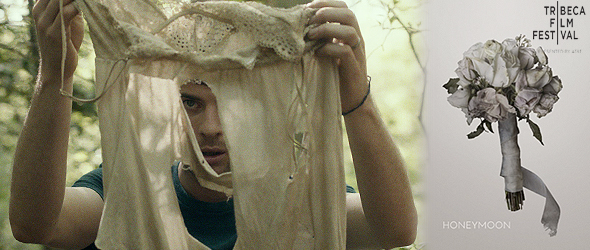
Leigh Janiak and Harry Treadaway talk about their film “Honeymoon” at Tribeca Film Festival

Director Leigh Janiak debuted her first feature, the horror film Honeymoon, this week at the Tribeca Film Fest. The film stars Rose Leslie (“Game of Thrones”) and Harry Treadaway (Showtime’s upcoming “Penny Dreadful”) as happy young couple, Bea and Paul. Their blissful honeymoon is interrupted when Bea is found disoriented in the woods one night, resulting in a terrifying personality change.

MediaMikes: Can you describe the idea of using something as happy as a honeymoon as your starting point?
Leigh Janiak: That’s where we came from when we started it. It was we’re going to take something really happy and seemingly beautiful and see what we need to do to it to really destroy it and watch it decay. And it was just like idea of how something so personal can become foreign and fall apart.

MediaMikes: Can you talk about your cast, because it’s mostly just the two of them throughout?
Janiak: They’re both lovely. It was the first time they’d both really done American accents to the full extent but I think that they did an amazing job, I’m completely blown away and you believe them. And you believe their love. They both have an incredible energy, they’re obviously extremely talented, but you never know chemistry-wise. We didn’t do a chemistry read before and it was kind of just like feeling their different vibes separately and it worked, thank god.

MediaMikes: Rose Leslie specifically has to undergo such a huge change in the middle of the film, did you discuss with her specifics about how her character is, I’ll say, pre- and post-op?
Janiak: We spent a lot of times with Rose just generally tracing her transformation and just understanding where she was hiding from Paul, when her character was trying to tell the truth but couldn’t do it. But it was really a scene by scene basis. And we did the same thing with Harry too by the way because Paul’s character transforms as well, just not quite so physically.

MediaMikes: Horror films tend to go either the way of the supernatural or the way of aliens, which one do you find scarier?
Harry Treadaway: I don’t know, like it depends! It’s also about almost what you don’t see, I think that’s what makes me scared. It’s sort of the emotions and stuff behind it that would actually get me scared. I think. Not aliens though, the other one!

MediaMikes: Ghosts?
Treadaway: Yeah!

MediaMikes: Coming up, you’ve got Penny Dreadful where you’re playing Dr. Frankenstein, what is the show bringing to this character?
Treadaway: That’s not for me to say…all that I’ll say is that it was, I mean, John Logan is you know a pretty incredible writer…Sam Mendes producing and then Juan Bayona who directed the first two is really amazing and we’ve got a cool exciting cast. And I’m just doing my little bit, really.

Here MediaMikes got into a little spoiler territory with both Leigh and Harry, so if you’d like to remain unspoiled, you can check out the trailer below, and keep an eye out for Honeymoon, which has recently been acquired by Magnet Pictures. For those of you who’d like some more gorey details head past the video. 

Spoilers ahead…In the film’s climatic scene with now-transformed Bea, the long suffering Paul has to essentially birth a slimy alien entity from Bea. I asked both Janiak and Treadaway to talk about creating and performing this standout horror moment.

Treadaway: That was another night. Just another night…That was the fourth scene up that night and we were like ‘right, how are we going to do this?’ and we tried to do it the best we could. But it was uh, certainly one of the most unusual scenes I’ve probably done.
Janiak: My special effects makeup artist was this guy named Christopher Nelson and he’s been working in this business forever. He’s also incidentally the groom in Kill Bill Volume 2, super talented, he works on American Horror Story. I had put together a really extensive look book and it’s funny I actually referenced like a shower cord but I wanted biological material. And we looked at things like The Fly or Alien. We wanted that really tactile physical effect. And he created this thing and it was perfect and really disgusting and awesome. That scene took two nights to shoot so it was a very intense time.

MediaMikes: Why did you opt for the alien approach rather than supernatural for your feature?
Janiak: It was really just about making an intimate body snatcher movie. So I think that a lot of the horror is actually grounded body-horror and then there was this idea of, we wanted to give answers, the main thing for me is about this relationship falling apart but beyond that we wanted the answers of what’s actually driving these transformations. And that’s why it was the extraterrestrial thing.

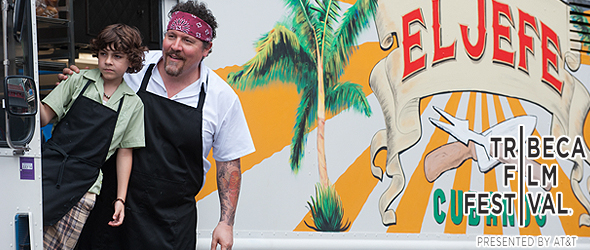
Jon Favreau talks about “Chef” at Tribeca Film Festival

Chef, the new film from Jon Favreau held its premiere on Tuesday in New York. The hugely successful director of “Iron Man” and “Elf” hasn’t directed an independent film since 2001’s “Made” and was excited to debut the comedy, which he also wrote and stars in, at the Tribeca Film Festival.

In the film, Favreau plays Carl Casper, a chef whose embarrassing confrontation with a food critic goes viral on the web causing him to lose his job at a successful restaurant and start from scratch with a food truck and a road trip with his son. Favreau spoke on the red carpet about the inspiration for this story: 

Favreau: “When you write something like this, you’re not really sure where it comes from. I wanted to write something about a chef and something about being a dad and this is the film that came out. And the fact that I’m at the point in my career where if I have an idea like this, I could get it made and have such great friends who would come together and be part of the cast so I found myself very fortunate.”

Luckily for audiences, Favreau’s friends include Robert Downey Jr who plays Marvin. It’s a small but pivotal role as Marvin provides Carl with his new food truck.

How was it working with Robert Downey Jr. without having him playing Iron Man?
Favreau: “I love working with Robert and it was great for him to be on my movie. Because on the Iron Man movies, I feel like I was really there to help support him and make the character look good and make the story make sense and you know, be there in a supportive role. Here, he came on board my movie to do whatever he could to elevate the film.”

As the story concerns a man frustrated working for a successful business while being artistically unfulfilled, I couldn’t help but wonder if coming off of studio films, the story was at all autobiographical, but Favreau maintains this isn’t the case:

Favreau: “No, I’ve been very lucky, I work on big movies and small movies and I really am very proud of all of them. As a matter of fact, I’m going to do “The Jungle Book” [for Disney] after this which is much bigger than “Chef” so unlike the character in the movie, I really like mixing it up a bit. I think the character I play is a little more confused with what drives him. But I really did have a good time doing a small movie like Chef which is similar to how he feels in the film.”

Favreau was joined on the carpet by his onscreen son, the talented, 10-year-old Emjay Anthony, who had nothing but good things to say about his veteran cast:

Anthony: “Sofia Vergara is just drop dead gorgeous, and [John Leguizamo’s] kind of a ladies’ man and so am I, so there was a little contest there. And then Jon Favreau is just such a great actor.”

As for any upcoming projects for the young Anthony, he told us not right now, but “I’m open for business if anybody wants me!”

“Chef” opens in the US on May 9th.

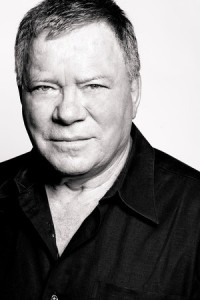
William Shatner talks about his one-man show “Shatner’s World”

Photo Credit: Manfred Baumann

You might know William Shatner as Captain Kirk from “Star Trek: The Original Series”, or Denny Crane from “Boston Legal”, either way the man is a legend in the business. At age 83, he is still going strong and has tackled everything from acting to theatre to being an author. In 2012, he returned to the stage on Broadway with his one-man show, “Shatner’s World”. Since then he took the show on tour and now it will be playing in movie theaters for a special engagement on April 24th through Fanthom Events. Media Mikes had the special privilege to chat with Mr. Shatner about the show and his outstanding career.

Mike Gencarelli: You took “Shatner’s World” from Broadway, then touring and now to cinemas; what has been the highlight for you this journey?
William Shatner: The highlight is at the end of the evening…I think I am safe in saying that at every performance that I have done, the audience had stood up and applauded at the end. The emotion that comes over the footlights between me and the audience has moved me to tears many times. The audiences affection at the end of the evening is palpable and that is truly the highlight for me, Mike. And for the price of a movie ticket, you can see a Broadway play in theaters. This is a live capture of the Broadway play and it will be released in 700 theaters and you can see it for the price of only a movie ticket. So you can’t beat that.

MG: “Shatner’s World” calls back to your roots starting off in theatre; how was it returning back to that setting?
WS: I have been asked for years, since the last time I was on Broadway, to come back and do a play and in some cases a musical. But they needed to get at least a six month commitment and I didn’t have that time available. So I thought “I guess that’s it for me and Broadway”. But within months of saying that came an opportunity to go back to Broadway with this show and I even was able to go to the the exact theater where I was for my last Broadway play. So the irony of that, or the beautiful or symmetry of that is not lost on me.

Photo Credit: George Qua-Enoo Photography

MG: What was the the name of that last Broadway show?
WS: It was “A Shot in the Dark” with Julie Harris…many years ago.

MG: In “Shatner’s World”, you mentioned several struggles on your career early on; what would you say is your defining moment?
WS: I have the kind of career that was a slow build. Every time something sensational was going to happen it didn’t work out that way it was suppose to. There was this slow wave of attention and activity that I think actually climaxes in this one-man show. To go on stage alone for an hour and a half to two hours and hold an audience and get the kind of reaction I’ve been am getting, that is the cumulation of years of experience and attention. It didn’t happen suddenly, there was no defining moment. Instead, there was a series of small wavelets as apposed to a tsunami.

MG: Having such a full career, what were some of the hard decisions you had to make to cut out in order to get this show down to an hour and a half?
WS: There were many parts that didn’t make it, especially getting the show ready for Broadway. I had to sharpen and refine and reduce it to it’s supreme moments, if you will, where it epitomizes everything that I wanted to say. Not only stories but also extraneous words, so it is a difficult process. The core of this show was to say “Yes” to life. To give this idea, this concept, that life is precious and needs to be embraced with both ears and smothered by you because it is over so quickly. So the stories that went along with that core were the stories that I kept.

MG: I loved the energy that you brought to the stage; how do you channel all that energy running around on stage and still while being funny and charming?
WS: It is part of the entertainer’s magic, I guess, but that is my energy and it comes from my core. That is what I bring to you on stage, you being the audience. I feel that there is a magical link between me and the audience. I feel it and you feel it. I am there for you. We are having a love affair, the performer and the audience. I actually feel the embrace and perform to that and that is energizing to me.
MG: I have to honestly say that from just watching the show, I felt pumped and I didn’t even see it in person, so congrats on that as well for being very effective.
WS: I am so glad to hear you say that, thank you. That is a lovely compliment and I appreciate you saying it.

MG: You bet!, what would you say is biggest challenge doing a one-man show?
WS: There is a number of challenges. You are talking continuously for two hours and trying to remember the words. It is not unlike musicians doing a set and having the set numbers in front of them. They have clues as to what is next. So that is what I had but it still had to remember those words. So now that I haven’t done this in many months I am going to be in Las Vegas at the MGM Grand on June 19th, 20th, 21st doing the one-man show, which is what a thrill let me say, so I am going to have to re-learn the lines now. So that is a challenge but not only that but I am going to have to teach the show to an individual on how to work that software for the electronics and the media. So that is going to be a challenge in Las Vegas. Then I am going on a tour for a few selected dates in January and have to re-do that again. So the dint of the words and the expenditure of energy that is so orgasmic [laughs] and you have to be ready for it, so those are challenges also.

MG: You mentioned your musical career in the show; do you have any plans to go down that road again?
WS: Well, I have been asked to do a cover album…and I just may do that. I love music. I can’t sing or sustain a note but what I do have is the musicality of the language. Many languages, English among them, has an intrinsic melody and rhythm that needs to be sought out, if you will. It is one thing to speak like we do but another to find the heart of the language and I love that. So my ability to be able to combine that musicality of the words with a melody line that comes in behind it, it became a signature thing. I just love doing it and I am anxious to do it again, so whether it is an album or live. I did perform my newest album, which is called “Ponder the Mystery”. I did it three times with Billy Sherwood’s group in the Los Angeles area last year and it got a great response and I would love to repeat that.

MG: From being an actor, author, spokesperson etc; what is left on your bucket list that you want to do?
WS: Oh my goodness. I haven’t done anything in life. I feel unaccomplished and I feel like I have done nothing [laugh]. Being a performer, once the performance is over…it is gone. It is in the ether. It may have just as well not happened. The next night is the next challenge. It is a challenge of many kinds. It is a challenge of redoing that performance that only you can remember. The challenge is also that if there will be an audience for that performance. I am feeling that way right now. Doing all this publicity is an attempt to fill that gap that I hope that 700 theaters will be filled up with people coming to see the show on April 24th. There is so much to do and so little time left to do it.

Ralph Steadman talks about his work with Hunter S. Thompson and film “For No Good Reason”

Ralph Steadman is a British Gonzo artist that is best known for his work with American author Hunter S. Thompson, author of “Fear and Loathing in Las Vegas”. After meeting each other in 1970 to cover the Kentucky Derby, Steadman and Thompson formed a long-time relationship. Steadman’s did the artwork for Thompson’s books over his career. He is also an author himself having written numerous books focusing on his drawings…or as Hunter would have called it his “filthy scribblings”, according to Ralph. This April, “For No Good Reason” makes its U.S. debut in NYC, which is a documentary on Ralph’s career. Media Mikes had a chance to chat with Ralph about the film and his work with Hunter S. Thompson.

Mike Gencarelli: Tell us about how you got approached for the documentary “From No Good Reason”?
Ralph Steadman: The director Charlie Paul initially came down to see me, then the producer Lucy Paul. This was over a period of twelve years, you know. They would stay for lunch, we would talk and then we would carry on. So over twelve years, we made this film. It just seems so long ago from when we first started it. They got Johnny Depp involved, which was good because he has become a personal friend of mine over the years. He is such a great guy, easy going, warm, genuine and terrific fellow…
MG: I loved Johnny’s narration in the film as well, very nice touch.
RS: Oh yeah, it was lovely. I agree.

MG: How did you feel about having a documentary about your life done?
RS: I first thought “For God’s sake…why?” “For no good reason”…that is what Hunter would have said. I used to always ask “Why are we doing this Hunter?” and he would always say “For no good reason, Ralph” [laughs].

MG: How was it seeing some of your drawings brought to life and illustrated in the film?
RS: That was quite interesting. I couldn’t be an animator in old Disney way when they used to draw one picture and then other but slightly different and then you would put them together like a flip book and they would actually move. The only thing I liked like that was doing something simple like a dot or a splat and putting it in a book form and flipping it and watching it move, that to me was magic. I like doing that kind of thing. But seeing my drawings in the film was really great.

MG: I find it so interesting that you said in the film that your work is unprofessional and “it is as unexpected to me as it is to anyone else”; can you talk about this aspect?
RS: Yeah, that is because I don’t do any pencil work. I never plan anything. I just begin and the drawing becomes what it becomes. My reaction every time is “I don’t know how I did that”. I am always amazed. “How the fuck did I do that?”, I usually say. It’s like Ludwig Wittgenstein’s idea that only thing of value is that thing that you cannot say but you can see it. I like that a lot.

MG: So how did your splatter technique come about then?
RS: Oh that was clumsiness. I was clumsy. I said “Oh shit” when I flicked my wrist with my pen but I realized it made this beautiful sweep of blots. I thought to myself them “Oh I like that, it’s quite nice” So I started to use it more deliberately. I would spill ink all over the place. I liked the idea of putting a sheet of paper on the studio floor taking a bottle of ink high on a ladder and dropping it. Not all of it…but just enough. It would make terrific, radiating splatters of different designs. Then you look and think “Hmm, it could be a spider” and I would go from there.

MG: Looking back at the film now, how do you feel that it has come together?
RS: I was amazed by it actually. After twelve years, it was nice to see it all come together. They did cut out a few things that I would have liked them to keep in like my art teacher, Leslie Richardson. This was a pity since I really wanted him in it. What they were after was the notoriety including the fame of Johnny Depp. So poor Leslie Richardson, who is now 93, was left out. But he still goes around kicking old ladies and children in the streets [laughs].

MG: Tell us how you originally crossed paths with Hunter Thompson?
RS: When I was planning to come to New York in 1970, I had some friends that invited me to stay with them in the Hampton’s. They were soon to be married, so I felt a little uncomfortable saying with them for a long period of time. So after staying a little while, I was going to leave for the city and I was about to leave when there was a cal from a guy named J.C. Suarez. He was an editor from Brooklyn. He wanted me to come to Kentucky and meet an ex-Hells Angels, who just shaved his head. I asked why did he do that and he said “Why? Because he’s a Hells Angels. He is a rebel”. So I asked “What for?” He told me that he was not only looking for a photographer but for an artist and they saw my book of pictures called “Still Life with Raspberry”, which was my first book of collected drawings. Don Goddard was the foreign editor of The New York Times and he had found the book in England and then came back and said that they need to put me with Hunter Thompson. So that is how it happened.

MG: Do you feel that your career would have been different if your path’s didn’t cross?
RS: As far as I was concerned, meeting Hunter and going to Kentucky was a bulls eye for me. For all the people that I could meet in America, he would be the one…go figure. Meeting Hunter was the best thing for me in terms of making a career. What we did for journalism was that we became the story and that became know as gonzo journalism. That was really what was so good about it. One day, this guy Bill Cardoso told us that the Kentucky Derby piece we did was “pure gonzo”. Hunter never heard the word before and it really stuck. He used to say “Don’t do those filthy scribblings”. He used to call my drawings filthy scribblings [laughs]. He used to also tell me “Don’t write Ralph, you will bring shame on your family”. But he always loved to sort of go against you but on purpose because he would know that it would provoke me and my work would benefit.

MG: “Fear and Loathing in Las Vegas” is one of my favorite books and the movie is great as well…
RS: The thing is people get too sniffy about the movie and things like that. They say that it is not quite this or quite that. No! It is a version of the book. I didn’t mind it, especially since the whole damn thing, “Fear and Loathing in Las Vegas” was a crazy idea to begin with.

MG: Do you recall how long it took you to complete the illustrations for the “Fear and Loathing in Las Vegas” book?
RS: I think I did nine pictures in a week and it was done. The rotten thing was that I ended up selling all of the originals since I was told it would be a good career move. I think I got $75 dollars each for them. Can you imagine what they are worth now?

MG: Has your drawings been affected since the death of Hunter S. Thompson?
RS: No, not really. I have been doing bird drawings for the last few years. I don’t like drawing politicians any more, I can’t be bothered. They are so awful. I don’t feel so bitter about it. I do not feel like I am trying to change the world. I have changed the world enough since I started and it is worse now than when I started [laughs]. So good, I have done what I had meant to do [laughing]

MG: Yeah, you start off the film saying you set out to “change the world”; I was going to ask if you felt that you have accomplished that goal?
RS: We’ll you look around, I have done my part but bloody computers have changed everything.The business and also people in general. You can’t walk down a side street without somebody passing you by and they are not looking at you or around them, they are looking down at their phone. I had to go on a train recently to Halifax for a show of my drawings and there was this woman on the train that was a good example. She had red hair which was long down one side and shaved on the other side. I have a drawing of it in my book here. She was so awful, I had to draw her. But she had her makeup out in one hand and her phone in the other from the moment she got on the train. That is the problem about the invasion of the computer, like Twitter. Everyone wants to tweet you now. So that is very weird to me.

MG: Tell us about your latest book “Proud Too Be Weirrd”?
RS: I collected together a bunch of things that I never had no good reason to use [laughs]. I thought I would start with the first page and go through my studio finding this and finding that and just building the book from there and that is how I worked on it. This guy Steve Crist from AMMO Books got in touch with me about doing it. He used to work at TASCHEN. Benedikt Taschen rang me after the book was made and said he was actually very disappointed because he wanted to do the book, but at the time I didn’t know this. He did my book with Hunter, “The Curse of Lono”. Steve Crist used to work with Benedikt and that’s where he began. He sort of adopted the style of big book like TASCHEN did. I really like the title “Proud Too Be Weirrd” and it is a great book

MG: What are some of the artists that inspire you?
RS: I love Picasso. He is such an inspiration for me. There is a film called “The Mystery of Picasso” that is really worth seeing if you can get a copy. It is fascinating for me to watch him at work. The director, who made the film, was allowed to by Picasso to be in the studio with him. This is what Charlie did with me as well for our film. Picasso would set things up for him including painting on glass and having him film from the other side. This is amazing work and it really continues to inspire me.

MG: Are you working on anything else new currently?
RS: I got a new book of creatures that I am working on right now. These are completely made up creatures for example instead of a pelican; you do a pelicant [laughs]. You have to keep doing something otherwise what is the point. I guess I am taking advice from my father, who couldn’t bear to just sit about. I am also learning how to etch steel plates as well. So I suppose I should continue to carry on.


Related Content

Erin Darley and Kai Winikka talk about their film ‘Killer Pizza’

“Jimmy and Sam are two college graduates who return home and find themselves working at a small pizza shop that pops up out of nowhere. It doesn’t take long for them to suspect that they’re working for two cosmic freaks with more sinister intentions than simply delivering pie. What is happening at the Killer Pizza shop? What is behind their secret recipe?”

That is the synopsis of ‘Killer Pizza’, the definitive feature-length picture about growing up, getting jobs, and surviving a Killer Pizza monster invasion.

Today I sat down and talked with the creative team behind the film: co-writer/director Kai Winikka and co-writer/producer Erin Darley. Both filmmakers live in Lawrence, Kansas and are graduates of the University of Kansas.

B.C. Allen: How was it that you two first met?
Erin Darley: When I was a Freshman at K.U., Kai was one of the Presidents of Film Works.
Kai Winikka: I ran a Cult Movie Night, once every month during my Senior Year, through Film Works. Film Works was an extra-curricular for freshman whom weren’t able to get into some of the production classes. It was more of a student-driven organization. Erin was a cult-film enthusiast, and it was always a big thing to get girls to show up. I always made more of a point to reach out to Erin since she was really into it. I’d tell her, “Ya know, we’re showing ‘Breakin’’ and ‘Jaws 4’, you have to come: bring your friends!”
ED: It was just a bunch of nerds coalescing, keeping each other motivated.
KW: It was a group of dinguses getting together to make movies.

BCA: What previous projects have you worked on together?
ED: “Porn & Pudding” was a thing. Everyone loved that. And that spawned a club. There is a “Porn & Pudding” club, and it was actually pretty serious. Kai is shaking his head because he is ashamed that I’m telling everyone this.
KW: That’s YOUR film, that’s not my film. (laughs) Our first real collaboration was probably
“Bustin’ Out”, where we both co-wrote and co-directed. It was for the 48-Hour Film Festival about superheroes, so naturally we made a Women-In-Prison movie. It was about a woman whose evil twin imprisoned her with a bunch of other women – whom were played by men — ED: Chicks with d*cks in chains.
KW: And there was an amulet that allowed her to shoot lasers out of her breast-icles.
ED: And then there was “Nanny Goat” which starred my sisters.
KW: And my basement in K.C.K.

BCA: What the origin of the idea for ‘Killer Pizza’?
KW: “Nanny Goat” was originally Plan A for the 48-Hour Film Festival, and if it didn’t work out, Plan B was “Killer Pizza”, but it was a lot sillier at the time. “Nanny Goat” did well and ended up winning the Audience Award. It was originally going to be about a babysitter, so naturally they order pizza; and of course the pizza ends up killing them.
ED: I always say that it goes back to standing there and deciding whether “Nanny Goat” was going to work and Kai just said, “If it doesn’t work out we’ll just order a pizza and we’ll throw it on your sisters and it will be eating them. And then at the end of the movie it crawls up to the camera, looks at the camera, and belches.”
KW: It’s come a long, long way from there. Although “Killer Pizza” is about a Killer Pizza and has Ron Jeremy in it, I’d like to say that this is a legit horror movie. It’s not campy at all.

BCA: You mention Ron Jeremy, how is it that he became attached to this project?
KW: I did a documentary in 2008 called “XXX in the Midwest” and Ron came to Washburn University in Topeka, Kansas to do a debate. So we waited in a long line afterward to meet him and he did the interview, had no issues, and signed the waiver like it was nothing. It left an impression, like he’s someone who is down for anything. He’s known as the hardest working man in show business, and he doesn’t say no, well, if it’s the right project.
ED: I came back from Colorado last year and Kai said that if I helped him write “Killer Pizza” then we’d get Ron Jeremy to be in it and we’ll put it on Kickstarter.com. So we wrote a part for him. And when we thought we were done with the script – which was three drafts ago – we knew it was time to contact Ron Jeremy. We sent him a letter, not knowing how long we’d have to wait to hear back from this guy. I went off to work, at a restaurant, and I was checking my e-mail obsessively, and he e-mailed us back within thirty minutes, and he said “Yes.” And I still have the letter, which started, “Dear Hedgehog,…”

BCA: What would be the biggest hurdle for this production?
KW: The biggest challenge I think will be the effects, that’s what I anticipate it being. There are a lot of them and they are elaborate; and there is a lot of testing that has to go down beforehand. And they can still go wrong, like on set, the day of. Also making sure we can make our day and keep the production sailing.

BCA: What makes you want to use practical effects as opposed to digital effects?
KW: It has more charm. There is more heart to it. I am a big believer in visual effects when they are combined with practical, but this movie doesn’t really call for that.
ED: I think C.G. is trying to be realistic, but it doesn’t always work. Regular effects don’t always look super real, but the suspension of disbelief takes care of a lot of that for us; but it’s more fun, I would say.
KW: It’s the heart. C.G. comes close, but not close enough.

BCA: Do you have a specific look you are going for with this film?
KW: It’s going to be a really dark film, so the idea is to go in and bring the black way, way down, and taking a lot of the color out. That idea is really appealing to me. The look of the film “976-EVIL” is the kind of look I am going for.

BCA: When was it that you started to write, or realized you wanted to be storytellers or filmmakers?
KW: In high school, a group of guys and myself were making “Jackass”-type videos. We were doing it every week, and then every day; and it got to a point where I was telling them they’d have to do it again because it wasn’t good enough, and my friends told me I was taking all the fun out of it. It grew from there.
ED: I made high school movies, too. But I didn’t discover my writing ability until college. I’ve just always done it as a fun, personal thing. I write poetry, and short stories. Screenplays are great, but there’s no one who is going to tell you that screenplays are literature. They are great if you think in terms of images. Screenplays are awesome if you think of a great story; you can just bang out a series of images and dialogue and say “That’s done.” And if you want to you can go back to it and add the prose later.

BCA.: What is the endgame for “Killer Pizza” are there any specific festivals you are looking at?
KW: I think the best festival out there for this genre would be Fantastic Fest. And of course, show it locally at the Kansas City Film Festival.
ED: I defer to Kai on that. I want to see this movie, and that’s all I am thinking about. I figure I’ll just make this movie to watch it myself, and then take it from there.

Killer Pizza is a feature-length weird horror film to be shot Summer of 2014 in Lawrence, Kansas.
Kai and Erin are currently crowd-sourcing the funding for “Killer Pizza” with a Kickstarter campaign.

Eddie Bakshi talks about producing “Last Days of Coney Island” and this year’s Kansas City Film Fest

If you’re a fan of classic animation you surely are a fan of Ralph Bakshi. In his five decade career he has created such seminal animated features as “Fritz the Cat,” “Heavy Traffic,” “Wizards,” “The Lord of the Rings,” “Cool World” and many more. This week at the Kansas City Film Fest a retrospect of his work will be shown, featuring screenings of “Heavy Traffic,” “Coonskin” and “Wizards,” culminating in a Q&A Skype session with the director after Saturday’s screening of “Coonskin.”

Introducing the films this week will be another filmmaking member of the Bakshi family, Ralph’s son, Eddie. Eddie caught the filmmaking bug at a young age and is finishing up his animated producer’s debut, “Last Days of Coney Island.” While waiting for the Fest to begin, Eddie Bakshi spoke with Media Mikes.:

Mike Smith: Can you give the readers a little inside introduction to the upcoming retrospect of your father’s films at the Kansas City Film Fest?
Eddie Bakshi: The festival is presenting screenings of three of his films: “Heavy Traffic,” “Coonskin” and “Wizards.” There will also be samples of the original art – the original animation cells used to make the film. They will be on display and some will also be available to purchase. In addition, he will be Skyping in to the festival after the Saturday evening screening of “Coonskin” for an audience Q & A. The audience will have a chance to ask him a question about any of his films, be it “Coonskin” or his latest film, “Last Days of Coney Island.” He’s currently editing that film right now and will actually be Skyping in on the same computer he’s editing on.

MS: Can you talk a little about “Last Days of Coney Island?”
EB: “Last Days of Coney Island” is a project that we’re both working on. He’s directing and I’m producing. We’re currently in the middle of editing it. It’s an eighteen-minute featurette. When we announced it on Kickstarter we had said it would be a five to seven-minute short but now it’s a bit longer. Actually, we may continue the project and turn it into a full length feature film. If we can get the funding we would like to tell the entire “Coney Island” story, which takes place in the 1960s and involves cops and a whole lot of seedy characters…the inhabitants of Coney Island. It will be a classic Bakshi film in the vein of “Heavy Traffic.” It has a lot of strange characters and they’re all interlinked. He’s very happy with what he has done now but he would love to turn it into a feature. He’s very happy with the story and how it’s going. He’s been very involved the past several months lengthening the story to eighteen-minutes. The art style is very interesting.

MS: You will be offering some of his original art and cells to the public?
EB: Yes. It’s a great way for his fans to own a piece of his work.

MS: Is this retrospect a way to introduce his work to new fans as well as letting old fans know about his newest project?
EB: It’s a new way to promote Bakshi Productions. It’s really the first real chance people will have to ask him about the project directly. There has been a real spike in the increase of interest in his work since the advent of outlets like Twitter and Instagram. Many new fans are being exposed to his work. An outlets like Facebook these fans are finally getting to see the images from his films and it generated a lot of interest in the new film. We’ve been getting offers from all over the country to attend film festivals to not only talk about “Last Days of Coney Island” but to show his older films as well. It’s kind of like a bundle package. Once “Coney Island “ is ready we can take that to festivals, or show a trailer for it with some of the older films.

The Kansas City Film Fest runs through April 13. For more information go to www.kcfilmfest.org

Frank Pavich talks about directing documentary “Jodorowsky’s Dune”

Courtesy: Sony Pictures Classics

Frank Pavich is the director of the new fantastic documentary “Jodorowsky’s Dune”, which chronicles about Alejandro Jodorowsky’s never made film version of Frank Herbet’s “Dune”. He has also worked as a production manager on TV shows like “Paranormal State”. Media Mikes had a chance to chat “Dune” with Frank and find out about how he got involved with Jodorowsky and his passion for what he does.

Mike Gencarelli: How did you get involved with the documentary “Jodorowsky’s Dune”?
Frank Pavich: You just hear and read about these things like “The Top 50 Greatest Movies Never Made”. I was a fan of Jodorowsky and his movies like “Holy Mountain” and “El Topo” going back to even when you couldn’t get it except on like crazy VHS bootlegs. There was a small segment about his unfinished “Dune” in a documentary called “Jodorowsky Constellation”, but it only ran like five minutes. But during it you see his screenplay book and I thought to myself “What the hell is that book?” Once you see that book, you feel the need to just learn more and more about it. So I searched and search until one day, there was no more information out there that I hadn’t seen. So I decided to just find the guy himself and speak with him.

MG: How did you end up tracking him down and convincing him to do this?
FP: I wish I could tell you what made him do it. I think the only thing I can say was from my obvious unbridled enthusiasm. I was searching for him and I found that he has an agent in Spain for acting. I didn’t even know he acted in movies other than his own but obviously he does because he has this agent. I just sent her an email and explained my situation. She took my email and just forwarded it to him. So then a couple of weeks later, I just happen to wake up to an email from Alejandro Jodorowsky. It was awesome. If I remember correctly, I didn’t even open it for like a week. I was afraid if he wrote “Dear Frank….NO!” It would have crushed my dreams. So when I opened it included was a very short message saying “I hear you are looking for me? I live in Paris and if you would like to discuss doing a project like this we would need to meet face to face”. I was like “GREAT! You don’t have to twist my arm”. I made an appointment and went to his house to discuss. I gave him the short pitch and either he just thought I was crazy or deep down that we weren’t going to finish it but he agreed to do a few interviews. So we started and went back a few times to shoot more and more interviews over time. Overall, I think it worked out really well.

MG: What I loved about this documentary is that there wasn’t like a million interviews…
FP: Oh, I hate those.
MG: Right! You had the key 10 people involved and that is all.
FP: That is what I always wanted to do. I hate those documentaries where it is only 90 minutes long and features 90 people. I can’t follow who is who and I can’t follow what is going on. Each person comes on for a half a sentence and I just get lost. I wanted to keep it to a minimum number of people. We had the greatest storyteller in the world.
MG: I agree, most importantly you kept Jodorowsky in the spotlight…
FP: Thanks for picking up on that man!

Courtesy: Sony Pictures Classics

MG: What was it liked getting to review Jodorowsky’s screenplay book during your meetings?
FP: It’s funny because the first time I met him to pitch him the idea; we sat on these two chairs facing each other and in between us what this ottoman with books on it. He had actually placed THE “Dune” book on there but he never let me look at it and I didn’t ask. It was like he was teasing me with it [laughs]. It was so cruel but also hilarious. But the book was amazing. Once you get to go inside of it, you get to see that is in fact a complete film. It has every scene from the first to the very last. It also has every bit of dialogue and character details. It is something that I do not think was ever done before. It was ready to go and be filmed. What was also very interesting is that the screenplay was totally different than the book of storyboards, since it evolved over time. As he got all his “spiritual warriors”, it started to change. Just like if he would have gotten to shoot it, I am sure it would have evolved again. It is really interesting to see the process of his creativity.

MG: Tell us about the animation in the film and how was it getting to bring parts of Jodorowsky’s “Dune” come to life?
FP: We had this great animator, his name was Syd Garon. I met him through another friend and I thought that his work was perfect. He had that perfect light touch. I didn’t want to overdue the animation because it is not my vision of “Dune”, it is his vision. I just wanted to take those storyboards, which are primarily pencil on paper and breath enough life into them to elevate it off the page a little and hopefully then the viewer’s imagination will fill in the rest. It straddles the that middle ground between the storyboard and what the actual completed feature film would have been like. It was so much fun to do. We went through the book and literally got to pick out the scenes that we wanted to bring to life.

Courtesy: Sony Pictures Classics

MG: What was his reaction when he saw these animated sequences?
FP: He has this philosophy when he directs his movie for everyone to leave him alone and he doesn’t want to hear from anyone since he is the artist. That is great and that is why we get the kind of movies that he makes. So I was afraid that he was going to be over my shoulder the whole time but he was definitely not a hypocrite. He believes that for himself and believed that for me as well. He let me do what I wanted and didn’t bother me at all. The first time he saw it was at the premiere at Cannes. It was a really cool experience and a really great place for him to see it. Him and his wife were next to me watching it and kept trying to peak over at them to see if they were laughing, interested or sleeping [laughs]. I could see that they were really enthralled and into it. They were also both wiping away tears at the end, which is great because you always want to make an 85 year old man cry [laughs].

MG: Having seen the film a few times now and I agree the film is quite dramatic.
FP: It is so interesting. It all comes down to his world view. This story for somebody else could be a very depressing story or it could be a winy story or angry story. “Oh, look what I didn’t get to do”. For him though, he thought it was great. He didn’t get to make the movie but he made my movie and he also had a great career and a lot of other movies were influenced by his work. Even I get choked up watching the end of the film, where he says that you have to try and that it is all about ambition. It is great. He is such an amazing and powerful guy. I am very lucky to have had a chance to work with him.

MG: Tell us about the score in the film?
FP: Our composers name is Kurt Stenzel. It is his first film and he was just great. He has never done a score before. He is this electronic musician and does all this great synthesized music. But he and I go way back actually and we grew up in Queens, New York together. I first knew of him when he was part of the New York hardcore scene. His old band was the very first New York hardcore tape that I ever bought back in 1987 or something. It is totally crazy. So he has gone from the New York hardcore world to a career scoring films. He can be like the new Mark Mothersbaugh. We are also hoping to release the score down the line for the fans.

Courtesy: Sony Pictures Classics

MG: How did the relationships between other films like “Raiders of the Lost Ark’s “Masters of the Universe”, “Prometheus” and others get recognized?
FP: It is weird. Some of them are obvious. When we were making the documentary “Prometheus” came out, so that was an easy one. I remember seeing the commercial and thinking “What the hell?”, since that was the Giger mountain. It was crazy. It was totally lifted from the “Dune” artwork. Then some of them we really had to search for and some we couldn’t even include. After he attempted to make “Dune”, he spoke about how he started his career in comics, he did “The Incal” and “The Metabarons” series and a bunch others. If you look at the “The Metabarons” comic, you can see images in there that ended up in the movie “The Avengers”. There was no way to put that into the movie because it would be an entirely different chapter showing how his work influenced this and that etc. But his stuff is everywhere. Even Kanye West’s last tour/album was inspired by “Holy Mountain”. So we can say that he touches everything from “The Avengers” to Kanye West. How can someone do that? So we just be searching around and looking at the storyboards and trying to see anything that resembled them. They think that there were about twenty of those books made and only two exist today. So where are the other eighteen? You see so many similarities in other films that somebody else has had to have seen this book over the years.

MG: Do you think the world will ever see Jodorowsky’s take on Dune?
FP: I think this is his take on the film. I do not think he has that burning desire to do it anymore. I think he feels that “You want to see the movie? Then it is here, watch the documentary”. I think in his mind he feels like it is done. I think he has moved on also since it has been so many years. Also can anyone make a “Dune” movie anymore? Lynch had a hard time. Syfy did a one over a decade ago. So many people have taken from the “Dune” source material, the book, which in turn has influenced so many other films. Maybe if a true representation of “Dune” came out people would think, “Oh, I have seen all this before”. They have seen in various films that maybe it wouldn’t be as exciting for them. Jodo is happy and he has no regrets. He is also very happy to have been able to tell his version of the story now in this film.

Courtesy: Sony Pictures Classics

MG:  What can we expect from the Blu-ray release in terms of special features?
FP: There is a ton of great material that we are passing off to our distributor, Sony Pictures Classics. I am not sure what is going to end up on the Blu-ray but I would think that they would want to include it all on there. We shot hours of interviews footage. So, we have hours and hours of interviews with Jodorowsky and all these people that couldn’t fit into the story we told. But it is still valuable stuff that I want to share with the world. If I was a betting man, I would say that it will be included on the Blu-ray release. It is too great not to have it.

MG: What do you have planned next after this film?
FP: I have a couple of ideas and projects in my head stirring around. But man, it is a challenge because this movie came out really good and I am really proud of it. It premiered at Cannes and went to Telluride and all these great film festivals. Sony Pictures Classics is releasing it. How much better can this be? What do you do to top this or complement this? That is the challenge for me. It takes so long to make these movies anyway. As far as I learned with this, if you are not totally in love with the movie you are making you are never going to finish it. Hopefully, I can find a subject that is as interesting as Alejandro Jodorowsky and his version of “Dune”. If you hear of anything left me know [laughs].

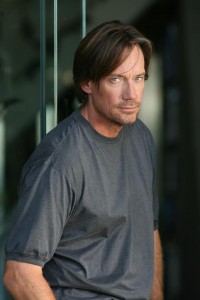
Kevin Sorbo talks about new films “God’s Not Dead” & “Revelation Road 3: The Black Rider”

Kevin Sorbo is know best for his roles in “Hercules: The Legendary Journeys”, “Andromeda” and “Kull the Conqueror”. Media Mikes had a chance to ask Kevin a few questions about his upcoming films “God’s Not Dead” and “Revelation Road 3: The Black Rider”.

Mike Gencarelli: What drew you to this film, “God’s Not Dead”?
Kevin Sorbo: It’s always the story. Great script, wonderful characters, fantastic message!

MG: How did you prepare to play a character like Professor Radisson?
KS: I have atheist friends. I have many conversations with them about my faith, their non belief. I have had college professors like him and have met with other college students who have had the same experience.

MG: In the film you push your students to admit god is dead; did that clash with your religious beliefs?
KS: Not at all. I’m acting. There are certain things I would be uncomfortable with as an actor and wouldn’t do, but the message here is great and needs to be brought to the light.

MG: Big “Duck Dynasty” fan, did you get a chance to meet The Robertsons during filming?
KS: They were brought in a year after we finished shooting, so we never met.

MG: You are currently shooting “Revelation Road 3: The Black Rider”, tell us what we can expect?
KS: A whacky ride into a post apocalyptic world where mad max meets the final chapter of the bible. Just had a fun, crazy character to play. No redeeming qualities in him really, but that remains to be seen with hints he may be back for other “Revelation Road” movies.

MG: Lastly tell us about your current Kickstarter campaign for the film “Survivor”?
KS: Sci-fi movie where I play the captain of a ship that had to leave earth decades ago when world war destroyed it. We answer the distress beacon of another planet and all hell breaks loose upon our arrival. Movie is shot and is looking for more money to wrap up post production.

Sharni Vinson talks about new film “Patrick: Evil Awakens”

Copyright 2013 Roget Clinic Pty Ltd.

Sharni Vinson is an Australian actress that got her American debut in the dance film “Step Up 3D”. Since then she has starred in numerous strong female leads like the Australian shark thriller “Bait 3D” and last year’s action/horror film “You’re Next”. She is an actress that is not afraid to get her hands dirty and she plays these fantastic roles. Media Mikes had a chance to talk with Sharni about her latest new film “Patrick: Evil Awakens” and what we can expect next.

Mike Gencarelli: Tell us what drew up into the role for “Patrick: Evil Awakens”?
Sharni Vinson: I think a lot of things at the time drew me to the film. I always like to keep an eye out for any Australian projects that come up. I am Australian and I love getting a chance to get back there and shoot a film with my people [laughs]. So, the fact that this was an Australian movie interested me immediately. The attached cast was a big draw as well. Charles Dance and Rachel Griffiths are two actors that I definitely look up to and admire their work. I thought it would be a great challenge for me. So I wanted to take the opportunity. I also liked that it was a remake of a successfully film from the 70’s, I was also very enticed to see how it could progress with today’s technology advancement.

MG: What is your process for getting into a character like Kathy?
SV: We did not have any rehearsals for this movie. We never had any table readings. It was really interesting actually. I flew into Australia from America the day before we started shooting. So I hadn’t met anybody from the film and you know they say you are supposed to develop all this chemistry beforehand. But the process for this one was quite minimal and really unfolded as we were shooting. I felt like with the set, which was so dark and our wardrobes was really what put us into the character. As soon as I put on that uniform, I started to visualize how it was going to unfold. It was a lot of happening in the moment. Each project is different and this was a great experience getting to do it so naturally.

MG: What was your biggest challenge working on this film?
SV: It was a very smooth shoot. We didn’t run into too many problems. I think maybe the most challenging part could have been was that I was working with an actor, in more than 50% of my scenes, who was in a coma. So he did not speak at all. It was a lot of it was reacting and then reacting to yourself as well. I felt like it was almost along the lines of green screen work, which was very different for me. So that was definitely was quite the challenge I think.

MG: You are known for playing really strong female leads like in “Bait 3D”, “You’re Next” and now this; what do you enjoy most about kicking ass and getting your hands dirty?
SV: HA! It is exactly that what I love about them [laughs]. I grew up in Australia on a farm. I grew up in the dirt and in the ocean and was always very physical. I did a lot of dancing and swimming growing up. With movies, we all know it can get quite tedious sitting on the set for long hours and there is a lot of waiting involved. So when you are doing a role that is heavily involvement with action and utilizing a strong physicality you are always getting to work with a stunt coordinator or trainer in your downtime. I would always rather keep going in my downtime than stop. When you have downtime, you sort of realize how exhausted you really are but if you keep going you feel like you are Superman or something…it is crazy [laughs]. Action and horror genres have been quite good to me. That’s three in a row…

Copyright 2013 Roget Clinic Pty Ltd.

MG: Yeah, I was going to bring up the common theme genre of horror you have trending; what draws you to these films?
SV: I almost want to say that is complete coincidence. I grew up watching horror movies and now I am shooting them. I was absolutely obsessed with them growing up from a really young age. It wasn’t even that I put it out there that I wanted to do horror, these are the roles that I have come my way and that I have taken a liking to. They also, like you mentioned, have that strong female character in them and that is great also and I am enjoying getting a chance to play those characters.

MG: What else do you have planned for 2014 and beyond?
SV: I am very excited to get “Patrick” out there, which comes out March 14th. Next, I am actually doing a film in China mid-year. It is going to be awesome. A part of the film “Bait” was shot in China, so I am excited to get to back there. I do not think the film has settled on a final title yet, so keep an eye out.

Will Vasquez talks about new film “Murder in Miami”

Debuting this week on DVD, “Murder in Miami” has been described as “a sexy, thrilling ode to the classic De Palma films of the ’80s – particularly Body Double.” Media Mikes caught up with the film’s director Will Vasquez to talk about his new film, multi-tasking and his boring early days as a photographer for Playboy.

Mike Smith: Your main character is a photographer. Did you rely on any of your past experiences in creating him?
Will Vasquez: A little of the character and his lifestyle I drew from my past experiences, but I’m not as cool as he is.

MS: While a film director has a flowing canvas to tell his story, a still photographer must do it all in one photo. What was the biggest difference in changing from photographs to film?
WV: Film has it’s challenges, because you have movement and sound to deal with. But it’s much more powerful because film has the ability to mess with your emotions. For me, in some ways, I felt liberated when I transitioned from photography. In a photograph, you’re imprisoned in a single frame, where everything has to be perfect. If you really dissect Hollywood movies, you will find errors in some shots, but because the frame changes, the audience doesn’t have a chance to notice them, because they are paying more attention to the story.

MS: You not only wrote and directed “Murder in Miami,” you served as your own cinematographer and editor. Is this because you felt that, as the film’s creator, you knew exactly the look and tone your were looking for?
WV: I love the entire creative process of making movies, and I like to be hands on. Being involved with all the aspects of filmmaking is why I got into this business, and what drives me. The only drawback is that you have to carry the entire film in your head for a couple of years. It feels great when you finally complete the final edit, and you can purge your mind.

MS: Is there a sense of embarrassment on the photographer’s part when shooting photos for publications like “Playboy?”
WV: No, because photographers are there to do a job. At the end of the day, you have to deliver three different looks from your model and do a lot of coverage of each look. You’re not thinking about anything else other than getting the best shots, so you’re eyes are always scanning the frame checking the model’s hair, her pose, that her tummy is flat, that she has pretty fingers and her hands don’t look like claws, even that her feet look pretty. Because every shot has to be perfect.

MS: Do you have a favorite “Playboy” model? Or a least favorite?
WV: I worked with a lot of great models, but my favorite has to be Cynthia Kaye.

MS: Is there anyone you would have liked to have photographed but didn’t?
WV: I would have loved to have photographed Jenny McCarthy. She recently appeared in “Playboy” again and looks better than ever. I think that she really represents the classic “Playboy” girl next door. She’s beautiful, cool, funny, intelligent, and likes to have sex.

Yusry Kru talks about directing “Vikingdom”

Yusry Kru may not be a name you recognize but he is making a name for himself not only working as a director but also producer and visual effects supervisor. He recently directed the action film “Vikingdom”. Media Mikes had a chance to as Yusry a few questions about the film and what’s next.

Mike Gencarelli: What was the most challenging aspect for you on “Vikingdom”?
Yusry Kru: Obviously, when we made the decision to film everything in Malaysia, I knew it was going to take massive planning to get it right. I remember, 20th Century Fox coming over to film in Malaysia for ‘Anna and the King’. This is the equivalent of them filming that whole movie in California (but with less money, of course). So, you could say that pre-production was the most challenging. I broke down the script to every single location, person and prop, and made a list, down to the spoon on the dinner table. From there, I called in a few illustrators and had them draw every single thing/person on that list. By the end of it, we probably had hundreds of illustrations before we even started with pre-production. We then scouted for locations in Malaysia that we could possibly use, that actually matched the illustrations. If there were none, we would then know these had to be built. It is the same process for every little detail on the pre-viz. Overcoming it was really by doing a thing at a time, without letting the whole production overwhelm you. Having said this, the filming was no walk in the park either… But if you’re asking about the most challenging aspect, that would definitely be the pre-pro. It was really extensive.

MG: Tell us about how the character Eirick was created?
YK: I discussed with Dom (Purcell) on how the character should be portrayed in the film. Imagine someone who was brought back from the dead… someone who has lost every reason for living… primarily driven by the fact that he is no longer able to be with his immortal lover, Frejya. To make matters worse, he is asked to go head on against the God of Thunder, Thor! How’s that for motivation? So he is a reluctant hero and his character is subdued until he fights against Thor at the final battle.

MG: Tell us about what you have in the cards for 2014?
YK: I am currently smack in the middle of directing my sixth feature film entitled “Cicakman 3” (or in English “Geckoman” – a successful Malaysian comedy super hero franchise I created in 2005), which is the 2nd sequel to my debut as a director in the film industry. KRU is also in the midst of completing our first 3D animation movie entitled ‘Ribbit’, about a frog with an identity crisis. Ribbit, with the voices of Sean Astin, Tim Curry & Russell Peters will be screening at EFM in February 2014. KRU is also in the midst of pre-production of various other projects, which we anticipate to announce at Cannes Film du Marche.

Dominic Purcell talks about his new film “Vikingdom”

Dominic Purcell is known best for his role of Lincoln Burrows in Fox’s long running TV series “Prison Break”. Recently Dominic has worked with acclaimed director Uwe Boll on great films like “Assault on Wall Street”. Media Mikes had a chance to chat with Dominic on his latest film “Vikingdom” and what he has planned for 2014.

Mike Gencarelli: What was the most challenging aspect for you working on “Vikingdom”?
Dominic Purcell: Most challenging aspect was the trust it required to engage in a heavy CGI movie made outside the safe confines of Hollywood an industry that excels in extravagance.

MG: How do you prepare for a character like Eirick?
DP: Preparation for me is all about economy. If its necessary I will but rarely do. I rely on the text and excute what is simply required.

MG: What do you enjoy most about working with Uwe Boll on various projecting including “Assault on Wall Street” and “In the Name of the King III”?
DP: Uwe is a courageous film maker that challenges conventional thinking. Directors and film makers of this kind have always been inspirational for me they allow when given the opportunity to challenge and provoke thought. Is this not what is important? I will continue to work with Uwe on future projects that provoke and challenge apathy and comfort.

MG: You had a very busy 2013 and 2014 looks to surpass, tell us about what you have in the cards?
DP: I’ve got couple of films being released. All worth a look. I’m especially interested in “A Fighting Man and watching how it is received. Spending a year training (boxing) and getting my head smashed it better get some love out there amongst critics. It’s a good film.

Brighid Fleming talks about role in “Labor Day”

Brighid Fleming is an up and coming teen actress who has appeared in television series and films ranging from “Its Always Sunny in Philadelphia” to “Gamer” with Gerard Butler. Brighid’s most recent film “Labor Day” stars Josh Brolin and Kate Winslet and was released to rave reviews. Media Mikes had the chance to speak with Brighid recently about her work on the film as well as her work on the upcoming horror film “The Road Killer”.

Adam Lawton: Can you tell us what first got you interested in acting?
Brighid Fleming: When I was younger we used to go to New York a lot to watch plays. Seeing all these made me fall in love with the idea of performing. My mom asked me after one time if I wanted to meet the characters after a performance and I told her no. I wanted to be the characters. She got me involved in Stage Theater and from there I just couldn’t stop.

AL: Can you tell us about your new film “Labor Day” and your character Eleanor?
BH: The film is about a convict that gets picked up by a mom and her son. The man ends up hiding out with a family and sort of takes care of them. It’s a love story that stars Josh Brolin and Kate Winslet. I play the role of Eleanor who is a very edgy and independent girl. She is very smart and knows what she wants. Things were pretty free with the character and I think I was able to add quite a bit to her. Eleanor is a pretty interesting character.

AL: What was it that interested you in the role?
BH: I was really drawn to how strong the character of Eleanor was. Finding a role this strong for someone my age is sort of rare. A friend suggested that I submit an audition tape so I did even though I thought no one would ever see it. A couple weeks later I got a call telling me about the call back. It was very surprising.

AL: What was it like working with such a diverse cast and what was your best memory from the shoot?
BH: All of my scenes were with Gattlin Griffith who plays Henry however; I was able to me Kate Winslet. She was so great. Kate was very nice and level headed. It was great experience. Probably my favorite memory from the shoot was the day we were filming out on these big white rocks. Our scene was shot as we were walking across them. This was also the same day I had my first on screen kiss. That day was a lot of fun.

AL: Can you tell us about some of your other upcoming projects?
BH: I have a role in Shakespeare’s “A Mid-Summers Night Dream” which is being put on by the Inter-City Shakespeare Company. This program is really great as you get attend workshops put on by the professional artists from the company. This is a great opportunity for young actors and actresses and you can find more out about the program at www.innercityshakespearecompany.org. I also am working on a play written by Eric Ludnik titled “Day Trader” which runs through mid February. Besides those performances I am an associate producer on a horror film titled “The Road Killer” which stars Maria Olsen. I am a big horror film fan and while working with Maria on another project we became friends and are now working on this project together.

AL: Is producing something you see yourself doing more of as you get older?
BH: I have always been very interested in the production side of things. I have always been writing and actually wrote my first novel when I was 7 though, it may have not been very good. (Laughs) I like the idea of being behind the camera. I think there are a lot of interesting aspects to both being behind and in front of the camera. Producing and acting are things that I hope to be able to keep doing for a long time to come.


Related Content

James D’Arcy talks about new film “After the Dark” and TV series “Those Who Kill”

James D’Arcy is known best for playing three roles in the 2012 epic sci-fi film “Cloud Atlas”, directed by Tom Tykwer and The Wachowski’s. He also played the role of Norman Bates in “Hitchcock”. Media Mikes had a chance to chat with James about his role in his new film “After the Dark” and his new A&E TV series “Those Who Kill”.

Mike Gencarelli: How did you get involved with the film “After the Dark”?
James D’Arcy: I woke up to an email from my agent sending me the script. I read the script completely cold and I had no idea what I was about to read at all. There was the moment in the script when I shoot one of the kids in the head, that is when it really got my interest. I thought this was really an unexpected twist. Then when I finished the script, I thought it was challenging, provocative and intelligent. You have to have a brain to watch the film. I was enthusiastic due that those aspects. Then I received a bunch of photographs of where we would be shooting. When I saw the locations, it made much more sense to me. I couldn’t visualize how it would work until I saw the photographs. I was just blown away. Then met with John Huddles and really liked him. He had a lot of great ideas and it just grew from there.

MG: I was wondering about the shooting locations since they were extremely beautiful.
JD: Yeah, it was incredible. The three places we filmed in Indonesia were the Prambanan Temple, Mount Bromo and Belitung Island. When I saw the island, I thought “Oh my God, that looks like a holiday”. It was beautiful. We did have to work unfortunately as well [laughs]. The other two Prambanan Temple and Mount Bromo, I haven’t never seen any place like them before. I had no idea a place like Prambanan even existed before. For Mount Bromo, we actually shot in an active volcano. It was filming on Mars. It was really worth it since these were just such extraordinary places.

MG: What intrigued you most about your character Mr. Zimit
JD: I really didn’t know if he was a good guy or not. I liked that there was this dubious gray area. I liked that he was smart and very charismatic. You just never quite knew where you where with him. He was constantly pulling the rug out from under your feet. I thought he was very complex and not obvious and I appreciated that enormously as an actor.

MG: You provided narration throughout as a few of the scenarios played out; was this done before or after shooting the film?
JD: You have an advantage over me since I haven’t seen the completed film yet. We didn’t record any narration separation. We shot it as part of the scene. I do remember that I was slaving over this very long speech at one point. We actually shot that and I remember thinking that this was most likely going to be used as a voice over. Some of the dialogue we shot twice, once was in the classroom and once was on location, so we never quite knew where the director was going to make the cut.

MG: Since you haven’t see the film, I am not sure you can relate but I loved the score in the film and we also interviewed the composer, Jonathan Davis and Nicholas O’Toole, I felt like the music was another character in the film.
JD: Yeah, I can’t comment much on that. But I have been in movies, where the music does something and becomes a character itself. It doesn’t just enhance what you are already hearing and seeing, it adds this extra layer. That is when music is best in the movies.
MG: Honestly, “Cloud Atlas” is one of those films for me and I loved how well the score was intertwined into the film.
JD: Yes, that score was quite amazing. Tom Tykwer did a phenomenal job.

MG: What can we expect from your upcoming A&E series “Those Who Kill”?
JD: It stars Chloe Sevigny and myself. We are both very damaged human beings with scores to be settled. We shot the whole thing in Pittsburgh, which is an extraordinary location since it allows a lot really artistic shots. It is a very dark and powerful show. It was great being able to take a character over a few hours as opposed to just one feature film. We had a chance to explore. them. I am very excited for this show.

MG: You’ve done roles like Mr. Zimit in “After the Dark”, Thomas Schaeffer in “Those who Kill” and you played three roles in “Cloud Atlas”; do you seek out specific roles when you approach a project?
JD: I do not think that I have ever actively seeked out a role. But when you read a script, you immediately know the ones you have an affinity with. Often, the ones that I have an affinity for are also the ones I am afraid of. I am not sure if I am able do them, which leads me to then investigate and pursue further.

MG: What else do you have in the cards for 2014?
JD: I am filming a movie right now called “Survivor”. It is stars Milla Jovovich, Pierce Brosnan, Angela Bassett, Dylan McDermott and myself. We are shooting in London and Bulgaria. It is an action/thriller. It is really good fun and James McTeigue is directing it. He is just wonderful. I also did a film last year called “Let’s Be Cops”, which is a very broad comedy, even though I am not the funny part of it. Because of the way, the film was shot most of the scenes I were in were more serious but I did get to see the funny stuff and it is quite funny indeed. I think that comes out in the Summer.


Related Content

Copyright: MediaMikes.com © 2014 · Powered by: nGeneYes, Inc. · Login

All logos and images used on this website are registered trademarks of their respective companies. All Rights Reserved. Some of the content presented on our sites has been provided by contributors, other unofficial websites or online news sources, and is the sole responsibility of the source from which it was obtained. MediaMikes.com is not liable for inaccuracies, errors, or omissions found herein. For removal of copyrighted images, trademarks, or other issues, Contact Us.