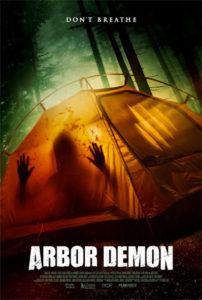
Indie Film Director Patrick Rea Talks About “Arbor Demon”

At 37-years-old, Director/Writer Patrick Rea is already making a name for himself in horror circles around the country. Since graduating from the University of Kansas in December 2002, Patrick has made dozens of short films and collaborated with other directors and writers on even more. He’s starting to get his footing as a feature-film director and took time out of his busy schedule to talk with MediaMikes about his latest film, “Arbor Demon,” which was a part of the Panic Fest lineup in January and premiered on video-on-demand on February 3rd.

Jeremy Werner: Not to steal one of the questions from one of the fine folks that attended Panic Fest, but I loved the answer you gave at it. So I have to ask, where did the inspiration for “Arbor Demon” come from?

Patricka Rea: It was a combination of things. When my wife and I were dating, we went camping one night at Lake Perry, near Lawrence, Kansas. In the early hours of the morning, there was an altercation that occurred between two other campers near our tent. After the fight ensued, one of the campers decided to hop on a rusty four-wheeler, with a deer skull on the front, and drive angrily around the campgrounds, narrowly missing our tent. My wife and I were pretty freaked out, but to cut the tension, I joked that it would be funny if something came out of the woods and attacked them, so we could get a good night’s sleep. That was where the seed of the idea came from. Once Michelle Davidson and I actually started writing the screenplay years later, my wife was pregnant, so the story really shifted to dealing with a woman’s pregnancy, along with being trapped inside a tent.

JW: What was it that Davidson brought and added to the script?

PR: Michelle is a great screenwriter and a terrific partner. Our process is really about going back and forth with ideas and solving problems within the story. She added so many layers to the script and really brought a fantastic female perspective. The movie is primarily a female driven story, and Michelle took that aspect to the next level. She also is a mother of two, and has a lot of experience to draw upon.

JW: I remember hearing that this script, including the name of the movie, has changed over time. What was it that changed and why?

PR: The original title of the film was “Enclosure”. It has played at a number of film festivals with that title and will continue to carry that name overseas. The biggest reason for the change was that distributor wanted the film to be more visible to consumers on Video On Demand. Since the film now starts with an “A”, it will be higher up on the listings.

JW: The creature in the movie, you really don’t get a good look at it until the end. But when you do, you notice all these different look quirks about them. What hand did you have in crafting the creature and what inspiration did you draw from?

PR: Davidson and I worked hard to come up with a fresh take on the monster. I enjoy drawing, so I sketched out ideas for the design. Eventually, we hired Megan Areford (“VHS: Viral,” “Cooties” and “Sharknado”) to handle make-up effects. She took my initial artwork and made some of her own sketches, which were incredible. From there she started working on the actual prosthetics for the creature and we communicated over Skype.

JW: Since the woods and nature plays a role in the movie, was there anything you manipulated in the woods you filmed in?

PR: I would say that we spent a good amount of time just trying to find unique trees and formations in the woods that would enhance the setting and story. But, in terms of actual manipulation, we built a small forest, designed by Production Designer, Leslie Keel (“May,” “Red” and “Welcome to the Jungle”) on a soundstage around the tent. This was to create the illusion that we were still in the woods when shooting all the tent interiors. This also allowed us to control the lighting and sound.

JW: What horror inspirations do you draw from when writing and directing?

PR: The early work of John Carpenter has always been a big influence on me, from the framing of the shots, to the pace and storytelling skills. I’m also inspired by directors like Wes Craven, Sam Raimi and of course Steven Spielberg. At this point in my career, I like to read about the challenges they faced while making their films. It helps me feel better when I have various roadblocks to overcome during the process.

JW: You’ve done a lot of shorts in the past and a handful of full-length movies…which one do you tend to gravitate more towards and enjoy working on?

PR: Well, I prefer doing feature films, but I love making short films. Short form filmmaking allows me to experiment with new equipment, crew and ways of telling a story. There are a lot of films that I don’t think should exist outside a smaller duration, so I tend to gravitate to those types of projects between features. I think I’ll always make short films, if nothing else to keep my storytelling skills sharp. Making a feature can take years, so it’s good to keep putting out shorter work in order stay on everyone’s radar.

JW: Obviously, this is your career. This your passion and love. What’s something outside that horror genre that you’d be interested in experimenting with and what are you working on next?

PR: I’m working on a number of things, including a CBS kids show titled “The Inspectors” which airs on Saturday mornings. Right now, Michelle and I are getting our next horror feature off the ground, that is a fresh spin on the imaginary friend story. As for experimenting, I really want to direct a high-concept sci-fi film. Just waiting for the right project to come along.

“Arbor Demon” is available on demand here.

Film director Jeff Santo talks about “This Old Cub”

It’s late June, 1972. I’m in my first season of Little League at a park in Morton Grove, a suburb of Chicago. I come to the plate with the bases loaded and when the pitch comes in I swing as hard as I can. I hit it a long way but, because we’re all kids, there is no outfield fence. If I want a grand slam I’m going to have to leg it out. I chug around the bases and as I get to third base my coach yells at me, “Jesus, you run like Santo!” I slide home safely and go home the hero. At home it dawns on me what my coach said. He was referencing Ron Santo, the third baseman of the Chicago Cubs. It also dawned on me that, a), when I wasn’t pitching I played third base and, b), I had been given uniform #10, which was Santo’s number. I took that to be fate and for as long as I played baseball – I stopped at age 54 – I wore #10. My son, Phillip, also wore #10. My grandson, Hudson, who just turned 6 months old, has already worn #10. To say we worship at the church of Santo is an understatement. I’ve carried one of his baseball cards in my wallet for decades and even got him to sign it in 1998.

After a brilliant career, Ron Santo went on to endear himself to new generations of Cub fans by providing commentary on the radio. Ronnie was a homer through and through and some of his best remembered calls are when he let emotions overcome him. What many fans didn’t know was that Ron Santo battled diabetes every day, including when he was playing. However, he was so scared that the team would not think him healthy enough to play that he hid the disease from the public until long after his playing days ended. Despite a brilliant career, Santo was never elected to the Baseball Hall of Fame during his years of eligibility. When I lived in Baltimore I would occasionally strike up a conversation with Brooks Robinson, arguably the greatest third baseman ever. He would agree with me that Santo should be in the Hall of Fame and every year, before the voting, I would write a letter to the voting committee and remind them that if the greatest third baseman of all time thinks Ron Santo should be in the Hall of Fame then he damn well better be. Sadly, they ignored me.

In 2003 Santo’s name was placed on the ballot for the Veteran’s Committee. Even though he placed first in votes, he never received the required amount for induction. Santo’s son, Jeff, a filmmaker, decided to honor his father by producing the documentary film “This Old Cub.” It followed his father as he went to the ballpark, greeted fans and, most importantly, continued to battle diabetes, a disease which eventually claimed both of his legs. The film ends with Ron receiving the news that he had not been voted into the Hall of Fame. Proceeds from the sale of the film are donated to the JDRF and to date over a half-million dollars has been raised.

It was five years ago, on December 5, 2011, that the Golden Era Committee gathered to vote on ten players in their final chance for induction. The only player to earn that honor was Ron Santo, who was elected as a member of the class of 2012. Sadly, just a year earlier, on December 3, 2010, Ron Santo passed away at the age of 70. As I posted on Facebook that day, I cried all the way into work that morning.

After Ron’s induction into the Hall of Fame, Jeff Santo revisited his film and created a “special edition,” which includes a final interview with Ron as well as highlights from the ceremony where his number was retired, the dedication of a statue to him outside Wrigley Field (Phillip and I traveled to Chicago for that event) and, of course, his Hall of Fame induction. Since the Cubs FINALLY won the World Series, I thought I would speak with Jeff about the film in the hopes that new Cub fans will seek it out.

Mike Smith: I have to ask…how big is your dad smiling today?

Jeff Santo: He’s definitely smiling man. We miss him. We miss him everyday. But I could feel him during the postseason. You could just feel his presence. Our family took a trip to Chicago for the World Series and we had an awesome time. It really brought back a lot of memories. For my brother and I Wrigley Field was basically our playground. To go back and see dad’s statue and all of the things they had done with Wrigley. They’ve made it a cathedral. And to see all of the people with their number 10’s on…it was amazing. Our dad is in our hearts all of the time. And especially during the World Series. He was there and we felt that strong presence all of the way through it.

MS: Most people know of your dad because of his baseball career but I thought that the bigger message in “This Old Cub” was his on-going battle with diabetes. How important was fighting that battle to him?

JS: It was right up there with winning the World Series or getting into the Hall. My brother and I can always remember him having to take a shot every day before he went to the ballpark. It was just what he did. We didn’t know it was a debilitating disease that may cause him to lose his legs in the future. Or that he had a 25-year life expectancy. We had no clue about that growing up. We just knew that dad took his shot in the morning and then went out to do his business at the ball park. That was it. Of course I learned more after we grew out of our childhood days. Doing the film…to be able to go back in time to see what he did and what this disease could do to a person. To know all of the adversity he went through and how he fought hard to become the ballplayer he was. That was another level that he rose to. As a son watching your father go through that it’s heartbreaking but then you’re inspired by how he handled it and it just makes you a better person. Being his son I can say that. So in the movie we really wanted to show what he overcame without sentimentalizing it. We wanted to show him as a man and what he did accomplish. I wanted to approach the story as a filmmaker and not just be a son making a film about his father. My dad always said…and I remember this from way back…he accepted having diabetes. If he didn’t accept it he couldn’t have gotten through it. It was like, “I know I have this disease now how do I deal with it?” When he first got it in the minors he wanted to ignore it. He didn’t want to take insulin. But then he had to accept it and ask how could he still maintain the level of play as a ballplayer and get through this and work it out. He had to test himself. He had to see how low he could go before he had to take a candy bar. Back then they didn’t have glucometers to check your blood sugar levels. He took that fight on. “I have this. This is who I am. Let’s go.” It was a part of his life and he always knew it was a part of his life.

MS: The “special edition” of “This Old Cub” includes footage from your dad’s Hall of Fame induction. How bittersweet was that honor?

JS: It was very bittersweet. It was sad not being able to see him on the stage. His wife gave an excellent speech but it was sad not being able to see him there. He so wanted to be up there and we all knew that. It was sad. It was tough going out to Cooperstown I have to tell you. Now the World Series was different. We enjoyed it because so many other people were enjoying it. I think the Hall of Fame was sad because so many other people were sad that he wasn’t there. I know he’s glad he’s there but I think it was ridiculous that he couldn’t get in before he died.

MS: They missed out on a hell of a speech.

JS: They missed out on a hell of a moment! For someone that so appreciated his baseball career and his life. It would have been a great moment. But everyone knows he should have been there and that was gratifying to us.

MS: I used to talk with Brooks Robinson when I lived in Baltimore about your dad and he thought your dad should have been in the Hall.

JS: Brooks is in the film. And that’s exactly what he said. And if someone like that says he should be in…come on! I mean you can’t get any better than Brooks Robinson at third base!

“This Old Cub” is now available in the comfort of your home on Video On Demand. You can also order it here. To learn more about Diabetes or to make a donation to the JDRF, click here.

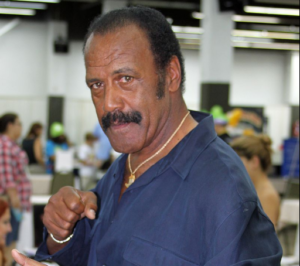
Fred Williamson Talks About His Film Career and the State of the NFL Today

They called him “the Hammer.” While playing for the Pittsburgh Steelers, Oakland Raiders and Kansas City Chiefs, Fred Williamson was one of the most feared defensive backs in the history of the NFL, finishing his career with 36 interceptions in 104 games. He retired in 1968.

That same year he followed fellow football star Jim Brown to Hollywood, appearing on such television series as “Star Trek,” “The Bold Ones” and “Ironside.” In 1971 he had a recurring role as the title characters boyfriend on “Julia.” He made his feature film debut in the Academy Award winning film “MASH,” and later appeared in several classic “Blaxploitation” films, including “Black Caesar,” “Hell Up in Harlem” and “Three the Hard Way.” He also appeared as a Vietnam vet in an episode of “The Rookies.” A few years later, that character was featured in his own film, “Mean Johnny Barrows.” The story of a troubled Vietnam veteran trying to make it back in the world, the film preceded “First Blood” by six years. The film was also Williamson’s directorial debut.

Since then, he has appeared in such films as “From Dusk ’til Dawn” and “Starsky and Hutch,” as well as a series of films featuring ex-cop turned private eye Dakota Smith.

Mr. Williamson will appear at the Kansas City Comic Con from Aug. 12-14. Prior to his appearance he took some time out to speak with me about his “rules” for making films, the state of today’s action films and why the NFL isn’t what it used to be.

MIKE SMITH: At age 78 you are still working steadily.

FRED WILLIAMSON: I make three movies a year.

MS: Is it as fun and exciting now as it was when you started your career?

FW: It’s more exciting because I control what I do now. Most of my films I direct and I write the stories. I hire three or four writers to write the script and I take the best parts from each writer and rewrite the whole thing myself. It’s more fun and more creative.

MS: Do you still make sure you get the girl and don’t lose a fight?

FW: That’s only two of my three rules. Number three is you can’t kill me either. You can’t kill me, I don’t lose a fight and I get the girl.

MS: I see you have another Dakota Smith film coming out.

FW: Yes, I have a new film called “The Last Hitman.” I also have a film that I made in Berlin called “Atomic Eden” and after that I have a film called “Check Point.” I have three films coming out in the next six months.

MS: You’re coming back to Kansas City this weekend. I assume playing in Super Bowl I would be your favorite memory of your time here. Do you have others?

FW: All the time I spent there in Kansas City contributed to my creative years in football. I had a great time in Kansas City. Kansas City was a challenge. You have to remember that this was in the 1960s, so the racial prejudice was very strong there and in other communities at that time. But for me that was motivation…it was what helped make me as great as I was. Someone telling me I couldn’t do something was an extreme motivator for me.

MS: Looking at the way football is played now – you can’t hit in training camp, only one practice a day, defensive players appearing almost afraid to hit for fear of being fined – do you think the game has gotten better or worse since you played?

FW: The game would be more expensive for me if I played today because I’d probably get a $25,000 fine the minute I stepped on the field. (laughs) The “Hammer” tackle would have gotten me kicked out of the game and fined $25,000. I think the thermometer is if you – the refs – can hear the tackle, it’s illegal. If you can hear the pads hit up in the stands, it’s a 15-yard penalty and a $25,000 fine for unnecessary roughness. It’s the changing of the game. That’s why you don’t see that many hard tackles now. Guys are reaching in and trying to stop them with their arms because they really don’t know how to tackle anymore. And these running backs are gaining more yards because no one wants to hit them. They run through arm tackles because most of them are strong runners so they just run through arm tackles.

MS: Nobody seems to know how to wrap up anymore.

FW: You can’t take a chance anymore. Wrapping up means laying your shoulder into him. You can’t wrap a guy up until you stop his momentum, and you have to stop his momentum by cracking him. But now if you crack him too hard it’s a penalty. How do you stop a guy without being able to hit him first? You can’t stop him with an arm tackle.

MS: How do you feel about the action films of today. Are they better now or worse then your films of the 70s and 80s because of being able to use computers?

FW: Computer things are boring, man. Who wants to see some guy jump out of an airplane and land on a moving car when you KNOW that’s not real? That’s not possible. To me it’s boring. They are losing their audiences because now the special effects are the star of the movie. Why do they pay a guy $20 million when the effects are the star of the movie? They need to go back to the days of Robert Mitchum. Gregory Peck. Richard Widmark. Burt Lancaster. Guys like that. You saw how they walked and how they talked. It wasn’t the fact that they could fly through the air or bounce off of a building or just miss getting run over by a car and then getting up and shooting the bad guy. No, no, no. Let’s go back to reality. There’s nothing real in those films.

MS: Thank you again for your time. I hope you enjoy your time back in Kansas City.

FW: I’m looking forward to it. I’ve got a lot of old friends there and a lot of former players that still live there so I’m looking forward to recapturing that experience.

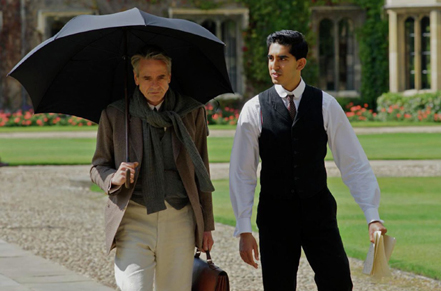
Director Matt Brown on “The Man Who Knew Infinity”

In 1914 a self-taught math genius named Srinivasa Ramanujan left behind everything he knew when he boarded a ship that would take him from his life in Madras, India to Cambridge University in England. He was drawn to the prestigious school via a correspondence with English mathematician G. H. Hardy who recognized Ramanujan’s enormous potential not just for discovering known theorems without any formal education, but for seemingly cracking brand new ones.
Their collaboration is charted in director Matt Brown’s new feature The Man Who Knew Infinity starring Dev Patel and Jeremy Irons as Ramanujan and Hardy. Despite the left brained subject at hand, Brown’s film delves further into the very human story of a man faced with living in an entirely new world. Patel and Irons make for a compelling duo experiencing a huge, but ultimately fruitful, culture clash. The pair are supported by a roster of talented actors including Stephen Fry, Toby Jones and Kevin McNally. The road from Robert Kanigel’s book of the same name to its film adaptation was one that took over twelve years to travel and Brown spoke with me on the phone about how it all came together (Spoiler: It didn’t involve shoehorning in an unnecessary romantic subplot!)

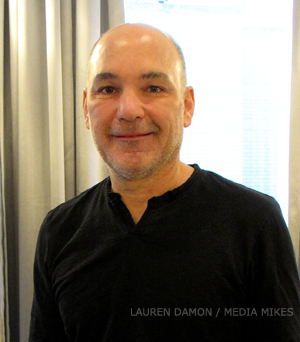
Lauren Damon: First off, speaking as someone who knows nothing about math, you made a very touching film!

Matt Brown: [Laughs] Thanks, I don’t know much about it myself so thank you.

LD: Since this is your second feature since 2000, how long ago did you come across Ramanujan’s story and what made you decide to make it?

MB: Well…my aunt was a member of a book club and about twelve years ago I was visiting her and she introduced me to Robert Kanigel biography. I had done a small film right out of school that I never really got to finish and so this was my first sort of opportunity to do a little bit of a bigger film–or we were hoping it would be–but it was a long road. I mean it was twelve years trying to get this film made so I sometimes joke that I think I was nervous to go through the process of having to make another film and I picked maybe the hardest film in the history of the world to try to get made. [laughs]

LD: I read that you had had an interest in World War One, which this story takes place during but it’s not really the focus…

MB: No it doesn’t, it’s just with–You know I’d read Birdsong by Sebastian Faulks and I was really fascinated by the period, as anyone that has read that incredible book might be afterwards, and this was set against the great war and that just sort of got my attention for a second look at it. Once I’d read it, I really fell in love with the human story and the relationships. You know, as a writer, you’re always looking for conflict and drama and it just had two characters that couldn’t have been any more different. So it drew me in. I was drawn into the isolation that Ramanujan was going through…This illness and everything he went through was something I could really relate to because I was helping caretake actually for my brother at the time. I was helping with his wife because he had cancer. He subsequently got better and wrote all the music for the movie, so it was a happy ending.

LD: That’s amazing.

MB: It was pretty amazing.

LD: There are many biopics that handle these mathematical geniuses–like Theory of Everything or A Beautiful Mind–did you look to any of those?

MB: Sure I guess like over the years, I couldn’t not have. You know it was over such a long period of time, and I’m a movie lover so I’ve them all at this point, I think! [laughs] And it’s funny because we all have perceptions of films and they’re not always totally accurate what our perception is of what the film was. I remember watching Beautiful Mind one time to try to see how they portrayed the mathematics visually in it. And it was shockingly small, the amount actually. It was like the one moment where he adjusts the tie, and he makes the pattern of the tie work. And it was like small and subtle. I don’t even know if there was another moment in the movie that did it besides doing lots of math on the chalkboards. People writing furiously. You know and I didn’t want to do that. I wanted to do a film that was organic. Anything we tried to do we wanted to do it in the camera. And it was really important to me to just portray the mathematicians as multidimensional human beings that weren’t crazy and weren’t like frenetically insane and were actually, you know, complex flawed characters. So I didn’t need to make it into something it wasn’t already. I think just trying to be authentic to what the story as more than enough. I mean this had so much drama: Man breaks caste, leaves his country and his home, gets trapped by the war, goes all the way to England only to find that the one person that brings him there is emotionally completely unavailable…And how these two had to come together.

LD: Throughout the film, so many of the actors have to speak so passionately about what their characters are working on. Did any of them delve into studying what they were talking about?

MB: Yeah they both spent some time trying to–Well, first of all I just would say it was really important to Robert Kanigel who wrote the book that I philosophically understood some of what was going on with the mathematics. And certainly I came to respect them as artists, pure mathematicians. It was really important to Jeremy and to Dev. Jeremy, I know read A Mathematician’s Apology, they both read the biography and I think that they both wanted to do right by this story. So they, they did a lot of research on their own and they worked with [mathematician] Ken Ono who came to set and worked with me while we were shooting which gave the actors a lot of confidence that the script was right. That when they would point at a formula or when they would look at the notebooks, everything was exactly right. And you know it’s one of those things that afterwards you know people always say that ‘well, the math people of the world will love your movie’ but I’m like ‘well, actually you don’t take that for granted.’ It’s really been humbling that I can have Freeman Dyson or Steven Strogatz be like ‘You got us. You did it.’ You know and that really means a lot to me. And so that aside, I want the movie to touch people that are not mathematicians. It’s very important that–that’s who I made for was for people like me or you or anyone that doesn’t know math and maybe we could just respect it as an art form and come to see their passion with it. Really the movie is about acceptance and the human story.

Jeremy Irons with director Matt Brown

LD: Meanwhile, I feel like Dev Patel probably wasn’t so much a household name until after Slumdog Millionaire in 2008, but you had the rights to the story for so long, how did that casting come together?

MB: I mean it’s been, it’s just been a process. I think when we started Dev was  you know just had  done [Slumdog Millionaire]. It was so long ago. You know, we went through different actors at different points over twelve years trying to get a movie made. But you know I think it was sort of–I have to think that there’s a plan for these things in some sense. And I knew that I wasn’t gonna compromise on the film in terms of the overall authenticity of it. I mean I’ve mentioned to the press at different times that [producer] Ed Pressman really stood by me when we had been offered opportunities to make the film if we would have Ramanujan fall in love with a white nurse to get it financed. And we didn’t do that. So I think there’s just a bigger plan at work and it happened the way it happened. Dev was ready to go at the right time and committed to it and felt like this was a character–he saw the nobility of the character and it was really important for him to play this role. And it’s a different kind of role for him than we’ve seen him in before and he does it brilliantly.  And for Jeremy, I think it was an opportunity to revisit something in a different way as an actor for him. And he, his performance is just so pure and beautiful.  I’m just humbled to be part of it.

LD: You also have an amazing supporting cast with Stephen Fry, Toby Jones…

MB: Yeah and Jeremy Northam, all those guys. You know, Stephen Fry is amazing–they’re all amazing–but Stephen you know he had his own project, for ten years trying to get it made,  and when we found out that we were gonna be making the film I reached out to him and I said do you wanna maybe join our team for this? And he did! And he flew all the way to Chennai for a weekend. Just took two days to shoot, to play Sir Francis Spring in it. And it was such a big thing for the movie to have the first time you see British actor to have that kind of gravitas that Stephen Fry could bring to it. That authenticity was a really great gift that he gave the film. But they were all wonderful.

Dev Patel and Stephen Fry

LD: How long were you filming in India?

MB: Not long, about nine days. Which was really…it was hard because it was an independent film and you obviously get compared to I don’t know, movies like–I mean, I’m really flattered anytime anybody ever mentions like the John Nash film for instance that was about fifteen times our budget [laughs] you know? So if it’s even in the conversation. But you know, we had a very short shoot compared to those kind of movies and we did twenty two days in England and then we had to say goodbye to our crew after we’re in a great rhythm. And then we switch to India, to Chennai, which is nothing like Madras in 1914. It was a real challenge and a brand new crew all of the sudden which is Indian and goes to a totally different rhythm. It was a tribute to my team–my production designer Luciana Arrighi, the cinematographer [Larry Smith], my costume designer [Ann Maskrey]– that they all came out alive and in one piece. [laughs]

LD: I’ve read now that you’ve also adapted an Ian Fleming biography, are you actively working with that?

MB: No that’s something I had written a while back. That’s, I’m not really sure what the state of that. I think that they said that that was going into production this year though so that was exciting. I have another movie called London Town that I think is in the Los Angeles film festival right now and then doing, I think it’s having a premiere maybe in Cannes. And that’s about falling in love with a band for the first time. A young man coming of age story with the band The Clash and Joe Strummer. Jonathan Rhys Meyers stars in that.

LD: That’s quite a change from Mathematics and World War One!

MB: Right? But you know what, it’s not though. That’s the funny thing, I thought the same thing then I was thinking about it more and more…It’s socially conscious kind of and it’s about artists, you know, so in a weird way it isn’t so different. But yeah, it is different because it’s a little easier on the face of it to rock out to Joe Strummer.

I screened The Man Who Knew Infinity as part of the 2016 Tribeca Film Festival. It is currently in limited theatrical release with national expansion in the coming weeks.

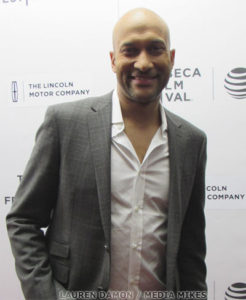
TFF: Keegan-Michael Key on “Keanu” and the Upcoming “Don’t Think Twice”

Keegan Michael Key rose to fame on Comedy Central with Jordan Peele on their hit sketch show “Key & Peele”. The television duo rode off into the sunset of that series this past September but they’ve already reteamed on the big screen in the action comedy Keanu which opens today. The film finds the pair fighting drug gangs to recover Peele’s character’s stolen kitten. Keegan was in attendance at this year’s Tribeca Film Festival to premiere Mike Birbiglia’s Don’t Think Twice which he stars in alongside Birbiglia, Gillian Jacobs and Chris Gethard. On the red carpet, the hilarious Key was glad to joke about working with the many felines of Keanu as well as his role in the touching improv-centric Don’t Think Twice.

Lauren Damon: So how was it working with that cat?

Keegan-Michael Key: The cat was super difficult. The cat—lemme explain to you—this cat, you wouldn’t believe how fast this thing became a prima donna like ‘Nah, I’m not gonna eat cat food anymore. I’m only going to eat caviar. The salmon has to be from Alaska.’ I mean, it’s like what are we doing?? It took like—I can’t believe we got the movie finished to be quite honest with you. [laughing] In real life, it was seven cats. So the thing is it was each cat was given the job of doing a particular thing. So some cats run from point A to point B. Some cats really relax and chill out in your arms and some cats put their paws up and go ‘meeeeow!’ All this kind of stuff. So they were actually not as hard as you would think. Especially for kittens. Like they’re trained. They always say it’s hard enough to ‘herd cats’ well, imagine herding kittens! But we had amazing trainers. Really amazing trainers. And a lot of kibble. [Laughs] Like a lot of cat food and catnip to keep ‘em in line. 

LD: Was it a relief for you coming off “Key & Peele” to get to work with Jordon so soon again?

KMK: Oh yeah! And also it’s easier even though a movie’s longer, it’s easier to play one character. You know, it’s easier because there’d be times you’d be in wardrobe and looking in a mirror but learning lines for a different sketch as you’re like ‘I’m dressed like an Egyptian pharaoh but these are the lines for the gangster!’ You know, and so just to play one character and have there be an arc was really helpful.

In Don’t Think Twice, Key plays a member of an improv troupe who snags a job on an SNL-like comedy show, seriously affecting the dynamic of the whole group.

LD: Did the theme of Mike’s film–that idea of “going above” your peers [in having your own comedy show]–resonate with you? Had you experienced it from either side?

KMK: Yeah, it resonates with me. I think that because you have to remember at the end of the day, do everything in your power to just to make it be about the work. Because the success will trip you up. If you start thinking things like you’re better than somebody it’s of no use to anyone. It’s not helpful, it’s not kind. And so I think that what I’ve been trying to discover or negotiate is just working. Work as hard as you can. If somebody else is at the same level or different level works—does work that inspires you, let that continue to inspire you, even if you’re ‘higher than’…you know? That doesn’t mean anything. That’s not real. Those are just labels. Good art is good art no matter what level it’s being made at.

The cast of Don’t Think Twice

Keanu opens in theaters April 29th (read our review here). The fantastic Don’t Think Twice is scheduled for release this July.

Tom Hiddleston and Susanne Bier Premiere AMC’S The Night Manager

Tom Hiddleston and Olivia Colman in “The Night Manager”

“The Night Manager” recently completed its first series run in the UK to much critical acclaim and strong ratings throughout. Fortunately for American viewers, the series gets its stateside premiere tonight on AMC. Based on John Le Carré’s 1993 novel of the same name, “The Night Manager” follows Jonathan Pine (Tom Hiddleston) an ex-soldier-turned-titular-customer-serviceman in a posh Egyptian hotel. He’s presented with the opportunity to help British Intelligence agent Angela Burr (Broadchurch’s Olivia Colman) take down jet-setty guest and illegal arms dealer Richard Roper (a superbly sinister Hugh Laurie) from the inside of his operation out. Outraged by Roper’s behavior, and with some very personal motivations as well, Pine swiftly accepts. What follows is a taut spy thriller that features an amazing cast that also includes Elizabeth Debicki and Tom Hollander.

The series premiere screened this weekend as part of the Tribeca Tune In series celebrating television. I caught up with Hiddleston and director of the series, Susanne Bier, for a quick chat on their red carpet.

Susanne Bier is an Oscar winning director (2011’s Best Foreign Language film, In a Better World) who was eager to take on this project in any capacity. “Well I mean, this project I would have done had it been a puppet show!” Bier enthused, “Because I love John Le Carre and I love the novel. But I was also very tempted to do TV. I mean the format of doing six hours as opposed to two hours was just really tempting and really interesting and compelling.”

With the show having already gone over so well in England, Bier was looking forward to opening it up to a new audience and maybe a new perspective on it:  “I think there’s always different perspectives. I mean American audiences are responding just as [excitedly] about it up til now, so I hope so!”

One of the chief changes made from the novel to the series was the switching of British Intelligence agent Burr from a male to a female character. For Bier “Part of it was updating it. Part of it was the fact that by updating it we could take it out of the sort of public school white heterosexual world and maybe actually have a bit of the diversity which is where the world is actually at.” And of the brilliant Olivia Colman, the director added: “And she was absolutely the right choice for it!”

Tom Hiddleston

With Tom Hiddleston‘s Pine reporting to Olivia Colman’s Burr, I wondered if the actor saw a pattern of his recent projects whereby his characters’ fate was in the hands of his strong female leads (Such as Jessica Chastain in Crimson Peak or Tilda Swinton in Only Lovers Left Alive) . Hiddleston—who, it must be said gave thoughtful answers to the entirety of this NYC press line— took some time to reflect on those roles before answering  “I haven’t thought about it consciously in the work. I mean…it seems very true to life, doesn’t it? For men to be in relationship to women? [laughs]” He paused again, “I don’t know that they are, how was it you phrased it? Their ‘fates were in the hands of women’–it’s an interesting interpretation!…It rings true to me that each character would have specific relationships to women, but I would never—I would have to think about it longer to think of it whether his fate were in their hands…It is a new interpretation and I’m not disagreeing with you. My point is I think everyone is responsible for their own actions and that responsibility in each of those characters is shared out. I think Pine’s responsible for what he does and he would never discredit Burr by saying that [the mission] was her idea. He does things on his own volition that he’s responsible for and Pine’s fate is in Pine’s hands.”

As for looking back on his recent characters, he did stipulate: “The only instance who I would say that you brought up is [Crimson Peak’s] Thomas Sharpe who is governed by a very toxic relationship with his sister and out of the sense of duty and codependency he feels trapped. But again, his fates not in her hands, I just would question…I suppose I’m being pedantic about phrasing. But I think everyone’s fate is in their own hands.”

Hiddleston not only stars in “The Night Manager” but he took on the more demanding role of executive producing as well which he “loved,” adding “It recomitted my engagement with the material in a very serious way. I loved the extra responsibility. Responsible for the story, for the script, for the thing running on time and it just gives you greater–to me–the extra responsibility made me give even more commitment. So yeah, hoping there will be more of that.”

The Night Manager premieres tonight at 10pm on AMC.


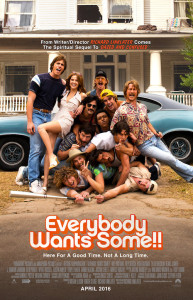
Sitting down with “Everybody Wants Some!!” stars J. Quinton Johnson, Glen Powell and Wyatt Russell


Described by its writer/director, Richard Linklater, as a “spiritual sequel” to his popular 1970’s set film Dazed and Confused, Everybody Wants Some!! follows the fun times being had by a small college baseball team in 1980. To promote the film, co-stars J. Quinton Johnson, Glen Powell and Wyatt Russell sat down with me at the Alamo Drafthouse Theatre in Kansas City. Johnson enters the room in full voice, performing a song he literally just wrote. Powell, the most outgoing of the group, sits between the other two, eager to chat. Russell, a former hockey player and the son of Kurt Russell and Goldie Hawn (he has his dad’s eyes) busies himself with his phone. And so we begin:

Mike Smith: What was it like going back in time to 1980?

Glen Powell: It was a transitional time and everything. Clothing. Presidents. Everything was kind of shifting and changing. Our relationship with the world was changing and I think this movies about guys who were shifting from either college to the real world or high school to college. And that shift not only in their world but in the world at large is what the film is about.

Wyatt Russell: So it’s AWESOME! [everyone laughs]. I mean we talked about the clothes and the hair and the music. I think everything was much sexier then I just love that era.

GP: Nowadays we have social media…smart phones… so when you go to parties today everyone has their phone out to show how good time they’re having. But in that era it’s like having a good time with these people right here.

WR: I’m at the Bieber concert!

J. Quinton Johnson

J. QUINTON JOHNSON: I’M AT THE BIEBER CONCERT!!!

[Note: Justin Bieber was in Kansas City the same week as the guys]

GP: And when we’re having a good time, we’re also athletes on the dance floor. Rick [director Richard Linklater] told us that back then athletes were peacockers, in every sense of the word. When I was an athlete, we were almost wallflowers. You go to practice and then you go home and do your thing. I mean these guys are drinking beer. Today it’s much more competitive.

JQJ: You’re not going to be out at the club.

WR: I played hockey. When I played in Europe it wasn’t a problem going out for a few drinks. But when I played in the states it was pretty rigid. Back then it wasn’t for a career you were going to make a lot of money and become a brand and sell a lot of clothes.

GP: Rick also talked about the body type of an athlete back then. Today everyone takes supplements…they’re all almost like Adonis, they’re all shredded. Back then Rick said we would’ve been in what you would call pretty good shape. I mean you are athletes but you just don’t look like one. It’s a different body type now.

MS: Was it easy to film the baseball scenes? I mean you all had participated in athletics before, right? Wyatt, you played hockey…

JQJ: I played basketball.

Glen Powell

GP: I played football. On the set we would have baseball practice every morning. We had a couple guys who had played professional ball. One had played for the A’s, and a couple of played in college. So those guys helped out the guys who might not have had that much baseball experience. We also had to do a skills video as part of our audition. I think Quinton had the most entertaining non-baseball video.

JQJ: I mean I was an athlete. I could catch a ball. I could throw a ball. But I wasn’t a baseball player and Rick knew that instantly. So what I did is I added more flair as an artist. Again I played basketball so I threw a dunk in there. And I kept trying to throw in more as a person. I was juggling. I had a shot of a dog running through the park, set to the tune of Thin Lizzy’s “The Boys are Back in Town.”

GP: I was filming Ride Along 2 so I went to a batting cage and filmed mine. And then I just laid a bunch of 80s music on top of it. Mine wasn’t nearly as fun as yours.

Wyatt Russell

WR: I had like five minutes to do mine because I had a go somewhere. The casting director called me on Friday and said you have to have it in… By 5 o’clock… On Friday. It was a big festival going on and all my friends were out of town. I didn’t even have a baseball glove. So I ended up going to my brother’s house and had him film me using my seven-year-old nephew’s glove.

MS: The film is full of great 80’s music. Did you listen to any particular songs to get into the feel of the era?

GP: Yes. Rick gave each of us and iPod nano with 100 songs from 1979 and 1980 on it. And so were ever we went… whatever we did… we listened to the music. And if we are in his game room playing ping-pong we listened to the music. It was a big part of getting us in tune with the times.

Everybody Wants Some!! is now playing in select cities. For tickets, visit everybodywantssomemovie.com

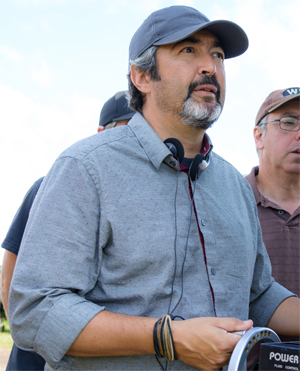
Director Jon Cassar Talks About His New Film, “Forsaken” and the Possible Return of “24”

You may know the name Jon Cassar from his Emmy Award winning association with the popular television series, “24.” But when he’s not putting Jack Bauer through his paces, he’s taking the reigns of one of the best Westerns of the past decade.

“Forsaken,” which Mr. Cassar directed, boasts a strong script and an even stronger cast, including Donald and Keifer Sutherland, who star as father and son. Mr. Cassar took some time out to talk to me about “Forsaken,” the return of the Kennedys and what may be next for “24.”

MIKE SMITH: What attracted you to “Forsaken?”
JON CASSAR: Actually I was there when the project was born. A few of us were sitting around on the set of “24” talking, waiting to set up a shot when we started asking each other, ‘what would be a great thing to do once “24” ends?’ Eventually we all decided, ‘let’s do a Western together.’ So that’s really where it started. Once we decided on that Keifer came along. He wanted to do a film with his father so everything just worked. I’m happy to say that I was there at the inception. We got a brilliant writer (Brad Mirman) who not only wrote us a classic Western but also a touching father/son story. So by then I had Keifer, I had a great script and THEN I get Donald Sutherland? There’s no way I wasn’t going to be involved!

MS: Any trepidations about taking on a Western? They seem to be so hit and miss these days.
JC: Yeah, of course. I mean you do worry about it. I mean at one point it was the most popular film genre’. The most popular television genre’ also. I mean, it’s amazing how many popular television shows were Westerns. But it did, of course, begin to fall out of favor, all though it is making a little bitty comeback over the past few months. But you’re right. But I knew I had a great Western story. And I knew I had a great father/son story that people could connect with. I knew that relationship was really the heart of it and if we did it right I knew if would connect. And it’s fun doing something that isn’t a true CGI film. It’s fun doing something where the effects are more simple.

MS: What was it like as an observer to watch Keifer and his father work together?
JC: It was great. I’m very fortunate to have had a front row seat to watch Keifer and Donald working together. From the first time it was fantastic. They are both veteran actors and, in my opinion, two of the best actors of our time. To watch them work together was a pleasure. As it was watching all of the actors. Demi Moore. Brian Cox. Michael Wincott. They are all so experienced. I was very lucky to have a front row seat and watch them work.

MS: Keifer. Michael Wincott. Greg Ellis. You used quite a few of your “24” company in the film. Was that because you already had a good familiarity with them and their work?
JC: Absolutely. First of all, you have to know that all of the actors in the film were basically my friends. I didn’t have a studio dictating who was going to play what part. We actually got to pick who we liked. A lot of them were Keifer’s friends. And of course, by having done “24,” they knew me so it made the connection easier for sure.

MS; The recent return of “24” was very successful. I’ve heard rumors that Fox is considering re-booting the show. Is that something you plan to be involved with?
JC: Nothing is official yet. I am involved and we have talked. I can say that if it goes forward I won’t be involved in the pilot but I do hope to be involved in the series. However, at this point I’m not.

MS: What else are you working on now?
JC: A few years ago I did a mini-series called “The Kennedys,” which was an eight-part mini-series that starred Greg Kinnear as JFK and Katie Holmes as Jackie. We’re doing a sequel to that, called “After Camelot,” based on a book. It will deal with what happened to the Kennedys after John and Robert died. It’s mostly the Jackie story and it follow her during her marriage to Onassis as well as John Jr. and Ted Kennedy. It will encompass all of that history. We shoot that soon in Toronto. It will run on the Reelz Channel. It’s actually a fun project for me to do because we’re re-creating all of the history that we all grew up with.

Chantel Riley Talks About Broadway’s “The Lion King” and Her Role in the New Film “Race”

Born in Toronto, Chantel Riley’s path to stardom began when she realized she wasn’t doing what she truly wanted in her life. She is now. Since 2012 she has starred as Nala in the Broadway musical “The Lion King” and last year was able to take time off from the show to begin her movie career with a pivotal role in the new Jesse Owens bio-film RACE.

During a break in her busy schedule, Ms. Riley took the time to speak with me about the physicality of “The Lion King,” her role in RACE and why one day she hopes to be able to “ease on down the road!”

MIKE SMITH: Tell us a little bit about your background? How did you end up on Broadway?
CHANTEL RILEY: I’m originally from Toronto and I went to University in Toronto. After school I pretty much got a 9-5 job but after about a year and a half I realized it definitely wasn’t my thing. (laughs) Because I was a performer. I had taken dance lessons and I had grown up singing in my church. I just had an idea that something else was out there for me. I had no idea what it was but I knew I needed a change. A friend of mine told me about an open casting call they were having in Toronto for “The Lion King.” I had never auditioned for anything before in my life. This was my first time doing anything like this. So I went to the audition and got a few callbacks, which was very exciting. I had a couple well extended lunch breaks…I kept having to go downtown for these callbacks. A couple months later I got a call from my agent and they wanted me to audition to be part of the cast of “The Lion King” in Germany. So I flew to Germany, did the audition and booked the job on the spot. I did the show there for about a year and then I auditioned again for Julie Taymor, who directed “The Lion King” on Broadway, and was offered the role of Nala in New York on the Broadway stage. And here I am!

MS: So basically you’re just like Shirley Jones…you just show up and you’re on Broadway!
CR: (laughing) Exactly!

MS: You’ve portrayed Nala for quite a while now. Do you have to prepare anything special for yourself to keep the performance fresh? I can imagine doing the same thing 8 shows a week for a couple of years might get boring after awhile.
CR: Yes I do. I keep occupied by taking classes and making short films. These things keep me thinking outside the box. I also use what I learn from the classes and the films and bring it with me on the stage. It gives me a new sense at how I look at each performance every night. And this also gives me the chance to try something new. Every night we have a new audience. So it’s a great way for me to try new techniques and to find different ways of performing.

MS: I’ve never seen the show on Broadway but I’ve seen photos and the occasional video clip. It’s a lot more than just standing on a stage and singing. Is the show more difficult physically as opposed to musically?
CR: The show is very physical. We’re constantly on stage and we play lions and zebras and other animals. My role has me constantly running around. If Nala isn’t jumping on-stage she’s jumping off-stage. There’s a lot of activity. AND singing. I sing two songs in the show. We sing live and the dancers are moving non-stop. So it is a very physical show.

MS: You have an important role in the upcoming film RACE. What is your character’s relationship to Jesse Owens in the film?
CR: Quincella Nickerson was someone who was very close to Jesse Owens. She was not only his friend but a huge fan of his. She was a socialite whose father owned a huge insurance company in California. At that time that was pretty huge…that an African-American could be that affluent. She spent a lot of time with Jesse…attending parties and things. There were rumors going around that she and Jesse were engaged to be married. They spent a lot of time together. So we see a lot of that in the film…a lot of her in the film.

MS: If you could play one role on Broadway, either current or a show from the past, what would it be?
CR: Definitely Dorothy from “The Wiz.” I think that would be such a fun role. It would be so exciting. And it’s such fun music. That would be so much fun!

MS: What do you have coming up next?
CR: I’m working on a new short film with James Brown-Orleans, a fellow cast member from “The Lion King.” We’ve done a lot of short films together. Our most recent film, “Teacher’s Nightmare,” just won the Wendy’s International Short Film Award for Best Drama. That’s pretty cool.

A Conversation with Deadpool’s Greg LaSalle

If you’ve made the right decision this Valentine’s Day weekend and have checked out Deadpool then you may not have heard Greg LaSalle but you definitely saw him. Sort of. LaSalle is one of the tech wizards behind the Academy Award winning MOVA Facial Performance Capture system used in bringing Deadpool’s X-men reinforcement, Colossus, to the screen. While Colossus’s body and voice were provided by actor Stefan Kapicic, LaSalle stepped in front of the MOVA cameras to give the metallic facial performance.

The morning after Deadpool made its New York debut amidst a Deadpool fan costume contest, I sat down with LaSalle for a conversation on Deadpool, other Marvel films and this amazing process used to bring characters such as the Incredible Hulk and Thanos to life.

Lauren Damon: Did you go to the fan premiere last night?
Greg LaSalle: Oh yeah, that was a lot of fun.

How many Deadpools showed up?
LaSalle: Oh you mean the people who dressed up? Oh I don’t know, I think there were quite a bit. I think they chose like seven of them or something, it was pretty funny. One in a tutu, I mean…it was hysterical.

Are you someone who goes to conventions in general seeing that?
LaSalle: No–
“Avoid them like the plague!”
LaSalle: [laughing] No, it’s not that, you know it’s just I have so many things to do. I don’t get a chance to do that very often.

Can you talk about what MOVA Facial Performance Capture is?
LaSalle: I’ll start by telling you first a little bit about what motion capture actually is–which is where you would wear the reflective markers. And that system, those systems were actually developed to deduce where a skeleton is moving. So as those cameras became higher resolution, people started shrinking the dots and gluing them to people’s faces. The data set you get from that is only like 200, 250 points. So a friend of mine in the bay area decided that he would fund the development of research to find out how to actually capture the entire surface of the skin deformity and that’s where MOVA comes from. That development.

So it’s super high resolution, it captures about 7000 data points, all the wrinkles, all the subtlety of the performance is captured. So it’s basically like capturing a scan per frame of the film of the actor. And then about two years ago Digital Domain developed a technique to take those and apply them mathematically to a computer generated character. So the entire performance gets carried over so it really looks, you know, all the performance is captured.

I heard that it’s captured through paint instead of dots?
LaSalle: We apply, it’s invisible makeup in white light that just is applied as a random pattern and then the system has strobing black lights and white lights. So certain cameras take a picture when the black lights are on and all they see is this random pattern makeup. And that’s what’s used to create the scans and track the points across the face.

Seeing as you worked on both Avengers and Age of Ultron and a couple years had passed between them, did the process for capturing the Hulk change? If you worked on the Hulk?
LaSalle: I did, in the first Avengers that’s what it started out as actually, it was before filming was working with Industrial Light and Magic to capture Mark [Ruffalo] to see how he would move as the Hulk. On set they used a bit of different technology so this new technology that we used for Colossus is actually the first time it’s been used. This mathematic transferring of the performance. Things like in the past, like in Avengers, we surveyed the actor. We’d get all the information about how the actor’s face would move and then companies would build a rig which is just a way of animating and when you run a slider, the lip goes up and it goes up as if it was the actor. But it doesn’t have all the subtlety and nuance of the variation in a performance. The new technology the does.

Did you have any hand in that Hulk-smashing-Loki scene?
LaSalle: Well we only specialize in the facial stuff, so only the expressions part of–but that was my favorite part of the first Avengers movie. That ‘boom boom boom!’ [LaSalle does some pretty accurate Hulk smashing motions] It’s a shame though to see Tom Hiddleston beat up like that because he’s such a nice guy.

You captured his face for that? Wasn’t it just grunting?
LaSalle: Yeah yeah…It’s so many years ago now and we’ve done so many things that I can’t remember exactly what we did. If I remember correctly, they put a pipe with some foam on the end and they kept [jabbing motions, laughing] like they’re pushing the back of [Tom’s] head so that he’d [jerks his head]…It was very strange!

What did you work on for Age of Ultron?
LaSalle: Actually I only did the–Thanos. Working with Josh Brolin.

Also on Guardians of the Galaxy too?
LaSalle: Mhmm.

I don’t know if Marvel would let me ask you but when is he coming back?!
LaSalle: That’s really funny because I was convinced while we were filming Age of Ultron that they’re gonna–I just have this feeling that something will happen. I mean he’s like the baddest dude in the whole universe and they have to do something–

Yeah coming up of course we have [Captain America] Civil War, that’s Earth-bound but [Thor] Ragnarok is coming and that’s out there! He’s waiting in the wings…
LaSalle: I mean I wish I could say. I’m not privy to those kinds of things to begin with. But it would be really cool to see a bad ass movie with Thanos. I mean they have so many characters and so many things to do. Kevin Feige–he’s the president of Marvel–knows this universe probably better than Stan Lee and he has this all mapped out in his head. He knows exactly what he’s doing.

Do you keep up with the other projects in between what you’re working on?
LaSalle: I don’t actually like actively keep up. I look for within the industry, what we could work on and how we could pull things off.

So working as Colossus, you’re performing his scenes and they just transfer your face into his?
LaSalle: Yes, in simple terms, yes. It creates a scan first and then this fancy math transfers that by figuring out where–you teach it ‘Okay, this is where the center of my cheek is and this is the center of where Colossus’s left cheek is’ and it mathematically calculates what else is going on in that area. It transfers it.

How did it come to be this split performance where you’re on the face and Stefan Kapicic provides the body and voice?
LaSalle: Tim Miller understands this technology really well, so he figured he could take the best of what different people had to offer and Frankenstein all that together. And he was adamant about having an authentic Russian voice. I believe he even recorded another and he just didn’t like it and then he found Stefan. And I think it works extremely well. It’s a pretty cool way of using the technology.

What was the most fun about being Colossus?
LaSalle: Well I’ve known Tim for a long time and I just like working with him. He’s fun, he’s actually a lot like Deadpool in his comedy and the way he’s sarcastically funny. So I enjoy working with him on that. But I also did the tests which we did like six years ago so it’s been really awesome to see it finally get made. So just the general overall feeling of being happy about that.

Was Tim involved at all in how Deadpool was treated in [2009’s] Wolverine?
LaSalle: No

Was there discussion about just getting away from that entirely?
LaSalle: Tim is a huge comic book fan. He reads a ton, he likes graphic novels. He knew that he wanted to take what’s on the page and have that be what’s in the film. He wasn’t going to mess with it, he wanted to–as a fan he knew that that’s what everybody wanted to see. That’s what he wanted to do.

How instrumental was Ryan Reynolds also in getting this?
LaSalle: I think it was a collaborative effort because they all have their understanding of the character so they–and Tim is great that way. I know he had people that they discussed it: ‘This is what I’d like to see, this is what you’d like to see’ and then they figured out a way to get that all to happen.

This is your second time in front of the camera [after an appearance Night at the Museum: Secret of the Tomb] is this what you’d like to do more of?
LaSalle: Well I think it’s fun, I’ve been acting for a while and that’s why Tim gave me the part. But I like to do both. I think it’s fun to play the computer generated characters because you get to do really wacky stuff. And then but I also like really small, intimate type live action things. So I’ve been shooting a few short things.

What’re some of your favorite films this past year?
LaSalle: Oh, I liked the Big Short, I liked Trumbo if you’ve seen that. I thought Trumbo was really good.

Yeah, it was weird to watch that in the context of “Award season” since there’s so much of Oscar in the storyline…
LaSalle: I know! You gotta block all that stuff out. Well it’s so interesting too. I mean it’s doubly cool that it’s true.

Do you have more acting roles coming up?
LaSalle: I just finished filming, ironically with Blake Lively [married to Reynolds]. A movie with her called All I See is You which there’s what we call invisible effects. It’s a live action movie but they wanted to use this new technology to drive her newborn baby being born and a character that she sees in her head. So I played both of those parts.

Playing a fetus?!
LaSalle: Not the fetus! As soon as it’s born I had to do the scenes of taking the first breath of screaming and crying and opening the eyes and looking around. They wanted all this subtlety. They figured a live performance would do that more than trying to animate all that subtlety into it.

[This next question features discussion of a specific Deadpool moment, so for the SPOILER-shy, skip down past this one!]

Does that mean you had anything to do with Deadpool regrowing a baby hand? [A brilliant moment after Deadpool cuts his off to escape Colossus’s handcuffs]
LaSalle: (Laughs) No! No. It’s so funny because I’d known that he cuts his hand off for a very long time but I never go to see anything–I only knew because Colossus ends up with his hand. And I never knew what happened. So when he cut his hand off, the first time he saw the movie it was like ‘OK now how does it grow back? How does it grow back?’ And then they even made that funny, it was awesome. I didn’t know what to expect because I don’t like to see the movie until they’re completely done because there’s just so many things that pull you out of it, you know? So I wanted to wait til it was done and I think that all this talk–the blood and the guts and the R-rating, it’s perfect. I don’t care!

It would be weird if you had this much violence and then just no blood, it’s annoying when PG-13 movies do that–
LaSalle: Plus it’s there because it needs to be, a couple of short seconds and it’s not gross. It’s just real.

[Spoiler over!]

Back to Deadpool , considering there are so many films now in the ‘Marvel Universe’, what do you think is most appealing about this character, what does he bring?
LaSalle: Well I think his authenticity to the original character. And the comedy. I mean I think there’s a lot of funny stuff in the Avengers movies and some of the other stuff, but that’s what Deadpool’s character is built around. And I think that that just makes it’s different and stand out.

If Deadpool had to be pitted against any of the Avengers, who do you think would win out?
LaSalle: Oh…This might sound bad but I think Deadpool is way smarter than those other characters. So I think he’d win a lot of stuff. Because he thinks differently than they do.

Tommy Wiseau talks about “The Room” Rifftrax Live, James Franco in “The Disaster Artist” and his Hulu series “The Neighbors”

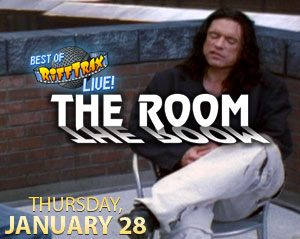
Tommy Wiseau is the director, producer, writer and star of the cult classic film “The Room”. Since the film was released back in 2003 it has achieved “Rocky Horror” like fame playing to midnight screenings non-stop to a huge fan base. Some called the film one of the worst ever made but true fans see “The Room” for what it really it, which is fun! The film was parodied live by the Rifftrax gang last year and is heading back to theaters again on January 28th, 2016. Media Mikes had a chance to catch up with Tommy again to discuss “The Room”, James Franco playing him in “The Disaster Artist” film adaptation and what else he is currently working on.

Mike Gencarelli: Tell us how you feel about “The Room” being parodied by Rifftrax Live?
Tommy Wiseau: Yeah they reached out to me about a year ago about doing it. I liked what they did, I mean, I don’t support parts of it 100%, but it does show how fun “The Room” is. People take things too serious and the film isn’t made to be serious, it is made to be fun. If you haven’t seen the Rifftrax Live version of “The Room” in theaters, I would recommend it highly when it comes around again January 28th, 2016. And bring a big group of friends with you as well.

Mike Gencarelli: The film has been out for 13 years now, are you ever taken back by the continued interested in it year after year?
Tommy Wiseau: Yes, I am still surprised. I am happy that people are still talking about it and still seeing it in theaters. I also have been working a few new projects as well that I am excited for fans of “The Room” to see as well. I love touring with the film across the country. I usually show “The Room” and an episode of “The Neighbors” as a double header. It is a lot of fun to do and also getting to interact with the fans.

Mike Gencarelli: Last time we spoke back in 2011, you mentioned you were planning a 3D release for “The Room”; can we expect that soon?
Tommy Wiseau: Yeah that is something that I have wanted to do for a while. Making a film into 3D is definitely not an easy process. So yes, I still want to release “The Room” in 3D, but right now I am not sure if I want to reshoot the entire film in 3D or just convert it. But I am definitely still planning and exploring my options. Right now James Franco is making his film of “The Disaster Artist”, so I will let him have that and then I will focus more on the 3D after it is released.

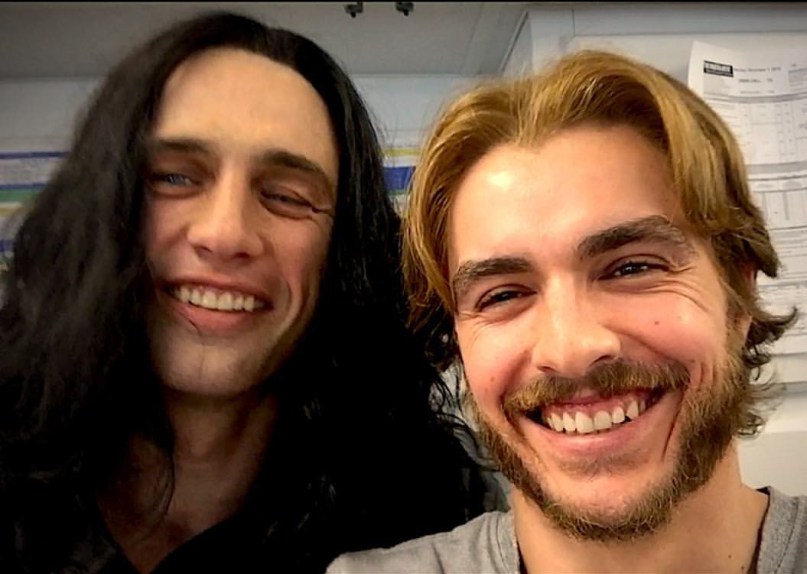
Mike Gencarelli: Speaking of that, tell us about your feelings on James Franco playing you in the film adaption of Greg Sestero and Tom Bissell’s book “The Disaster Artist”?
Tommy Wiseau: I think James is one best actors in the business. I feel good that someone like him is playing me. Of course, I also feel a little like they are taking something away from me since it is based around my life and my movie. I hope that this is a big success for James since then in return I think it will also then bring more people to “The Room” and that’s good.

Mike Gencarelli: Exactly, I think that this will put your film back in the spotlight and also introduce it to a new audience…
Tommy Wiseau: Yes, exactly. I am hoping about that. James and his brothers are doing a very good job so far and I am excited to see it when it comes out later this year.

Mike Gencarelli: Do you have any involvement or input on the upcoming film?
Yeah James did speak with me about the role and I gave him some tips. My life is very complex but I believe he will do a good job. I also have a small part in the film as well, which is cool.

Mike Gencarelli: Did you enjoy playing the villain Linton Kitano in newly released “Samurai Cop 2: Deadly Vengeance”?
Tommy Wiseau: It is always great to play a villain, I loved it. This film was a very fun experience for me I can tell you that.

Mike Gencarelli: Your TV series “The Neighbors” has aired 6 episodes on Hulu; any plans for more episodes on that format?
Tommy Wiseau: Yes! Currently 6 episodes have aired on Hulu and the fans really have been excited about what we have so far. I am currently working on another 6 episodes for Hulu. We have been also exploring releasing the episodes in animated format as well. So that is something that we were trying and it also getting a good response. I hope to have the next 6 episodes on Hulu by the end of 2016.

Mike Gencarelli: You did a Reddit AMA last year where you mentioned a new project called “The Foreclosure”, what can you tell us?
Tommy Wiseau: Yeah that is a project that I am currently working on as well as “The Neighbors”. “The Foreclosure” focuses on the housing market right now and looks into the current situation that we are facing today with people not being able to pay for their houses and being forced to foreclose. It is a current topic. There is also another project that I have that is currently untitled but that I cannot talk about right now…maybe in about 3-4 months, I can. But a lot of very excited stuff coming up for my fans!

A “Hateful” Conference with Quentin Tarantino, Kurt Russell, Jennifer Jason Leigh and More

Quentin Tarantino’s eighth film, the aptly titled Hateful Eight, is now open in its limited release ‘Roadshow’ engagement for the next two weeks across the US and Canada. For film lovers, Tarantino is harkening back to a style of movie presentation in ultra wide 70 millimeter film that comes complete with a musical overture and intermission. It’s a must for Tarantino fans and I can’t wait to revisit this shocking murder mystery in the old west very soon.

Hateful Eight centers around ‘Hangman’ John Ruth (Kurt Russell), a bounty hunter chained to his bounty, the devious Daisy Domergue (played with absolute venom by Jennifer Jason Leigh). The angry pair’s stagecoach is stranded in a blizzard in the mountains of Wyoming en route to Domergue’s date with the gallows. They take shelter at the only inn midway to their destination where they are locked in with a host of other shady stragglers bearing their own secrets. Tarantino ratchets up the claustrophobia and tension from an extremely strong screenplay in the hands of a brilliant cast.

Seven of the Eight joined director Tarantino and moderator Josh Horowitz (MTV) prior to the film’s release at their New York press conference where the enthusiastic director discussed his thoughts behind the roadshow format and basically received high praise from his all-star cast including Russell, Leigh, Bruce Dern, Tim Roth, Michael Madsen, Demian Bichir and Walton Goggins.

Tarantino, an emphatic supporter of film over digital described how he and The Weinstein Company set up the Roadshow:

QUENTIN TARANTINO: The Weinstein Company has done an amazing thing–Just to put it in perspective, Warner Brothers put their entire weight behind Christopher Nolan when he did Interstellar. Never the less, they only played in about 11 venues in the course of his 70mm run, we are playing in 44 markets in 100 theatres with our roadshow. And not only that, they literally are some of the biggest and funnest big movie palaces still left. Like you know, The Music Box in Chicago, The Hollywood Theatre in Portland…I think it’s the Fox Theatre in Detroit, Cinerama Dome for 2 weeks in Los Angeles…It’s just really wonderful. And the places that didn’t–all the places that have 70mm capabilities we utilized them, but then other places we just moved the screens in. And moved them in and created it and I remember even talking about it when we first had a discussion. It was like ‘We should be like Neil Diamond coming into town…we should be like Book of Mormon coming into town!’ We go into big venues and maybe they don’t even show movies anymore but we’ll set up our big screen and we’ll set up our projectors and we’ll let ‘er rip! And I mean it has been a herculean effort but they pulled it off. We are screening in 100 theatres between US and Canada. I’m very very proud…

We’re trying to do this like the old school roadshows where…the normal version of the movie that plays, the normal release version–which, by the way when you think of movies like Laurence of Arabia or Ryan’s Daughter or anything, we’ve all probably seen the regular release version–but the roadshows had an overture, they had an intermission and they were a little longer. Ours is about 7 mins longer just for the roadshow version. But you also get…really cool programmes. And they all come with their own pin up ready for your locker of different Hateful Eight people.

Past Oscar nominees Bruce Dern and Demian Bichir were thrilled to be working with Tarantino for the first time and spoke about the opportunity to do so:

DEMIAN BICHIR: I think you know, the first that you’re curious about [is] how everything is gonna work out. Not only because you have this huge director’s name in front of you but with this amazing cast of actors. I remember the first time we had this table reading, you always want to one day say a Tarantino line on film, so I was already very happy and excited about it. But then to listen to every single line in the mouths and bodies of all this group of fantastic actors, that was beautiful. And not only that, I remember at the first reading that we had at this hotel back in Los Angeles, going back home and telling my girl everyone is so damn fucking nice! Because you know, a small fish can be lost in a big ocean unless they embrace you, unless they treat you well. And the first thing that made me very happy when I actually met Quentin was to find a warm man, a very generous loving man, and then you know, the whole thing was a confirmation of whatever I’d thought always. You know, the biggest artists are the nicest.

BRUCE DERN: I’ve been very lucky in my career but this guy, he does a couple things the others of the people I’ve worked with didn’t do: He has the greatest attention to detail I’ve ever seen…The other thing he does is he gives you an opportunity as an actor and everybody behind the camera as well a chance to get better. A chance–his material is so good, so original, so unique if you will, that the big part of it is you’re so excited that he chose you and NOT Ned Beatty or Jimmy Caan [laughs] So that you’re excited to go to work every day. And like with Mr Hitchcock for a few days, I had this every day with Quentin. You’re excited to go to work every day because he just might do something that’s never been done.

Later DERN added: I think that if there’s one thing I might say, the man obviously has a magnet. And what the magnet does to actors is you’re so drawn to him. And we haven’t brought up my main reason why is his reverence for what went before. His respect for the industry…is just mind boggling. And he means it. And if you dared question him, he will put you in your place and tell you facts about stuff that you never even knew was made. And that was the delight for me. And there’s that kind of thing you don’t get very often.

Joining Tarantino again were former Reservoir Dogs Tim Roth (also of Pulp Fiction) and Michael Madsen (featured in both Kill Bills). These ‘vets’ talked about re-teaming with him.

TIM ROTH: Well, I mean the man is the same. But yeah, I was around sort of at the very beginning and then I have this huge break from working with him. So I did get to see in a highly impactful way how his world has changed. How his, the set has changed…and the kind of circus atmosphere that kind of exists on his set. The crew has so much more knowledge of cinema and how to tell his stories. So I saw that big leap. And that was very exciting. It’s different, when we made Reservoir Dogs, I think we made it in about five weeks or so.

TARANTINO: In particular the case of Reservoir Dogs, I was probably the–along with the PAs–I was the least experienced person on the set. Tim and Michael both made a lot of movies by that time. I was just getting through the process.

ROTH: Well you did pretty good!

MICHAEL: Thanks Quentin, I wouldn’t even have a career if it wasn’t for you.

MADSEN elaborated on how he viewed his role as the shady ‘cow puncher’ Joe Gage: I read a biography of James Cagney and he said that if you play somebody who’s very noble, you should probably try to find a mean streak in that person. Or something dark that they’re carrying around. And if you play somebody who’s very evil you should probably find something good in that person. So there’s always a duality of what you do. And the best thing about making a picture for Quentin is that he let’s your character have a duality. If you’re capable of doing it.

Death Proof‘s KURT RUSSELL spends much of Eight chained to Tarantino newcomer JENNIFER JASON LEIGH, Russell explained working within this dynamic.

KURT RUSSELL: Well, first when Jennifer and I started to rehearse, we didn’t really think there would be much of a problem with the chain. We didn’t think it would represent anything much either and nothing could have turned out to be further from the truth. Everything that we did was informed by how that chain was dealt with. And so we had to learn to sort of get the Fred and Ginger of it all together. And that informed their relationship. So for me there was John Ruth and for Jennifer there was Domergue and together we were gonna be this team. Which we felt there was, like anything else, if you’ve been chained together for a week-week-and-a-half, 24/7, you’re gonna know about that person. And the Stockholm syndrome’s gonna set up pretty fast. And it did. In fact over a five month period of time, the Stockholm Syndrome between Jennifer and I set up. It informed everything that we did…
I just want to say one other thing and we haven’t said this but, it was an unspoken thing, this will be the first time she’s heard me say this: Because of who John Ruth was, everything when that clapper goes bang, shouts ‘Action’, that chain is MINE. I own it. Because of that, I felt that as soon as ‘Cut!’ that chain was HERS. We had to have a balance. And boy, I’ll tell you something, I really appreciated what she was going through. You turn that chain over to the other person, it wasn’t easy.

JENNIFER JASON LEIGH: I’m not as good a dance partner!

THE HATEFUL EIGHT

LEIGH elaborated on delving into the character of Daisy:
So much of it obviously is on the page because you’re dealing with such a great script and such a great character. With Daisy there’s a lot that’s mercurial and we had to find. And we wanted to find it together. And so much of Daisy is informed by John Ruth because she is always reacting with him because of what he’s done–The chain, the hits–what might she get from that. Where, you know…she thinks she’s a lot smarter than John Ruth, and actually she is. [Laughter] But there was–she kind of feels like she’s playing him a lot of the movie but there’s this one moment in the movie– and this is what’s so great about doing a Tarantino movie and what’s so great for all of us actors is that we’re always being surprised by everything–There’s a moment where it all shifts. Where John Ruth isn’t just a putz. You know, like a fool that she is just so much smarter than. He’s suddenly very smart and very dark. When he goes and gathers all the guns from everyone. And then she has to rejudge him, just like everyone else in the movie. Everyone in the movie is terrible and hateful. Everyone in the movie you also care for, they have their…maybe their weakness is the good part of them in a certain way…And I just remember the day we shot that scene ’cause Daisy is having a blast. I mean, yeah, she’s going to the gallows but she knows she’s not going to the gallows. She’s got it figured out. But in that moment, it’s not so clear anymore. And that was so exciting as an actress, to not know that was coming. To read it on the page and yet when I felt it happen in the room, I swear my blood went cold. And it was just like phenomenal.

WALTON GOGGINS, who plays Chris Mannix, the new Sheriff of the town (and in my opinion the MVP of the Eight if we had to choose one) also praised Tarantino’s scripts when asked if there was ever any improv of alternate line suggestions:
GOGGINS: There’s no improv in this press conference. He wrote everything. [Laughter] No, no, why would you mess with perfection? You know, we say that because it is. You know it’s every actor’s dream to get an opportunity to say a Quentin Tarantino monologue. Or a line of dialogue. But there is no need to change it. Even to add a ‘the’ or an ‘and’ or a comma, it really is perfect the way that it comes out of his imagination.

Eight actually went through a few drafts, especially after a live read was held in 2014 featuring much of the cast. I asked Tarantino how that live read affected how the film ultimately turned out:
TARANTINO: Well we altered a lot because it was only the first draft. And one of the things about the movie is I wanted to actually do three different drafts of the film. And so this live read was just from the first draft. Which is different than I normally do. Normally I write these big, long unwieldy novels and there’s the beginning and here’s the middle… And the middle’s always great because now you’ve committed to writing so much now you know more about the characters than you ever could before you start writing. And then there’s the end and kind of, by that point the characters have just taken it. So they always dictate the ending to me.
I mean, I’m doing genre movies, so I have an idea where I’m going at the end. I mean at the end of Kill Bill, I thought it was very possible she would kill Bill, alright? [Laughter] But how? Why, exactly? How you feel about it, that was very open to question. But that’s the good thing–one of the reason’s I like genre is because I can explore a lot of different things, but I still kind of have a road that I’m traveling to some degree or another. But this one I wanted to do differently. I wanted to spend time with the material. More time than I normally spend ie through the beginning, middle and end. So I wanted to you know, even go through the process of telling the story three different times.
And I can just give you an example: In the first draft, the Lincoln letter, which is a motif that plays out through the film, it was only dealt with once. And it was in the stage coach. Now, I knew I wanted to do more with it but I wasn’t ready. And I didn’t have any obligation to have to do it in the first draft. I could kind of find it on my own. And then in the second draft, it appeared at the dinner table scene. And in the third draft, it appears later the way you see it in the movie.
But just to give you another example, Daisy’s end in the third draft–which is what is in the movie–was where I thought I wanted to go in the first draft. But something stopped me from going there with her in that first draft. I almost felt I didn’t have the right to do that to her yet. Because I didn’t know her well enough. Not by just the first draft. So the second draft, and not in a tricky way almost just in an emotional way just as far as I was concerned, I wrote the whole second draft from Daisy’s perspective. Alright, just emotionally. Not in a tricky prose way, but just an emotional way. So I could really get to know her. I wanted to be on Daisy’s side for an entire draft of the story so I could really feel I knew her. And then after I feel I knew her, I could do what I needed to do to her.

To find out just what Tarantino did to Miss Daisy Domergue, go catch the roadshow while you can. It’s a thrilling movie mystery experience and one of my favorite films of 2015. Tickets and more information are available at: Tickets.TheHatefulEight.com/
Meanwhile, the regular release goes wide on December 31st.


Related Content
Director Todd Haynes and Stars Cate Blanchett and Rooney Mara Speak about ‘Carol’

CAROL

The works of author Patricia Highsmith have been crafted into some truly great films including Alfred Hitchcock’s Strangers on a Train and Anthony Minghella’s The Talented Mr. Ripley. This weekend, Todd Haynes’s latest film Carol from Highsmith’s The Price of Salt adds to these successes with brilliant work from a cast lead by two-time Oscar-winner Cate Blanchett and Oscar-nominee Rooney Mara. Blanchett plays the Carol Aird, a wealthy soon-to-be-divorced socialite in 1950s New York who begins a complex relationship with Mara’s younger shop girl Therese. The two navigate their feelings for one another while being challenged by the social norms of that time period. I attended Carol’s New York press conference this week where they, along with screenwriter Phyllis Nagy and fellow castmates Kyle Chandler and Jake Lacy joined moderator and WOR Radio film critic, Joe Neumier to discuss the film.

Director Haynes began the conference by discussing his approach to Highsmith’s work and this powerful romance at the center of the film:

Todd Haynes: I really was taking it on, as if for the first time, looking at the love story. Something that I felt I hadn’t really ever accomplished directly in my other films. And that really began with reading The Price of Salt, Patricia Highsmith’s beautiful novel, and the gorgeous adaptation of Phyllis’s script that first came to me with Cate attached. So it was quite a bundle of incentives when it first landed with me in 2013. But love stories are, you know unlike I guess war which is about conquerring the object, love stories are about conquerring the subject. And so it’s always the subject who is in a state of vulnerability and peril at some level. And through much of Carol that is the character of Therese who occupies a much less powerful position in the world in Carol…is younger, is more open, is sort of experiencing this woman with a freshness that is different from Carol’s life and experience. But what I loved about this story was how what happens between the two women really moves them through a series of events which change them both. And ultimately by the end of the film, it’s shifted sides. Carol is the one who comes to Therese with her heart on her sleeve at the end of film. So all of that made a lot of the smaller elements of looking and who’s being looked at and who is doing the looking and all of those questions, something that was very conducive to the cinematic language.

I asked Cate Blanchett, who had a supporting role in The Talented Mr Ripley in 1999 if she had studied Highsmith’s work in preparation for that film and how her perception of Carol changed upon revisiting it for this role:

(L-R) KYLE CHANDLER and CATE BLANCHETT star in CAROL

Cate Blanchett: Yeah it’s one thing entirely reading a novel and quite another when you’re then reading it again when you’re going to play a character in the book. I mean I read everything of hers I could at the time we were making Ripley. It was actually, much to shame, the first time I’d ever encountered her work. But I also was very interested in you know all of the sort of filmic incarnations of her work as well…And there’s some wonderful observations and parts of internal monologue–well more internal monologue that Therese has–but observations of Carol that’re in the novel that were really really useful to read. I just read at the time, the first time I read the book as a reader but to then to try and make that stuff manifest was really exciting.

Screenwriter Phyllis Nagy actually got to speak extensively with Highsmith before she passed away in 1995. Moderator Neumier followed up with Nagy as to whether Highsmith was nervous about this novel becoming a screenplay for film:

Phyllis Nagy: Well she was dead by the time this came to me. So we didn’t have that conversation…[laughs] I’ll have it with her later tonight. She didn’t like many of the film adaptations of her work.
Cate Blanchett: Didn’t she?!
Phyllis Nagy: Oh no, she couldn’t stand them. Especially Strangers on a Train.
Cate Blanchett: Oh what does she know!?
Phyllis Nagy: You know from her perspective–the guys trade murders in that book and in the film of course they don’t and it was one of the first arguments we had when I said ‘Oh, I love Strangers on a Train!’ she said [frowning] ‘Hmmm’ really with disgust. But she liked aspects of the films, Robert Walker she loved and she thought Alain Delon was extremely attractive, of course. So I hope that she would find this entire enterprise extremely attractive. I think she would. I think we are all of us not betraying the intent and the tone of the work. Which, really I think is the only thing you can do to be reverent to a source material. Everything else is up for grabs.

ROONEY MARA stars in CAROL.

Rooney Mara praised Haynes’s film for portraying Carol and Therese’s romantic relationship honestly without preaching:

Rooney Mara: I think one of great things about the film is that it’s not a political film, it’s not a film with an agenda, it’s not preaching to the audience. So people are allowed to just watch it for what it is which is a love story between two humans.

Later, she addressed whether or not Therese having an older female lover lessened the chances audiences would see the age gap as something Carol was exploiting.

Rooney Mara: …Would it ever feel predatory? It’s not like I’m 17 years old. You know, Therese is younger than Carol and she certainly is–they’re at different stages in their lives but I don’t think that she’s so young that it would be…it never felt predatory to me and I don’t think it ever really would have, male or female.

Rooney’s character at the start of Carol is already in a relationship with an over-eager boyfriend Richard, played by Jake Lacy who spoke about Richard:

Jake Lacy: Todd spoke a little when we first met about the idea that, for Richard the world is there to take, you know. He’s young, he’s in New York, he’s first generation American. He’s smart, he’s handsome, he has a job and a girl. You know, the world is his for the taking and yet it slips away from him. And sort of without knowing it, thank god that it does because otherwise…he’s fifteen years or ten years earlier than Carol and Harge and that world if he and Therese stayed together and created a life like them. It wasn’t a life anymore, you know?…To me, for Richard the idea of a dream that then falls apart, or that someone is not willing to be a part of that dream and trying to wrangle them into it…

Kyle Chandler plays Harge, Carol’s husband who is grappling with losing his perfect family in his divorce from Carol. Chandler spoke about the importance of playing his character without making him stereotypical:

Kyle Chandler: …It allowed me, I think at some point I realized that it could be a stereotypical character very easily. And [to] portray what you would imagine Guy from the Fifties under these circumstances…but what happened was at some point, the worst possible moment in a man’s life or a woman, when they’re in love, and they realize they’re not in love anymore. And this character never realized he wasn’t in love anymore. He was always in love and he was intensely in love. And he also had this little child. Not just his wife, not just his child, but his family unit. So important to him, and so important to say nothing of his social status and what he was. But he refused to give that up. So that…allowed me I think, to stay within that and never lose love or respect; But still be very confused on what is going on. Which goes back to that one direction that [Haynes] gave me when [Sarah Paulson’s character, Carol’s ex-lover Abby] is walking in the room and I look across and I go, ‘Who ARE you?’ basically.

SARAH PAULSON stars in CAROL

Paulson as Abby, Carol’s ex-lover, is one of Carol’s strongest bonds in the film, who she actually calls upon to pick up Therese when they hit some obstacles. Paulson spoke about her character being in this tricky situation.

Sarah Paulson:
…I do think, I wonder what I personally would do if someone I loved and still had feelings for, if I was called upon to come in and rescue the person that she currently loves…I don’t know, I don’t know. It was to me a very big testament to her friendship and her love and I think the desire to be around Carol and in Carol’s orbit no matter what. I think that Abby’s sense of society–and I don’t mean literal society but her community, her friendships, you know they were probably quite narrow at that time. So to lose something like that would be…the consequences of that would be too enormous. I just started thinking about things like that…

Haynes also commented on how a modern audience views all of Carol’s female relationships versus how people within that time period in the film would have seen it:

Todd Haynes: There are also things that a modern audience has to keep reminding ourselves we’re quite different at this time, counterintuitively. Where an older woman could invite a younger woman to lunch and it was absolutely totally appropriate. Where she would have never invited the head of the ski department to lunch. Or they could check into a motel together as two women but if they were a heterosexual unmarried couple, checking into a hotel at this time would have been a scandal. So there’s ways in which the morays and the codes of the time are also things that we’re learning and reading against their actions and gestures.

Carol is now in theaters, you can read my 5-star review here.

Paul Bettany discusses “Shelter” with stars Jennifer Connelly and Anthony Mackie

Paul Bettany may be known as one of our finest English actors, with roles in such major films as A Beautiful Mind, Master and Commander, The Da Vinci Code and of course, Marvel’s Avengers franchise. What he also is however is now a fifteen year resident of New York City with Oscar-winning wife (and Beautiful Mind co-star) Jennifer Connelly. The city, which Bettany loves, is currently facing a homeless crisis which sees 60,000 people seeking public shelters nightly. The majority of them families.

The actor had been developing a story about judgment and redemption for his feature directorial debut, but it wasn’t until Hurricane Sandy hit his home city that Bettany honed in on filtering his story through the lens of the homeless experience. The result was Shelter, which Bettany describes as a “moving optimistic story,” and stars Connelly as Hannah and Anthony Mackie (Captain America: Civil War) as Tahir, a pair of homeless people from completely different worlds now residing in New York City. They come together to help each other face their pasts and the everyday trials of living on the streets. An impassioned, opinionated Bettany joined Connelly and Mackie this week at the New York press conference for the film.

One particular homeless couple focused Bettany on where his story would go:

Paul Bettany: “I live in a really nice apartment I moan about because I’m now a New Yorker…outside this apartment was this homeless couple. A black man and a white woman, she was blonde. And I would see them, we would see them, we would pass them on the school run. My children would say hello to them, they’d say hello to us, and that was kind of the extent of it. And I have to, I’m ashamed to say, that day by day, their poverty became more and more acceptable to me and they became invisible. Before they actually disappeared. And then Hurricane Sandy hit and we never saw them again. There was a mandatory evacuation of our area of Tribeca and they used to live in a tiny little piece of like a ‘park’–it’s laughable, it’s smaller than this room–on the corner of Canal Street and the West Side Highway. And they used to live under a plastic tarpaulin and I noticed that they seemed to complain a lot less about their circumstances than I did and I admired that. And then I really couldn’t see them anymore and I felt the instinct to write about them. But I didn’t know who they were. And then I thought, well wait a second, maybe that would be a really good way to discuss judgment because I find our response to homelessness really puzzling. It’s a peculiar response that people have.”

This “peculiar response” was loudly voiced this week by New York’s own Police Commissioner Bill Bratton who had advised city dwellers to ignore panhandlers and not spare them any change in order to get them off the streets. At the press conference Bettany, who spent three years developing the script for Shelter and by extension working with and researching organizations that support the homeless, was asked to address this idea, firing back:

Bettany: “I’m not one to say anything rude about anyone else but, that’s a fucking stupid idea. To ignore a homeless…The homeless. Especially when there’s 60,000 of them on the streets—staying in shelters—in a city that’s home to more billionaires than any city on Earth, you know…I can’t believe that someone would say ‘ignore homeless people.’ And frankly, it’s absolutely the reason I feel it’s urgent. Obviously I spent three years bleeding it into a movie that’s trying to talk about exactly that. So forgive me if I get a little bit heated about it. Because that sort of mentality just drives me up the wall.

They’ve been ignored for too long. I’ll just tell you this, if you are a family on the brink of eviction, you’re 80% less likely to be evicted If you have legal counsel. But there is no right to legal counsel in a housing court. It would cost the city $12,500 to grant that family legal counsel. The average stay in a shelter for a homeless family once they have been evicted costs the city $45,000. So not only does it seem to be morally the right thing to do, it also just seems fiscally a smart thing to do, right? You’re thinking outside the box…

All of these figures that I have my head you know because I’ve been really thinking about this for a long while, I say them in front of audiences and I can just—I know that they’re mind blowing and then kind of numbing and that’s the interesting thing about narrative. Narrative can breath life into those figures that can be baffling. And peculiarly they become more meaningful the smaller they get. Which is why Shelter is just about two people. And two people who need forgiveness and who are deserving of forgiveness. Cause you know what? It’s not just those 24,000 children [staying in shelters] because when I say it, I always I feel the audience go ‘[gasps] Not children!‘ but actually we’re all innocents. We’re all worthy of forgiveness. And we’re all fundamentally deserving of a home”

For Connelly and Mackie, working on Shelter refocused their perspectives on the struggles people face.

Jennifer Connelly: “There’s no group of people that isn’t entitled to the same basic human rights as the rest of us…It reminded me how much I need to strive to remain aware and to keep seeing those people. And to keep seeing what’s happening around the world. And to keep you know, to be conscious of how blessed we are to worry about the silly things that we worry about most of the time. When people are worrying about where they’re going to sleep and how they’re going to feed their kids and will they make it through the day. Important to think about.”

Anthony Mackie: “The level of judgment and the lack of humanity I saw in myself was disgusting. Every time I would walk past a homeless person I’d be like ‘Get up, get a job! Get off drugs!’ I never took into account what that person had been through or what happened to get that person to that place. And it just really blew my mind, you know, learning what I learned about homeless shelters and just the idea of finding a warm place to sleep at night, it reminded me of the prison system. And the idea or the lack thereof of rehabilitation in the prison system. You know just trying to get a good night sleep within incarceration… And it was just troubling and eye opening. And I never really took into account the number of families.

You know when I was a kid we used to do this feeding the hungry at my church every other Saturday and it blew my mind one day when I was you know, like scooping out food and this kid from my school was there. I was like ‘Holy sh—shibbity jibbit! That dude we go to school together!’ And somewhere between that moment of realization and appreciation for what my dad sacrificed for us to have and me becoming ‘Anthony Mackie’ I lost it. And this movie really made me realize. And it was very humbling and very sickening to see that within yourself. And so now I make my kids go and scoop chicken on the weekends. And if they don’t do the right thing, I take their shit from them and give it to other kids. [laughs]”

Connelly immersed herself in organizations that reached out to those struggling:

Connelly: “Coalition for the Homeless, that group of people were really helpful to me. I spent time with them, talking to them and visiting shelters and going out on their food runs. Which, every night they deliver meals and stop at set points around the city and people rely on those meals so you can meet people coming in. And I heard a lot–I met and watched and learned from a lot of people. There’s a place called the Lower East Side Harm Reduction Center, which started out just as a needle exchange program, and it still is and also has health support services and outreach programs, and overdose prevention and a number of other programs. I spent a lot time there at their location, and going on their walkabout talking to people. Yeah, people were very generous with their stories and with their time. So I was really listening to people, watching people and hearing their stories.”

As for the actual making of the film, Bettany made the considerable leap from acting to directing. I asked him if he’d turned to any of the impressive directors he’s worked with in the past (a list including Joss Whedon, Ron Howard and Peter Weir) for advice when he began this project.

Bettany: “No. No I didn’t but they were the biggest resource for me in showing them early cuts of the movie. Ron Howard, Darren Aronofsky, lots of people that I know–David Koepp, and not just directors, Joss Whedon, Johnny Depp…Just loads of people that I’ve worked with and trust and really whose–who I really admire. But I did that afterward.

You know, I really kept my eyes open as an actor, I’m really interested. You know I see it, you see it when you meet a young actor first day on set, you can see whether they’re gonna be the sort of actor who’s gonna bullshit that they know what they’re doing [laughs] or asked loads of questions. And I was really inquisitive and I wanted to know ‘hey, what’s that do?‘…I was that sort of an actor when I was them at that age. And so I’ve been watching and one of the things that I’ve really noticed with the great directors and actually I first saw this, recognized in Peter Weir, is he knows who’s telling the story. Whether it is the actors holding the responsibility or whether it’s the camera crew holding the responsibility. And if it’s the actor holding the responsibility, every take is the actor’s. And by that I mean there is no complicated techni-crane move that’s going to move in on you during your speech and come in and catch a tear rolling down your cheek and eight out of ten of them are out of focus. ‘Cause all of those takes are for the crew, because there’s this complicated camera. Every scene that is held by the actors is just simple simple camera work. Nothing can be out of focus, every take can be going to you the actor. Just generous, every take. Every take. And then when it’s the camera crew, you better be on your fucking mark. Because they’re the ones telling the story, right, they’re the ones responsible for it. So I thought about that a lot and tried to figure out who was the most important. (It was me. [laughs])”

Connelly was asked if she’d like to turn the tables and direct Bettany eventually, but it seems unlikely:

Bettany: “Do you want to direct me? I can’t imagine anything worse, I’m very difficult.”

Connelly: “I have no eminent plans to direct anything although I’d imagine it’d be something that I’d find–it intrigues me but I’m not nearly ready to, I don’t think–”

Bettany: “I’d be terrified!”

Shelter opens in limited release and on VOD November 13th

Nick Robinson talks about “Jurassic World”

Nick Robinson made the leap from the critically acclaimed indie Kings of Summer (2013) to starring in the number one movie of this past summer, Jurassic World. The smash hit features Robinson playing teenager Zach, one of the nephews of park operations manager Claire (Bryce Dallas Howard). Zach, along with his brother Gray (Ty Simpkins), are left to fend for themselves when Jurassic World is overrun by the escaped Indominus Rex. After a quick visit with promotional raptor “Zulu” on the show floor, Zach sat down with me at this year’s New York Comic Con to discuss making the blockbuster.

Lauren Damon: What were your favorite scenes to film?
Nick Robinson: I think my favorite scene to film–one of my favorite scenes to film just on like a practical side was the moment when we open the doors to the old visitors center. Just because that was so cool to see what they were able to think up…Like all the set decoration was like so specific and it was cool to see 22 years later what kind of damage had ensued in this place. And then also the scene where Gray and I are in the back of the veterinary unit and we have to fight off the raptors. That was really fun to shoot just because I felt like an action hero. The whole thing was shaking and we had to like roll a barrel off and stab ’em.

LD: The movie is twenty-two years old and you’re only twenty can you remember the first time you encountered the original? 
Robinson: I don’t know if I remember the exact first time that I encountered it but pretty young. I’d probably say–I remember like at least by like seven or eight having seen it a few times and it’s just a great film. Like all of Spielberg’s stuff, Amblin films, it’s just got real timeless qualities and you know as soon you’re getting into it you’re just going to see something good. You know, John Williams knows how to throw some notes together…it’s just a great movie-going experience.

LD: Did you spend a lot of Ty Simpkins when you guys were cast as these brothers?
Robinson: Yes we did. I think it was by design…From the first day we got to set to when the first day we actually shot it was like about a month and so Ty and I got to just hang out just without any pressures of a camera rolling, and we just got to know each other so that helped a lot.

If you could make a hybrid dinosaur, what kinds of animals would you throw in there?
Robinson: That’s a good question. Maybe a pterodactyl and a raptor with some like falcon and tiger thrown in there for good measure. Just make like the deadliest thing of all time.

When the sequel eventually gets made, how do you see your character fitting in?
Robinson: Maybe Zach goes into train under Owen [Chris Pratt’s character] to be a Navy SEAL and then you know he gets trapped in a love triangle [laughs] between someone and someone so we’ll see what happens. Just an idea…it’s brainstorming.

Working with Chris Pratt was there a lot of jokes being pulled?Robinson: Yes. Yes. That man is like a–he’s a machine, he’s got like an improv brain like nobody I’ve ever met before and he’s…It’s just you never know what is gonna happen. And every day it’s just really fun because he makes it that way. He kind of leads by example and so it was yeah, pretty fun.
Any examples you can share?
Robinson: Um…an appropriate example, I mean, he ate a bug one time. For twenty bucks he ate a bug. Yeah.
Who’s twenty bucks?
Robinson: Who’s twenty bucks? Uh, not mine!

Being we’re at Comic Con, are there any superheroes you’d ever like to play?
Robinson:  Maybe Iron-Man just because he’s got a bad ass suit and that would be fun…
Not Star Lord?
Robinson: Well okay I don’t wanna take that–That’s…that’s Chris. But yeah I’d probably say Iron-Man. This is my first time at Comic Con and I’ve seen a lot of the films killing it right now.

Jurassic World is available to own on blu-ray on October 20th.

Copyright: MediaMikes.com © 2015 · Powered by: nGeneYes, Inc. · Login

All logos and images used on this website are registered trademarks of their respective companies. All Rights Reserved. Some of the content presented on our sites has been provided by contributors, other unofficial websites or online news sources, and is the sole responsibility of the source from which it was obtained. MediaMikes.com is not liable for inaccuracies, errors, or omissions found herein. For removal of copyrighted images, trademarks, or other issues, Contact Us.