
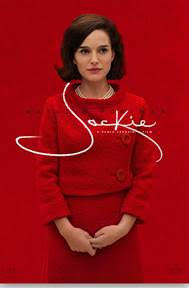
Film Review: “Jackie”

Starring: Natalie Portman, Peter Sarsgaard and Billy Crudup
Directed by: Pablo Larrain
Rated: R
Running time: 1 hr 40 mins
Fox Searchlight

Our Score: 3 out of 5 Stars

I am a Kennedy buff. Born in 1960, I was raised in a family that regarded the Kennedy family in the same way the British regard the Royal Family. I’m too young to remember JFK – though my father once wrote a poem where he noted that I was an angry child because one of my favorite kids programs had been preempted by a speech from the President. My mother woke me up in the wee hours of the morning when Bobby Kennedy was shot. As a 20 year old I worked for Ted Kennedy’s presidential campaign. I’ve studied the family as much as I could. When Jacqueline Kennedy passed away in May 1994 a funny thought went through my mind. I had never heard her speak. Every time I saw footage of her, she was either running from the press or, earlier in her life, smiling quietly. It wasn’t until the era of YouTube, when a television special about the White House that Mrs. Kennedy hosted was uploaded, that I finally heard her speak. Soft and quiet, like the coo of a dove. And that is the voice that drives the new film “Jackie.”

“Jackie” is two very different looks at the former First Lady. First is the young, vibrant Jackie. Freshly moved into the White House, she has angered some in the country by remodeling. To show the people what she did, she agrees to host a television special, giving many in the country their first look inside “the people’s house.” The second look is that of an angry widow, just a week after the assassination of her husband, trying to figure out how to make sure her martyred husband’s legacy will live on. This is the more dramatic Jackie and this is where “Jackie” works best.

It’s been six years since Natalie Portman won the Best Actress Oscar for “Black Swan.” Since then, with the exception of a couple of Marvel movies she hasn’t really been showing up in mainstream films. Here she returns with a vengeance. She captures every facet of Jacqueline Kennedy. The smiling, laughing young woman and the embittered widow, refusing to change out of her clothes, stained with her husband’s blood, because she “wants them to see what they’ve done.” Again, it’s the second persona, one who agrees to speak with a reporter to describe her feelings and to conjure the image of Camelot, that holds your attention.

Portman is surrounded by a good supporting cast, including Greta Gerwig as White House Social Secretary Nancy Tuckerman, Crudup as the reporter who knows all along that he will never be permitted to print most of his interview and Danish actor Caspar Phillipson, who bears an amazing resemblance to the late President Kennedy. Sarsgaard is adequate as RFK, but the fact that he doesn’t even attempt a New England accent is annoyingly noticeable.

But Portman is the story here. Go check her out before she disappears for another six years.
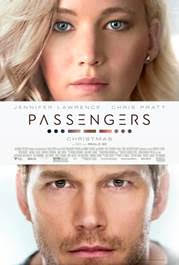
Film Review: “Passengers”

Starring: Jennifer Lawrence, Chris Pratt and Michael Sheen
Directed By: Morten Tyldum
Rated: PG-13
Running Time: 116 minutes
Columbia Pictures

Our Score: 1 out of 5 Stars

At casual glance, “Passengers” is “Cast Away” in space. 30 years into a 120 year journey, Jim (Pratt) is awoken from suspended animation due to a technical glitch with the spaceship, Avalon. But out of the thousands aboard the ship, including the crew, he is the only one to be disturbed from his slumber. Alone, he spends the next year trying to entertain himself, only finding companionship with an android bartender named Arthur (Sheen). But there’s only so much chit chat with a machine, along with digital dance gaming, basketball, and other recreational activities, one can do before developing cabin fever and crippling loneliness.

But on one particularly lonely day, after contemplating suicide, Jim comes across a pod containing Aurora (Lawrence). It’s love at first sight, but suddenly he develops a moral quandary in his brain. Being an engineer, he has the capability of waking up Aurora. Aurora’s natural beauty is alluring enough for him to do some electronic snooping. So, much like a 21st century stalker, he goes through her digital footprint and learns everything about her. This should creep out any sane audience. Right?

Now comes the worst part. Instead of asking a moral question about the lengths humanity would and should go to combat isolation, “Passengers” takes a disturbingly sexist route. Jim awakens Aurora and keeps his bastardly deed to himself, thinking he’ll wait for the right moment to tell her he’s ruined her life and condemned her to a lonely death. Of course, any good audience should know it’s only a matter of time until Aurora finds out. But once she does, “Passengers” attempts to paint Jim as the.

I’m really not ruining anything for you. I’d like to believe I’m saving you. Aurora’s revelation happens around the midpoint of the film. The only reason it happens so early is so that “Passengers” can spend the rest of its runtime, justifying Jim’s actions, directly and indirectly. But the movie makes the mistake of allowing Aurora to say the one thing we should all be thinking, “He’s committed murder.”

He has. “Passengers” never finesses the simple, but complex ethical questions behind Jim’s actions. Instead we’re just supposed to believe the ends justify the means. It doesn’t help when we watch as Aurora attacks Jim in his sleep, along with moments where Aurora is by herself. Instead of watching her sulk or seeing her realize the horrifying predicament she’s in, we watch her play video messages of her friends back on Earth, basic calling her narcissistic and selfish. It also doesn’t help that when Jim and Aurora are separate, Aurora is helpless and constantly at risk of peril, while Jim seems like a self-sufficient machine.

Regardless of its visual style and modest attempt at interesting concepts of intergalactic space travel, the most glaring flaw in “Passengers” is one that can’t be ignored. It should be condemned and abhorred. While Jim’s plight could certainly be relatable and sympathetic, “Passengers” almost seems to casually fall back on the concept of victim blaming. “Passengers” is a movie about a relationship built on selfish lies, stalking and entitlement. Its attempt at romance and a cutesy happy ending are stomach-turning.

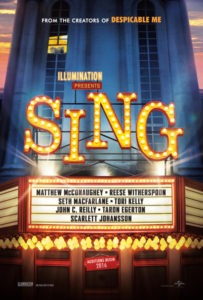
Film Review: “Sing”

Starring the Voices of: Matthew McConaughey, Reese Witherspoon and Seth MacFarlane
Directed By: Garth Jennings
Rated: PG
Running Time: 108 minutes
Universal Pictures

Our Score: 3 out of 5 Stars

An Illumination Entertainment movie without any Minions or Gru seems like a risky venture, given their track record when they release a movie that strays away from the “Despicable Me” franchise. But if the masterminds at Illumination are willing to roll the dice more on endeavors like “Sing,” they’re bound to find a diamond in the rough. “Sing” isn’t about to blow the roof off, but its decent escapism.

Buster Moon (McConaughey) is a confident Koala that’s stuck operating a failing musical theater. He’s a visionary looking to make a profit and bring live entertainment to the surrounding city. Moon is also looking to make his deceased father proud because his father worked his tail off washing cars to buy Moon the theater for him (I don’t know how with that profession). But in a world where musical theater is apparently no longer popular, Buster gets the idea to hold a singing competition to bring the masses back to his sinking business.

The competition brings creatures from all walks of life including Rosita (Witherspoon), a pig, is a stay-at-home mom who’s overworked and overloaded with over two dozen children. Then there’s the wise-cracking, street singing mouse, Mike (MacFarlane), who’s a clear pun on Frank Sinatra during his times in the Rat Pack. Ashley (Scarlett Johansson) is a punk rock porcupine who’s trying to find her own voice in her boyfriend’s crappy band. There’s also Meena (Tori Kelly), a teenage elephant, Johnny (Taron Edgerton), a gorilla, and some other throwaway animals that you shouldn’t worry yourself about because the movie doesn’t either.

Luckily “Sing” avoids becoming an animated version of “American Idol,” but it also follows a lot of familiar beats and story tempos. Because the movie seems completely content and forthright with being an unoriginal idea from the get-go, it can be forgiven because of its good-natured spirit and endearing characters. “Sing” really treats these characters as individuals with hopes, dreams and ambitions, instead of caricatures that can carry a tune. It helps make their songs more meaningful and power…but…

…most of the time (if not all) they’re singing contemporary pop-culture hits, or recognizable oldies and classics, which is only irksome if you feel that Nicki Minaj or Crazy Town isn’t appropriate for a kid’s movie. If writer and director Garth Jennings really wanted to tell us that musical theater is deserving of a reboot or our attention again, he should have considered hiring a crew to write some original music. Having animals sing Taylor Swift or Leonard Cohen feels lazy in a year where Disney hired Broadway’s latest darling, Lin-Manuel Miranda, to write lyrics for “Moana.”

Despite its lack of storytelling imagination and original songs, “Sing” is still an adorable movie with an IPod stuck on shuffle soundtrack. It’s made better by the voice actors, who I presume actually sing, which is pretty much an all-star cast of karaoke finalists (except for MacFarlane who really is as good as he sounds). But don’t expect McConaughey to hang his voice acting hat on this one. He’s more likely to gloat about his voice work in “Kubo and the Two Strings.”

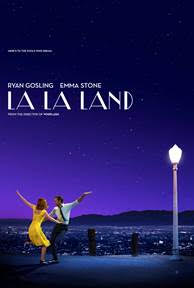
Film Review: “La La Land”


Starring: Ryan Gosling, Emma Stone and John Legend
Directed By: Damien Chazelle
Rated: PG-13
Running Time: 128 minutes
Summit Entertainment

Our Score: 4.5 out of 5 Stars

Earlier this year I found myself listening to 80’s music thanks to “Sing Street,” a semi-original musical about growing up and finding your own unique voice in the chorus. I was enamored with the movie’s somewhat original music. I found myself reflecting on what makes original content, that pays homages or mirrors the past, refreshing for the soul. Something fresh and new makes you feel young, but if it’s also acting as a salute to previous generation, conjuring up fond memories.

I’m not going to claim that I’m old. If anything, I’m always jokingly belittled by my co-workers for being the young pup. So, I can’t claim that “La La Land” is evocative, but I understand what it’s reminiscing about. From the get go it establishes itself as a neo-classical musical that generously throws back to the tap dancing or over-the-top ensemble singing of “Going Hollywood,” “On the Town” or “Singin’ in the Rain.” The style clashes with the 21st century in unique ways, allowing the viewer to take a step back in time and refocus their senses in the current era.

Sebastian (Gosling) is a jazz pianist, struggling to make it as a musician for hire. So much so that when he’s handed a setlist, he finds himself playing off into his own groove or rhythm. Then there’s the aspiring actress Mia (Stone), who’s paying the bills by being a barista and making it to as many auditions as she can. The two awkwardly, and too consistently, bump into each other indirectly or directly. The sparks fly however when the two realize their encounters may not be coincidence.

“La La Land” is a love letter to a bygone era of cinema and antiquated model of love. It may be intentionally subversive that the two leads bump into each other so much before eventually exchanging flirtatious jabs or a callback to how gimmicky people on the silver screen used to fall for one another. Regardless of Damien Chazelle’s intentions, he has a lot of fun playing with the clichés of the movies, while sadly using them to help move the story along.

What Chazelle does do wonderfully however, is show off his expertise as the writer and director as if he’s become a scholar of the musical genre. The script isn’t as airtight when the theatrics, dancing, and music aren’t all working together, but this kind of endeavor could easily suffer more if it was too heavy on the music. The length is the right amount of time and the ending is a wonderfully melancholy exclamation point on a movie that will inspire some, and cause others to give pause and reflect.

Despite not being natural singers, Goslins and Stone on their own carry a tune, moreso Stone. The big numbers, including the opening, blend together whimsical dancing and music infused with jazz, swing and big band. Chazelle, a musician himself, knows when to have the music take over a scene and simply allow the lyrics take over. Just from listening to the soundtrack, I can determine that Chazelle spent more time on the production than the lyrics.

“La La Land” may become the winter darling of those who manage to catch it, I know it’s caused me to spin the soundtrack a few times and tap my foot to its catchy, heartwarming tunes. 2016 has been a dour year, and even worse for the cineplexes that have been populated with big budget sequels that lack creativity to DC superhero movies that lack originality. I’d like to believe that “La La Land” is the light at the end of the tunnel and that anyone who catches it can at least end this miserable year with a smile on their face.

Film Review: “Rogue One: A Star Wars Story”

Starring: Felicity Jones, Forest Whitaker and Diego Luna
Directed by: Gareth Edwards
Rated: PG-13
Running time: 2 hrs 13 mins
Disney

Our Score: 4 out of 5 Stars

“A long time ago, in a galaxy far, far away…” So begins “Rogue One: A Star Wars Story.” But that is all the film’s opening has in common with episodes I – VII. There is no wordy crawl, giving you a hint at what’s been going on before you sat down in the theater. No, this is Episode III.V – 3.5 – and if you’re even vaguely familiar with the previous seven films, you pretty much know what’s about to take place.

Set 18 years (my guess) after the events of “Episode III,” “Rogue One” is the tale of the band of rebels who risked everything attempting to steal the plans for the original Death Star. The film begins when Galen Orso (the always great Mads Mikkelsen) is taken by the Empire to help complete the Death Star. His young daughter, Jyn (Beau Gadson) is left behind and forced to fend for herself for many years. We meet up with Jyn again as an adult. As portrayed by Felicity Jones, she is a young woman of resolve, one who has continually searched the galaxy for her father. She teams up with Cassian Andor (Diego Luna), a member of the rebellion. When word comes that one of the Empire’s pilots has defected and is telling stories about the Death Star, the duo put together a small group of like-minded people to assist in stealing the battle station’s plans.

As much as I would love to go into more plot details, I fear the good folks at Disney would have me torn apart by a Gundark. And so would you, dear readers. Let’s just say that the film is a well-made addition to the saga. The cast is surely up to the task, with Jones and Luna giving strong performances. The supporting players do just as well but I’ll single out Donnie Yen as Chirrut Imwe, a blind warrior whose devotion to the Force knows no limit. A shout out also to Alan Tudyk as K-2S0, a droid with more than a little attitude.

Written by Oscar nominees Chris Weitz (“About a Boy”) and Tony Gilroy (“Michael Clayton”), the screenplay is a fine combination of dark and funny. Director Edwards, who helmed 2014’s “Godzilla,” keeps the film moving quickly. The special effects, as expected, are beautifully presented. The X- and Y-wings jump off the screen as they zoom by. Another visual triumph concerns the return of a familiar character who is rendered by the same process that was used to feature the 1980’s version of Jeff Bridges in “Tron Legacy.” However, while I found the effects in “Tron” to be quite disconcerting, the effect here is breathtaking.

This is the first “Star Wars” film not to be scored by John Williams and it suffers for it. Though some of Williams’ original music is included, the main composer here is Oscar winner Michael Giacchino (“UP”). The score is not unpleasant, but when it’s followed by Williams’ music, it sadly pales. But if you were going for the music you’d just buy the CD. “Rogue One: A Star Wars Story” is a fine stand-alone film and one that will have you anticipating “Episode VIII,” which is just a short 367 days away!


Related Content

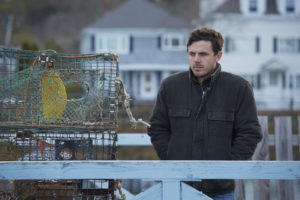
Film Review: “Manchester by the Sea”

Starring: Casey Affleck, Lucas Hedges and Michelle Williams
Directed by: Kenneth Lonergan
Rated: R
Running time: 2 hrs 17 mins
Amazon Studios

Our Score: 5 out of 5 Stars

Lee Chandler (Affleck) is the kind of man who just likes to go about his business. The maintenance man for a group of apartment buildings, his days are spent shoveling snow, fixing leaks and helping tenants unclog their toilets. He doesn’t say much, taking in the world with sad eyes. But when his brother suddenly dies, Lee is forced to not only deal with the fallout from that tragedy but another one from his past as well.

Featuring award-worthy performances from its three leads, “Manchester by the Sea,” is the perfect drama to off-set a multiplex full of Bad Santas and Dwayne Johnson. Lee’s brother, Joe (Kyle Chandler) has died and Lee must return to his old hometown to attend to things. While there he visits his nephew (Hedges) at his ice hockey practice. Several of the players gossip about Uncle Lee, though one maintains that “it never happened.” As the film progresses, we see Lee dealing with being charged with raising his nephew at the same time having to relive some of his past.

The story is told seamlessly by writer/director Lonergan, with modern day easily blending into the past, slowly building up to why everyone in this small town appears to know of Lee. Affleck has steadily grown from the young tag along in “Good Will Hunting” to an actor of great range. His eyes often saying what he won’t with his mouth, Lee’s simple life is anything but simple. As Lee’s former wife, Michelle Williams bares her emotions in a performance sure to break your heart. As the young nephew suddenly left father-less, Hedges equally impresses. All three actors are sure to draw some serious consideration come awards season, as will the film itself. Easily one of the years best!

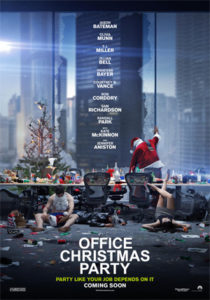
Film Review: “Office Christmas Party”

Starring: Jason Bateman, Olivia Munn and T.J. Miller
Directed By: Will Speck and Josh Gordon
Rated: R
Running Time: 105 minutes
Paramount Pictures

Our Score: 2.5 out of 5 Stars

Anymore when I watch a new Christmas movie, I tell myself that it could have been a lot worse. “Love the Coopers,” “Fred Claus” and “Surviving Christmas” are just a few of the awful Christmas movies in the past decade that come to mind. But luckily moviegoers have been treated to a handful of yuletide delights at the theaters over the past couple of years. Lately the raunchy comedies have dominated, going light on the holiday cheer, and heavy on the eggnog and drugs. “Office Christmas Party” follows this current pattern, delivering an entertaining enough comedy, but an ultimately forgettable raunchfest.

Clay (Miller) heads up the Chicago branch of Zenotek, a lowly computer technology company that tries to compete with the likes of Dell, Apple and others. His sister, Carol (Jennifer Aniston), who is also Zenotek’s CEO, has just given him the bad news. Bump up your growth to 12% or cut 40% of your staff by the time Christmas rolls around. Being a worker’s boss, he can’t fathom laying off dozens of his closest friends. So in the hopes of landing one of the biggest clients in the Windy City, he sets out to throw the ultimate company Christmas party.

There’s also some other side plots, including office romance and sex, Jason Bateman’s character is dealing with a divorce, and there’s a worker who’s trying to pass off a prostitute as his supermodel girlfriend. None of this really amounts to anything or comes off as remotely heartwarming. It only serves as cohesive glue in between jokes, physical humor, and pop-culture sight gags like the throne from “Game of Thrones.”

But the set-up for the jokes is tired and predictable. It’s almost like the duel directors and multiple scriptwriters were a lot more hesitant to go with ad-libbing and natural comedic abilities of its cast. It makes “Office Christmas Party” a more by-the-books comedy with scripted and foreseeable. When being allowed more natural, the likes of Miller, Bateman, Kate McKinnon, Rob Corddry and others are genuinely funny.

Not every moment is unfunny chatter. Once the party kicks off, there’s enough visual comedy to keep it going to its inevitable conclusion. I also can’t help, but be a fanboy of Bateman’s deadpan delivery and Miller’s goofy sensibilities. “Office Christmas Party” isn’t going to become a holiday staple like “Christmas Vacation” or “Bad Santa.” It’s a handful of laughs and short escapism for those who don’t want to watch one of the Oscar hopefuls.

Film Review: “Nocturnal Animals”

Starring: Amy Adams, Jake Gyllenhaal and Michael Shannon
Directed By: Tom Ford
Rated: R
Running Time: 116 minutes
Focus Features

Our Score: 4 out of 5 Stars

“Nocturnal Animals” requires two viewings, if you can stomach it that is. Tom Ford’s vision is a messy movie, with a fuzzy meaning. But despite the juggling act, the disorderliness feels intentional. “Nocturnal Animals” is two movies for the price of one, with each tale telling and revealing more about the other. “Nocturnal Animals” delivers a slow reveal that will surely dissatisfy many, while simply turning off others in the first few minutes, but please those who hang with it and scratch beneath the surface.

Despite owning a successful LA art gallery, Susan (Adams) seems indifferent to life. She’s married to an unfaithful man, her child has left the coop and she inhabits an artificial home full of artificial art pieces. Something stirs her from her humdrum existence, her ex-husband’s novel. Edward (Gyllenhaal) has sent her a copy of his book and inquired through email about possibly meeting for dinner to catch up. The novel, “Nocturnal Animals,” is not only dedicated to her, but she tells everyone that Edward had always referred to her as a nocturnal animal.

When she flips to page one, the movie then dives into the context of the book. It begins with a family being driven off the road in rural Texas by dangerous men and turns into a husband/father trying to make sense of a horrifying night that has turned into a lifelong nightmare. The raw viciousness and violence of Edward’s book seems to startle and upset Susan. But it’s not the visceral nature of the book; it’s how much of it mirrors their old relationship.

You could almost call “Nocturnal Animals” a wonderful ensemble, featuring actors and actresses who have won or been nominated for an award, or those who certainly should. Gyllenhaal does double duty as Edward in Susan’s life and as the heartbroken, vengeful father in the book. Accompanying him and Adams are Michael Shannon, Aaron Taylor-Johnson, Armie Hammer, Ilsa Fisher, and others. The visual storying telling between the fictional book and the reality are clear, but it’s when the two begin to reflect each other metaphorically and physically, that it becomes blurry.

The neo-western style of the book story never really meshes well with the simmering thriller happening in the real world, but the dramatic and tonal shifts help break up any monotony that might creep in because on their own accord, each story isn’t stellar. It’s only interesting when both are slapped together, with similar symbols bleeding through the lines of reality. Director Tom Ford deserves all the credit in the world for keeping the wild swings in storytelling and writing in check, without derailing the movie entirely.

However, the commentary on Susan and Edward’s formal love life is suspiciously misogynistic. Understandably, Edward is the one commenting on it and Susan is the one merely reacting to his comparisons. But it offers a one-sided narrative of what once was, painting Susan in a broad and negative light. Although that could be its inherent intention, depending on how you want to view the ending to the movie, and the book within the movie, I can help but wonder about it’s reception of the roles were changed.

“Nocturnal Animals” will certainly draw comparisons to some of David Lynch’s more bizarre offerings, but Ford’s style isn’t charmingly oddball enough. It’s intentionally dark content and bizarre imagery is more likely to turn-off a regular audience than dazzle. But it’s a compelling movie to watch and delight to discuss with those who have managed to stomach it. Ford, the fashion designer turned director, is a unique talent worth keeping an eye on.

Film Review: “Moana”

Starring the voices of: Dwayne Johnson, Auli’i Cravalho and Rachel House
Directed by: Ron Clements, John Musker – co-directed by Don Hall and Chris Williams
Rated: PG
Running time: 1 hr 43 mins
Walt Disney Company

Our Score: 5 out of 5 Stars

Say hello to Maui. As voiced by Dwayne Johnson, Maui is a demi-god of great strength, humor and a beautiful singing voice! When her family is in need of help, it falls on the young Moana (Cravalho) to seek out Maui before it becomes too late.

Both brilliant and breathtaking, “Moana” is sure to be the next Disney classic. The characters are beautifully established and the actors behind them are pitch perfect. While much will be made of young Ms. Cravalho – who celebrated her 16th birthday on November 22 – the star here is the man formerly known as “the Rock.” Johnson established his skills for comedy in such films as “Be Cool” and “Pain and Gain,” his performance here is truly award worthy. And what a singing voice! Too bad the film is animated, as I wouldn’t be surprised if he can dance as well.

Like previous Disney animated features, the animation is outstanding. 95% of the film takes place in/on water, and the images on screen – I saw the film in 3D but it’s not necessary to enjoy it – flow by beautifully. Also like previous Disney animated films, there are some cute and funny animal characters that will steal your heart, among them a dimwitted chicken and the cutest piglet you’ve ever seen. Yes, cuter than the REAL Piglet! Other voice talents include Rachel House as Moana’s grandmother and Jermaine Clement as the crab Tamatoa. The songs are all Oscar worthy, with many them written by “Hamilton” scribe Lin Manuel Miranda. When all is said and done, it’s certainly the best way to spend 90 minutes this holiday!

Related Content

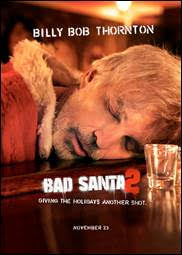
Film Review: “Bad Santa 2”

Starring: Billy Bob Thornton, Kathy Bates and Tony Cox
Directed By: Mark Waters
Rated: R
Running Time: 92 minutes
Broad Green Pictures

Our Score: 1.5 out of 5

We need a laugh. Right? I don’t need to point out or remind anyone that this year has been miserable. We as Americans deserve a hearty laugh at the theaters as we begin to wind down 2016 and put it behind us. You might get one with “Bad Santa 2,” but you won’t feel good about it and it certainly won’t cheer you up.

Willie (Thornton), the titular star of the first, is back and is just as miserable as ever. His crude happy ending in the first movie is a distant memory as he’s broke and lonely. Compounding his frustrations is the fact that he can’t commit suicide because his oven is electric. Hanging around still is Thurman Merman (Brett Kelly), the young boy from the first. He’s now a grown-up, one note joke and the first sign that the “Bad Santa 2” filmmakers had no grasp of what made the characters in the first movie so likable.

Marcus (Cox), after a stint in jail, is hoping to knock off a massive Chicago charity with the help of Willie. But unbeknownst to Willie, they’re recruiting a third for the job, Willie’s mom. Sunny (Bates) is just as foul-mouthed, belligerent and disgusting as the son she raised. When the trio of actors is left to their own devices, when they’re most likely ad-libbing scenes, they provide some of the movies only laughs. Everything else is scripted garbage.

The original director, writers, and a handful of cast members must have known better when being presented with this project over the past 13 years. “Bad Santa 2” isn’t a genuine sequel. It’s a greedy studio cash grab in the season of giving. The new writers and director are unable to capture the misanthropic nature of the original, opting more for unfunny and mean-spirited one liners, and cheap sex gags. The script feels more like a fanboy sequel rather than a realistic continuation of Willie’s story, which really didn’t need a continuation.

There are a lot of things that made the original entertaining and a classic for 21st century Grinches. The original was always hesitant to have Willie become a good person. Instead it opted for him to realize he can still be a scumbag, but a good person to those he cares about. The sequel misunderstands his one minute lapse of kindness in the first. “Bad Santa 2” utilizes his sour affection every chance it gets to convey the idea that he’s always been a lovable conman. This leads to nauseating predictability and false holiday charm that Willie will stop Marcus and his mom from stealing millions from a charity for the homeless and children.

Overall, “Bad Santa 2” is a 92 minute callback that fails to understand what made the original such a guilty delight. If you’re looking for a laugh and some form of escapism from the family this holiday season, you should stay far away from this movie. You should stay home this holiday season, grab a bottle of liquor, watch “Bad Santa” and add “Bad Santa 2” to the list of things you’ll want to forget about 2016.

Film Review: “Loving”

Starring: Joel Edgerton, Ruth Negga and Nick Kroll
Directed by: Jeff Nichols
Rated: PG-13
Running time: 2 hrs 3 mins
Focus Features

Our Score: 3 out of 5 Stars

In April 1967, the United States Supreme Court heard the case of Loving v. Virginia. Years earlier, Richard (Edgerton) and Mildred (Negga) Loving had been arrested, tried and found guilty in the state of Virginia. Their crime? Falling in love.

Based on the true story of the couple whose case made it legal for people of different races to marry each other, “Loving” is propelled by the performances of the two leads. Even though their small group of family and friends seems to accept this odd couple of a white man and a black woman, there are still boundaries. While shopping in a black-owned shop with the pregnant Mildred, Richard gently rubs her stomach. What should be a beautiful moment is meant with a stern gaze from the shopkeeper. One night the police barge into the Loving’s house, catching the couple in bed sleeping. Despite their marriage license, they are taken to jail where Richard is allowed to make bail. He is told that not only can he not bail his wife out but she must wait for the judge to come by in a few days. A deal is made in which the judge, who tells them they are breaking God’s law, agrees not to send them to prison if they leave the state of Virginia. How high is the price of love?

While the film strikes many emotional chords, I was left with more questions than answers. When we first meet Richard and Mildred their relationship has already been established. But what about their early days? How did they meet? How in the hell did they date? Were the nice people we see around them always so supportive? Sure we care about the Lovings and support their fight. But it would have been nice to be there when the battle began.


Related Content

Film Review “Bleed for This”

Starring: Miles Teller, Aaron Eckhart and Katey Sagal
Directed by: Ben Younger
Rated: R
Running time: 1 hr 56 mins
Open Road
Our Score: 4 out of 5 stars

You have to really have followed boxing in the late 1980s – early 1990s to remember Vinny Pazienza. Billed as “the Pazmanian Devil,” he was a hard fighter who could take a punch and almost always got up off of the mat. “Bleed for This” tells the story of Vinny’s ultimate comeback.

1988. We meet Vinny Pazienza (Teller, in excellent form – and shape) trying hard to make weight. Eventually he makes it to the required 140 lbs but his body is no match for the beating he endures. After losing he collapses from dehydration. Unable to get a decent fight offer, Vinny goes to train with Kevin Rooney (Eckhart), who at one time trained Mike Tyson. However, since Tyson left him for Don King, Rooney has been struggling. He and Vinny connect and, after Rooney suggests that Vinny fight at a weight he is more comfortable with, things begin to roll. But as he reaches the top of the mountain Vinny soon finds himself flat on his back one more time.

Well-paced and well-acted, “Bleed for This” could have gone the way of most sport biographies, which is to introduce the protagonist, watch him win a little than put some horrible event in front of him. Following his greatest victory to date, Vinny suffers a broken neck in a car accident, an injury that pretty much insures that he may never fight again, let alone walk. But fate has different ideas.

This is another in a list of fine performances by Miles Teller, who was so good in last year’s “Whiplash.” Here he captures the ego of Pazienza perfectly, making a man whose boasting should make him unlikable actually become someone to care about. Eckhart, his hairline shaved back, is also strong as Mooney, with both Sagal and Ciarin Hinds excelling as Vinny’s mom and dad. If you’re a fan of a great comeback story, I highly recommend you give “Bleed for This” a try.

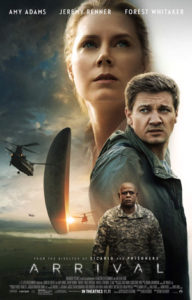
Film Review: “Arrival”

Starring: Amy Adams, Jeremy Renner and Forest Whitaker
Directed By: Denis Villeneuve
Rated: PG-13
Running Time: 116 minutes
Paramount Pictures

Our Score: 4.5 out of 5 Stars

If you’re hoping for an alien movie filled with mindless city destroying explosions, slow-motion gunplay, and jingoistic speeches by presidential figures, you’re going to be severely disappointed with “Arrival”. But if you’re looking for a profoundly tragic and beautiful sci-fi movie that transcends its interstellar subject material with an introspective look at what it means to be human, then you’re going to love “Arrival”.

When a dozen circular, monolithic structures appear over the surface of the planet in 12 seemingly random spots, the Earth quickly comes to a screeching halt. Classes are called off, planes are grounded, the economy goes into a literal freefall, and the world sits and watches as nothing happens. No sounds, no communications and no clue as to what these odd ships are here for. There’s an impending fear because dozens of governments attempt communication, but aren’t quite sure if the beings that they’re talking to are friendly or not. The U.S. government acquires the best of the best for the job, Dr. Louise Banks (Adams).

While senior U.S. military officials like Weber (Whitaker) expect immediate results, Banks has a deep understanding of language as well as the patience it takes to understand what an intergalactic species is saying. The master linguist is aided by Ian (Renner), a mathematician that comes in handy to device a program in place to decipher the visual language the aliens are using. But alas they face an uphill battle.

Fear of the unknown, the inability for governments to work together, conspiracy theorists having a social media outlet and an impatient generation are at full work outside the space ships and military quarantine zones surrounding the structures. “Arrival” doesn’t necessarily focus on that too much though because we all know that the human race couldn’t handle the possibility of extraterrestrial life. As “Men in Black” so eloquently put it, “People are dumb, panicky dangerous animals.”

“Arrival” finds more usefulness out of Banks’ psyche. It’s tough to describe the internal and mental conflict broiling in Banks’ head without revealing too much of what gives meaning to the slow burn reveal towards the end of “Arrival”. Director Denis Villenueve, whose other movies have ambiguous endings and hidden meanings (“Prisoners”, “Enemy” and “Sicario), is the right choice for a movie that has more than meets the eye.

Adams helps convey the deep emotional turmoil inside Banks and is complimented by the various forces pulling her apart. Throughout the run time of “Arrival”, we watch Banks struggle with the insignificance that humanity feels when knowing we’re not the only special entity floating around in the universe. That struggle turns into one of confusion and understanding that something greater is at work than the petty distress that mankind feels when losing it’s individuality.

The release of “Arrival” feels poignant considering the current election in the U.S., but for those who look beyond that simplistic snapshot reaction, there’s a deeper meaning at play. If “Arrival” has anything to offer, it’s therapeutic reassurance that despite the struggles we face because of our differences, every living human being on this planet still feels love, regret, sorrow, and joy. And understanding that idea every day could ultimately lead to unity and healing.

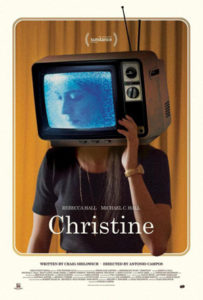
Film Review: “Christine”

Starring: Rebecca Hall, Tracy Letts and Michael C. Hall
Directed by: Antonio Campos
Rated: R
Running time: 1 hr 55 mins
The Orchard

Our Score: 3.5 out of 5 Stars

There is a saying in the television news business that goes, “If it bleeds – it leads.” Definition – people are drawn to seeing other people suffer. Have you ever watched the news and the anchor looks into the camera and says, with a serious voice, “the video we are about to show you may be disturbing?” And if so, have you ever turned away? So imagine now that you’re watching television on July 15, 1974 and you hear the pretty broadcaster say, “In keeping with Channel 40’s policy of bringing you the latest in ‘blood and guts’, and in living color, you are going to see another first—attempted suicide.” Would you turn away?

The story of television personality Christine Chubbuck, who actually spoke the above words, “Christine” is an in-depth look into a problem that was either misdiagnosed or just ignored: depression. We meet Christine (Rebecca Hall in an award-worthy performance) sitting in front of a camera and “rehearsing” an interview she’d love to have with the disgraced President Richard Nixon. She uses these tapes to study her on-camera “language.” She also uses a pair of hand puppets to express many of the things she’s afraid to voice. Once an important part of Boston news, Christine now finds herself at a little station in Sarasota, Florida, where she went to relieve the stress in her life. Even though she has a crush on the stations anchorman (Michael C. Hall), she doesn’t date and, at age 29, is still a virgin. Her depression is obvious to us, the viewers, but to those around her she just seems put-offish. But with the opportunity to go to Baltimore being dangled in front of her, she begins to change.

I have to admit that I barely remember the incident that made Christine Chubbuck infamous. Television often blurs its reality. That’s why, in the film, Christine continually rails against the set decorator who insists on using artificial flowers. She strives for reality in all things. Ms. Hall gives a thorough and nuanced performance, making Christine both sympathetic and almost unlikable. The supporting cast also acquits itself well, with special mention going to Mr. Hall and the great Broadway star John Cullum as the owner of the news station.

With the success today of so many female television reporters, including Diane Sawyer, Martha Radditz and Katie Couric, it’s hard to remember how tough women had it in the workplace 40 years ago. The fact that one of the characters watches “The Mary Tyler Moore Show” is all we, as the audience, need to see. See you on the news.

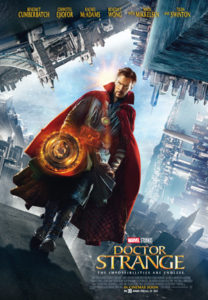
Film Review: “Doctor Strange”

Starring: Benedict Cumberbatch, Chiwetel Ejiofor and Tilda Swinton
Directed By: Scott Derrickson
Rated: PG-13
Running Time: 115 minutes
Walt Disney Studios Motion Pictures

Our Score: 4 out of 5 Stars

How many trick or treaters did you get that were dressed as Doctor Strange? I’m going to guess that you got none. You probably saw more kiddos dressed like Thor, Spiderman, Batman, Harley Quinn or Iron Man. Well next year you might see a few more kids wearing fake or drawn on goatees and donning red velvet colored capes.

The latest addition to the Marvel cinematic universe is the egocentric neurosurgeon, Stephen Strange. The world renowned doctor showboats while patients’ lives are on the line. He loves demonstrating his calm demeanor and unflinching hands under immense pressure during operations that require precise movements. He values his hands much like a model covets their hourglass shape. But that all goes out the window after he suffers a horrific accident (don’t text and drive), that requires pins, needles and plates to reconstruct his hands. All that’s left after multiple surgeries are trembling scarred fingers resembling flesh pudding.

Refusing to accept that he’s lost the use of his hands, Strange goes on an experimental medical journey that ends in impoverished Tibet. Whispers and rumors have led him to the mystic Ancient One (Swinton). Despite reservations about Strange’s narcissism, she takes him in. She hopes to upend his self-centered Western mind and open it to the powers of Eastern religion and ancient mysticism; all while spouting lines of dialogue reminiscent of Taoism or Gautama Buddha.

Outside of being the most mentally and spiritually stimulating entry into the Marvel movie catalog, “Doctor Strange” features a superhero that prefers brains over brawn. But when fighting is required, it’s a visually stunning treat. The visuals are a mix of “Inception,” M.C. Esher, “Avatar: the Last Airbender,” “The Matrix,” and a Pink Floyd acid trip. When the world begins to bend and fold, the grand music score, with morsels of Eastern stringed musical instruments and psychedelic synthesizers, props up the optical mind trickery.

As for the story, it lacks the right amount of emotional magic and it seems to suffer what most Marvel movies lack, an interesting and relevant villain (just sit through the credits for more proof that Marvel is out of villains). Mads Mikklesen, who’s been an iconic villain in everything from
“Casino Royale” to his eerily role as a middle-aged Hannibal Lecter in NBC’s TV show, seems wasted in this movie as Kaecillius. Kaecillius’ motivation is a blend of rebellion against the Ancient One and his immoral infatuation with immortality.

Despite my frustrations with a lack of Mikklesen, Cumberbatch and Swinton are a delight to watch with their “Karate Kid” teacher/student moments. The duo has the most to offer their characters while everyone else is left to play second fiddle to them. Rachel McAdams plays Strange’s toss-away love interest and Chiwetel Ejiofor spends most of his time standing in proximity to main characters so he can provide key plot points.

Despite some of its storytelling flaws, Doctor Strange is the most thought provoking of Marvel’s movies, while keeping intact the thing we’ve come to know and love from Marvel studios. “Doctor Strange” was definitely a risky gamble for Marvel, but it’s paid off. And not just because of Cumberbatch’s acting and a crew dedicated to dissecting and dismantling everything we thought about the world, but because it puts aside the city destruction and violence for some thoughtful superhero development.

Copyright: MediaMikes.com © 2016 · Powered by: nGeneYes, Inc. · Login

All logos and images used on this website are registered trademarks of their respective companies. All Rights Reserved. Some of the content presented on our sites has been provided by contributors, other unofficial websites or online news sources, and is the sole responsibility of the source from which it was obtained. MediaMikes.com is not liable for inaccuracies, errors, or omissions found herein. For removal of copyrighted images, trademarks, or other issues, Contact Us.