
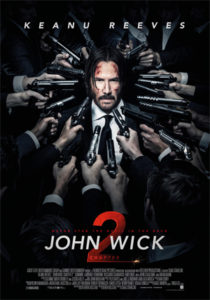
Film Review: “John Wick: Chapter 2”

Starring: Keanu Reeves, Common and Laurence Fishburne
Directed By: Chad Stahleski
Rated: R
Running Time: 122 minutes
Summit Entertainment

Our Score: 4 out of 5 Stars

Did the first “John Wick” need a sequel? No. Does “John Wick: Chapter 2” need a sequel? Yes. I didn’t know I needed “Chapter 2” in my life, but I’m glad I got it and now I want more. “Chapter 2” is more of the same from the first installment and that’s not a bad thing. It’s a great thing.

Picking right up where the previous movie ended, John Wick (Reeves), also known as “The Boogeyman,” is finishing off the lingering threats and hitmen who did him wrong from the first installment. But instead of easing back into a low-key and somber retirement, with a new dog in tow, he’s greeted by an old acquaintance, Santino D’Antonio (Riccardo Scamarcio). D’Antonio recruits Wick to help him take over a seat of power in the criminal underworld. Wick isn’t so sure, but Santino uses an old blood oath and three missiles to Wick’s home to sway him.

All the potential consequences and paths of this blood oath, as pointed out to Wick multiple times throughout, are Wick’s death. Luckily for Wick, and the audience, he’s the one who spends entire runtime dishing out death. Before the story even contemplates getting too muddled in specifics and new characters, “Chapter 2” takes a deep breath and once again stops itself from becoming too literal. Just like the original, character introductions are more about the person’s individual quirks, skills and ticks, than their actual name or purpose. And “Chapter 2” keeps the video games tropes around as everything is still paid through magical golden tokens and Wick’s gun is stuck on auto-aim.

This helps keep everything flowing as this sequel is about 30 minutes longer, but rarely dull. While “John Wick” was more about the man behind the blood hungry myth, the sequel appears to be more about Wick diving deeper into the world around him, including the Continental, the criminal safe haven, hangout and safe zone from the first film. The Continental is still shrouded in mystery, but the little depth that is revealed implies it’s a lot more than just a U.N. for gangbangers. It may be the actual cogs of society and government.

What made the original so good is that it never bogged itself down in realism despite the backdrop being New York City. Instead it collects visual actualities to prop up this notion that this alternative reality is percolating beneath the surface. “Chapter 2” expands this alternate reality by dropping visual indications on how all these backstabbing swindlers and emotionless assassins have managed to govern themselves. Murder is their business and they’re serious about it. The rules in this violent fantasy world are simple, habitual, rehashed for clarity, and never biased towards any of the heroes and villain.

“Chapter 2” also further establishes previous canon while building on fresh canon without having any of the new nuances become superficial. The violence is a lot more over-the-top, but played straight-faced for laughs. The killings are more gruesome, but never repugnant. Like much of the visually stunning set-pieces, like a room of rotating mirrors bathed in laser light, the violence is aesthetically pleasing. That’s because it’s visually relayed that Wick doesn’t love or sink his teeth into this line of work anymore, but does it as a necessity for survival.

The same crew from the first is back for more, providing an enjoyable and realistic continuation of a seemingly one-off story about a retired assassin out for revenge. He’s no longer out for revenge, but struggling with the underworld that wants him to be addicted to the rush and thrill of being a hired gun. Wick’s world is noir, retro, and techno all in one cohesive ball. The John Wick franchise is not only a great addition to the action-film catalogue, but a much needed renaissance for the CGI-heavy genre.


Film Review: “Eagles of Death Metal: Nos Amis (Our Friends)”

“Eagles of Death Metal: Nos Amis (Our Friends)”
HBO Films
Director: Colin Hanks
Runtime: 83 min

Our score: 4 out of 5 stars

“Eagles of Death Metal: Nos Amis (Our Friends)” follows the American rock band Eagles of Death Metal as they recount their experience before, during and after the tragic terrorist attack at their concert in Paris on November 13th 2015. Directed by Colin Hanks the film spotlights the deep bond of friendship between co-founders Jesse Hughes and Josh Homme as well as the connection the band has with their fans. This relationship along with the groups feeling of responsibility to help Bataclan survivors deal with the physical and emotional wounds is the premise for “Eagles of Death Metal: Nos Amis (Our Friends)” and what brings the band back to Paris just 3 weeks after those attacks.

Sadness, anger, hope and happiness are just some of the emotions you will be exposed to by watching HBO Films latest documentary “Eagles of Death Metal: Nos Amis (Our Friends)”. The entire world was impacted by the terrorist attacks on November 13th 2015 none more so than those who survived it, the families of those who did not and the band who was playing on stage at the time of the attacks. Director Colin Hanks is direct in his approach as he does a great job capturing the emotions of the band and fans through candid interviews as they prepare to return to Paris just 3 short weeks after the attacks with hopes of unity and to provide some level of comfort to those still struggling with the lingering effects of the attacks.

More than just your typical behind the scenes rock doc “Eagles of Death Metal: Nos Amis (Our Friends)” delves deep in to not only the bands love of their fans but also the extremely strong bond between front man Jesse Hughes and drummer Josh Homme. Friendships this strong are a rarity and throughout the course of the films 83 minutes you can clearly see how this life long bond is transferred to crowds around the world. Even in the darkest of moments this relationship seems to serve as the foundation for the bands strength in moving forward. If you watch one documentary this year it should be this one.

“Eagles of Death Metal: Nos Amis (Our Friends)” premiers

Monday, February 13th @ 10pm on HBO.

Film Review: “The Space Between Us”

Starring: Asa Butterfield, Britt Robertson and Gary Oldman
Directed by: Peter Chelsom
Rated: PG-13
Running time: 2 hrs
STX Entertainment

Our Score: 1 out of 5 Stars

Have you ever seen a movie and afterward thought, “well, that’s two hours I’ll never get back?” Well, the makers of “The Space Between Us” owe me four hours. Because that’s how long it felt like it took this sci-fi-rom-com to tell me the story of the first person born on Mars and his quest to visit Earth.

Present day. A manned mission is being sent to Mars. Everyone is checked out medically and they’re off. Unfortunately it appears that the programs physician was a doctor, like Bill Cosby used to refer to himself as a doctor. It seems one of the lady astronauts is pregnant. As if she was married to “Bonanza’s” Ben Cartwright, she dies in childbirth, leaving the other astronauts, including the maternal Kendra (Carla Gugino) to raise him. Jump ahead 16 years and the young boy, named Gardner (Butterfield) is a thin, lanky, big-eyed boy longing to know what life on Earth is like. His existence has been kept secret by the mission’s benefactor, Nathaniel Sheppard (Oldman), who comes off here as less Richard Dyson and more Richard Nixon, not wanting the story of the astro-mom’s death to get out, fearing his funding will dry up. Gardner spends his days working around the space station, occasionally breaking the rules by going outside to drive like Dale Earnhardt, Jr. across the surface of the Red Planet. To appease Garner, they decide to operate on him, strengthening his bones with carbon rods and installing an item nears his heart because, in the weightless gravity of Mars, his body will not develop properly. His heart will become too big and the journey to Earth may kill him. Sadly, it doesn’t.

What a horrible film! While I applaud the premise the execution is horribly hit and miss. It’s as if the filmmakers already know that the audience has checked out of this film at the 10-minute mark. While on Mars, Gardner makes an Internet (Inter-world) chat partner who goes by the name Tulsa (Robertson). Tulsa is a foster child who lives with an alcoholic crop duster pilot, who apparently only lets her live with him for the monthly check. Gardner has told Tulsa that he lives in a Penthouse apartment in NYC and can’t go outside because of a medical condition. Tulsa just assumes Gardner is afraid to meet up. When he returns to Earth, Gardner easily escapes (apparently there are NO security guards at NASA, where people come and go, interrupting space missions and press conferences with ease) and meets up with Tulsa. They duo begin a journey to find Gardner’s father, a man he’s never met, going only on a photo of his mom and the man outside a beach house. Of course, like E.T., in the Earth’s gravity and atmosphere Gardner begins to get sick. Will he survive to meet his pop? After what you’ve just read, do you still care?

The film is full of horribly bad clichés and unbelievable plot points. A trip to the local warehouse store, where they purchase items using stolen cash and credit cards, reveals that Tulsa is a budding, and terrible, songwriter. Even though they are being hunted down she takes the time to sit at the electric piano display at COSTCO and serenade anyone within earshot. They then head to Vegas, where Tulsa takes advantage of the Strip to show Gardner “the world,” including Paris, Shanghai and Venice. Keeping one step ahead of the law, they decide to steal an unassuming car. Apparently the highways are full of bright red early 1970s Lincoln Continental convertibles, because not once do they attract the attention of law enforcement. When they reach the beach, Gardner comments that in the past few days he’s done things he always dreamed of, like touch water. What in the hell do they shower with on Mars (or any space station). And why did all of the establishing shots of the Mars compound show Gardner constantly walking over a footbridge, under which is a pool of water. Was the kid too damn lazy to just walk over to the edge and put his hand in? Believe me, the only thing this movie is missing is Chloe Grace Moretz, who has starred in my choices as the “Year’s Worse Film” twice in the past three years (“If I Stay” and “The 5th Wave”). Thankfully I think I’ve found my winner for 2017 so the next 11 months of movie-going should be enjoyable for me. Director Chelsom also gave us “Hannah Montana: The Movie,” which means I’m pretty sure what’s going to be playing on the double-bill at the drive-in in Hell.

I’ve always said that I’ll give any film at least one star because it’s in focus. This movie was in focus. Do yourself a favor and put as much space as possible between yourself and “The Space Between Us.”

Film Review: “Arbor Demon”

Starring: Fiona Dourif, Kevin Ryan and Jake Busey
Directed By: Patrick Rea
Rated: Unrated
Running Time: 100 minutes
Gravitas Ventures

Our Score: 3.5 out of 5 Stars

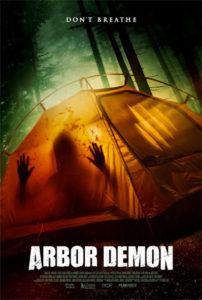
Things aren’t exactly going well for Charles (Ryan) and Dana (Dourif). They are getting ready to celebrate their anniversary, by returning to the spot where Charles proposed to Dana, and their different perceptions of life and long term goals are beginning to show. While Charles doesn’t exactly seem to know it yet, the trip is a way to patch up the relationship as it exists now and take it another step forward with Dana’s recent discovery at the doctor. She’s pregnant.

Charles isn’t the most enthusiastic about having children, seeming to ignore kids they encounter in public and jokingly saying that they’re not the kind of married couple that’ll have kids. However the risk of impregnating Dana doesn’t ever slow down his insatiable sex drive. There’s an impending sense of doom as they enter the woods, but things get eerie when they encounter a drunken group of hunters, firing wildly into the air and making a ruckus at the dead of night.

The encampment of drunks is attacked by an unseen force and soon Charles, because he’s a paramedic, makes it his duty to risk his life and take in an injured member of the group, Sean (Busey). The trio hunkers down inside the flimsy safety of an orange tent as something sinister stalks around in the woods, blending in with the surroundings. But it doesn’t attack. That’s because it may want Dana.

Lacking jump scares and jolts of fright, “Arbor Demon” seems more interested in the tension that evolves inside the tent that Dana, Charles and Sean are cowering in. When not focused on backstabbing survivalism, the movie peels back layers of its own mythology, touching upon the supernatural elements of nature and it’s deep connection to motherhood. It’s not until the end that the “demon” reveals itself and we understand why Dana is the treasured prize of the creature lurking in the woods.

Dourif, who’s probably sick and tired by now of hearing about how much she looks like her father, carries the fear of Dana of well through her eyes, breathing and physical reactions. Dana isn’t just fearful of the creature, but seemingly more fixated on if her marriage can survive the bombshell that she’s carrying Charles’ child. It plays into the third act and the movie floats away from its horror elements, finding more fun by playing with Indian mythos and supernatural components.

The story evolution helps break-up the potential monotony of your run-of-the-mill terror in the woods plotline. “Arbor Demon” isn’t going to scare you, but it does give the viewer a moment of reflection about how humanity and nature are so closely related, yet we constantly forget about it. “Arbor Demon” says a lot about gender roles when you get down to it. Dana seems to have an understanding while Charles and Sean seem to be in fight-or-flight mode.

Film Review: “Trespass Against Us”

Starring: Michael Fassbender, Brendan Gleeson, Sean Harris, Lyndsey Marshall, Rory Kinnear
Directed By: Adam Smith
Rated: R
Running Time: 99 minutes
Film4

Our Score: 3 out of 5 Stars

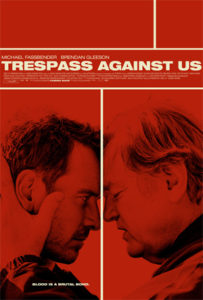
For a man seeking a quiet life, Chad Cutler drums up an awful lot of trouble in Adam Smith’s rural family drama, Trespass Against Us. Set deep in the English countryside, the feature debut from Smith can be tonally uneven but boasts enough solid performances and pops of quality car chases to recommend it.

Michael Fassbender stars as Chad Cutler, the heir apparent to a family of thieves in a caravan park. His father is the blustery Colby Cutler (Brendan Gleeson) who preaches only what his father taught him. In between sending his son and their gang out on robberies, Colby interferes with Chad’s young son Tyson (Georgie Smith) getting an actual school education. It’s a life Chad wishes to escape as he sets his eyes on moving into an actual house with Tyson and his wife Kelly (Lyndsey Marshal). Unfortunately Colby’s infamy looms large over the local population, often stifling Chad’s ambitions. Also impeding his progress? Chad himself. Chad is a caring father, but his whole world has been crime and he’s great at it. Despite his illiteracy, he’s the most intelligent of his crew as well as the best driver–crucial for their hit and run robbery jobs in the neighboring towns. The entire trailer crew becomes endangered when Colby sends them unknowingly to invade a local judge’s mansion.

Fassbender isn’t often cast as the family man (Steve Jobs was hardly the best example) and here it works well. Him and Smith share some touching scenes and I also got a kick out of Chad’s chastising of Tyson at a chip stand. More importantly Fassbender skillfully conveys the simmering conflicts within Cutler. His shark-like grin when dealing with his cohorts is equal parts charming and threatening, belying his frustration with his continued position in this dim gang. Conversely Chad clearly enjoys the thrill of the car chases when he is persuaded to work. Most of the persuasion here carried out by Gleeson’s formidable Colby who growls his way through some good scenes.

The English countryside makes for an unconventional crime story background and Smith does quite a lot with it. The car chases through the village then out into the woods are well shot and thrilling despite their relatively small scale. I’d never seen cows incorporated into a manhunt quite like they are here! At times, the local population can skew too quirky (Sean Harris as a perpetually filthy yokel is a bit much) but the familial drama central to the story keeps things grounded thanks to the strong performances of Fassbender, Gleeson, Marshal and newcomer Smith.

Trespass Against Us is now out in theaters as well as on DirecTV

Film Review: “The Founder”

Starring: Michael Keaton, Nick Offerman, John Carroll Lynch, Laura Dern and Linda Cardellini
Directed By: John Lee Hancock
Rated: PG-13
Running Time: 115 minutes
The Weinstein Company

Our Score: 4 out of 5 Stars

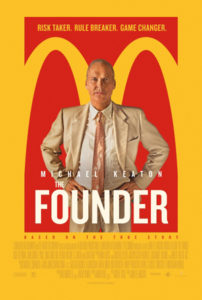
A hyper charismatic Michael Keaton drags a pair of wholesome Americans into a deal that they soon regret. No, it’s not Beetlejuice, but rather John Lee Hancock’s The Founder, the true story of the man responsible for making McDonalds the global franchise it is today. Director Hancock is no stranger to selling shrewd businessman stories having previously helmed the Disney-pursues-Mary Poppins pic Saving Mr. Banks. Like Mr Banks, The Founder relies on how charmingly its entrepreneur can overtake a profitable concept from its hesitant creators. In this respect, The Founder zips along on the boundless energy that Keaton infuses into Ray Kroc.

It’s hard to imagine America without the golden arches of McDonald’s. It’s a vision that not even the franchise’s namesake brothers had foreseen when the wily  Mr.Kroc rolled up to their booming San Bernadino burger stand in 1955 to sell his milk shake mixers. Here the brothers, Dick and Mac (played by Nick Offerman and John Carroll Lynch) devised the fast food kitchen as we know it, breaking away from the slower drive-ins of the day. Traveling salesman Kroc has had more than his fair share of drive in frustrations–slow carhops, wrong orders, cumbersome trays–and knows an opportunity when he sees one. “Franchises!” he enthuses to stoney faces of Offerman and Lynch. They prefer quality over quantity. What the McDonalds don’t know about Kroc is he falls asleep to the recorded mantra “nothing is as powerful as persistence.” Which he has in spades.

Despite Kroc’s triumph Hancock does not give Ray a pass on his swindling ways. Played by Michael Keaton (accompanied by his thematically appropriate arched eyebrows), Kroc is a magnetic presence to be sure and like many cinematic villains, fun as hell to watch work. However, the perfectly cast Offerman and Lynch are infinitely more sympathetic. Aesthetically they’re the stoic hound dogs to the fox in the henhouse that is Keaton. John Carroll Lynch specifically tugs on the heart strings multiple times as he watches his family’s vision slip out from under them. A trauma great enough to hospitalize him at one point. And if that weren’t enough, a sulking supporting turn by Laura Dern as Kroc’s first wife, Ethel, goes a long way to showing what an exhaustive personality her husband has always been without the film needing to delve much into his backstory.

Viewing this film from 2016 makes Kroc’s success in his endeavors a foregone conclusion but to Hancock’s credit, he keeps the burger flipping and legal gymnastics interesting. He manages to condense the McDonalds’s “overnight success thirty years in the making” in one balletic montage that really showcases the ingenuity of the brothers in designing their “speedee service model”. In a world where the fast food assembly line is omnipresent, it is somewhat heartening to see the genuine human element and efforts that went into its inception. That the fruits of said efforts were ultimately swiped by a ‘founder’ who hadn’t founded anything luckily let me get right back to regretting the dubious influence the fast food trend had on the dietary habits of millions…but hey, did I mention how much fun it is to watch Michael Keaton?

Film Review: “Split”

Starring: James McAvoy, Anya Taylor-Joy and Betty Buckley
Directed By: M. Night Shyamalan
Rated: PG-13
Running Time: 117 minutes
Universal Pictures

Our Score: 4 out of 5 Stars

Dissociative identity disorder (DID) is more commonly known as split personality disorder (SPD) or multiple personality disorder (MPD). The 90’s was full of daytime talk shows, like Oprah, talking to people who allegedly suffered from the disorder. The TV appearances didn’t add much credence to the ongoing debate over the diagnosis and legitimacy of the mental illness in the scientific and psychological communities. Instead it provided housewives with fodder and a free-pass for Hollywood to rejuvenate one of their favorite horror/thriller tropes. Now in 2017, the disease is back in “Split,” but not without a ferociously unique bite.

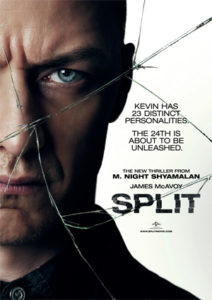
It’d be unfair to say that Kevin (McAvoy) kidnapped three women from a suburban Philadelphia mall. There are nearly two dozen other distinct personalities in his brain that could have done it or plotted to do it. However, just like his victims, we’ll soon find out that Dennis did it, but not without a little help. The trio of girls will also meet Patricia, Hedwig, Barry, and a handful of Kevin’s other internal personalities. The one victim that “Split” will tend to focus on is Casey (Taylor-Joy). Unlike her fellow captives, she isn’t crying or screaming for help. Casey seems to not only have a grasp on the situation, but an understanding of Kevin.

Another person with a deep understanding of Kevin is Dr. Karen Fletcher (Buckley). She’s talked with Kevin and nearly all of his personalities, but she’s unaware of his latest emotional developments and actions. She doesn’t view Kevin as a freak of nature, but as someone/something more. She believes Kevin’s DID makes him superhuman in nature, with personalities that not only control his mind, but his body, enhancing or crippling some of his physical attributes. That’s why it worries her that there are rumblings of a 24th personality, nicknamed ‘The Beast’. But is it just rumors between Kevin’s personalities or is there truly another personality, which can climb walls and feast on human flesh, lurking inside Kevin’s brain?

There’s more psychological and emotionally scarring at work in “Split” other than the harmful effects of DID. The mental traumas that Kevin and Casey endured previously before the current abduction predicament are revealed and make them more human. The level of empathy for the inherent villain of the movie, Kevin, is nurtured through light-hearted humor, the innocence of some of his personalities, and the one honest moment where the audience finally meets the real Kevin. McAvoy and Taylor-Joy find wordless ways to make their characters sympathetic, simply by letting tears well up in their eyes or flashing various facial tics at the right moment.

“Split” isn’t quite a return to form for Shyamalan, but more of an evolutionary step in his directing and writing. For years he’s been the twist guy that throws in some jump scares for good measure, but he’s dropped a lot of that in “Split,” relying more on atmosphere and the ability of his actors and actresses. But there’s a light joy to his movie, almost understanding that a movie about a man with DID should surely have a few jokes. Although anyone suffering from the disease and anyone without a funny bone in their body from the medical community would say otherwise. That’s not to say “Split” isn’t without its faults.

It runs a little bit too long and sometimes pushes the envelope without any purpose other than to visually or emotionally upset the audience. That may be Shyamalan tinkering with the formula since he is in new territory. “Split” is a restricted thriller, relying more on drawn out suspense and claustrophobic anxiety. “Split” is a slow boiler with enough tension to make you jump at the slightest movement. It also has Shyamalan working with a tragic villain for the first time since “Unbreakable.” If “Split” is Shyamalan’s apology for everything in between “Signs” and “The Visit,” then apology accepted.

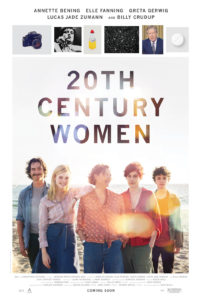
Film Review: “20th Century Women”

Starring: Annette Bening, Elle Fanning and Greta Gerwig
Directed by: Mike Mills
Rated: R
Running time: 1 hr 59 mins
A24

Our Score: 3 out of 5 Stars

In 2010, writer/director Mike Mills penned a film loosely based on his father called “Beginners,” with Christopher Plummer taking home an Oscar for his work. This week Mills has turned his pen towards his mother, with Annette Bening shining through in a performance that could end up the same way as Plummer’s did with Oscar gold.

Jamie (Lucas Jade Zumann) is a 15-year old boy being raised by a less then orthodox mother. We learn from Jamie that his mom Dorothea (Bening) wanted to be a pilot but instead now holds a high position with a major company. Dorothea is 55 and divorced. She doesn’t date much and, when she does, it doesn’t last long. Her world is Jamie. Or so she thinks. Her world also consists of Abbie (Gerwig), a boarder dealing with the possibility of having cervix cancer, William (Billy Crudup), a former hippie with a knack for fixing cars and pottery bowls, and Julie (Fanning), a neighborhood girl that Jamie is helplessly in love with. As their stories intertwine, it’s hard to see who the mature member of the “family” is and who the child is.

Set in 1979, the film makes great use with its pop culture references. Musical acts like the Raincoats and Black Flag dot the soundtrack while references to President Ford falling down the stairs of Air Force One or President Carter addressing the nation and it’s “crisis of confidence” – now referred to as “the Malaise Speech” – help set the tone of the on-screen action. As someone who remembers these events, and the “groovy” clothes from the period, it triggered some fond memories of my youth.

The film does have some problems with its pacing, but the energy jumps up when any of the three female leads are on screen. Fanning and Gerwig are both solid, especially since neither one of them were born in the time the film takes place. But it is Bening, one of our most overlooked talents, who shines here. She mines her emotional depths as she tries to find ways to connect with her son while still trying to maintain a lifestyle she has reluctantly become accustomed to. It is one of her finest performances and one I sincerely hope the Academy recognizes this year.

Film Review: “Elle”

Starring: Isabelle Huppert, Laurent Lafitte and Anne Consigny
Directed By: Paul Verhoeven
Rated: R
Running Time: 131 minutes
Sony Pictures Classic

Our Score: 4 out 5 stars

“Elle” has put me in an uncomfortable situation as a male reviewer because I’m going to have talk about rape. The act has been used before, so in that sense, it’s nothing new. Moviegoers have seen it in “Straw Dogs,” “A Clockwork Orange,” “Boys Don’t Cry,” and other films. Sometimes it’s the focal point or a moment that punctuates a grisly reality or message. But in “Elle,” there’s something disturbingly different about rape. It seems like an afterthought in the busy life of Michele (Huppert) and slowly becomes a tool of empowerment.

The movie begins with an intruder, breaking into Michele’s home, quickly and savagely raping her, as her gray cat casually looks on. He finishes and flees without much thought, leaving her unconscious and bleeding. It’s a difficult scene, no doubt. But what happens next is bizarre. She picks herself, goes to work, and even tells her son that she won’t entertain the thought of calling the local authorities. But that doesn’t stop her from daydreaming about murdering the rapist with her own bare hands.

It almost seems like she’s too busy to worry about the rape. She’s got a company to run with a video game that’s nearly half a year behind schedule. She seems unfazed by the video game graphics of a demonic creature molesting and raping an innocent woman, or the excessive amount of sexual and graphic violence that her all-male staff seems to be worried about inserting into the game itself. Then there’s all the family drama at home.

Her son can’t stand-up and assert himself in his own marriage, her ex-husband lingers trying to suckle at her own success, her mom lives with an escort, and her dad is one of the most infamous serial killers France has ever seen. “Elle” seems to be saying that the rape is almost the least of her worries, and certainly one of the least most screwed up things to happen in her life. That’s not to take away from the ferociousness of the movie’s opening moments.

“Elle” is an unpredictable journey that explores the psyche of a woman; Not a victim. It’s impossible to foresee how the movie unfolds because most of the time, Michele is shattering stereotypes and clichés of how society feels a rape victim should react. That’s not to say that this movie could be viewed as grossly insensitive to actual rape victims. But to put it bluntly, it is liberating to see someone who realizes the horrors and stigmas attached to rape, only to relish in it and use it as fuel for a much deeper and darker fire.

You don’t have to wait long for the rapist in “Elle” to reveal himself, unleashing a myriad of moral and ethical questions, both for Michele’s character and the man behind the ski mask. The surrealism of the movie is perfected by Huppert’s performance, which feels tragic at first, but unflinching when she breaks through the shackles of the viewer’s expectations. Huppert gives Michele a realistic range, which seems even more daunting when you begin to realize that Michele’s purpose may be to subvert a lot of society’s views of violence, sexuality and innocence.

Director Paul Verhoeven took a bold step directing “Elle” because it’s hard to imagine a mainstream audience stomaching it past five minutes or seeing Michele as a relatable character. It’s crazy to think that this is the same man who brought American audiences, “Hollow Man,” “Starship Troopers,” and “Showgirls.” With that in mind, this could be a middle finger to American taste and sensibilities after Hollywood flushed him down the toilet.

Film Review: “Silence”

Starring: Andrew Garfield, Adam Driver and Liam Neeson
Directed By: Martin Scorsese
Rated: R
Running Time: 161 minutes
Paramount Pictures

Our Score: 4 out of 5 Stars

Very rarely do you have a religious piece of filmmaking that doesn’t question religion or support the existence of a greater entity. Martin Scorsese is no stranger to the topic; raising hell with “The Last Temptation of Christ,” but his latest film is a deep meditation and self-reflection on the topic. The myriad of ideas behind “Silence” are a little too insurmountable to summarize without glossing over one or two powerful and important themes. Nothing about this feels like your stereotypical Scorsese movie, which means it’s all substance and no style.

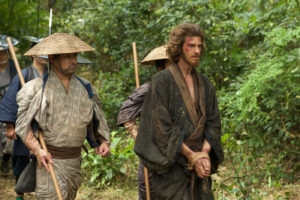
The movie follows Jesuit priests, Sebastia Rodrigues (Garfield) and Francisco Garupe (Driver). They receive a distressing letter about their mentor, Father Cristovao Ferreira (Neeson). He’s apparently committed apostasy and disappeared in post-Feudal Japan. Despite warnings about the inherent dangers of being a Christian during the Kakure Kirishitan era, a time when Christians were deep in hiding in Japan and feared being publicly executed for their beliefs, the duo head off with nothing but their faith and an alcoholic guide looking to be forgiven for his past sins.

While the first act establishes 17th century Japan, the rest of the movie follows Sebastia. There’s nothing unique about him, I guess that’s just how the cards fell in terms of storytelling and/or history. Both Sebastia and Francisco are devout men, struggling to deal with the harsh reality of potentially being murdered for their religion in a foreign land, as they watch as others are brutally slain in their God’s name, and in inherently, their names as well.

“Silence” is a struggle of morality, faith, and life. There are moments where Sebastia’s beliefs are selfish, wholesome, absurd, and compassionate. The clash of religious ideals stems from the Japanese power structure believing in Buddhism and viewing Christianity, not only as a threat, but as a toxic influence that can’t sprout in their land, which they constantly refer to as a swamp. And more frankly, the Japanese government sees Christianity as a sly form of Western intrusion and corruption. The philosophical struggles between the two beliefs don’t develop until halfway through “Silence” and that’s when they things get more profound.

We get to see the rotten and enlightened side of religion’s impact. It’s difficult to pinpoint an encompassing message in “Silence” because it plays out like a scholarly debate on faith. The three biggies in “Silence” are its reflection about how important and damning symbolism can be, it’s criticism about how humans can fetishize their own beliefs, the idols they keep close, and the images that they deem holy, and it’s praise for how religion can teach us compassion and give us silent strength when dealing with the impossible.

On a more personal level, Sebastia’s voice-over narration and internal monologue provide insight into his selfishness of wanting to be martyred much like Christ. Outside of Sebastia’s unintentional egocentric spiritual journey, it’s a humanistic learning exercise as he internalizes concerns that his prayers are said and uttered to an empty void with no one on the other end. Anyone who’s ever prayed can surely relate to that plight.

“Silence” isn’t entertaining in the traditional sense. You may find yourself bored if you aren’t willing to put your beliefs and other beliefs up for scrutiny or if you view religion as an intangible topic. “Silence” is not just an intense examination of religion, but it’s a study of societal ethics and personal morality as it relates to history, culture and your community. It’s not until the end that Sebastia aligns his priorities with what’s best for his. “Silence” may very well be Scorsese’s deeply religious message for those wanting to live life and find peace.

Film Review: “Live By Night”

Starring: Ben Affleck, Sienna Miller and Zoe Saldana
Directed by: Ben Affleck
Rated: R
Running time: 2 hrs 8 mins
Warner Bros

Our Score: 3.5 out of 5 Stars

If you don’t include the 1930s and 40s, the list of good gangster films is pretty short. Off the top of my head, I consider “The Godfather” trilogy, “Goodfellas,” “Bonnie and Clyde,” “The Road to Perdition” and “Miller’s Crossing” to be among the best of the genre. I’m guessing that Ben Affleck also agrees with my list as his latest directorial effort, “Live by Night,” samples a little bit of all of them.

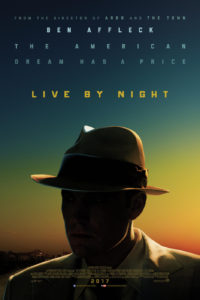
After serving his country in World War I, Joe Couglin (Affleck, who not only directed the film but adapted it’s screenplay from a novel by Dennis Lehane) decides he’s not going to take orders from anyone any longer. Wanting to “sleep during the day and live by night,” he decides to pursue a life of crime with two pals from the neighborhood. He doesn’t want to be a gangster. He just wants to be.

Of course, things never go according to plan and Joe soon finds himself in love with the boss’ girl, Emma (Miller). The boss finds out and, after a pretty good beating, Joe lucks himself into the hospital, where he plots his revenge. A revenge that’s not best served cold but one that emanates from the sunny prohibition streets of Tampa.

Directed with an obvious love for the genre, “Live By Night” is a stylish – man did they know how to dress back then – film that overcomes some obvious errors with a first rate cast. Affleck does fine as Joe and I couldn’t help wondering, as I watched the film, if he wouldn’t be perfect if they ever did a bio pic about Gene Kelly. He has the chin and he can certainly wear the clothes. Miller also excels as a girl who seems to be hiding a secret. As Joe’s rum-running partner and later wife, Saldana rises above what could have been a stereotypical “black woman in the south” caricature and makes her Gabriella a strong and equal partner. Other notable performances are turned in by Chris Cooper, Brendan Gleeson and Chris Messina.

Technically the film is quite faithful to the Tampa of the times and, as a Tampa native who once lived at Nebraska on 26th Street, I couldn’t help but swell with pride when I learned that Joe was selling his rum as far north as Nebraska and 27th Street. Not sure if I like rum – I’m not much of a drinker – but it’s nice to know that in the early 1930s I would have been able to have a drink every now and then!

Film Review: “A Monster Calls”

Starring: Lewis MacDougall, Felicity Jones and Liam Neeson
Directed By: J.A. Bayona
Rated: PG
Running Time: 108 minutes
Focus Features

Our Score: 4.5 out of 5 Stars

“A Monster Calls” is not a kid’s movie, although the trailer says otherwise and the studio probably wanted you to think differently when they greenlit it. There are moments that are too childish to entrance a teenage audience, but too dark and meaningful for a young one to fully grasp. I think the only people who would enjoy “A Monster Calls” are an adult crowd. Because when all is said and done, it takes a mature mind to recognize how beautiful and tragic it is.

The family members whispering amongst themselves is enough to give Conor O’Malley (MacDougall) a nightmare. Conor is viewed as a creative, but fragile adolescent, which makes those around him hesitate to state the obvious. His mom, Lizzie (Jones), has a terminal illness. The chemo isn’t working and the prognosis is bleak for the young mother. O’Malley’s father is out of the picture and his grandmother, played by Sigourney Weaver, is unable to handle the thought of having to bury her daughter. She’s more focused on getting custody of Conor and quickly settling other family affairs.

But Conor is suffering from a different kind of nightmare. Nightly in his dreams, he watches as the nearby cemetery, decrepit church and a twisted dead tree, collapse into the Earth. He screams as he sees his mother being swallowed along with the horrific mess. He clings to her as she’s about to fall into the unknown abyss that’s eating everything up. But before his nightmare reaches its crescendo, he awakes, sweaty and trembling. That’s when he’s greeted by a “monster”.

What conjures the deep throated tree monster, voiced by Liam Neeson, isn’t immediately clear and doesn’t become clear until the end. But what “A Monster Calls” does is provide something unique to the stereotypical coming-of-age movie. The voice of reason lies within the monster that spins fanciful ideas, speaks in vague riddles, and dishes out tales that seemingly relate to Conor’s growing predicaments.

The monster tells Conor that he will tell three stories and that by the end, he wants to hear one from Conor. Each tale doesn’t directly relate to a person or instance in Conor’s life, but each story weaved by the tree can be interpreted on multiple levels, possibly revealing its own secrets and truths to different viewers. The monster isn’t real, although there are plenty of moments to make you question that thesis.

It’s easy to see how a movie like this could have become a nightmare on its own accord. MacDougall, a somewhat fresh face to the movie scene, is given a lot of heavy lifting. While veterans and newcomers like Weaver and Jones are tasked with the adult response, MacDougall has a tougher task. He has to balance the conflict of teenage hormones clashing with a bitter reality. MacDougall handles the emotional cataclysm like a pro. This is a performance that could push him to stardom.

The script never becomes too sappy or attempts to emotionally manipulate the viewer, at least without a satisfying payoff. The visual style matches the fantasy book it’s based on, relying on real-life, CGI, and animation. The animation is a true standout with vibrant water colors that spill from scene to scene. Outside of its wonderfully distinct style, it’s a deep observation about the power of loss and the capacity of absolute truth. “A Monster Calls” is a soulful metaphor for anyone who’s old enough and open enough to feel, think and grow.

Film Review: “Hidden Figures”

Starring: Octavia Spencer, Taraji P. Henson and Kevin Costner
Directed by: Theodore Melfi
Rated: PG-13
Running time: 2 hrs 7 mins
20th Century Fox

Our Score: 3.5 out of 5 Stars

As 2017 begins the good people at Fox have graced us with the inspirational “Hidden Figures,” the first “feel good” film of the New Year.

As the Cold War looms, the United States and the Soviet Union are in a battle to be the first to enter the heavens. The Russians dispatch monkeys, dogs and whatever else will fit in a space capsule high up into the atmosphere, hoping to be the first nation to conquer the blackness of space. As the stakes get higher we join the proceedings at Langley Air Force Base, in Virginia, already in progress. It is here that we meet three of the best “computers” that NASA possesses: Katherine Johnson (Henson), Dorothy Vaughn (Spencer) and Mary Jackson (played with good, old fashioned sass by newcomer Janelle Monae). They are African-American brainiacs whose job is to compute figures for the space program. Of course, this is Virginia in 1962 so they are kept in the “colored computer” room. When a “computer” is requested to help plan the flight of astronaut John Glenn doors are opened, though at a snail’s pace.

Uplifting, if not a little heavy handed, “Hidden Figures” is based on the true story of three very remarkable women and all three stars make the wise choice of not being stereotypical in their performances. Though the fact that they are black is an important part of the story, they could have been green as far as the upper brass at NASA is concerned. They’re not told that a BLACK woman has never sat in on a briefing. They are informed that ANY woman has never been and probably never will. However it is the proudness the ladies show in both their race and gender that carry the film along. In supporting roles, Jim Parsons may find himself typecast forever in scientific roles as he plays one of the main planners of the Glenn mission while Costner is quite credible as the man who must make the decisions necessary for a successful mission. It took me until the end credits to recognize Kirsten Dunst, who co-stars as one of NASA’s HR people. She is also strong here. The film does get a little heavy handed at times, including a scene where Costner takes aim at a sign reading “Colored Restroom,” ripping it off the wall and assumingly ending racial separation as far as bathrooms are concerned.

With the recent passing last month of John Glenn, “Hidden Figures” is a solid tribute to his courage as well as the courage of the women behind the man.


Related Content

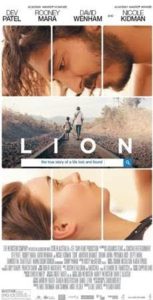
Film Review: “Lion”

Starring: Sunny Pawar, Dev Patel and Nicole Kidman
Directed by: Garth Davis
Rated: PG-13
Running time: 2 hrs 18 mins
The Weinstein Company

Our Score: 5 out of 5 Stars

I’ll admit up front that I am a sucker for films that deal with adoption. I was adopted when I was 18-months old. Inspired by the film “Antoine Fisher” I eventually tracked down my birth family, learning that I was originally the middle of 11 children. That’s right – thanks to a movie I found 10 brothers and sisters. So when I learned that adoption plays a large part of the film “Lion,” I was anxious to see it. And I’m so glad I did.

It is the mid 1980’s when we first meet the young boy Saroo (Sunny Pawar in an amazing performance). Saroo idolizes his older brother, Guddu (Abhishek Bharate). He follows him around and helps him steal coal from the mining trains that pass their small village. They sell the coal for money to help their mother, who works as a laborer carrying rocks! Yes, even in the 80’s people still got paid for carrying rocks. One night, against his better judgement, Guddu agrees to take Saroo with him. The boys get separated and Saroo finds himself on a train taking a journey that takes two days to end. Now alone in the bustling city of Calcutta he must live on the streets. Unable to speak the language (he does not speak Hindi) and unable to find his village featured anywhere on a map, he is placed in an orphanage and eventually adopted by a family in Australia. In the blink of an eye he goes from poverty to wealth and grows into a well-adjusted young man. But he never forgets his past and the family he left behind.

Powerful. That is how I’d best describe “Lion.” In a way I consider myself lucky that I was adopted as a baby. I had no idea the loving family I had been taken from. After meeting my brothers and sisters I learned that I was the family “urban legend.” The oldest child, my brother Anthony, would tell the others that they had a brother “out there” somewhere. When I met Anthony he told me that for quite a while after my birth and subsequent disappearance he would sneak out at night and look for me. My only memories from my youth are of myself and my adoptive parents. To have been age five when I was separated from my family would have been beyond traumatic. Young Mr. Pawar gives an award-worthy performance as the young Saroo. As does Dev Patel, who plays Saroo as a young adult. This is a film made up of moments. Whether it’s Saroo with his girlfriend (Rooney Mara), or his adoptive parents (Kidman and David Wenham) or just him alone with his thoughts, each moment builds on the next. Bring your Kleenex!

Film Review: “Fences”

Starring: Denzel Washington, Viola Davis and Jovan Adepo
Directed by: Denzel Washington
Rated: PG-13
Running time: 2 hrs 18 mins
Paramount

Our Score: 5 out of 5 Stars

I have to pat myself on the back. I’m happy to say that, over the past 40 years, I’ve been able to see a movie or a play and just KNOW that an actor is heading for stardom. In 1981 I went to see a film called “Carbon Copy,” which featured George Segal as a white man who learns that he has a black son. Making his debut as said son was a young man named Denzel Washington. And while I found the film funny I left the theatre with my friends praising the young Mr. Washington. I was able to meet him a few years later in New York City and I told him how I had singled him out for stardom. He was very appreciative of my comments. So much so that, when he spelled my name wrong on the photo I asked him to sign (he put the “e” before the “a”) I didn’t have the heart to correct him. 35 years since I first discovered him, Denzel Washington is at the top of his game in a film he also directs called “Fences.”

Troy Maxson (Washington) is the typical working man of the 1950s. Monday through Thursday he goes to work, does his job and comes home. Friday is pay day and he repeats his daily routine, only on Friday he gives his pay to his wife, Rose (Davis). Troy also likes to drink. At one time a great baseball player in the Negro Leagues, Troy is too old now to play in the recently integrated Majors. This makes him angry. He watches as he and Rose’s son, Cory (Adepo) builds a successful high school football career but sours on the notion of allowing him to get a scholarship to college. He insists that Cory learn a trade, not rely on sports, to support himself. But there is more going on with Troy then meets the eye.

Both Washington and Davis won Tony Awards for their work in “Fences” on Broadway and it’s easy to see why. Like a play, the two actors banter back and forth for two acts. Act one is all Washington…all braggadocio and swagger. As the film progresses we begin to learn more about Troy through his older, first son Lyons (Russell Hornsby), a musician and Troy’s older brother Gabriel (Mykelti Williamson), a mentally unstable casualty of World War II. Both Hornsby and Williamson give strong, well defined performances. In his film debut, young Mr. Adepo more than holds his own against the veteran Washington. Act two belongs to Davis, whose unquestioning trust of Troy is tested through no fault of her own.

Working with a screenplay by playwright August Wilson (“Fences” is the third of ten plays written by Mr. Wilson which explore the life of Black America in the century of the 1900s.), Washington crafts a fine film as a director, opening up the once stage set drama and giving each actor a place to share their story.

Copyright: MediaMikes.com © 2016 · Powered by: nGeneYes, Inc. · Login

All logos and images used on this website are registered trademarks of their respective companies. All Rights Reserved. Some of the content presented on our sites has been provided by contributors, other unofficial websites or online news sources, and is the sole responsibility of the source from which it was obtained. MediaMikes.com is not liable for inaccuracies, errors, or omissions found herein. For removal of copyrighted images, trademarks, or other issues, Contact Us.