

Film Review: “Hacksaw Ridge”

Starring: Andrew Garfield, Teresa Palmer and Vince Vaughn
Directed by: Mel Gibson
Rated: R
Running time: 2 hrs 11 mins
Summit Entertainment

Our Score: 5 out of 5 Stars

In the summer of 1979 I joined the U.S. Army and took Basic Training at Fort Jackson, South Carolina. I’d like to think we were tough then…running in the Carolina heat – we were the last training cycle to have to run in boots – running the obstacle course and complaining loudly that, when we got the chance to see a movie on post, we got stuck with “Beyond the Poseidon Adventure!” I mention this because, 37 years before I arrived, another young man took Basic at Fort Jackson. His name was Desmond Doss.

We meet young Desmond (Darcy Bryce) and his brother, Hal (Roman Guerriero) as they run through the beautiful countryside of their Virginia home. Like most boys do, they begin to rough-house, which quickly turns to punches. Egged on by their father, the boys begin to throw haymakers. Sensing he’s going to lose, Desmond picks up a brick and lands it against the side of Hal’s head. We have a winner. Of course this does not sit well with his parents, who warn the young boy that he could have easily killed his brother. Religion is important in the Doss household and the commandments are stressed. To break the one that reads, “Thou shall not kill,” according to Desmond’s mother (Rachel Griffiths), is the worse sin of all. Which seems like an easy rule to remember until Pearl Harbor, when the passive Desmond joins the Army. In doing so he learns he’ll have to fight to the bitter end for his beliefs and his life…against his fellow soldiers.

Based on the life of the only Conscientious Objector – these are people that refuse military service on the grounds of personal or religious beliefs – to win the Medal of Honor during WWII, the film relies on strong performances and brilliant storytelling to tell the story without being heavy-handed. Wanting to serve his country, Desmond (Garfield) joins the Army, having been assured that his CO status will not hinder his basic training experience. Sadly, that is not the case. His fellow soldiers, his drill instructor (an amazing Vaughn) and his unit commander are not pleased with his decision. In their eyes, a soldier who won’t pick up a weapon is a coward…someone they certainly can’t count on in battle. As he is given terrible tasks to perform, as well as almost nightly beatings, Doss continues to push on. He scarcely avoids a courts martial and, after much debate, is allowed to travel to Okinawa with his fellow soldiers. It is there that he shows all that will listen what a true hero is.

The cast, led by Garfield, proves to be up to the task of taking the audience into the middle of a war. All of the young men are able to get across the message of helplessness of having to keep your wits about you when everyone else is unable to do so. Garfield does a fine job, as does Ms. Palmer, who plays Desmond’s soon to be wife, Dorothy. But it is Vince Vaughn, as the company NCO in charge that delivers the most powerful performance. Gone is the snarky smart guy, replaced by a character that is perfectly fleshed out. Think of him as a cross between R. Lee Ermey in “Full Metal Jackson” and Tom Sizemore in “Saving Private Ryan.”

Like the latter Spielberg film, the depiction of war is, indeed, hell. Gibson pulls no punches as he moves his camera among the casualties, filling our eyes with missing limbs and our ears with screams. Gibson has always had a great eye behind the camera and this film only adds to that reputation.

“In peacetime, sons bury fathers,” one man notes in the film, noting that “in times of war, fathers bury their sons.” Such is the price of war. I thank God every day that in my six years in the Army I never had to pick up a weapon in anger. I didn’t have to make that choice. Desmond Doss did. And his choices made him a hero.

 

Related Content

Film Review: “Inferno”

Starring: Tom Hanks, Felicity Jones and Ben Foster
Directed by: Ron Howard
Rated: R
Running time: 2 hrs 1 mins
Sony Pictures

Our Score: 2.5 out of 5 Stars

It’s funny that I saw this film the same night the World Series started. The film opens with Bertrand Zobrist (Foster) being chased through some classic Italian streets only to jump to his death from one of the grand towers. Is Bertrand’s story exciting or would I have been better off watching Chicago Cub player Ben Zobrist getting three hits in game one. I’ll let you know in a second.

Based on the latest best-selling novel by Dan Brown, and once again starring Tom Hanks as renown symbologist Robert Langdon, the tale finds Dr. Langdon waking up in a hospital believing that he is in Boston. Imagine his surprise when he discovers that he is in Florence, Italy and has been in the hospital due to having been grazed in the head by a bullet. His wallet and watch are gone but he does find something called a Faraday Pointer which, when activated, produces a map to Dante’s various levels of hell. Intrigued yet?

While I very much enjoyed both “The DaVinci Code” (I gave it 3 ½ stars out of 4 on a website I wrote for long ago) and “Angels and Demons” (3 out of 4 – same site), those films had a lot more action in them. I found “Inferno” quite boring at times, wishing I had paid my money to have someone read the book to me, which would have been more exciting than what was happening on screen. But I don’t blame the cast or the crew. This is the third time Hanks has played Langdon and it’s obvious that he is comfortable in the role. The supporting cast also does well, with Foster’s Bertrand Zobrist popping up through flashbacks to try to keep the story moving. And director Howard, one of my personal favorites, has no trouble keeping the action interesting. When there is action. Unfortunately there are also huge chunks where people just ramble on and on about Dante, hell and where they should be heading to next. Wherever it is, the cast waits and waits on Hanks to divulge the next destination, then gives him a resounding “Of Course!”

If you’re a fan of the series you might enjoy this more than I did. If not, spend your time with BEN Zobrist. Go Cubs!


Related Content

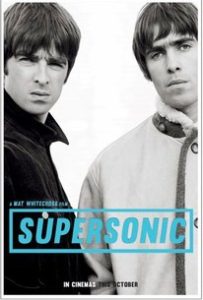
Film Review “Oasis: Supersonic”

Directed By: Mat Whitecross
Rating:R
Genre: Documentary
In Theaters:Oct 25, 2016
Runtime: 122 minutes
Studio: Mint Pictures

Our Score: 2 out of 5 stars

Oasis is a band torn apart by fame, drugs and family disputes. As soon as the band got famous, they also were falling apart. Flashback to 1994, I picked up a cassette of Oasis’ debut album “Definitely Maybe” and I was an instant fan but that love affair did not last long. Following the band’s 1995 follow up “(What’s the Story) Morning Glory?”, which superseeded the first but also lead to the band’s decline. I don’t recall really latching on to their third studio album, “Be Here Now” and their future albums as well.

“Oasis: Supersonic” is a new documentary from team behind the Academy Award-winning biopic “Amy”. The film tell sthe story of the band from the beginning to the peak of their career, conflicts between the brothers Liam and Noel Gallagher and almost immediate decline from the top. Overall, I wouldn’t call them my favorite band but I was curious to learn a bit more of their downfall but the film honestly was a bore. Running over two hours, I felt like it could have been summed up in a one hour MTV special, if MTV covered music anymore.

I do have to commend the film though and the reason I kept watching was due to the very up close and personal footage that was included. This wasn’t a documentary filled with interviews from people around the band or unrelated people but with the band themselves. If you are looking for some never before seen archive material and interviews with the band, then this film does deliver in that sense. I just got bored very quickly and just wanted to revisit their few hit songs and move on.

Film Review: “American Honey”

Starring: Sasha Lane, Shia LaBeouf and Riley Keough
Directed By: Andrea Arnold
Rated: R
Running Time: 163 minutes
A24

Our Score: 3.5 out of 5 Stars

The thought of a nearly three hour movie starring Shia LaBeouf is likely to scare a lot of people off from watching “American Honey” and I’m not going to sway you back. “American Honey” is a road trip movie without an end or direction, but during its entire runtime, it feels like it should. It’s a unique movie with an honest portrayal of Middle America, but also a frustrating long movie without a rebuke for some of its more sour themes.

Having been filmed in parts of the Kansas City metropolitan area, I admit I felt a unique connection to the movie, seeing all the familiar sights. That familiarity helped me attach characters to people that populated my own Kansas City high school and neighborhood. But the movie doesn’t begin in my hometown; it begins in lower class suburban Florida with Star (Lane). When we meet her, she’s scouring dumpsters for tossed out food that’s still in the bag. It’s so she can feed her younger brother and sister because no one else will. Her father seems more focused on drinking beer and groping Star to slow-dance music, while her mom, having moved on with her life, seems more obsessed about line dancing at a country bar.

So it makes sense that Star is lured away by Jake (LaBeouf) and a crew of ruffians that sing along to gangster rap and Rihanna’s #1 hits. Jake’s innocent flirting and the promise of a life without restraint convinces Star to abandon her siblings, leaving them in her divorced parents “care”. This new life though, with Jake and the others, is actually a “magazine crew” (those annoying kids who find a different lie every time to sell overpriced magazine subscriptions) that goes from town to town across the country. Leading these youthful Nomads is a druggie vagabond that’s never sober.

The journey takes the “magazine crew” from Kansas City to Oklahoma to Grand Island, Nebraska and to Williston, North Dakota. Each city offers an interesting slice of Americana, from the rich people that dot the Midwest farmland to the blue class workers stuck in underpaying jobs. “American Honey” seems to offer more spice and intrigue with the people that Star encounters, which is unfortunate considering how interesting Star’s character is.

She’s good-hearted and naturally trusts the strangers she encounters, even hopping in a vehicle with three adult men in Nebraska who take her back to their place for expensive tequila and steaks. She loves Jake even though he’s clearly a loser with deep emotional issues. She befriends everyone in the “magazine crew” and appears to enjoy the work even though the “job” is exploiting her. She finds different ways to cheer up people around her or help those that she doesn’t know. Yet we never get a distinct feeling about how the sights and interactions are impacting her psyche or if she’s intelligent enough to understand the deteriorating situations around her.

Her aimless path possibly signifies the wanderlust that has infected much of America’s youth today. It never vilifies or champions the magazine crew beyond portraying them as the fun-loving potheads that they are. None of them seem like bad individuals or rotten apples, just young adults without ambition outside of money, getting inebriated and fornication. “American Honey” may simply be stating that youthful lethargy is a consistent no matter the generation. But there’s no denying that during the course of the movie, the pop-culture they consume is feeding into their apathy and idleness.

“American Honey” never blames Star and the others for what the audience may be faulting them with, but it never really points any blame at anyone. Without ever coming to a conclusion, it’s very frustrating that the movie never points a finger of blame or indirectly implies that the actions of someone, something, or society has led Star to this fun, yet troubling point in life. “American Honey” may simply be asserting that bad things happen and may always happen to a certain demographic of this country and that their joy is just as fleeting as their youth.

“American Honey” will certainly have meaning to various people and that might actually be one of its strongest points. It paints such a vivid and beautiful picture of youth in the U.S., that it could say a lot of honest things to a lot of different people. It’s a movie that grew on me, much like a melancholy memory from my youth. I may not have enjoyed the experience, but looking back on it I slowly begin to understand its importance and significance. But I go back to the first sentence of this review and say, do you really want to watch a directionless movie that pushes towards three hours with Shia LaBeouf? If you want an idiosyncratic art film, this is it. But you also run the risk of finding yourself bored and exasperated.

Film Review: “The Accountant”

Starring: Ben Affleck, Anna Kendrick and J.K. Simmons
Directed by: Gavin O’Connor
Rated: R
Running time: 2 hrs 8 mins
Warner Bros

Our Score: 4 out of 5 Stars

Christian Wolff seems like a normal child. Until you spend time with him. Currently he is sitting at a table, feverishly putting a puzzle together. Suddenly he panics – he only has 999 of the 1000 pieces. When the missing piece is found Chris completes the puzzle. As he inserts the final piece we see that he has completed the puzzle upside down – the image is face-down. All we see is the blank cardboard back. “Is this normal,” Chris’ father asks the man Chris has been brought to meet. His reply: “Define normal.”

A well-crafted thriller, “The Accountant” picks up 20-years after the puzzle incident with young Christian Wolff (Affleck) now a successful C.P.A. With his dented thermos, brought-from-home sandwich and pocket protector, he could be the nerdy guy next door. Except Christian has a secret. One that Ray King (Simmons), head of the US Treasury Department’s Crime Enforcement Division has been trying to solve for years. King enlists the help of Marybeth Medina (Cynthia Addai-Robinson) to discover why Wolff seems to be involved with some very high profile (read: non-law abiding) customers. Meanwhile, Wolff has been also asked to solve a problem. When a corporate accountant for a major robotics company suspects that someone is stealing from the company she asks Christian to take a look at the books, which may or may not have been cooked for years.

Smartly directed, with a nice twist in the story, “The Accountant” rests squarely on the shoulders of Ben Affleck. I love the fact that he is a mathematical savant, giving the audience a chance to wonder what could have happened to Will Hunting had he not followed Skylar to California. Affleck gives Wolff a quiet coolness, never raising his voice or getting agitated. Kendrick’s role is really secondary. She is here to attract Christian to the main plot line of the film, the going-ons at the robotics company. Affleck is aided by several great character actors, including John Lithgow, Jon Bernthal and Jeffrey Tambor. Director O’Connor, who helmed the underrated MMA film “Warrior,” keeps the film moving with strong pacing that never misses a beat.

Film Review: “The Birth of a Nation”

Starring: Nate Parker, Armie Hammer and Jackie Earle Haley
Directed by: Nate Parker
Rated: R
Running time: 2 hrs
Fox Searchlight

Our Score: 5 out of 5 Stars

Haunting.

When people have asked me my opinion of “The Birth of a Nation,” that is the word I’ve used most. The story, the images, the history…

A young boy is surrounded by family and friends. His chest bears what is described as “the mark.” He is told that he is destined to be a prophet and to lead. Born into slavery, the boy is taught to read by the wife of the owner of the cotton plantation he lives on. As “white” books are off limits, he devours the only book he is allowed to hold, the Bible.

Year later, the boy is now the man we know as Nat Turner (Parker). Soon he is leading his fellow slaves in worship. This occupation serves him, and his master’s (Hammer) well when he is hired by neighboring plantation owners to come and preach to their slaves to keep them in-line. Feeling uneasy, but wanting to help out the master who, for the most parts, has been good to him, he addresses the workers, quoting Bible verses that speak about serving your master and being obedient. However, after witnessing the horrific treatment of his brothers, Nat begins to get fiery in the pulpit. No longer does he preach about a God that demands obedience. Now he speaks of a God of love, who is also a God of wrath! A wrath that Nat Turner took upon himself to deliver.

Winner of both the Grand Jury Prize and the Audience Award at this year’s Sundance Film Festival, “The Birth of a Nation” is easily one of the best, and most important, films of the year. Like “12 Years a Slave,” it introduces audiences to a part of history that few choose to remember and many choose to forget. And the credit goes to its star, director and co-writer, Nate Parker who, surrounded by an amazing cast, tells the story of a true American hero whose exploits are often glossed over because of the way they were achieved.

Parker, resembling a young Denzel Washington, is flawless as Turner, often expressing his emotions, be they joy or sadness, more with his eyes then his voice. And, like Washington, he holds the screen with his presence. Hammer also excels as the owner who, when everything boils over, is just as hateful as all the others. As a slave hunter with a penchant for violence, Jackie Earle Haley is pure evil. The supporting cast, including Aja Naomi King as Turner’s wife and Penelope Anne Miller as the mistress of the plantation, also give amazing performances.

Technically the film is beautifully photographed and the musical score by Henry Jackman carries the film along and matches the visuals note for note. But the message here IS the message here. As the film nears its climax a young man exclaims that, “They’re killing black people for no other reason than being black.” Words from 1831 that continue to reverberate in 2016.

Haunting.

Film Review: “The Girl on the Train”

Starring: Emily Blunt, Rebecca Ferguson and Haley Bennett
Directed By: Tate Taylor
Rated: R
Running Time: 112 minutes
Universal Pictures

Our Score: 3 out of 5 Stars

Something’s in the water in Westchester County, New York. Megan Hipwell (Bennett) refers to herself as the county whore to her psychologist (Edgar Ramirez), while flirting with him in over-the-top fashion. She’s cheating on her emotionally abusive husband, Scott Hipwell (Luke Evans), presumably with more men than just her psychologist. Her carefree and apathetic nature is used to mask her emotionally fragility. The Hipwell’s next door neighbors are dealing with turmoil of their own, but not within their own marriage. Anna Watson (Ferguson) and Tom Watson (Justin Theroux) are dealing with Tom’s ex-wife, Rachel (Blunt).

Rachel may just as be emotionally damaged as Megan. She takes the train to her non-existent job every day so she can glance at her ex-husband’s home for a brief second. Unknowingly, she also is glancing into the home life of Megan and Scott’s life. In her head, Rachel imagines a happier home than the one that actually exists. Everyone collides and connects in a disgruntled mess when Megan goes missing the same night Rachel goes on an epic bender involving a full fifth of vodka and hotel-sized bottles of other assorted liquors. Rachel begins to include herself in everyone’s lives even more while also being a prime suspect in the criminal investigation behind Megan’s disappearance.

“The Girl on the Train” will most likely be compared to 2014’s “Gone Girl” which is really unfair. “The Girl on the Train” isn’t as smart, witty, or amusingly dark as “Gone Girl”. “The Girl on the Train” is more like a contemporary reimagining of the late 80’s and early 90’s steamy murder skin flicks like “Fatal Attraction” or “Disclosure”. The comparison to “Gone Girl” may be because of the narrative for “The Girl on the Train,” which is very confusing at times. It jumps back and forth between the past and present so much that you begin to mistake who’s telling the story and which story has already happened and which one is still unfolding.

The time jumps are a method by the film to confuse the viewer about who’s responsible for Megan’s disappearance and, as anybody could easily guess, her death. The movie leaves a lot of red herrings, but the movie makes a fatal mistake by establishing from the get-go that when we see things through Rachel’s eyes, she’s an unreliable narrator, ultimately nixing any theories or ideas that come falling out of her brain or her blurred drunken visions.

“The Girl on the Train” is a two-hour version of “48 Hours” that intentionally jumbles up the “who-dun-it” portion of the story. But if you’re a keen observer, you’re going to ultimately guess what’s going on during Rachel’s alcohol fueled hallucinations, Megan’s flashbacks during her psychologist visits, Scott’s recollections and the unsettling calmness of Anna and Tom’s love life. By the time the big twist arrives, the movie isn’t quite sure how to proceed. It ends up over explaining how it all went down and tries to find some resemblance of meaning to end on.

“The Girl on the Train” is carried mainly behind some terrific performances, including Blunt who portrays a struggling alcoholic coping with horrific memories and a failed marriage. If the movie was more memorable, Blunt would surely be an early runner for a best actress Oscar. Bennett’s character, despite not being too relatable or sympathetic, is given meaning and passion through Bennett who once again, may have been in an early running for an Oscar if this movie was better. “The Girl on the Train” isn’t this year’s “Gone Girl” and won’t be a movie you’ll be talking about long after you leave the theater, but is interesting enough to sustain its near two-hour runtime. Folks who regularly watch Investigation Discovery will find plenty to enjoy here and others, like me, may find it’s brooding steaminess oddly charming, but ultimately flawed.


Related Content

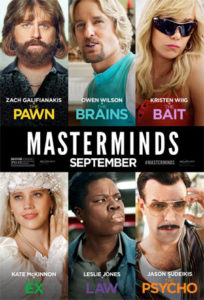
Film Review: “Masterminds”

Starring: Zach Galifianakis, Kristin Wiig and Owen Wilson
Directed by: Jered Hess
Rated: PG 13
Running time: 1 hr 34 mins
Relativity Media

Our Score: 3.5 out of 5 Stars

What do you do if you’re a short, dumpy man with a Prince Valiant haircut that is hopelessly in lust with your hot female co-worker? If you’re David Ghantt (Galifianakis) and that co-worker is Kelly Campbell (Wiig), you agree to steal $17 million from your employer. Piece of cake!

Based on a true 1997 event, “Masterminds” has been sitting in the can for a year while the studio went through bankruptcy. The film is extremely funny at times and features a cast of comedic who’s-who. Galifianakis gives Ghantt a quiet dignity, making him appear to be oblivious to those who would take advantage of him. Wiig is equally sweet. Wilson is part of an amazing supporting cast which also includes Kate McKinnon, Jason Sudekis and Leslie Jones. McKinnon, who stole this past summer’s “Ghostbuster” reboot, does the same here as David’s unsmiling fiancé, threatening to withhold consummation if he continues to eat Googoo clusters.

The script has fun with the film’s premise and setting, which is the late 90’s where everyone in the South hangs out, robs banks and hire hitmen. With every instance you can’t help but be amazed how such a stupid group of people could pull off the biggest cash robbery in United States history. As things get crazy, the setting jumps first to Mexico then to North Carolina where the story climaxes. The gags are hit and miss but when they hit they’re pretty amusing.

Quick note – if the filmmakers could have found a gig for Melissa McCarthy this could have been an un-official “Ghostbusters” sequel. But at least it’s funnier than the real “Ghostbusters 2.”

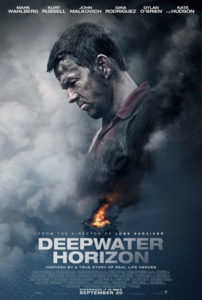
Film Review: “Deepwater Horizon”

Starring: Mark Wahlberg, Kurt Russell and John Malkovich
Directed By: Peter Berg
Rated: R
Running Time: 107 minutes
Summit Entertainment

Our Score: 4.5 out of 5 Stars

Over six years ago, the Deepwater Horizon explosion triggered the worst environmental disaster in U.S. history. Since then, BP has agreed to the largest corporate settlement in history, to the tune of nearly $19 billion in fines. The economic impact to the Gulf Coast was even higher, with estimates around nearly $25 billion, but it could easily be higher than that. Outside of the financial realm, thousands upon thousands of different animals and even hundreds of people on land suffered adverse health effects. As daunting as those numbers are, nothing cut’s as deep as the loss of a brother, father, or son, that 11 different families experienced on April 20th, 2010.

“Deepwater Horizon” covers the complicated 24 hours that led up to the explosion on the floating football field sized oil rig quite well. The movie mainly follows Mike Williams (Wahlberg), the Chief Engineer for Transocean. Transocean is a foreign property that actually owns the rig. The oil castle is on lease to BP, despite BP’s best attempts to run it like it’s their own. The petroleum palace is over one of the most difficult oil and gas prospects in the Gulf, the Macondo Prospect. Upon Williams’ arrival, the well is about to be filled up with a cement plug. But there’s a problem.

BP, constantly reminding them and the audience that the rig is behind schedule, isn’t concerned about doing the best job of creating or testing the cement plug that’s about to be put in place. They’re ready to clean up and move on to the next vast oil prospect. “Deepwater Horizon” paints the BP officials on-board the rig as nefarious penny pinchers, but in this case the pennies are hundreds of thousands of dollars. After a couple rounds of testing, the cement plug appears to be good enough for BP. , And against the beter judgement of Deepwater Horizon Manager Jimmy Harrell (Russell) and his crew, they go along with it. Sadly I think you know the rest.

While Berg spends every chance he gets making the audience loathe the slimy BP execs, he manages to humanize the people we encounter on the rig. While BP acts like they’re individual cogs to the massive machine that is the Deepwater Horizon, Berg shows them act more like a family unit. Like most co-workers in tight confines, they surely get on each other’s nerves, but the ebb and flow of the environment’s safety keeps them tight. Safety is the biggest component of survival and outside of the jokes, jabs and scowls, this crew ensures everyone stays safe and out of harm’s way.

The absolute panic and mayhem that takes over when the rig finally explodes into a massive fireball is intense to watch. This isn’t like most disaster movies where people complete inhuman feats of heroism to escape, this is blue collar men and women finding a way to survive in a scenario none of them were trained or prepared for. There are plenty of moments where characters express their deep despair at the situation, exclaiming through tears that they’re going to die. The media coverage of this event over half a decade ago was focused more on ecological disaster that it was and is still is today. We never got that human aspect as much and this movie is a tragic window into what happened in the span of a couple of hours.

Berg’s last movie, “Lone Survivor,” was a bone crunching look at how survival isn’t brave or courageous, it’s absolutely terrifying. “Deepwater Horizon” is the exact same, but instead of a warzone populated with soldiers, ordinary folks are dodging flaming debris, shrapnel from exploding metallic piping, and pushing broken bones back into place. Despite what the advertising says, “Deepwater Horizon” isn’t a movie with a hero that comes in and saves the day. These people saved themselves and they don’t feel like heroes, they feel survivor’s remorse. They wonder what they could have done differently to save their friends or stop the explosion.

Berg displays the heartbreaking range of emotions and his cast is able to reflect that without skipping a beat. Because many of us aren’t familiar with the names of those that were lost that day, there’s a decent amount of uneasiness about when someone could die or if they will die. For those who want to know what horror happened the night the Deepwater Horizon rig exploded, this movie captures it to near-perfection.

Film Review: “The Magnificent Seven”

Starring: Denzel Washington, Chris Pratt and Ethan Hawke
Directed By: Antoine Fuqua
Rated: PG-13
Running Time: 132 minutes
Columbia Pictures

Our Score: 2.5 out of 5 Stars

“The Magnificent Seven” feels like it comes about two months too late. I may have enjoyed this remake more if my phones weather app read triple digits outside and the theater was still pumping out Arctic air. “The Magnificent Seven” feels like a good fit for the summer line-up, especially with the cast at hand, stunning visuals and exciting action-packed finale. Maybe it’s because I’m gearing up for awards season or my mind is ready to overanalyze, but I was in total critic mode while watching this movie.

This remake of the original (which was also remake) follows familiar beats. Sam Chisolm (Washington) is a bounty hunter that is contracted by a pair of residents from Rose Creek. The town is under the thumb of a ruthless businessman. He’s milking valuable materials from nearby mines, utilizing the populace as slave labor and poisoning the town’s water source. The capitalist, played by Peter Sarsgaard, establishes his cold-heartedness early by killing residents and burning down the Rose Creek church. But not before giving a very ham-fisted speech about how evil he is and how capitalism and our society justify it.

Feeling like it’s his civic duty, Chisolm rounds up some degenerates to save the town. Pratt plays Josh Farrady, a charming alcoholic that gambles and kills those who double cross him. Hawke plays a Civil War sharpshooter, Goodnight Robicheaux, who clearly suffers from PTSD after the War of Northern Aggression. He’s accompanied by a Chinese assassin, Billy Rocks (Byung-hun Lee). Then there’s Red Harvest (Martin Sensmeier), a Comanche warrior, whose appearance is the most random. There’s also Vasquez (Manuel Garcia-Rulfo), a Mexican fugitive and Jack Horne (Vincent D’Onofrio) a murderous man-sized teddy bear that you can’t understand half the time.

The “origin” story takes forever to get moving. The movie is more fascinated about establishing and having fun with its star power, Washington and Pratt, than it is explaining why half the group would join a suicide mission to help protect a town that none of them have heard of. The throwaway montage scenes of training Rose Creek citizens to fight and the predictable action-movie beats could have been trimmed for a much more lean and fluid flick.

The overall charm of the cast is nearly enough to forgive the movie for its storytelling mistakes and unimaginative narrative. When there aren’t guns blasting, explosions going off, or one-liners, the movie is a real drag. I wasn’t emotionally invested enough in the townspeople to care about them being in the path of a murderous tycoon. I also wasn’t emotionally invested enough to feel anything when the body count started to pile up towards the end.

That being said, there’s actually a lot this movie does right. The visuals and action are infectious. A lot of what makes the fighting sequences exciting can be chalked up to the use of real horses, set pieces, and stunts. So much of it appears natural and real that when the use of CGI is required, the computer animation sticks out like a sore thumb. On that level, it’s a successful summer movie that came out towards the end of September.

It’s odd that the movie never appears to pay homage to old Westerns or attempts a style change that may help it carve a new path in a familiar trail. It’s brainless entertainment that has awkwardly shown up at the beginning of Oscar season. “Magnificent Seven” is a stick of dynamite blast half the time, but the other half of the time it’s like watching a tumbleweed blow unenthusiastically in the wind.


Film Review: “Blair Witch”

Starring: James Allen McCune, Callie Hernandez and Brandon Scott
Directed By: Adam Wingard
Rated: R
Running Time: 89 minutes
Lionsgate

Our Score: 2.5 out of 5 Stars

It’s been nearly two decades since a pair of aspiring filmmakers put together a cinematic game changer. “The Blair Witch Project,” a found footage film based on a made-up urban legend involving a supernatural witch in small town America, spurred late 90’s fandom and early Internet hysteria. Now the Blair Witch has entered the digital age. It’s no longer trapped in the Circuit City video camera age with a $22,000 budget. It now has drones, Bluetooth headset cameras, and $5 million to play with. And maybe that’s why it has inherently lost a lot of its horror charm and bite.

James (McCune) is the younger brother of Heather, who went missing back in “The Blair Witch Project” 20 years ago. James believes that a Youtube video of newly found footage may be the key to finding his long lost sister. So with the help of some friends, mainly documentarian and film school student Lisa (Hernandez), he travels to the Black Hills. Despite early eerie vibes, “Blair Witch” has is already having to retread familiar paths to establish its atmosphere.

Upon arrival in sleepy Burkittsville, James and his group meet Talia (Valorie Curry) and Lane (Wes Robinson). The two Burkittsville residents, whom straddle the line between white trash and goth metalheads (or are those the same thing?), are the ones who found and uploaded the Youtube footage. Their infatuation with the Blair Witch legend is a mixture of respectful fear and fanboy excitement. With Talia and Lane forcibly in tow, the group heads into the woods in the hopes of finding whatever bizarre phenomenon inhabits the creepy Maryland woods.

It’s difficult to sum up “Blair Witch” into a few simple words or a pithy comment. It flips on a dime midway through, going from the familiar slow burner that made the first one so memorable, to a nonstop jump scare haunted house. The first 30 minutes pays homage to the style of the original, leaving supernatural breadcrumbs for the cast to find. The tone pivot comes when the group has to stay a second night in the woods after predictably getting lost and divided.

Adam Wingard and crew, who’ve done previous other horror movies together (and very well I might add), show signs of adoration for the original. But in an attempt to make their own distinct vision, they may have trampled all over what made the original unique. The “found footage” has been edited from about a dozen different camera sources with some scenes clearly not being from any of the recording equipment on hand. They also expand upon the mythology, giving God-like powers to the witch. The over saturation of the witches new powers, gore, and predictable jump scares certainly cheapen the mood.

As for the jump scares, nearly every other one is unnecessary and come nearly every 30 seconds in the movie’s climax creating a blunt force experience that will either nauseate or thrill. While certainly stimulating to watch in theaters, the jump scare bombardment grows tiresome. At times I felt like I was watching a full screen version of “Five Nights at Freddy’s” on amphetamines. Outside of the repetitive first-person terror, “Blair Witch” finds inspirational moments. There are scenes that are cleverly claustrophobic and discomforting.

“Blair Witch” is a bold endeavor that may have been more respected if it wasn’t in the shadow of a 1999 movie that did so much with so little. “Blair Witch” is an expensive fanboy movie made by a genuine fan of the original. I have tip my hat to Wingard and crew for being ambitious with this sequel/reboot, and not being afraid of trying something new with old material. But I can’t help and think that “Blair Witch” should remain a cinematic relic.


Related Content

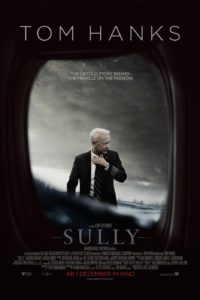
Film Review: “Sully”

Starring: Tom Hanks, Aaron Eckhart and Laura Linney
Directed by: Clint Eastwood
Rated: PG-13
Running time: 1 hr 35 mins
Warner Bros

Our Score: 5 out of 5 Stars

Before I saw this film, this is what I knew about Captain Chesley “Sully” Sullenberger: he landed a plane on the Hudson River and then he went to the Super Bowl, heralded as a hero. If only life was that easy.

January 15, 2009. A normal day for all involved, unless you’re a passenger on US Airways Flight 1549. As the world knows now, during take-off the plane met up with a flock of Canadian geese, several of who were sucked into both engines, rendering the plane powerless. Despite initial attempts to return to the airport, pilot “Sully” Sullenberger (Hanks) decides to set the plane down in the middle of the Hudson River. Miraculously, all 155 people on board survive. Sully is labeled a hero but before he can get patted on the back he is informed by the National Transportation Safety Board (NTSB) that he is being investigated for possible negligence. Computer simulations show that had he turned the plane around as intended, he could have landed safely at several nearby airports. Did he make the right decision?

Centuries from now, should movies still be being made, film historians will still be talking about Tom Hanks and Clint Eastwood. Hanks has two Oscars for his acting and three other nominations while Eastwood has four Oscars – two for directing – and another seven nods. “Sully” is Eastwood and Hanks at the top of their game. Our generation’s Jimmy Stewart, Hanks has excelled in playing the “everyman” who is forced to face impossible odds. Here he is tasked with the emotional weight of the film. “I’ve flown millions of passengers for 40-years and I’m going to be judged by what I did in 208 seconds,” he laments. Sadly, he is right. The airline knows there is going to be lawsuits, and if someone can be blamed, the better off for them. Hanks gives Sully a quiet pride. Even when he’s sure he made the right decision he can’t help but question himself. It’s an emotional rollercoaster, as Sully goes from appearing on David Letterman to having vivid dreams about the plane crashing into the New York skyline.

Eastwood has always been a simple director, letting his camera almost eavesdrop on the action. Here he puts us squarely in the shoes of the title character, to the point where you’re quietly second-guessing yourself. As usual, he stocks his films with top acting talent, including Eckhart (in a sweet mustache) as co-pilot Jeff Skiles and Linney as Sully’s wife, Lorraine. A great group of supporting actors, including Mike O’Malley, Jamey Sheridan and Anna Gunn make up the NTSB group investigating the incident.

A quick note: the film is being released the same weekend America will remember the 15th Anniversary of the attacks of September 11th, 2001. The film depicts some troubling shots, via Sully’s dreams, of airplanes crashing into buildings. Though part of a dream, the images are haunting so keep that in mind when deciding to bring a young child along. That being said, if you want to introduce your little one to a true hero, introduce them to “Sully.”

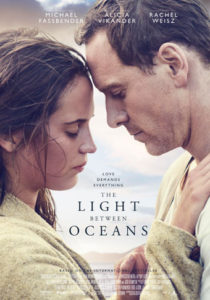
Film Review: “The Light Between Oceans”

Starring: Michael Fassbender, Alicia Vikander and Rachel Weisz
Directed by: Derek Cianfrance
Rated: PG-13
Running time: 2 hrs 12 mins
Touchstone Pictures

Our Score: 2.5 out of 5 Stars

The Oxford University Press Dictionary defines “Continuity” as: “the maintenance of continuous action and self-consistent detail in the various scenes of a movie or broadcast.”

Sadly, the director of “The Light Between Oceans” has never read the Oxford University Press Dictionary.

The year is 1918. Just returned from four years in “the BIG WAR,” Tom Sherbourne (Fassbender) is given a job maintaining and operating a light house off the coast of Australia. He is told the position will only last six-months, as the full-time operator is just recuperating from an illness. As he travels through the town, on way to the desolate island he will soon call home, he meets the beautiful Isabel (Vikander). The two are immediately smitten with each other. He takes her on a picnic and she asks if she can visit the island. He replies that the rules state only the lighthouse keeper and his wife are allowed. “So marry me,” she tells him.

Learning that his predecessor will NOT be coming back, Tom accepts a three year contract and immediately marries Isabel. They try to have children but Isabel proves unable to have children. One day, Isabel spots a boat floating off the coast, seemingly empty. Tom drags it to shore and finds out that it’s not empty. Inside is the dead body of a man and a still-breathing infant. Hmmmmmm.

Full of inconsistent time jumps and heavy handed foreshadowing, “The Light Between Oceans” starts off strong but peters out by the time the film ends…about 40 minutes too late. And the continuity is terrible. The way I saw it, the following happened in a 20 minute period:

Tom buries his miscarried child

Isabel spots a boat

Tom finds the child

And in the next ten minutes:

Tom notifies his employer that Isabel has given birth

People visit

Tom finds a rattle in the boat (BANG! – that’s the sound of foreshadowing hitting you over the head) and tucks it in his pocket

A stranger sees the rattle. Get the idea?

Things go from bad to worse when, on a visit to the mainland, Tom learns that there was a father and daughter who were lost at sea the day before he found the baby. Luckily Tom and Izzy have the baby christened at the same church the grieving widow/mother attends so Tom can stumble on the grave marker. Will Tom’s conscience allow him to continue the charade? What do you think?

Let me take a moment from discouraging you from seeing this film to tell you that, despite all of the script problems, both Fassbender and Vikander turn in fine performances. I read recently that the two are now a couple off-screen and the chemistry is very visible on-screen. Also fine are Weisz as the grieving widow and Bryan Brown, who plays her wealthy father.

OK, back to the things I hated. The film quick-jumps to 1950 quicker than Doc Brown’s DeLorean, wiping out almost three decades of plot, and providing more questions than answers. Speaking of questions, I have one here. IF you live on an island with ONLY your wife around to keep you company, why in God’s name would you EVER lock your front door. WHO are you keeping out? And, if as you’ve maintained, the dead father, who was German, may have been chased down by townsfolk still upset over the war and by his accent, make sure he doesn’t speak with an English accent in flashbacks. And WHY is this film over 2 hours long?

In looking back at my review of the director’s previous film, “The Place Beyond the Pines,” – obviously he likes to either be “between” or “beyond,” I found the following comment:

“Incredibly overlong with a plot twist you can spot from the back of the theatre, “The Place Beyond the Pines” wastes strong performances in a sea of cliché’s and coincidences.”

Sounds like some people can’t change!

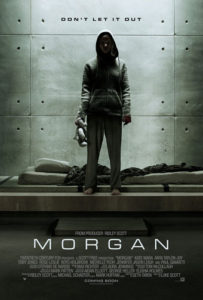
Film Review: “Morgan”

Starring: Kate Mara, Anya Taylor-Joy and Toby Jones
Directed By: Luke Scott
Rated: R
Running Time: 92 minutes
20th Century Fox

Our Score 1.5 out of 5 Stars

Sometimes when I watch something so promising, and filled with so much talent, I wonder if I genuinely missed something when I walk out not liking it. “Morgan” features veteran talents like Paul Giamatti, Ridley Scott as producer, Jennifer Jason Leigh, and a script that made 2014’s Blacklist (a list of the best unproduced scripts currently floating around Hollywood). So here I am a week removed from watching “Morgan” and I think to myself, I didn’t miss anything. It’s a bad movie.

Anya Taylor-Joy (someone who’s bound to get an Oscar nominating performance one of these days) is stuck as the science experiment gone wrong, Morgan. The five-year-old, by human years, is actually around 18-by-whatever-made-up-logic-this-movie-makes-years-old. She’s the end result of a human embryo breeding project. She’s birthed with some of the best genes out there as well as a couple of super human capabilities that are never really explained. After a month, Morgan is able to walk and talk. After a couple of years, she’s a self-sufficient preteen with a childlike wonder about the world. After five years, she’s capable of inflicting bodily harm on her creators and show signs of deep hatred. And after Morgan stabs a scientist in the eye for no apparent reason, it’s time to bring in the corporate business suits.

“Morgan” has the capability to deliver a message about cloning, the inability to understand raw human emotions, and eugenics, but instead focuses more on visual technique. “Morgan” ends up being all style with no substance. The groundwork is there as we watch sterile and emotionless scientists suddenly become parents, growing up and watching Morgan’s guileless nature. Then we watch as the parental instinct kicks in when the scientists try to understand and defend Morgan’s growing sociopathy. She may be a monster, but she’s their monster. Another missed theme is how corporate culture looks at the numbers more than the human impact, but I digress because this movie failed on all thematic levels.

But even as the movie slowly falls apart, “Morgan” still has one final chance to deliver upon any resemblance of meaning behind its script. The writers, producers, and director, fail to give anything outside slick visuals, bruising action sequences, and a disquieting environment for its characters. The third act of the movie turns out to be more of an experiment in forbearance as the twist of the movie slowly gets unraveled. Although I figured out the twist about 30 minutes in while another critic I spoke to after the movie figured it out five minutes in. I guess even M. Night Shyamalan could recognize “Morgan” has a bad twist.

It’s really unfortunate watching Taylor-Joy get generously applied with Dave Chappelle white face make-up and play in one of the more frustrating creature features in recent memory. Taylor-Joy popped up on the scene earlier this year in “The Witch” and has a lot of talent waiting to be displayed. She does a fine job relaying Morgan’s genuine wonder and empathy, while balancing Morgan’s uncharacteristic murder streak. Taylor-Joy does all this well, but it’s hard to piece together the mind of her character when the movie continuously jumps back and forth between Morgan’s personalities.

It doesn’t help that the movie states she’s only five, despite having the mind and body of a full blown teenager. Is she a test tube bred deadly assassin battling teenage hormones with the id of a child progressing too quickly into an adult world that she has no comprehension of? If so, why is this experiment worth anything to anyone, especially a company? Those are questions no one making this film ever thought to ask and inherently asking that question gives away the movie’s twist.

Just like its character, “Morgan” lacks any growth, meaning, or excitement. Whenever the movie gets close to developing a theme or message, it reverts back to finding meaning behind violence like a Kindergartener throwing a temper tantrum, frustrated that it couldn’t find a way to expel upon its interesting premise. If this is the final movie of the summer, the summer certainly goes out on an uncreative whimper.

Film Review: “War Dogs”

Starring: Jonah Hill, Miles Teller and Bradley Cooper
Directed by: Todd Phillips
Rated: R
Running time: 1 hour 59 mins
Warner Bros

Our Score: 4 out of 5 Stars

Who wants a little excitement in their lives? In 2005 the answer to that question was Efraim Deveroli (Hill) and David Packouz (Teller), former high school pals who reunite while attending a friend’s funeral. Via voiceover we learn that our government spends an average of $17,500 per soldier when outfitting them for war. War is recession proof. There are a lot of crazy gun nuts out there, but none as crazy as the U.S. Government. Someone needs to provide them…why not Efraim and David? Sounds pretty exciting, doesn’t it?

Thanks to some great performances, “War Dogs” rises above similar themed films (for some reason, I kept thinking back to 1983’s “Deal of the Century” as well as 2005’s “Lord of War”). Teller, who is best described as his generation’s John Cusack, gives David a sense of morality. Tired of giving massages to rich people on South Beach, he jumps at the chance to go into business with Efraim. And by the time he finds out HOW the business works, he’s made enough money to convince him that the chances he takes are worth it. On the other side of the spectrum is Hill, who has gone from comedy fanboy to multi-Oscar nominated actor. His performance here is strong, going from humorous to dramatic and back without seemingly breaking a sweat.

The supporting characters, including Bradley Cooper as an infamous gun runner and Ana de Armas as David’s love interest, also make the film enjoyable. Based on a true story, the action keeps the film flowing smoothly without becoming preachy. As one of the last films of the summer season, “War Dogs” is definitely one to watch before you end your summer vacation.

Copyright: MediaMikes.com © 2016 · Powered by: nGeneYes, Inc. · Login

All logos and images used on this website are registered trademarks of their respective companies. All Rights Reserved. Some of the content presented on our sites has been provided by contributors, other unofficial websites or online news sources, and is the sole responsibility of the source from which it was obtained. MediaMikes.com is not liable for inaccuracies, errors, or omissions found herein. For removal of copyrighted images, trademarks, or other issues, Contact Us.