Rough weather in the Midwest didn’t stop tens of thousands of people from packing into Bartle Hall in Kansas City over the weekend for Planet Comicon. For three days, folks braved monsoon-like rains to meet their favorite stars, socialize and geek out. Nearly every inch of the convention center was brimming with fans, excited to see, meet and hear from celebrities, creators and cosplayers.
Like previous years, the 2017 edition of Planet Comicon featured all-stars across the entertainment spectrum. Everyone from Ron Perlman (“Sons of Anarchy” and “Hellboy) and Felicia Day (“The Guild” and “Dr. Horrible’s Sing-Along Blog”) to Jason Aaron (Writer for “Doctor Strange and “Thor”) and Kevin Eastman (Co-creator of “Teenage Mutant Ninja Turtles”) brightened the otherwise gloomy days. Our very own Mike Smith even hosted an informative panel on “Jaws 2” and Hollywood sequels. You’d be hard pressed to find anyone who was disappointed by this year’s line-up and activities.
Saturday, one of the busiest days of the three-day extravaganza, could have been disastrous if it wasn’t for the quick work and social media tools at the disposal of Planet Comicon organizers. A backdrop collapse during John Barrowman, early on in the day, could have thrown a wrench in the organizer’s plans. But a quick reshuffling, along with constant updates on Facebook, Twitter, and Planet Comicon’s new phone app, notified fans about the up-to-the-minute changes. It’s just one of many signs that Planet Comicon is always evolving to become bigger and better. It’s truly a leader of cons in the Midwest and shows the perseverance to become one of the best cons in the U.S.
MediaMikes would be remiss if we didn’t thank Planet Comicon organizers for not only their hard work, but for the opportunity for some of our readers to win three-day passes to the event. We’re already planning to attend and cover next year’s Planet Comicon.
Photo by Dan Lybarger
“Hellboy” himself, Ron Perlman
Pikachu on the dance floor at an after party
Felicia Day with balloon versions of the “MST3K” robots
No-Face from “Spirited Away”
Emma Caulfield and Clare Kramer reflect on their roles on “Buffy”
Batman’s true weakness
Jason Isaacs talks Harry Potter and DC
A near-perfect Bob and Linda Belcher
The one-man show, John Barrowman
No shortage of creativity
Tara Reid talks about how she wound up in the “Sharknado” series
Ariel delighting children
Shannon Elizabeth has been busy since “American Pie”
An unlikely duo, the Mad Hatter and Jack Frost
Starring: Sharlto Copley, Brie Larson and Armie Hammer
Directed By: Ben Wheatley
Rated: R
Running Time: 90 minutes
A24
Our Score: 3 out of 5 Stars
Guns, swearing and an ensemble cast. Sometimes that’s all you need. At least that might have been the idea behind “Free Fire,” a 90-minute dark comedy meant to entertain and amuse those sick enough to sift through its violence to unearth the humor and enjoy the over-the-top gunplay. “Free Fire” is heavy on style and short enough to justify the full-fledged warehouse shootout, but its lack of storytelling substance and handful of one-dimensional characters risks shooting it down entirely.
Chris (Cillian Murphy) and Frank (Michael Smiley) are representatives with IRA, in Boston to purchase weapons from gun runner, Vernon (Copley). Mediating for the gun runner is Ord (Hammer) and Justine (Larson) for the IRA. Each side has their own underlings to schlep the merchandise around and nothing seemingly goes right during the late night meet-up. Things come to a head when underlings from both sides know one another and before you know it, the bullets start flying.
There are enough off-the-cuff remarks to understand that a few people in the overall group are a part of an underlying double cross, even before things go South. However, there’s just not enough information to fully understand the backstabbing that was about to take place before all Hell broke loose. The secondary plot at work seems inconsequential when everyone’s ready to kill each other off until the bitter end. It’s a story full of bullet holes, but I doubt “Free Fire” was concerned about that.
The movie is written and directed by Bill Wheatley, who certainly has a unique and perceptive style. “Free Fire” is so tightly filmed; it truly feels like a never ending gun battle without a dull moment in sight, unless of course you loathe brainless violence. Wheatley’s no stranger to content that will certain hook some while completely turning off others. “High-Rise” is a movie that’s intentionally repugnant, rewarding those that dig through the putrid humanity for the meaning and infuriating for those that prefer a much cleaner, deeper message.
“Free Fire” doesn’t serve a purpose other than to entertain and pay homage to late-night action movies of the 70’s and 80’s. It’s certainly a movie that Quentin Tarantino would have watched at the video store he was employed at if “Free Fire” had come out about four decades ago. Of course that would have influenced Tarantino to make a better movie. I would have preferred a story to “Free Fire” and much meatier characters so that their sass had more of a bite and their deaths were more consequential.
If “Free Fire” fails at the box office, it’ll surely become a cult classic, but if it succeeds, it’ll be shuffled to the side as a retro tribute to bygone action films. Regardless, “Free Fire” is crass escapism with some of the best filmed gunplay in recent memory. If you’re hoping for a little oomph to the plot and characters, outside of witty one-liners, you’ll be disappointed. If I could make a recommendation with what should accompany this movie, it would be alcoholic beverages and friends who bring out the immaturity in you.
Starring: Vin Diesel, Dwayne Johnson and Jason Statham
Directed By: F. Gary Gray
Rated: PG-13
Running Time: 136 minutes
Universal Pictures
Our Score: 2.5 out of 5 Stars
“The Fast and the Furious” franchise experienced a Renaissance when it embraced mindless action and over the top stunts, combining CGI with a real-life demolition derby, back when “Fast 5” was released. Since then it’s embraced this absurd concept that the fate of the world rests in the hands of speed junkies that refer to themselves as a close-knit family. Its intentional cheesiness allowed us to ignore the laws of physics and embrace these street racers turned globetrotting heroes. But “Fate of the Furious” stomps on the brakes by hovering precariously close to taking itself too seriously.
Dom (Diesel) is approached by a mysterious figure known as Cipher (Charlize Theron), while on his honeymoon in Cuba. Without the audience seeing it, a cellphone video convinces Dom to betray his “family,” go rogue and work for Cipher. Die-hard “Fast and the Furious” fans, who accept its cheese or eat it up like housewives munching on daytime soap operas, will certainly have their eyes glued to the screen as the betrayal unfolds. I, on the other hand, rolled my eyes and began waiting patiently for some neat explosions.
It’s difficult to talk about the plot in-depth because much of the movie hinges on why Dom is going rogue and Cipher’s connection to the greater world that’s been established through eight movies now. For a movie franchise about fast cars, scantily clad women, and explosions, there’s a surprising amount of depth within it’s pulpy drama, much like WWE’s Wrestlemania. That’s not lost on people who’ve spent over a decade and half with the group, or newcomers who’ve embraced it recently.
Dwayne Johnson, Jason Statham, Tyrese Gibson, Chris “Ludacris” Bridges, Michelle Rodriguez, and a handful of other side characters are back to appease fans who’ve stuck with the franchise since 2001. For those who aren’t familiar with the franchise, or have lazily watched them throughout the years like me, the paper thin plot and lack of meaningful development is still hanging in there. That’s actually a positive since anything more would have otherwise made the series unnapproachable as time went on.
The main problem is that “Fate of the Furious” tows the self-serious line it found itself on the wrong side of before “Fast Five.” Viewers are treated to exposition that feels like a lecture, instead of fast cuts that visually summarize our new villain, the story’s direction, or the plot. It’s a real drag when characters are reduced to robotic dialogue and technobabble during 30 minutes of talking; much like listening to two computers share data. It kills the adrenaline, especially after watching dozens of self-driving cars cause mayhem on the streets of New York City or a prison break highlighting Statham’s parkour fighting abilities.
Most of the cast knows they’re making a dumb movie and roll around in the scenery, chewing on bits and pieces while in their million dollar speed racers or while breathlessly fighting in ice covered Russia. Statham and Johnson are the best at this. Maybe they should have instructed Diesel and Rodriguez on how to liven up a little. Because Diesel is now the driving force, and one of the producers of the franchise and this film, his character has been place under the microscope. It’s a near fatal mistake assuming that the audience cares about him. People connect more with Johnson’s soccer dad persona and Statham’s hard-ass with a soft spot more than Diesel’s stoic demeanor. It appears that the loss of Paul Walker has left a big hole in the storytelling department.
“The Fate of the Furious” is an entertaining distraction that tragically relies more heavily on its slow storytelling pace, rather than its edge of your seat action. Despite its flaws, there are very few movies being given blank checks so that their characters can face off against a thermal nuclear Russian submarine with only nitrous powered cars at their disposal. The high of “Furious 7” makes “Fate of the Furious” a letdown, but the character’s affinity and eye popping action are enough to make it a passable addition to the franchise.
Starring: Aaron Poole, Kathleen Munroe and Kenneth Welsh
Directed By: Jeremy Gillespie and Steven Kostanski
Rated: R
Running Time: 90 minutes
Screen Media Films
Our Score: 3 out of 5 Stars
If John Carpenter’s creatures, Clive Barker’s perversions and the 80’s Satanic panic bent the laws of nature and had an unholy baby, it’d be “The Void.” For horror aficionados and special effects gore hounds, “The Void” is a visual buffet. But for those wanting a little bit more in terms of storytelling, they’ll find “The Void” to be full of empty calories. As someone who can appreciate both, I feel that “The Void” is a scene setter for an idea bigger than what the directors could envision.
Officer Daniel (Poole) is awoken from a casual nap in his police cruiser by an injured man stumbling out of the woods. He rushes the blood-soaked stranger to an area hospital where the night shift is more focused on a different, new hospital they’ll soon be operating in. The old hospital is on the cusp of closing down after a mysterious fire. The barebones staff can’t wait to pack everything up and move.
The key players is Daniel’s emotionally distant wife, Alison (Munroe), whose sought comfort in Dr. Powell’s (Welsh) sage advice and comforting demeanor. There’s also a pregnant teenager, a clumsy CNA, a vengeful father and a decent handful disposable side characters. They hunker down as trouble arrives in the form of cloaked cult members armed with knives. They gather ominously outside the hospital, attacking anyone who dares attempt to leave, but that’s not the worst of their problems. That comes in the form of a monstrous blood-soaked blob made up of various limbs, body parts and tentacles stalking the hospital halls.
The storytelling is suspect. It’s a Frankenstein of nearly all body horror films from the 80’s, like “Hellraiser,” “The Thing,” “Re-Animator,” and “Night of the Demons.” Most other times I’d be frustrated that a movie would so blatantly steal page after page out of different movies scripts, but it’s clear that there’s a level of reverence and homage to these movies. Everything from the special effects to the tropes is out of respect and admiration, not parody or theft.
But the non-existence of originality in “The Void” hurts it a lot. The lack of personal ingenuity on the director’s end makes the movie forgettable. It’s a great throwaway, midnight creature feature, but the story and its characters yearn for to have their own novelty. The relationship between Officer Daniel and Alison should feel more exclusive, rather than a side note on a lengthy journey through religious evil and hell on Earth.
There are moments that hint towards a grander scheme at work as well as a few simple aesthetics to create an exclusive experience for fans of horror. For 90 minutes, it’s a wonderful sensory experience in terror, but there’s nothing narratively juicy enough for me to sink my teeth into and chew on. “The Void” is an ambitious project, deserving of praise for what it does right, but it’s difficult to overlook its failure to satisfy the tastes of those who crave more.
Starring: Dacre Montgomery, Naomi Scott and RJ Cyler
Directed By: Dean Israelite
Rated: PG-13
Running Time: 124 minutes
Lionsgate
Our Score: 1.5 out of 5 Stars
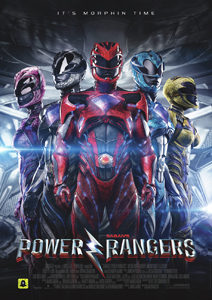
As a Millennial, I watched the “Power Rangers,” but I was not old enough or smart enough yet to do it ironically. Every day after school I’d plop my butt in front of the TV and watch a mindless repackaged Japanese TV show and enjoyed it like it was high art. My mom even suffered through the “Mighty Morphin Power Rangers: The Movie” in theaters so I could get my fix. But here’s the thing, I couldn’t tell you a single Ranger’s name, villain or plot from the shows or movie. So it wasn’t memorable for me, but I’m sure the agony of having to endure it still lingers with my parents. Well, they’ll be happy to know what goes around has come around.
A prologue, millions of years in the past on Earth, sets the stage. We see that circular crystal discs are what give powers to the Rangers, an elite class of protectors. Cut to the future where we meet the next batch of Rangers, but they don’t know it yet. This is the movie’s first mistake as it spends an awful lot of time setting up Jason (Montgomery), a directionless high school football superstar who plans a juvenile prank that ruins his life. He ends him flipping his truck, damaging his knee and being relegated to detention, seemingly forever.
In detention he meets Kimberly (Scott), a former cheerleader who’s betrayed her friend’s trust, and Billy (Cyler), a brainy, yet slightly autistic student who we’ll eventually come to find out is the only originally pure of heart teenager in this movie. “Power Rangers” eventually introduces Trini (Becky G) and Zack (Ludi Lin), but never cares enough to give us any background information on them until right before the third act. But by that point it feels unnecessarily crammed in, like most of the film’s character development.
The movie sometimes chooses to be subtle with its character’s traits, yet at other times slaps audiences across the face with thick intelligence insulting exposition. But this is one of many problems plaguing “Power Rangers.” The movie never seems to settle on if it’s for a new generation of young “Power Ranger” fans or nauseous nostalgia for those who grew up in the 90’s. It’s a mix of both, but the direction choices clash so much, it makes for a jarring cinematic experience.
At times we get that TV safe Saturday morning feel from our future Rangers, like cutesy physical humor montages and a “Kingpin” joke about “milking” a cow, but other times we get blasts of teenage reality like the fallout of revenge porn and drowning your sorrows in beer. I’ll admit that the latter makes the characters a lot more human and relatable, but none of it feels natural. The happenstance of how they all meet and become friends is about as logical as a Bryan Cranston and Elizabeth Banks playing intergalactic warriors who’ve been comatose for millions of years, simply waiting for the right moment to awake.
Cranston, as Zordon, is mildly wasted here, as his only on-screen performance is on a green-screen set covered in thick make-up. He shows up throughout the rest of the movie as a disembodied voice attached to a CGI grid screen, dispensing plot points and ridiculing the teenagers for not being able to come together as a team. Cranston’s delivery is too serious, never taking on the role as mentor. However, he’s complimented by the jokey robot, Alpha 5 (Bill Hader), who seems to fluctuate between hammy and cynical.
Banks plays the movie’s main villain, Rita. She’s the only one in the movie who chews on the green screen scenery. There are moments where Rita is truly delightful to watch because of how cheeky Banks’ delivers her dialogue, but there are certain elements to Rita that are unnecessarily included like when she commits cold-blooded murder or when she crawls across the screen like Regan spider walking in “The Exorcist.”
“Power Rangers” is glum and tonally frustrating, relying on concepts found in the recent trend of gritty reboots while attempting to be a self-serious homage to the original TV show. There are obvious editing flaws that even the average moviegoer should notice. It’s either bad storytelling and pacing or a baby playing with the buttons in the editing studios. Compounding these frustrations is a blatant product placement that would make NASCAR cringe. Was a “Power Rangers” movie ever supposed to be good? No. But it’s not supposed to be this bad.
Starring: Dan Stevens, Emma Watson and Luke Evans
Directed By: Bill Condon
Rated: PG
Running Time: 129 minutes
Walt Disney Studios Motion Pictures
Our Score: 4.5 out of 5 Stars
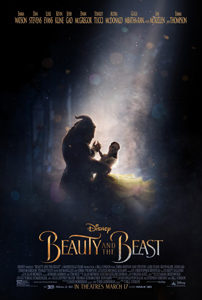
Disney has effortlessly remade one of its greatest films. That in itself should be commended because of the power that “Beauty and the Beast” still holds for old and young fans of the Disney brand. The 1991 animated classic still has some of the best theatrical music in their catalogue. It also has a story that managed to retell a fairy tale classic while thumbing its nose at formula, something that still feels fresh over a quarter of a century later. So how did Disney recapture the magic?
The sincerity by everyone involved is clear from the costume and set designers to the cast populating the screen. Emma Watson’s portrayal of Belle is spot on, from her obvious attractiveness to Watson matching Belle’s powerfully independent demeanor with stoic glares and gentle warmth in her eyes. There is subtle personality changes that evolves Belle from the two-dimensional hand-drawn character of yesteryear into a three-dimensional character grounded in reality that dances off the screen.
As for Dan Stevens, he had a tougher time capturing the brutish nature of his character, since the Beast is CGI. While I’d be willing to place bets that his voice was digitally tinkered with, Stevens’ ruffs, gruffs, and even singing, makes him stronger than Robby Benson’s portrayal back in the early 90’s. It also helps that we get a lot more backstory behind the Beast’s character and an extra layer of geniality beneath the coarse fur and fangs.
Going in I had my doubts that Luke Evans could play such a vain, muscular villain like Gaston, but luckily I was proven wrong by his character’s roguish suaveness and cunning wickedness. Josh Gad pairs with him nicely as a much more good-natured LeFou in this update. The cutlery and castle furniture are just as charming as their voice actors, Ian McKellan, Stanley Tucci, Audra McDonald, GuGu Mbatha-Raw, and Ewan McGregor, who’s leading the way as the talking candlestick, Lumière. McGregor doesn’t disappoint when he voices the show stopping “Be Our Guest.”
The story remains true to the original, scrambling up a few pivotal moments, adjusting pacing, sewing in ideas from the Broadway adaptation, and taking some creative liberties (which I’m sure you’ve read or heard about one in particular in the media by now). After 25 years, it makes sense that some nuts and bolts have to be shifted and modernized, but it never forsakes the heart and spirit of the movie. The story’s soulful mix of romance and music remains intact.
There are about 30 more minutes of content that gives the audience a deeper of understanding of the characters, and not just our two lovebirds. We relate and feel more for the talking furnishings and silverware more than we did previously. While purists might fold their arms and slouch in their theater chairs in disgust over these changes and the vision, others will be enchanted by this interpretation, finding something there that wasn’t there before.
“Beauty and the Beast” is a magical retelling that will make fans of young ones and make Disney loyalists fall in love with the story all over again. While the original is still the standard bearer for Disney storytelling and animation, this 2017 version isn’t without its own merits. The 21st century “Beauty and the Beast” is a lot more melodic and even more visually extravagant without ever being gaudy. Its familiarity makes it a must-see, but its newfound charm makes it an instant classic for newcomers.
Starring: Anna Kendrick, Lisa Kudrow and Craig Robinson
Directed By: Jeffrey Blitz
Rated: PG-13
Running Time: 87 minutes
Fox Searchlight Pictures
Our Score: 3 out of 5 Stars
The indie dramedy genre is generally characterized by it’s portrayal of a dysfunctional family, a haphazard group of friends or a bumbling arrangement of strangers in a scenario where there are multiple revelations, declarations and betrayals, soaked in sappy sentimentality and feel-good moments. Very rarely do the movies give audiences a cathartic release or genuinely move our hearts and soul. However, a few do. “Little Miss Sunshine” comes to mind. But most of these films are a dime a dozen, floundering on their own predictability or offering audiences brief, but humorous escapism. “Table 19” does both.
“Table 19” is named after the wedding table where the people who got an invitation, but should have known better and declined the offer, showed up. It’s the final table to be set and have it’s food delivered at the wedding. It’s brushed to the corner of the banquet hall, near the bathrooms and out of sight. The table 19 occupants are equally as random as their connection to the bride or groom. It almost makes you wonder if the nicer thing would have been to just never have sent an invitation at all.
There’s the heart-broken, former best friend of the bride and ex-maid of honor, Eloise (Kendrick). To her left is the Kepps, Bina (Kudrow) and Jerry (Robinson), whose marriage is struggling so bad they don’t even bother keeping up the appearance of smiling happiness or tolerable hatred anymore. To Eloise’s right is the adolescent Rezno (Tony Revolori), who’s only at the wedding because his mom didn’t think he had a chance of scoring a date or dance at his junior prom. Rounding out the table is ex-convict, Walter (Stephen Merchant) and a nanny from the past, Jo (June Squibb).
There’s a lot of emotion and backstory to unpack, but “Table 19” reveals a lot of it without sacrificing a handful of entertaining moments. Most of it unfolds naturally, in a manner that’s logical to the scant plot. Jerry loves mystery novels and wonders why such an oddball group would be stuck at the worst table. Eloise provides the answer, while withholding some secrets as to why she, a jilted lover, would bother showing up to the wedding her ex-boyfriend is at and why the couple even broke up in the first place.
Kendrick, as usual, is bubbly, likable and cute. It’d be interesting to see if she’d be able to pull off the villain in a movie someday. Merchant’s awkwardness as Walter provides some much needed comic relief that isn’t Jerry’s sardonic bluntness about the whole situation. The audience will surely relate with a lot of the characters on screen, but only because their plights are so generic. Despite my complaints about its reliance on indie tropes, I found myself enjoying the funny quirks each character carried as well as how the story resolved. The conclusion is the one thing I couldn’t quite predict.
The movie is written by the Duplass brothers, who’ve worked on a lot of indie dramedies, some bad and some well-written. What’s missing from their brand is the uncomfortable comedy that should be populating their envisioned settings. That’s where director Jeffrey Blitz comes in, whose work includes episodes of “The Office.” Together, the writers and director, create a passable movie, skirting on secondhand embarrassment, but nothing memorable or outstanding.
“Table 19” has some heartfelt performances and some jaunty comedic moments, but too often it finds itself lost in its own plotting and backstory. Sometimes it’s difficult to tell if we’re supposed to enjoy the characters company because they’re emotionally disfigured buffoons or sympathetic damaged souls. Even at 87 minutes, it feels like it takes too long to tell a simple story. At times its sappy like any love story culminating at a wedding, but sometimes you feel like you’ve shown up to a wedding you don’t want to be at.
Starring: Daniel Kaluuya, Allison Williams and Catherine Keener
Directed By: Jordan Peele
Rated: R
Running Time: 103 minutes
Universal Pictures
Our Score: 4 out 5 Stars
Something’s not right. It’s not just the subtle and blatant racism by Rose’s (Williams) family, but it’s the growing sense of dread that the audience experiences through the eyes of Chris (Kaluuya). Every other African-American that Chris encounters wears clothes straight out of a Norman Rockwell painting and speaks in uncomfortable pleasantries. Even worse is that when talking to these African-American’s Chris feels like he’s talking with every other white person he’s encountered at the family event.
Despite the blunt, and comedic, warnings of one of his friends, Chris is visiting the relatives of his five-month girlfriend. Rose tells him that she hasn’t mentioned she’s dating a black guy to her family, but she assures him it’s perfectly OK. She even tells him that her father (Bradley Whitford) would have voted for Obama for a third time if he could have. He later shoehorns that racially motivated banter into conversation as a way to get to know her daughter’s new boyfriend, as if her father assumes all black people voted for the 44th President. The awkward remarks and comments aren’t fooling Chris though. Something’s definitely not right.
For those familiar with Jordan Peele, who’s worked in television sketch comedy for over a decade, it might come as a surprise that his directorial debut is satirical horror, that’s a lot heavier on the tension than it is the jokes. The comedy is served up as a way to divide viewer apprehension, which there’s plenty of. Peele has a keen eye for unnerving the audience with numerous close-up shots, specific musical arrangements in even more specific spots, and performances that convey a sinister plot hidden deep in suburbia.
Peele, throughout his comedic career, has dropped muted and blunt horror movies references and “Get Out” is no different. For horror aficionados, there are plenty of nods, homages and stylistic choices reminiscent of Wes Craven, Stanley Kubrick and others. But for those in on the trick of the trade, you’ll find more to “Get Out” than its director’s love of scares as the film progresses. The social and racial commentary is sprinkled throughout and just not in Rose’s eerie, grinning family.
Chris, as well as his friend who keeps in constant contact with back home, seem to be the only ones that understand racism is still a thing. It’s seen early on with a policeman taking a statement after Rose hits a deer with her vehicle. Despite her being the driver, the officer still asks for Chris’ ID. That’s a more obvious statement by the film, but there are plenty of other moments shrouded behind smiling faces and looks, demeaning questions, and using undignified nicknames when talking with Chris.
The boogeyman in “Get Out” isn’t anything supernatural, but very real. As a white man who’s sat through plenty of horror movies, rarely do I ever get two distinct impressions. One, I am the boogeyman. Two, this is what the average black man deals with. The movie even begins with a nod to the Trayvon Martin incident as a black man walks through suburbia at night, thinking out loud about what George Zimmerman is lurking just around the corner.
As politically and socially carnivorous as “Get Out” is, it’s never victimizes black people or vilifies white people. The terror is real, projecting minority’s real world fears onto a plot revolving around body horror, brainwashing and 21st century slavery. It helps that Chris doesn’t find himself in the stereotypical backwoods, but in a picturesque homestead where everyone’s educated, nice and welcoming. But as I stated at the beginning, something’s not right. If “Get Out” is any indication, Peele is not only a refreshing voice for horror, but may have just steered the genre in a completely new direction that’s wildly exciting, scary and ferocious.
Directed By: Michael Dudok de Wit
Rated: PG
Running Time: 80 minutes
Sony Pictures Classic
Our Score: 4 out of 5 Stars
Since 2013, Studio Ghibli has been without Hayao Miyazaki. The creatively diverse, ever-promising studio has seemingly been stuck in a holding pattern. When a found is no longer present, it’s understandable for a production studio to shuffle its feet while trying to find some new footing. Ghibli’s first theatrical step since Miyazaki’s departure may have come in the form of a multi-national collaboration.
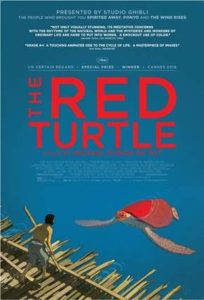
“The Red Turtle” isn’t really a story, more than it’s a visual journey. In many ways, it’s a fable without dialogue, taking viewers on a curious excursion. The movie begins with an unnamed man, clinging to life in a furious sea storm. He awakens, stranded on an island that has the most basic of essentials; a small cluster of ponds to drink fresh water from, various fruits to quell his hunger, and bamboo to craft a getaway raft. The only thing preventing his escape is an expressionless red turtle.
Someone with rudimentary observational skills would view “The Red Turtle” as simplistic storytelling without purpose. But the removal of dialogue requires the viewer to take in more than they normally would. You pay more attention to the thinly drawn facial expression changes, the grunts, the various orchestral selections and the nameless man’s dreams that spill into reality. I can tell you what “The Red Turtle” means to me, but this is multi-layered movie that relays a different message for those willing to watch.
I viewed the “The Red Turtle” as a thoughtful reflection about mankind’s need to reconnect with nature in a meaningful way, less we want to wind up alone on this floating blue ball called Earth. It’s not necessarily an environmental message that I took away, but one of humanity’s casual disrespect. We merely take what we need and seem frustrated when nature responds, not with violence, but with curiosity about why we don’t stop in breathe it all in. Once the nameless man works with nature, instead of against it, he begins to be happy and see the island as a miniature slice of heaven.
But like I said, others will take away a much different and distinct opinion from the subtext. This kind of opinion is true for most films, but “The Red Turtle” is crafted in such a way that if there is a true message to be consumed, it’s cleverly hidden beneath a lot of optical substance. Without giving too much away, there are deep themes about family dynamics, the destructive habits that nature and mankind reciprocally share, the mutual survivalism every creature on Earth is enduring, and that’s just a few.
While “The Red Turtle” is a metaphorical delight, it’s pace sometimes is slower than a casual stroll, seemingly padding it’s runtime so it could be considered a feature length film. This is a story that may have benefitted from a shorter runtime, but then again it may have lacked a lot of philosophical richness that viewers would be able to sink their teeth into. “The Red Turtle” is not only a stellar animation endeavor, but a soothing delight that reflects the human soul.
Starring: Gemma Arterton, Glenn Close and Sennia Nanua
Directed By: Colm McCarthy
Rated: R
Running Time: 111 minutes
Saban Films
Our Score: 4 out of 5 Stars
If it bites like a zombie, moves like a zombie, and growls like a zombie, it’s probably a zombie. That’s not the case though in “The Girl with All the Gifts.” Their zombies haven’t necessarily died and become reanimated monsters that crave human flesh and/or brains. Instead, a fungal infection is the culprit behind the mindless, violent masses stalking this post-apocalyptic world. The spores sprout and creep into the brain, like a vine weaving its way into a home’s foundation, causing a human to lose their mental prowess and become monotonous cannibals.
While the sight of a human would usually send a stereotypical film zombie into a tizzy, the zombies in “The Girl with All the Gifts” only react to scent and sound. Also in this dystopian future, where the last remaining humans have stowed away in heavily guarded forts, there’s a third, hybrid group that co-exists. It’s made up of second-generation children, born from a human turned zombie. They’re almost like a bridge between the two, exhibiting human emotions and intellect, but excited to sink their teeth into flesh and organs at a moment’s notice.
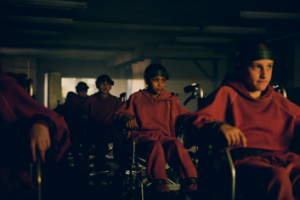
The elementary and middle-school aged children keep their inhibitions in check, but just the mere whiff of someone’s stench sends them chomping at flesh, snarling at people and attempting to escape their restraints. The most intelligent and articulate of the group is Melanie (Nanua). She’s also the best at keeping her animalistic urges in check while her entire class acts like starved sharks when a drop of blood hits the water.
Most everyone at the military base, whether its army men with assault rifles, apprehensive school teachers or scientists, is petrified of the children; except two people. Miss Helen (Arterton) sees humanity’s salvation in them. While Miss Helen may pine for the days before the apocalypse, she thinks that these kids are more than just a potential cure, but have true value in shaping the future of the world. Dr. Caldwell (Close) on the other hand picks the brains of the children, literally and intellectually.
“The Girl with All the Gifts” is based on a book of the same, where the writer most likely stole a few pages out of “The Walking Dead” playbook, incorporating emotion, character study, and morality into the zombie genre. Video gamers will get more of a Deja vu feeling as the fungal infection and foliage rich cities feel reminiscent of the PlayStation 3 game, “The Last of Us.” Despite some of the clear and possible influences, “The Girl with All the Gifts” avoids a lot of cliché pitfalls and is a solid addition to the zombie genre that’s been struggling to find anything fresh lately
Even with the star power of Glenn Close, the movie is led by the heartfelt, yet terrifying, performance of a 12-year-old actress. Sennia Nanua counterbalances the dire outlook in “The Girl With all the Gifts” with a curious coming-of-age story. If Melanie didn’t have dried blood on her lips and face half the time, she could be the Katniss of the zombie world. Melanie faces a lot of stark realizations about the real world as the movie progresses. Her adolescent transformation is quick, nuanced and captivating.
Melanie’s fresh grasp of the world, past, present and future, is integral, but it’s her relationships with Miss Helen and Dr. Caldwell that set-up a profound third act. It takes a while to get to the crux of it because the story meanders, but during that downtime, there are some solid moments. It’s there we find out about how the human mind and spirit can overcome carnal urges. It helps the audience better understand the painfully tragic choices we have to make when reality stares us down in the face.
The outcome will most likely be viewed as grim, but it’s important to keep in mind the lessons that Melanie picks up along the way. It’s interesting to watch a genre, generally rich with fear and cynicism, find a more impactful message about humanity’s selfish existence and fear of nature. “The Girl with All the Gifts” adds some intelligence to the brain dead genre by being more sensitive and curious about the human story developing on screen than it is with making the audience jump in their seats.
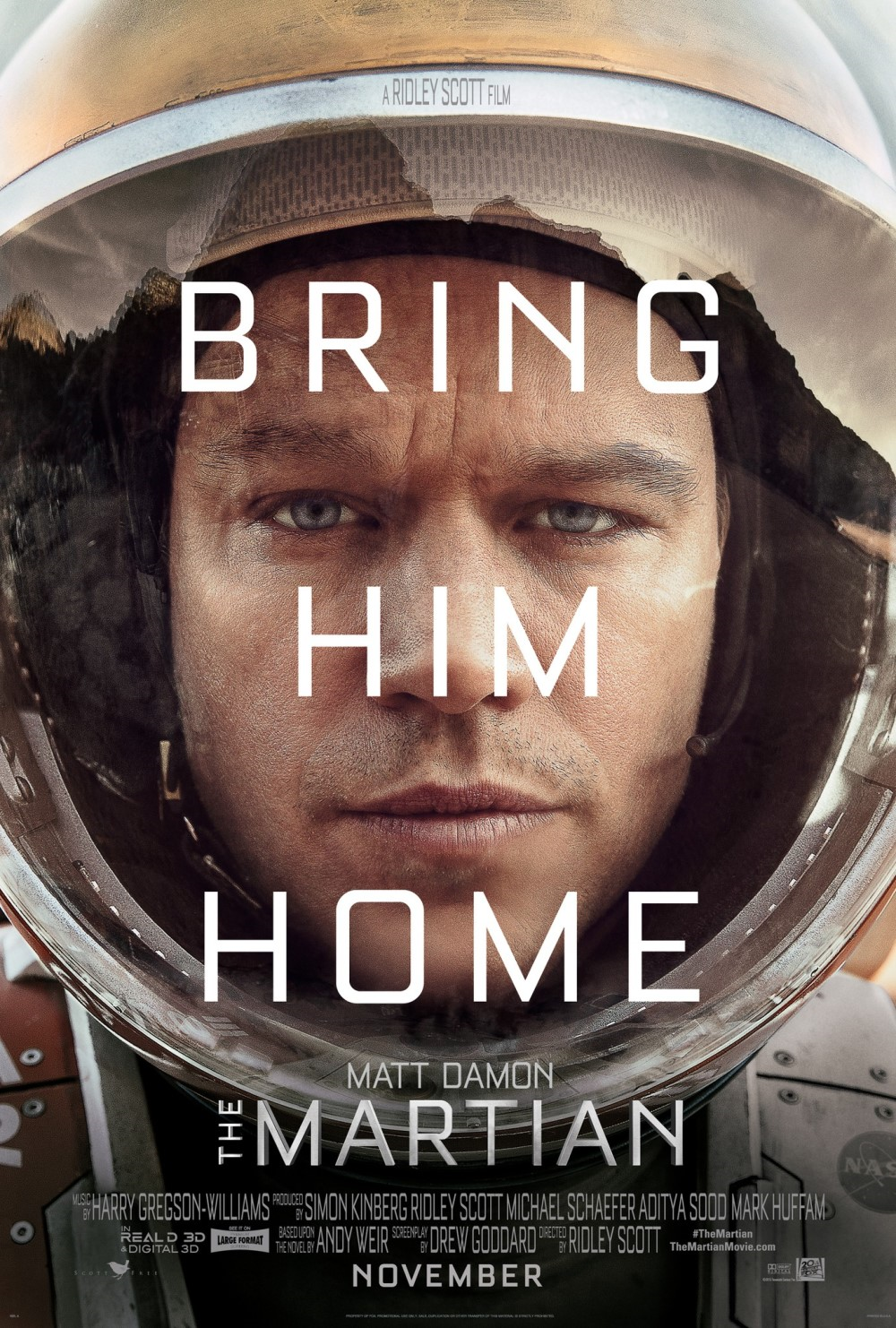
Starring: Matt Damon, Tian Jing and Willem Dafoe
Directed By: Yimou Zhang
Rated: PG-13
Running Time: 103 minutes
Universal Pictures
Our Score: 2 out of 5 Stars
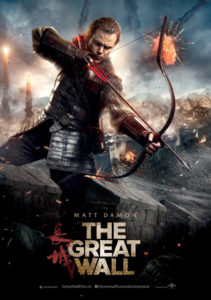
12th century China looks weird. And it’s not just because of Matt Damon’s scraggly face sticking out like a sore thumb. There’s been a lot of vocal concerns by the mainstream media that “The Great Wall” is whitewashing history, but don’t worry. The movie isn’t historical in any way shape or form. But it does manage to explain why Damon’s character is there. He’s a European merchant in search of gunpowder. He talks about how gunpowder is a rumor, fantasized about by Western powers. If someone were to find it, take it, and bring it back, they would receive untold fortunes.
That’s logical. In fact it’s the only logical thing in this illogical movie. Sure Damon has a bland accent that disappears half the time and it’s not quite clear what nationality his character is, but it’s not the explosive controversy that’s being portrayed on “Good Morning America” right now. This movie is about as historically accurate as Mel Brook’s “History of the World, Part I.” It solidifies that fact when we’re introduced to the CGI asteroid demon creatures that have been spent centuries attempting to invade China.
That’s not a glaring typo or a misplaced sentence fragment from another review. There are green monsters that come from a lemon lime radiating space rock populating the screen. These creatures are of a hive mind, following orders from an ominous queen. These green monsters apparently want to invade ancient China because…well…the movie never answers that. It’s frustrating because the writers couldn’t even bother to steal a page from the “Starship Troopers” playbook.
The queen alien, who’s very unimpressive compared to her underlings, isn’t just some animalistic creature without a shred of intellect. There’s a drive behind her as she meticulously plans out traps, devises battle plans, and evolves her army’s military tactics over decades. “The Great Wall” explain too much without ever explaining any of the basic groundwork. This should be stupid fun time at the movies, but it’s interjections of seemingly random alien rationale and ramshackle attempts at historical precedent are befuddling.
“The Great Wall” can never make up its mind on if it wants to be a serious attempt at a summer blockbuster or fantasy alternative history. It can’t be both and fails at being either one. I didn’t expect much walking in. I truly didn’t. I expected a 2017-style “Gods of Egypt” tax write off for Universal, but that’s not what I got. Even while my brain was on cruise control I managed to pick up on the poor plot pacing and subpar storytelling. That’s not a good thing.
The saving grace in “The Great Wall” is its half-hearted attempt at likable characters. It helps that Damon most likely knew they were filming hot garbage and played into its schlock. But I lacked beer and friends to appreciate the pricey travesty I was witnessing on screen. There’s no doubt that it’s visually intense and the set designs are meticulously detailed and gorgeous, but this is a rough movie to like or even recommend.
Starring: Keanu Reeves, Common and Laurence Fishburne
Directed By: Chad Stahleski
Rated: R
Running Time: 122 minutes
Summit Entertainment
Our Score: 4 out of 5 Stars
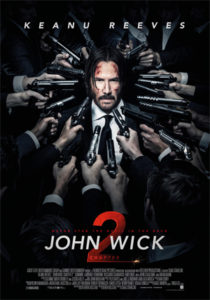
Did the first “John Wick” need a sequel? No. Does “John Wick: Chapter 2” need a sequel? Yes. I didn’t know I needed “Chapter 2” in my life, but I’m glad I got it and now I want more. “Chapter 2” is more of the same from the first installment and that’s not a bad thing. It’s a great thing.
Picking right up where the previous movie ended, John Wick (Reeves), also known as “The Boogeyman,” is finishing off the lingering threats and hitmen who did him wrong from the first installment. But instead of easing back into a low-key and somber retirement, with a new dog in tow, he’s greeted by an old acquaintance, Santino D’Antonio (Riccardo Scamarcio). D’Antonio recruits Wick to help him take over a seat of power in the criminal underworld. Wick isn’t so sure, but Santino uses an old blood oath and three missiles to Wick’s home to sway him.
All the potential consequences and paths of this blood oath, as pointed out to Wick multiple times throughout, are Wick’s death. Luckily for Wick, and the audience, he’s the one who spends entire runtime dishing out death. Before the story even contemplates getting too muddled in specifics and new characters, “Chapter 2” takes a deep breath and once again stops itself from becoming too literal. Just like the original, character introductions are more about the person’s individual quirks, skills and ticks, than their actual name or purpose. And “Chapter 2” keeps the video games tropes around as everything is still paid through magical golden tokens and Wick’s gun is stuck on auto-aim.
This helps keep everything flowing as this sequel is about 30 minutes longer, but rarely dull. While “John Wick” was more about the man behind the blood hungry myth, the sequel appears to be more about Wick diving deeper into the world around him, including the Continental, the criminal safe haven, hangout and safe zone from the first film. The Continental is still shrouded in mystery, but the little depth that is revealed implies it’s a lot more than just a U.N. for gangbangers. It may be the actual cogs of society and government.
What made the original so good is that it never bogged itself down in realism despite the backdrop being New York City. Instead it collects visual actualities to prop up this notion that this alternative reality is percolating beneath the surface. “Chapter 2” expands this alternate reality by dropping visual indications on how all these backstabbing swindlers and emotionless assassins have managed to govern themselves. Murder is their business and they’re serious about it. The rules in this violent fantasy world are simple, habitual, rehashed for clarity, and never biased towards any of the heroes and villain.
“Chapter 2” also further establishes previous canon while building on fresh canon without having any of the new nuances become superficial. The violence is a lot more over-the-top, but played straight-faced for laughs. The killings are more gruesome, but never repugnant. Like much of the visually stunning set-pieces, like a room of rotating mirrors bathed in laser light, the violence is aesthetically pleasing. That’s because it’s visually relayed that Wick doesn’t love or sink his teeth into this line of work anymore, but does it as a necessity for survival.
The same crew from the first is back for more, providing an enjoyable and realistic continuation of a seemingly one-off story about a retired assassin out for revenge. He’s no longer out for revenge, but struggling with the underworld that wants him to be addicted to the rush and thrill of being a hired gun. Wick’s world is noir, retro, and techno all in one cohesive ball. The John Wick franchise is not only a great addition to the action-film catalogue, but a much needed renaissance for the CGI-heavy genre.
At 37-years-old, Director/Writer Patrick Rea is already making a name for himself in horror circles around the country. Since graduating from the University of Kansas in December 2002, Patrick has made dozens of short films and collaborated with other directors and writers on even more. He’s starting to get his footing as a feature-film director and took time out of his busy schedule to talk with MediaMikes about his latest film, “Arbor Demon,” which was a part of the Panic Fest lineup in January and premiered on video-on-demand on February 3rd.
Jeremy Werner: Not to steal one of the questions from one of the fine folks that attended Panic Fest, but I loved the answer you gave at it. So I have to ask, where did the inspiration for “Arbor Demon” come from?
Patricka Rea: It was a combination of things. When my wife and I were dating, we went camping one night at Lake Perry, near Lawrence, Kansas. In the early hours of the morning, there was an altercation that occurred between two other campers near our tent. After the fight ensued, one of the campers decided to hop on a rusty four-wheeler, with a deer skull on the front, and drive angrily around the campgrounds, narrowly missing our tent. My wife and I were pretty freaked out, but to cut the tension, I joked that it would be funny if something came out of the woods and attacked them, so we could get a good night’s sleep. That was where the seed of the idea came from. Once Michelle Davidson and I actually started writing the screenplay years later, my wife was pregnant, so the story really shifted to dealing with a woman’s pregnancy, along with being trapped inside a tent.
JW: What was it that Davidson brought and added to the script?
PR: Michelle is a great screenwriter and a terrific partner. Our process is really about going back and forth with ideas and solving problems within the story. She added so many layers to the script and really brought a fantastic female perspective. The movie is primarily a female driven story, and Michelle took that aspect to the next level. She also is a mother of two, and has a lot of experience to draw upon.
JW: I remember hearing that this script, including the name of the movie, has changed over time. What was it that changed and why?
PR: The original title of the film was “Enclosure”. It has played at a number of film festivals with that title and will continue to carry that name overseas. The biggest reason for the change was that distributor wanted the film to be more visible to consumers on Video On Demand. Since the film now starts with an “A”, it will be higher up on the listings.
JW: The creature in the movie, you really don’t get a good look at it until the end. But when you do, you notice all these different look quirks about them. What hand did you have in crafting the creature and what inspiration did you draw from?
PR: Davidson and I worked hard to come up with a fresh take on the monster. I enjoy drawing, so I sketched out ideas for the design. Eventually, we hired Megan Areford (“VHS: Viral,” “Cooties” and “Sharknado”) to handle make-up effects. She took my initial artwork and made some of her own sketches, which were incredible. From there she started working on the actual prosthetics for the creature and we communicated over Skype.
JW: Since the woods and nature plays a role in the movie, was there anything you manipulated in the woods you filmed in?
PR: I would say that we spent a good amount of time just trying to find unique trees and formations in the woods that would enhance the setting and story. But, in terms of actual manipulation, we built a small forest, designed by Production Designer, Leslie Keel (“May,” “Red” and “Welcome to the Jungle”) on a soundstage around the tent. This was to create the illusion that we were still in the woods when shooting all the tent interiors. This also allowed us to control the lighting and sound.
JW: What horror inspirations do you draw from when writing and directing?
PR: The early work of John Carpenter has always been a big influence on me, from the framing of the shots, to the pace and storytelling skills. I’m also inspired by directors like Wes Craven, Sam Raimi and of course Steven Spielberg. At this point in my career, I like to read about the challenges they faced while making their films. It helps me feel better when I have various roadblocks to overcome during the process.
JW: You’ve done a lot of shorts in the past and a handful of full-length movies…which one do you tend to gravitate more towards and enjoy working on?
PR: Well, I prefer doing feature films, but I love making short films. Short form filmmaking allows me to experiment with new equipment, crew and ways of telling a story. There are a lot of films that I don’t think should exist outside a smaller duration, so I tend to gravitate to those types of projects between features. I think I’ll always make short films, if nothing else to keep my storytelling skills sharp. Making a feature can take years, so it’s good to keep putting out shorter work in order stay on everyone’s radar.
JW: Obviously, this is your career. This your passion and love. What’s something outside that horror genre that you’d be interested in experimenting with and what are you working on next?
PR: I’m working on a number of things, including a CBS kids show titled “The Inspectors” which airs on Saturday mornings. Right now, Michelle and I are getting our next horror feature off the ground, that is a fresh spin on the imaginary friend story. As for experimenting, I really want to direct a high-concept sci-fi film. Just waiting for the right project to come along.
Starring: Fiona Dourif, Kevin Ryan and Jake Busey
Directed By: Patrick Rea
Rated: Unrated
Running Time: 100 minutes
Gravitas Ventures
Our Score: 3.5 out of 5 Stars
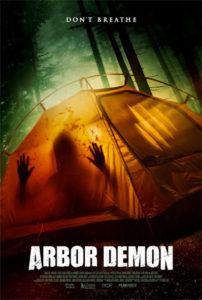
Things aren’t exactly going well for Charles (Ryan) and Dana (Dourif). They are getting ready to celebrate their anniversary, by returning to the spot where Charles proposed to Dana, and their different perceptions of life and long term goals are beginning to show. While Charles doesn’t exactly seem to know it yet, the trip is a way to patch up the relationship as it exists now and take it another step forward with Dana’s recent discovery at the doctor. She’s pregnant.
Charles isn’t the most enthusiastic about having children, seeming to ignore kids they encounter in public and jokingly saying that they’re not the kind of married couple that’ll have kids. However the risk of impregnating Dana doesn’t ever slow down his insatiable sex drive. There’s an impending sense of doom as they enter the woods, but things get eerie when they encounter a drunken group of hunters, firing wildly into the air and making a ruckus at the dead of night.
The encampment of drunks is attacked by an unseen force and soon Charles, because he’s a paramedic, makes it his duty to risk his life and take in an injured member of the group, Sean (Busey). The trio hunkers down inside the flimsy safety of an orange tent as something sinister stalks around in the woods, blending in with the surroundings. But it doesn’t attack. That’s because it may want Dana.
Lacking jump scares and jolts of fright, “Arbor Demon” seems more interested in the tension that evolves inside the tent that Dana, Charles and Sean are cowering in. When not focused on backstabbing survivalism, the movie peels back layers of its own mythology, touching upon the supernatural elements of nature and it’s deep connection to motherhood. It’s not until the end that the “demon” reveals itself and we understand why Dana is the treasured prize of the creature lurking in the woods.
Dourif, who’s probably sick and tired by now of hearing about how much she looks like her father, carries the fear of Dana of well through her eyes, breathing and physical reactions. Dana isn’t just fearful of the creature, but seemingly more fixated on if her marriage can survive the bombshell that she’s carrying Charles’ child. It plays into the third act and the movie floats away from its horror elements, finding more fun by playing with Indian mythos and supernatural components.
The story evolution helps break-up the potential monotony of your run-of-the-mill terror in the woods plotline. “Arbor Demon” isn’t going to scare you, but it does give the viewer a moment of reflection about how humanity and nature are so closely related, yet we constantly forget about it. “Arbor Demon” says a lot about gender roles when you get down to it. Dana seems to have an understanding while Charles and Sean seem to be in fight-or-flight mode.
The folks behind Panic Fest have a deep passion for horror and it showed all weekend long. Just like the past four years, the event was an absolute blast. While there’s always room for improvements, such as the amount of room there is at the Screenland Armour, it genuinely feels like the movies, the Q&A’s, the vendors, and everything else, were passionately combed over and whittled to near perfection. The efforts behind the creators and sponsors didn’t go unnoticed by those in attendance
The highlight from my first day was the sampling of local horror. Attendees were treated to movies with a local connection. I caught “Tonight She Comes” which was filmed in Missouri, just south of St. Louis, and was not for the faint of heart, squeamish, or those with a working moral compass. The other movie I caught was “Arbor Demon,” which was directed by KU alum, Patrick Rea. Despite his desire to film in his stomping grounds, he filmed his camping trip turned nightmare in South Carolina.
The second day, since I wasn’t hungover, began with an 11 a.m. selection of Saturday morning cartoons. Forever Bogus hosted the screening of late 80’s and early 90’s cartoons. As for the rest of the day, it was an eccentric collection of B-movie horror, nostalgic throwbacks, and psychological horror. The highlight of my night though was “The Last Podcast on the Left.” The trio of hosts, Ben Kissel, Marcus Parks, and Henry Zebrowski, tickled the funny bone throughout with taboo topics like Charles Manson, and absolutely bizarre topics like Batsquatch.
The final day was a rehash of some movies folks may have missed along with some new movies mixed in for flavoring. I feel like I caught the two best films of the festival that day though. Despite my well belief that the “Walking Dead” has ruined the zombie genre, “Train to Busan” and “The Girl with All the Gifts” is evidence to the contrary. And I’d be crazy not to mention “The Void.” Imagine if the creature effects people behind “The Thing” stumbled into a Clive Barker fever dream. That’s what watching “The Void” was like.
For those who attended, I bet you had a blast like I did. For those who didn’t, I hope to see you next year. You can check out the Screenland Armour here since they will be sprinkling some of the films from Panic Fest throughout the year. You can also go to the Panic Fest website here to keep an eye out for next 2018 and check out the movies I mentioned and didn’t mention.