

Film Review: Victor Crowley

Starring: Parry Shen, Kane Hodder and Laura Ortiz
Directed By: Adam Green
Rated: R
Running Time: 93 minutes

As director and writer Adam Green said himself, the “Hatchet” trilogy was a segmented, yet complete story. So there was never a need for a fourth “Hatchet,” yet here we are with “Victor Crowley.” Green can be forgiven for going back to the monster that made his career, especially since it’s taken on a life of its own and worked its way into the hearts of horror aficionados. Luckily, unlike others who’ve returned to their roots, Green has found a worthy amount of gory content and vicious fun to justify this fourth time around.

Picking up 10 years after the event of “Hatchet III,” the sole survivor of Crowley’s massacre, Andrew (Shen), is promoting a new book detailing how he survived. While many line-up to get an autograph or buy the book from him, an equal amount take the time to ridicule him for cashing in on death or accusing him of committing mass murder under the guise of the supernatural. What mainstream public could actually believe 40 people were killed by a disfigured Hulk-like entity in a swamp?

Of course it wouldn’t be a “Hatchet” movie without returning to that very swamp. Andrew is suckered back in, with the promise of more money on his book tour campaign. Getting mixed up eventually is an aspiring crew of filmmakers and the people transporting Andrew back to the site of the decade old massacre. Of course, the key component, Victor Crowley (Hodder), needs to be summoned to go on another killing spree.

The actually summoning is one of the few hiccups in an otherwise funhouse blood fest. Once Crowley shows up, “Victor Crowley” rarely lets up, spending the second half of the movie being relentlessly savage and overwhelmingly sadistic. But it’s equally funny, at least for those with an ounce of black humor in their funny bone. There’s a lot of fan service, within the own franchise as well as several nods to the horror community, that sometimes distracts from the core content.

I can’t give too much away because “Victor Crowley” is meant to be experienced instead of hearing my pitch as to why you should see it. Those who have already gone along for the trip will certainly check out “Victor Crowley,” and without a doubt I can say they’ll fall immediately in love with it. Very rarely does a sequel, much less the fourth of a franchise, live-up-to and exceed the expectations set by previous films, but “Victor Crowley” does. If this is the beginning of a new storytelling trilogy, it’s set the expectations for future films ridiculously high.
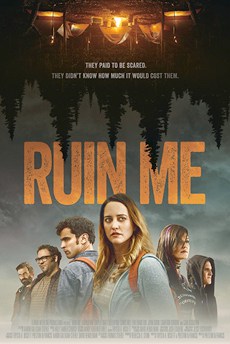
Film Review: “Ruin Me”

Starring: Marcienne Dwyer, Matt Dellapina and Chris Hill
Directed By: Preston DeFrancis
Rated: R
Running Time: 87 minutes

Any horror film buff would certainly take part in a Slasher Sleepout, a 36-hour experience that’s a mishmash of elements from escape rooms, haunted houses and a weekend camping trip. Is this actually a thing? I’m genuinely curious and would probably splurge on it if it existed. At least the six characters in “Ruin Me” did. When we meet the, they have this giddy excitement, that I’m sure I would have before a weekend of cheap scares alone in the woods, solving puzzles. Well, five out of six of those characters at least seem cozy to the idea.

Alex (Dwyer) is lukewarm to the concept. She’s begrudgingly going with her boyfriend, Nathan (Dellapina), who received the experience as a birthday gift from a pal, but his buddy couldn’t go so Alex is his fill-in. You’d think he’d have gone with another friend, or at least someone who’s favorite movie isn’t “Dirty Dancing.” The four other people joining them are all about horror though. There’s the awkward loner who rattles off horror movie references, the stoic weird guy, and an obnoxious Goth couple that has done these kinds of hodgepodge horror getaways before.

Of course, it wouldn’t be a true horror movie if something didn’t go wrong, and things go south quickly. At the beginning everyone plays along with the fake blood, fake mutilated body parts and hooded men in the forest stalking them, but it’s not until people start disappearing and the fake blood becomes real blood. “Ruin Me” has a bit of fun playing with the audience expectations about when things will take a nosedive and how far our characters are still willing to believe that they’re just being toyed with by 21st century carnival ride operators.

“Ruin Me” has a lot of twists and turns after the midway point. Some of the surprises are earned and are actually rewarding while others feel like concepts shoehorned into the script without actually fitting into the overall narrative. Alex, being the focal point of misery as the film progresses, has a lot of the believable twists to her character arc. Some of Alex’s reveals appear sloppy at face value, but they are a lot more believable in hindsight when everything is finally tied together.

“Ruin Me” is a midnight movie romp, which pays off for viewers who love watching characters trapped in sadistic head games. The argument could be made that Alex’s misery and the film’s head games don’t go far enough. It’s a fair point because “Ruin Me” seemingly makes a 180 degree turn in terms of tone at one point, without justifying the pivot. The “fun weekend gone wrong” trope could have easily sustained the movie, but it seems like the intentional swivel was an attempt to subvert. “Ruin Me” isn’t about to spawn a new genre or rewrite the horror movie rules, but it maintains a sense of mystery and excitement for those willing to go on the overnight with the characters. If nothing else, the writers might be on to something with this Slasher Sleepout.

Film Review – “Hostiles”


HOSTILES
Starring:  Christian Bale, Rosamund Pike and Wes Studi
Directed by:  Scott Cooper
Rated:  R
Running time:  2 hrs 14 mins
Entertainment Studios Motion Pictures


What would you do if you’d spent your entire adult life hating someone only to find that they are now your roommate? I’ll wait while you think up an answer.

A young husband (Scott Sheppard) is alerted by his wife (Pike) that there is a band of Native Americans approaching their homestead. The husband orders her and their young daughters to flee while he takes up his rifle. Sadly, he is no match for the marauding group, nor are his children. Terrified, the woman seeks refuge in the neighboring woods.

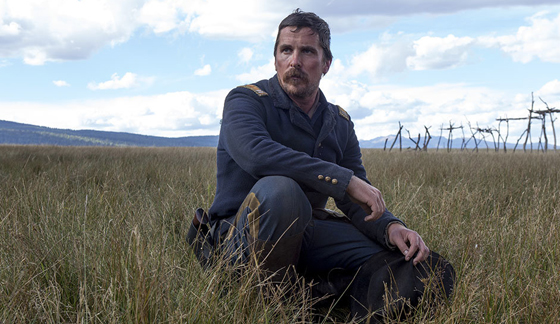
As things in Washington D.C. get progressive, Army Captain Joseph Blocker (Bale) looks forward to retiring soon. He has spent the majority of his military career hunting down (and killing) the Native Americans the government has deemed dangerous. Among them, was Chief Yellow Hawk (Studi), a Cheyenne who, along with his family, was captured by Blocker. Blocker is surprised to find out that the plight of the Native Americans has reached the cosmopolitan east coast of the country and that his last assignment will be to escort the Chief and his family safely to Montana, where he can live out his days as a free man. Blocker refuses, only relenting when he learns that to disobey will cost him his pension. To say he’s not happy is an understatement.

Scott Cooper has always been an entertaining filmmaker. Whether it’s the day to day life of singer Bad Blake in “Crazy Heart” or the bond of the Baze brothers in “Out of the Furnace,” he has a unique way of telling a story that makes the viewer feel they are part of the story. And he also knows how to get great performances out of his actors. Jeff Bridges won an Oscar for “Crazy Heart” and both Bale and Casey Affleck did some of their best work in “Furnace,” which is saying a lot since they both also have Oscars. Bale shines again here, as does the group of soldiers he takes with him on the mission, including Jesse Plemons, Jonathan Majors and newly Academy Award nominated Timothee Chalamet. Add to this group long time performers like Ben Foster and Scott Wilson, as well as the quiet, dignified Studi, and you have a cast that is more than up to the task. This also goes for Ms. Pike, who is found by Blocker’s party and taken into the group, with Blocker going out of his way to ensure her safety. Not for any ulterior motive but out of a sense of chivalry and decency.

Visually the film is beautifully shot, with director Cooper and DP Masanobu Takayanagi (“The Grey,” “Silver Linings Playbook”), along with composer Max Richter (television’s “Black Mirror”) painting portraits of the long ago countryside.

Film Review: “12 Strong”

Starring: Chris Hemsworth, Michael Shannon and William Fichtner
Directed By: Nicolai Fuglsig
Rated: R
Running Time: 130 minutes
Warner Bros. Pictures

Analyzing and critiquing films centered on America’s soldiers can be a difficult task. Too much criticism can draw ire from those who bleed red, white and blue. You can even take heat and be called unpatriotic for not heaping tons of praise on it. “12 Strong” is so-so. It’s beautifully shot, narratively confusing, decently-acted, but predictable. Sure it’s a story that isn’t well-known, but casting Chris Hemsworth as the lead ensures there won’t be anyone who will need to bring tissues into the theater with them.

The film begins quite literally on the morning of 9/11, sure to conjure up emotion from any viewer who lived through that day. Captain Mitch Nelson (Hemsworth) springs into action, demanding to see combat so that he can bravely lead his men into battle. It’s noble, but unnecessary when anyone who’s seen “Thor” or knows of Hemsworth’s star power, knows the actor wasn’t cast to file paperwork and sit behind a desk throughout the movie.

Nelson gets his wish and is shipped off to the Middle East. There he leads a group of Green Berets in mid-October into Afghanistan to assist the Northern Alliance, a collection of Afghan warlords and soldiers who are mainly playing defense against the oppressive Taliban. The Berets’ goal is to loosen the Taliban’s grip and to destabilize the terrorist organization. Assisting, as well as being assisted by, the Green Berets is General Abdul Rashid Dostum (Navid Negahban), one of the leaders making up the broken and embattled Northern Alliance.

The politics of the Northern Alliance as well as the covert operations are a lot more fascinating than what is actually on-screen. After watching the film I went home to do some research and became engrossed in the history of the battle before U.S. televisions began broadcasting bombs being dropped. It was also fascinating to read about Afghanistan’s shattered (and still is) political structure that barely holds the country together. None of that really comes across in “12 Strong” that tried to simplify the history books.

Exposition usually comes across in wooden dialogue, as well as speeches that feel unnatural. The movie also loses track a few times of where our Green Berets are supposed to be or what town they’re currently entrenched in or liberating. The final battle sequence comes off as a rush with a visually silly sequence of men on horseback shooting wildly at Taliban in tanks like some kind of over-the-top boss battle in a video game.

For all its flaws, “12 Strong” does commendable jobs in some of its smaller moments. General Dostum, who’s drastically underplayed throughout the film, provides necessary insight into how the Afghans view the U.S. intervention, saying at one point that the Americans will be called cowards if they leave, but invaders if they stay. He says it in all seriousness, realizing that the U.S. is in a no win situation with the hearts and minds of Afghanistan, but with his eyes expressing sympathy for that unfortunate scenario.

We also get a sense of camaraderie amongst the troops of the Northern Alliance and the Green Berets more than amongst the Green Berets themselves. It says a lot about the heart of America’s troops when the first person a Green Beret searches for in the aftermath of a bomb explosion is his young Afghani counterpart. “12 Strong” shows the horrors of battle without glorifying them or giving excuse for their brutal necessity.

It’s hard not to think about the political ramifications of what we’re watching on-screen, especially since we’re still in the war-torn country. The movie never takes a stance, as it shouldn’t. 17 years later, it’s still hard to find that political middle ground that would appease both sides of a frustrating war. “12 Strong” does a passable job telling a story about unsung heroes in the early days of that war, but there’s the lingering feeling that the soldiers portrayed in the film deserved a much better retelling of their struggles.

Film Review – “Call Me by Your Name”


CALL ME BY YOUR NAME\
Starring:  Armie Hammer and Timothee Chalamet
Directed by:  Luca Guadagnino
Rated:  R
Running time:  2 hrs 12 mins
Sony Pictures Classic


What is it about Italy that makes people fall in love?  Is it the weather?  The countryside?  The language?  I really don’t know.  I was only in Italy for a weekend and all I did was play softball.  But it was a beautiful country!

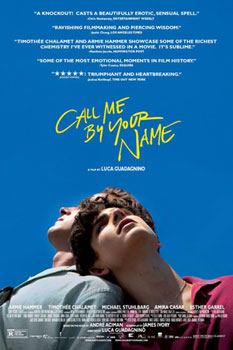
Elio (Chalamet) is a 17 year old musical wiz.  He lives with his parents in a small Italian town where the only signs of life are usually in the local tavern.  As summer begins, a car brings the tall, handsome Oliver (Hammer) to the house, where he will serve as Elio’s father’s research assistant.  Of course this means Elio having to move out of his room to another, which he eventually shrugs off.  Like Oliver, Elio and his family are Jewish, though they don’t go out of their way to announce it (according to Elio, his mother likes to say that they are “discretely” Jewish).  As the summer, and their friendship, progresses, they will discover they have much more in common.

A beautifully told story about discovering love, “Call Me by Your Name” is buoyed by the performance of its two lead actors.  Hammer, who you may remember as BOTH of the Winklevoss twins from “The Social Network,” shows a side I’ve never seen.  He makes Oliver both confident and unsure, worried that what is growing between he and Elio may harm the young man.  As Elio, Chalamet gives a true star-making performance, a boy, not yet a man, learning to deal with feelings he doesn’t understand.

The script, adapted from the Andre’ Acimen novel, is written by three-time Academy Award nominated director James Ivory, who was so instrumental in the success of films like “The Remains of the Day” and “Howards End.”  “Call Me by Your Name” actually plays like a Merchant/Ivory film – brilliantly performed and produced.  This is a story of love, though even those involved are unsure of its consequences.  As a character says in the film, “cinema is a mirror of reality and it is a filter.”  Just like life.


Related Content

Film Review: “Phantom Thread”

Starring: Daniel Day-Lewis, Vicky Krieps and Lesley Manville
Directed By: Paul Thomas Anderson
Rated: R
Running Time: 130 minutes
Focus Features

It’s difficult to say negative things about a Paul Thomas Anderson film. They’re so meticulously groomed by the writer and director that you could say even a bad movie on his end is still gorgeously filmed, well-acted, and rich in metaphor. His films generally aren’t for casual audiences and are geared more towards cinephiles. He’s had a previous fascination with broken individuals looking to redeem themselves or allowing audiences to watch them further wallow in self-pity and self-harm. “Phantom Thread” finds itself once again in that territory, but instead of praising it alongside other cinephiles, I find myself siding with casual audiences.

The flawed individual in “Phantom Thread” is Reynolds Woodcock (Day-Lewis), a 1950’s fashion designer for rich Londoners. Like any self-proclaimed master artist, he obsesses over his work, to the point where he becomes infuriated if the dress buyer doesn’t wear the outfit right. His army of elderly female assistants packs into his townhouse silently helping craft his latest masterpiece, but they know him better than anyone, remaining silent and doing as they’re told. Despite ruling with an unspoken iron fist, Woodcock is a bit of romantic. Just a bit.

He enchants a waitress, Alma (Krieps), but what makes him attracted to her isn’t necessarily her looks or her obedience, it’s her rebellious nature. He seems to enjoy her possessiveness, when she’s sometimes intentionally obnoxious and the fact that she’ not about to run out the door when he drops a mean retort or insults her. It’s a relationship that borders on abusive, for both sides, and sometimes makes the argument these two are so crazy, they’re simply meant to be together. It’s an unhealthy bond that should be a thrill to watch, but it doesn’t fester fast enough.

As the film progresses, it’s almost as if Anderson isn’t concerned about whether or not we’re still paying attention. He lingers on long uncomfortable silences, focuses on facial distaste by the characters, and sometimes lets inconsequential dialogue envelop the scene. Some of these moments are played for guilty laughs or showcasing Woodcock’s self-absorbed nature, but the relentless nature of it between genuinely interesting scenes are sure to push anyone’s patience. It’s almost as if “Phantom Thread,” unlike its main character, isn’t self-confident enough in its own craft.

Instead of establishing mood or creating drama between conflicts, “Phantom Thread” likes to show instead of tell. There’s nothing inherently wrong with that because that’s what a good filmmaker does, but sometimes what it shows us, tells us nothing. The final moments of this film seem to justify a lot of the build-up, but never the snail’s crawl pace of storytelling. Despite only being a hair longer than two hours, its flow felt like it was heading for a three-hour marathon. By the time it seems to have its stride, the credits begin to roll.

It’s unfortunate that one of the greatest actors to ever grace the silver screen will end his career on a less than memorable film. Day-Lewis’ performance, as is any other film he’s ever been in, is the true highlight of the film. Much like his other performances, he stretches the skin of his character over his body, immersing himself in this narcissistic fashion designer. Outside of Day-Lewis’ performance, Anderson’s keen directorial vision, and a deliciously twisted ending, “Phantom Thread” is sometimes tedious and a bit too full of itself.


Related Content

Film Review: “The Commuter”

Starring: Liam Neeson, Vera Farmiga and Patrick Wilson
Directed By: Jaume Collett-Serra
Rated: PG-13
Running Time: 104 minutes
Lionsgate

Sometimes the best compliment you can give to absolute schlock is that it’s alright. “The Commuter” doesn’t try to be more than it is. It manages to be mildly thrilling, sometimes genuinely intriguing, but mainly remains over-the-top. Sometimes bad movies sacrifice entertainment for the sake of attempting to become logical, or God forbid, taking itself too seriously. But luckily “The Commuter” is as fun as it is forgettable.

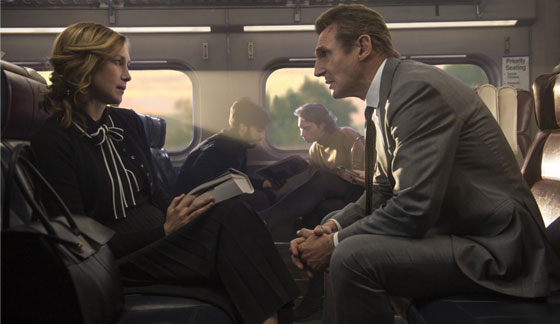
The fun begins after Michael McCauley (Neeson) is fired as an insurance salesman. Not looking forward to delivering the news to his wife, he sits quietly on the train ride home, attempting to push his troubles out of his mind. In comes a mysterious woman, calling herself Joanna (Farmiga), offering the recently fired and down on his luck Irish immigrant a chance at $100,000. $25,000 is offered up front if he accepts her strange quest and the rest comes if he completes it. His mission is to find a passenger named Prynne and plant a tracking device in their luggage.

“The Commuter” does a decent job establishing that Michael is desperate for money, and not just with his firing. He has a son at home who’s about to head to college and back in the 2007-2008 financial crisis, he and his wife nearly lost all their assets; so $100,000 dollars seems very tempting. Of course as Michael unravels the mystery around him, he finds that his task isn’t easy as it originally appears and there’s more at stake.

Consistently hinting at powerful men, evil that’s pulling the rods behind the curtains and other allegorical bad men, “The Commuter” never really fulfills on what should be a promising solution to the puzzle. Maybe the socio-political commentary was there, but scratched out in a noble attempt to make “The Commuter” sillier than it was originally attended. There are plenty of solid laughs intentionally written in, but an equal amount of unintentional chuckles at the absurdity of it all.

However, when “The Commuter” buckles down for drama, it wrings out a lot of tension from Michael going back and forth through train cars, as well as some surprising twists and turns. Neeson commands a lot of these scenes, conveying checked anger and frustration, as well as general bewilderment at the unfolding scenario. The movie does shoot itself in the foot when several other actors, like Jonathan Banks and Sam Neill, distract from the plot more than provide to it.

Without Neeson or director Jaume Collett-Serra, “The Commuter” would have certainly been a stumbling mess. The moments of mystery, amplified by Neeson’s willingness to go along with it, are what keep this train moving. There are moments that feel cliché and contrived, but they never actually feel like they’re beneath the 65-year-old actor. It’s a testament to Neeson’s body of work that he can still make the silliest of premises believable and fun without going full on Nicolas Cage with his performance.

Film Review – “The Post”


THE POST
Starring:  Meryl Streep, Tom Hanks and Bob Odenkirk
Directed by:  Steven Spielberg
Rated:  PG 13
Running time:  1 hr 56 mins
20th Century Fox


They were called The Pentagon Papers, an analysis of the almost 30-year history of the United States’ involvement in Vietnam which did not paint a rosy picture for a war that would eventually take the lives of nearly 60,000 Americans.  Their impact, not only on how the war was perceived but in how the press was regarded, is the story of Steven Spielberg’s latest film, “The Post.”

Passengers on a government jet observe a young man chatting with current Secretary of Defense Robert McNamara (Bruce Greenwood). “Who’s that,” someone asks, unaware that the subject of his question will one day set in motion a series of events that, in today’s cycle of “fake news,” will open eyes to the power of the press.  The young man in question is Daniel Ellsberg (Matthew Rhys).  Unhappy with what he has observed and been told, the military analyst leaks a series of reports commissioned by the Rand Corporation to the New York Times, which in 1971 begins to publish excerpts.  Outraged by this, President Nixon orders government attorneys to file a suit forcing the paper to stop publishing the papers in the interest of national security.

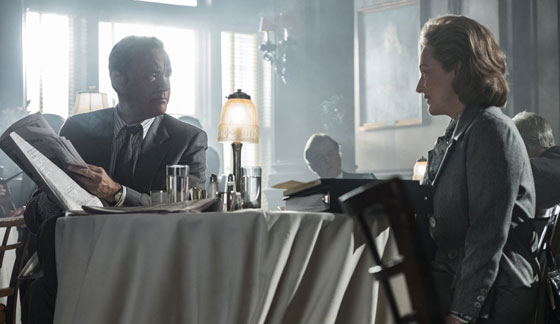
In Washington D.C., Ben Bradlee (Hanks), editor of The Washington Post, is upset.  Once again, the Times has scooped him.  This is such a common occurrence that Bradlee brandishes a copy of the Times and asks his reporters “anyone else tired of reading the news?”  The Post is owned by Katherine Graham (Streep), a D.C. socialite whose grandfather had owned the Post and who inherited the publisher’s mantle when her husband, Phillip, committed suicide.  She is wary of Bradlee’s plans.  Not only is there a chance that publishing the information will put her in jail – “Wouldn’t you go to prison to stop this war,” Bradlee asks – but she also risks alienating some of her closest friends, including Bob McNamara.  Decisions, decisions.

A film that packs a powerful punch, “The Post” joins “All the President’s Men” and “Spotlight” as films that show the true power of the press in the face of adversity.  Hanks has fun as the tough but compassionate Bradlee and Streep adds another outstanding performance to her already amazing resume’.  The supporting cast is just as strong, with fine turns by Odenkirk, Carrie Coon, Sarah Paulson, Jesse Plemons and Tracy Letts.  Even Richard Milhouse Nixon gets raves as the evil Wizard who thinks he can rule the Emerald City, and this country, anyway he deems fit.  Rather than employ an actor to portray our 37th President, Spielberg uses Nixon’s actual words and voice, through taped telephone conversations, to show what a devious and paranoid man the President was.

Spielberg keeps the story moving and, as with all of his films, the technical aspects are first rate.  And add another magnificent John Williams score to perfectly accompany the story.

Film Review “Insidious: The Last Key”

Directed by Adam Robitel
Starring: Lin Shaye, Angus Sampson, Leigh Whannell, Spencer Locke, Caitlin Gerard, Bruce Davison
Distributed by: Universal Pictures (Theatrical)
Sony Pictures Home Entertainment (Home Video)
MPAA Rating: PG-13
Running time: 103 minutes

Film: 3 out of 5 stars

The “Insidious” franchise has never really blown me away after the first film. Oddly enough the first “Insidious” is in my top 5 horror all time, so it’s a shame these sequels never really lived up to the first film. Taking the directorial reigns this time is Adam Robitel, he is the writer/director of “The Taking of Deborah Logan” (which is an amazing film), so I was psyched to see what he could do here. Unfortunately, I just feel like this was another unnecessary sequel. The film just doesn’t deliver anything new at all. I would love a deeper look into The Further and more subtle score led jumps like the first film had and was terrifying. This film, like the previous sequels, just lacks the terror.

Official Premise: Brilliant parapsychologist Elise Rainier receives a disturbing phone call from a man who claims that his house is haunted. Even more disturbing is the address — 413 Apple Tree Lane in Five Keys, N.M. — the home where Elise grew up as a child. Accompanied by her two investigative partners, Rainier travels to Five Keys to confront and destroy her greatest fear — the demon that she accidentally set free years earlier.

The star of the film is hands down, the amazing Lin Shaye. I have to say in this film she definitely gave her performance. She was bad-ass! God bless her, she is 74 years old and the lead of a hugely successful horror franchise. She is one of a kind. But I feel the franchise might need to take a new direction and get back to its roots in future films, which I am sure will follow. I want to see the demon/entity sitting in the corner of the room without knowing that I see it and having it terrify me know that I can’t look over to the corner with the fear that it will know I see it. That is the terror I want from the “Insidious” franchise.

Film Review – “Molly’s Game”


MOLLY’S GAME

Starring:  Jessica Chastain, Idris Elba and Kevin Costner

Directed by:  Aaron Sorkin

Rated:  R

Running time:  2 hrs 20 mins

STX Entertainment


Did you ever have friends over to your house for a night of poker?  This was a regular thing in my life from the mid-1980s through 1995.  Those of us who worked until midnight would get together after work a spend hours eating pizza, drinking Coke out of the little bottles (none of that NEW Coke for us) and playing games like Follow the Queen or Sh*t or Get Off the Pot.  Our highest bet allowed was $5.00.  I mention this only because Molly Bloom did the same thing we did, only her stakes were much higher.


Molly (Chastain) was a one time Olympic hopeful whose injuries took her from the ski slopes to a would-be journey to law school.  However, before she can crack the books she takes a job with real estate agent Dean Keith (Jeremy Strong), a bossy type who runs her ragged as his assistant.  One day she is given the phone numbers of (9) people and told to invite them to a high stakes poker game he is hosting.  Molly is put in charge of the buy in money and at the end of the night ends up with $3,000 in tips.  A fast learner, she soon begins to run her own game, rubbing shoulders with some of the most renowned actors, athletes and politicians in California.  When she moves to New York she again hosts games.  Things go well until she is arrested by the FBI for her actions.  What are the odds Molly beats the rap?


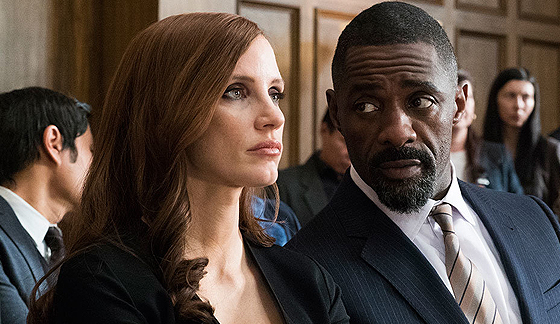
The first film to be directed by Academy Award winning screenwriter Aaron Sorkin (he also adapted the script from the real Molly Bloom’s book), “Molly’s Game” is a smart tale about how even the slightest mistake can come back to haunt you.  The cast is first-rate, with both Chastain and Elba, who plays Bloom’s attorney, Charles Jaffe, giving award-worthy performances.  The supporting cast is equally strong, including Michael Cera, identified simply as Player X, and Costner, who plays Molly’s hard-pushing father.  The film even serves as a “Dances With Wolves” reunion, with Graham Greene playing the judge who hears Molly’s case.


The script is pure Sorkin, which is always a good thing.  His work behind the camera is equally well done.  All in all, “Molly’s Game” is a fine inaugural effort from a budding new filmmaker.

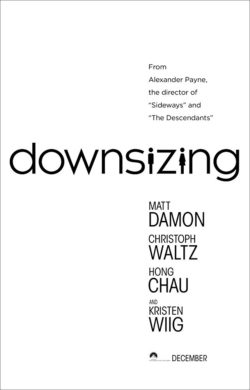
Film Review: “Downsizing”

Starring: Matt Damon, Christoph Waltz and Hong Chau
Directed By: Alexander Payne
Rated: R
Running Time: 135 minutes
Paramount Pictures

The most positive thing I can say about “Downsizing” is that you’ll never be able to guess where it’s headed. Even as the film hit the homestretch, I kept waiting for that “a-ha” moment or the singular statement that the movie looked to deliver. I never got that moment and in a way I left the theater in disappoint. But what lingered was uncertainty. Even after weeks of thinking on it, I’m still unsure about the message in “Downsizing” and whether or not it’s a peculiar sci-fi reflection on humanity or a tonal misfire.

Environmentalism is at the forefront in the opening minutes as we watch the Norwegians at work in a lab. They’re looking for a solution to the world’s overpopulation crisis. A solution comes in the unlikely form of shrinking. They’ve developed a way to shrink fully-grown humans down to five inches tall. This mean that the tiny humans will produce less waste, take up less space, and use less energy. Thinking long-range, they say in a few centuries they hope that all of humanity is down to a miniature size to help save Planet Earth.

Fast forwarding a few years after this scientific breakthrough, we meet Paul (Damon), who’s manages to persuade his wife, Audrey (Kirsten Wiig), to sell their assets and move to one of the biggest downsized communities in America. The pint-sized world, smack dab in the middle of the Arizona desert, presents an opportunity for the lower middle-class couple from Omaha to be millionaires in the miniature world, since you can stretch a dollar farther when your house is the size of Barbie’s Malibu dream home. Of course, not everything goes to plan.

Like I stated at the beginning, “Downsizing” is unpredictable because it manages to take every possible detour away from its original comedic premise of Paul attempting to adapt to his new life in a tiny world. It soon becomes a film about societal constructs, then organized crime amongst elites, then refugees, then class warfare, and then back to environmentalism. There’s the possibility I’m forgetting a few themes that Director and Writer Alexander Payne manages to wring out of his script. It’s a bold, bizarre endeavor that pays off sometimes.

But because of the constant gear shifting, there were moments I found myself bored and wondering if I really should get invested in any of the characters introduced, especially with how disposable most are outside of Paul. The sprinkling of humor sometimes keeps the movie grounded in its roots, but when it branches out it pokes you in the eye rather than enlightens. “Downsizing” may be a fun movie to discuss after watching, but that doesn’t necessarily translate into an entertaining film.

Film Review: “All the Money in the World”


ALL THE MONEY IN THE WORLD

Starring:  Michelle Williams, Mark Wahlberg and Christopher Plummer

Directed by:  Ridley Scott

Rated:  PG 13

Running time:  2 hrs 12 mins

Sony Pictures


J. Paul Getty was a son of a bitch.


The first person in the WORLD to accumulate a fortune worth one BILLION dollars, he was a hard-driven man who had no time for family.  So when his assistant announces that the police are on the phone because his grandson has been kidnapped, it’s no surprise when he instructs her to tell them that he is “not available.”  Thanks grandpa!


Based on a true story (one I clearly remember from my youth), “All the Money in the World” is a tale that lives up to the old saying that “money can’t buy everything.”  We meet 16 year-old Paul Getty (Charlie Plummer, no relationship to Christopher) as he prowls around the red light area of Rome.  Clearly under-age he is scolded by the women he approaches and walks along the road.  Suddenly a van pulls up and Paul is swept inside and quickly blindfolded.  He is secluded out in the country and his mother Gail (an always great Michelle Williams) is contacted.  The kidnappers want $17 million for Paul’s return.  They are unaware that, like the majority of the Getty heirs, she has no money.  She turns to the boy’s grandfather (Christopher Plummer) for help.  He gives her his answer when he is asked by a reporter how much he would pay to rescue his grandson – “Nothing.”


This film has gained some extra notoriety due to the fact that Kevin Spacey had originally been hired to play J. Paul Getty and that, in fact, the film was finished when news of Spacey’s alleged misdeeds was made public.  In an unprecedented move, director Ridley Scott chose to replace Spacey with Christopher Plummer and reshoot every scene that had once featured Spacey.  In six weeks’ time he managed to gather the entire cast and crew and pulled off a cinematic miracle by meeting the film’s original release date.  And what an amazing cast.


Williams, who was heartbreaking in last year’s “Manchester by the Sea,” is the tough, no nonsense mother who puts her son first in every decision.  She is cool and collected even when we, the audience, would be inconsolable.  Wahlberg is a former CIA operative who now runs Getty’s personal security.  He does his best, at Getty’s request, to negotiate with the kidnappers but finds little luck.  But the film rightly belongs to Christopher Plummer.  You can still watch the original trailer for “All the Money in the World” on YouTube, and you’ll come away with the feeling that Spacey would have given a strong performance.  But here Plummer is more than strong.  He’s brilliant.  He’s taken a character that the audience should hate and somehow makes his actions seem sensible, no matter how little.  Also, J. Paul Getty was 80 years old when Paul was kidnapped.  Spacey is 58 and required a lot of make-up.  Christopher Plummer is 88 and every year is ingrained on his still handsome face.  He recently received a Golden Globe Award nomination for his performance here and I wouldn’t be surprised if that is soon followed by his third Academy Award nod (he won an Oscar in 2012).


Director Scott keeps the story moving and the technical aspects, from art direction to photography, are well deserving of praise.  This is an amazing piece of filmmaking, made more so by the quirky back story, and is easily one of the best films of the year!


Related Content

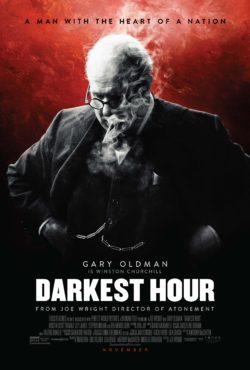
Film Review: “Darkest Hour”

Starring: Gary Oldman, Kristin Scott Thomas and Lily James
Directed By: Joe Wright
Rated: R
Running Time: 125 minutes
Focus Features

Earlier in 2017, Christopher Nolan gripped audiences with a land, sea and air telling of the evacuation of “Dunkirk.” While I personally wasn’t wowed with Nolan’s WWII film, I appreciate his craft at conveying fear and desperation in the eyes of thousands of Allied soldiers looking to escape the stranglehold of the German army. For those, like me, who were looking for a little bit more in narrative substance, “Darkest Hour,” might scratch that itch.

“Darkest Hour” begins with Winston Churchill (Gary Oldman) being named Prime Minister after multiple failures by Neville Chamberlain. Despite commanding respect from the House of Commons, his blunt speak and unorthodox approach quickly draws enemies behind the scenes. Lending their ears to the embattled Prime Minister is King George VI (Ben Mendelsohn) and his personal secretary, Elizabeth Layton (James). While showing passion for defense his homeland, Churchill becomes increasingly difficult to work with as Hitler’s grasp on Western Europe grows bigger and tighter.

“Darkest Hour” tries it’s best to summarize a turbulent short span of time between Churchill’s ascent into one of the most difficult positions at the beginning to WWII to the formulation of Operation Dynamo, the evacuation of Dunkirk. While narratively confusing sometimes, white lettering telling us the specific date keeps things in line as Churchill digs in heels and sticks to his guns against confrontations with his enemies and his allies.

Thanks to history books, and “Dunkirk,” we do know how the story will play out, but the drama and emotional turmoil behind the decision making makes for a fascinating retelling. The war room, that Churchill manages to glide through at his brittle age, is always buzzing and the potential for a “negotiated peace” with Germany sheds light on the diplomatic crisis at hand as the body count for the good guys mounts.

Underneath heavy makeup, Oldman is able to capture Churchill’s warmth, impatience, generosity and unpredictability. At times his tongue slips and we hear a little bit of the actor’s voice come through, but overall his mannerisms, matching Churchill’s voice, keep him in a grounded and highly believable role. Oldman’s performance is just as commanding as Churchill’s presence in the face of insurmountable odds.

History junkies may like this straight-forward and poignant approach to political discourse during war. But that’s not to say that movie goers will find themselves entranced by Oldman’s performance and this unique history lesson. Not only is the Oscar hype real about Oldman’s performance, but it’s a refreshing reminder about the power of genuine men and the power of their words during a world at crisis.

Film Review: “Jumanji: Welcome to the Jungle”

Starring: Dwayne Johnson, Karen Gillan, Kevin Hart and Jack Black
Directed By: Jake Kasdan
Rated: PG-13
Running Time: 119 minutes
Sony Pictures Entertainment

In 2015 there was a collective gasp by 90’s kids after Sony confirmed long held rumors that the studio would be making a sequel to the much-beloved “Jumanji.” The 1995 film is just one of the many reasons Millennials fondly remember Robin Williams, so creating a sequel for it over two decades later for a new generation is no easy task, even if their the goal is to cash in on nostalgia.s

The new film picks up in 1996, where an unnamed boy is given the classic Jumanji board game by his father. He tosses it aside and proceeds to play a video game instead. Sensing its expiration date, the board game creates a video game cartridge for the unnamed boy to pop in. Tripping ahead 20 years later, we meet four teenagers, stuck in detention with a mundane task, and looking for an escape. That’s when the Jumanji video game rears its ugly head, with those iconic jungle drums, entrancing the high schoolers to plug it in.

Whereas the original brought the jungle to our realm, the new Jumanji transplants it’s victims into its realm. The teenagers take the form of video game avatars, played by the surprisingly charismatic and charming hodgepodge of Johnson, Gillan, Hart and Black. Their comedic strengths (except Gillan) are somewhat subdued so that there’s a lot more group improvisation and camaraderie so that no one overwhelms or steals a scene.

With five screenwriters, there are moments where “Jumanji: Welcome to the Jungle” seems to understand video game clichés and utilizes them while at other times it seems to be written by a middle-aged man who believes video games are the death of creativity. In some ways you could say this movie suffers from the pitfalls of other video game movies where there’s not enough time to flesh out exposition and the action sequences suffer from rushed conflict resolution. But when the movie embraces video game tropes, it genuinely excels as popcorn entertainment and parody.

“Jumanji: Welcome to the Jungle” benefits from a fun cast, willing to embody their absurd characters and the even more ridiculous plot. But that doesn’t mean the film isn’t without its flaws. The third act is weak, sometimes neglecting established plot points and making little use of the actual jungle. I’m also curious as to how well it’ll be received and understood by those who grew up without the film or are unaware of the previous flick. For those looking for a healthy dose of nostalgia, “Jumanji: Welcome to the Jungle” is a passable film, but it doesn’t make the case for a potential franchise or another sequel.


Related Content

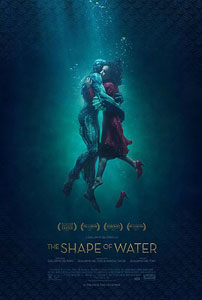
Film Review: “The Shape of Water”

Starring: Sally Hawkins, Michael Shannon and Richard Jenkins
Directed By: Guillermo Del Toro
Rated: R
Running Time: 123 minutes
Fox Searchlight Pictures

Guillermo Del Toro is known for his love of monsters, creatures, ghosts, ghouls and the macabre beauty of it all. That love takes on a new meaning in “The Shape of Water,” where Del Toro conjures up classic cinema vibes with the setting, cast, and trademark visuals throughout his latest film. After years of scaring and provoking thought, it appears that Del Toro is instead reflecting, not only on himself, but his influences.

On paper, “The Shape of Water” is a curious, if not off-putting, love story between Elisa (Hawkins), a woman made mute by an injury, and an amphibious creature, played by Doug Jones under heavy makeup. Elisa first spots the creature at her janitorial job at a secretive research center. She comes across the creature as it arrives at the base, after recently being captured in a South American river where it was worshipped as a God by local tribesmen. Curiosity gets the best of Elisa as she sneaks in to see the creature first-hand. She quickly becomes enchanted, spending her lunch breaks in the enclosure, to feed it hard boiled eggs and share her love of music with it.

The love story, as usual, has a deeper meaning that speaks volumes, but is unappealing to those who will simply see something else that’s a little too much for average audiences. It’s not necessarily a complaint of mine, but it is a scenario that’s a little rough to warm up to. It also lacks the benefit of necessary build-up and wordless romance that might not be Del Toro’s strong suit. If you can get past the strange romantic entanglement, there is a lot of beauty in Del Toro’s script.

Beyond that, there’s the evil in the world that inadvertently tries to tear the two apart. The creature’s captor, Richard (Shannon), is a dangerous control freak. He takes out his own insecurities on employees and looks to kill what he does not understand. His inflated sense of self-importance is compensation, but he’s looking to attain more power and work his way into the hierarchy of the military and other powers to be.

Because this takes place in the 60’s, there a sense that Elisa and the creature represent the counterculture to Shannon’s violent character. Very few people aid Shannon in his pursuit, while those around Elisa go against their common sense and assist in her attempts to break the creature out of confinement. It’s once the creature is out and Elisa gets to spend some alone time that I begin to feel conflicted about the attitude and direction of the film.

Del Toro’s “Beauty and the Beast” take for adults hits and misses in its third act when everything comes crashing together. There are signs of a cinematic masterpiece in “Shape of Water,” but too often Del Toro seems to cheapen the message about love for those without a voice and those who are alien in a “normal” society. It’s a tricky juggling act that would have been tough for any director, but Del Toro does make it work with his gothic imagery and performances from his cast. “The Shape of Water” should be a stronger film under Del Toro’s direction, but it’s still an emotionally resonant film.

Copyright: MediaMikes.com © 2017 · Powered by: nGeneYes, Inc. · Login

All logos and images used on this website are registered trademarks of their respective companies. All Rights Reserved. Some of the content presented on our sites has been provided by contributors, other unofficial websites or online news sources, and is the sole responsibility of the source from which it was obtained. MediaMikes.com is not liable for inaccuracies, errors, or omissions found herein. For removal of copyrighted images, trademarks, or other issues, Contact Us.