Interview with TRON’s Dan Shor

Dan Shor is known best for his role of Ram in 1982’s “Tron”.  He reprises his user role of Roy Kleinberg  in “TRON: The Next Day”.  Media Mikes had a chance to chat with Dan about his role in the film and also what he has been up to since.

Mike Gencarelli: What did you originally think about “TRON” when you signed on to play Ram?
Dan Shor: When I first signed on to play RAM I was thrilled. It was a comic book fans fantasy come true. I finally had the opportunity to put on a Halloween super hero costume and live out that pretend reality.

MG: Tell us about what you recall about the costume?
DS: The costume itself was like wearing skin tight pajamas to work everyday. I can remember walking down Mickey Mouse street across from Donald Duck lane on the Disney lot, in my skintight body suit thinking ‘nothing could be better than this’….

MG: Any fun stories from the set and/or working with Jeff Bridges?
DS: Jeff Bridges is exactly as you would think him to be. He was funny, friendly, intensely obsessed with video game play, and like all of us on the set, completely committed to the act of creativity. The acting process often creates quick and intense relationships that parallel the relationships that exist within the film. Though I haven’t seen Jeff in 15 years? We have spoken on the phone and our relationship is exactly as it was while we were making the film. As a side note: when Bruce and I worked on Legacy last year, it was as if not one day had passed, and (except for the expanded waistlines) we saw each other exactly as the best friends we were in the film.

MG: How did you get involved to play Roy Kleinberg in the “TRON: The Next Day”?
DS: I got to do Roy Kleinberg in Tron The Next Day when the creators of the Blue Ray edition (42 Entertainment) contacted my ShodaVision website. Though I still have an actors agent, and never officially left the business, I had been living outside of the country for many years and perception was that I had disappeared through some sort of time space wormhole.Having been one of the original members of the TRON world, and being quite aware of the reality that programs can easily be recreated after being de-rezzed, I was pretty pissed off that the creators of Legacy seemed to have no interest in my existence. That made me even happier when the 42 Entertainment people took the time and effort to find me. They, with the people charged to create a possible Tron 3, decided to follow the original fan’s desires and bring RAM back into the fold.

MG: Any word about if they are going to be going forward with another “TRON” film?
DS: I still don’t know if Tron 3 is going forward. And I do not even know that I will be involved if they do. Of course I would like it if it were so….but I am, sadly, all to knowledgeable about how Hollywood works, and am fully aware that I simply may or may not be involved based on any number of criteria.

MG: Tell us about working on “Bill and Ted’s Excellent Adventure” as Billy the Kid?
DS: Bill and Teds Excellent Adventure is going ahead with another sequel and , once again, without me. I only have fond memories of the experience of making the film and wish all involved all best luck and love…..wish William the Man were involved, but whatthefuck?

MG: What are you currently working on?
DS: I am currently working with my production company; ShodaVision, producing and directing internet corporate web streams for North Eastern Electricity Company’s energy savings programs. ShodaVision has created short and long form documentaries, music videos, both narrative and reality television series, and television commercials for International markets.

Bonnie MacBird talks about co-writing 1982’s “TRON”

Bonnie MacBird is the co-writer to the 1982’s “TRON”.  Media Mikes had a chance to about working on the film and her feelings on the continuation of the series.

Mike Gencarelli: Some of the ideas and technology in “TRON” is way ahead of its time, tell us about working on the script?
Bonnie MacBird: Originally, pre-Tron, Steven and I worked together on a spec script for Universal called Lightning for Jennings Lang. Steven had an animation company in Boston and had developed a cool special effect for lightning. We had a fun time working on this, and felt that our strengths were complementary. He had done a TV ad for a radio station featuring a backlit, neon character who looked a bit like the Michelin Man and whom he called “Tron” and approached me to write a movie in which Tron was a video game warrior. That was the extent of the idea when he moved his company to Los Angeles, and I left my story exec job at Universal to come over to the new Venice digs of Lisberger Studios and write and co-produce a film called “Tron” with Steven. I was tasked with creating a script that would showcase these elements. But there was no story, and no characters, except I would have to create one named Tron who looked like this radio ad character. In addition to developing a personality and character needs for this figure, my first contribution was to create Flynn, as I felt you needed a real life character to interact with Tron inside of the computer. The parallels with both Wizard of Oz and Alice in Wonderland were immediately apparent. I had recently seen Robin Williams in a small comedy club while covering theatre for Universal and had tried to get him a deal at Uni. I wasn’t successful but he hit big shortly after with Mork and Mindy. Robin was in my mind as Flynn when I created this character. But we also needed a new and wonderful world, one that had not been seen. Steven and his key animators including the super talented Bill Kroyer and Roger Allers (both of whom went on to direct) studied video games and the arcade culture, developing the look/feel of the movie, early on coming up with light cycles and “the grid”. They would feed these drawings and pencil tests to me, asking me to integrate the visuals into the script. It was a lot of fun at that time. I enjoyed working with the animators very much and set up a weekly improv session led by a talented actor/improviser, which both built community and fostered ideas between us. In addition to character work, which is I think my strongest asset as a writer, I knew that when you create a “world” in science fiction or fantasy, this world must be consistent in order to suspend disbelief, things must work in a way that is recognizable and orderly, so that story logic is preserved. In all the great franchises, Lord of the Ring, Harry Potter, and all the great science fiction of the Golden Age (Heinlein, etc.) this is clearly true. I wanted the computer world to be based on what is really inside a computer and to have its own inner logic. I should mention that I was already a bit of a computer geek going into this project. As a kid I was tantalized by an introduction to basic logic and programming from an innovative experiment that Patrick Suppes had put into a few grade schools in the Bay Area. And at Stanford, I studied computer programming with the legendary Donald Knuth… and my master’s thesis in film was a documentary called “Teaching Children to Read Using a Talking Computer”. At Universal, I had tried to get the Story Department to put all their coverage on the computer (there was no “online” then, except at Universities) and computers had not yet taken hold. This was considered a very novel and somewhat threatening idea and was rejected at the time with the comment “soon they will be making the choices for us.” Ha. So, I was already steeped in the tech culture of the time. Meanwhile, back to Tron research. At the time, there was exactly ONE computer store in all of Los Angeles, a tacky little storefront on a side street in Santa Monica. I found it and Steven and went there. It was mostly homebrew kits but they had a few books and I picked up one called COMPUTER LIB by Ted Nelson (a visionary himself!) and read about Alan Kay. I set up a research trip to Northern California in and around my alma mater. The Stanford AI project was partly the model for some of physical detail in the first TRON. Steven and I met with several scientists, and the last interview of the day was Alan Kay, then still at Xerox Parc. Some readers may recognize this name. It was Alan’s group that inspired Steve Jobs to envision what was to become the Mac. Alan’s group is credited for developing object-oriented programming and the first implementation of the graphical user interface that is the face of personal computing today. Alan even coined the term “personal computer”. So this visit was really to the mother lode. And way ahead of the curve. People had not even heard of this stuff yet. It was a big deal for all of us. Alan talked for close to four hours about computers, education, music, early childhood, theatre, storytelling, science, psychology, learning, artificial intelligence, programming, science fiction, biology, humanism, evolution, Bach, Buckminster Fuller, philosophy, neurology, aesthetics, and the future, the future, and the future. Steven and I had our minds blown. On the plane on the way back, I knew that we had to have a character based on Alan Kay and I set out to write him….and to hire Alan as the technical consultant on our film. Alan said yes and he and I began weekly meetings about the script, as I integrated what he taught me about how computers really work and the future of the internet and personal computing…. Into the world in which video games were a part. So conceptually, from very early on, I thought of the computer world as a vast arena, divided into different lands, or quadrants, of which the video game arena was one. The video game warriors generally stayed put “in their games” while other stuff went on elsewhere. But Tron… would not. I always felt it was important to intercut with the real world, and to have someone in the real world with whom to identify, and the character based on Alan Kay became the creator of Tron. The notion of “agents” or mini AI programs which learn your preferences and methods and work for you inside the computer, was gaining traction, though known only to a few techies then. Tron was originally a very smartly programmed video game character, whom Alan was gradually training or teaching to have far more complex functioning. But there were wrinkles in the process. As Tron became more and more of an AI (artificial intelligence) program, he became more and more human and began to develop free will. This was both a blessing and a curse, it would make Tron an eventual hero, but it would also get him into trouble. A classic sidekick character, the Bit, was similarly ambitious – he wanted to be more than a mere yes/no binary bit, he wanted to be a program. So all this factored into the original story and created a secondary theme of the dangers of hubris. Flynn was the fish out of water, the reluctant hero, who fell in accidentally and was sucked into the battle of good and evil almost by chance… later becoming the kind of hero he never thought he’d be in the process. There’s more to the story, but to sum it up, I did eight drafts of the script and something like fourteen outlines. One of my later drafts is the one Disney bought, but there were eight sets of writers after me. The credits went to arbitration and the WGA awarded me credit. I’m thankful to them for their fair and detailed process, and later served on several arbitration committees for them myself. As a side note, the real life Alan Kay and I enjoyed working together and became good friends during Tron. A few years later we married, and are still married today!

MG: After selling the script to Disney, did you have any involvement during the production of “TRON”?
BMB: I did not. I was offered to be associate producer but instead opted to carry on with other projects.

MG: What did you do following the sale of your script to Disney?
BMB: The sale of my script bought me some time to spec write my next script, and also to produce and direct a stage musical comedy – HOT ROLES – which had a successful Los Angeles run and great reviews. I had a good agent, and all of my spec scripts and treatments were sold and optioned, sometimes repeatedly (especially one called “SECRET MASTER OF THE UNIVERSE” about a science fiction writer who is believed to have special powers by his fans.) I wrote an afterschool special for Disney that was a casualty of a regime change. And many more scripts. And so I made an excellent living as a screenwriter for many years following. However whether a movie is made or not is out of the hands of the writer. It’s quite possible to be successful as a screenwriter without being produced. Not as satisfying, of course! On the other hand, I consider myself a writer in the larger sense, and I also wrote many other kinds of things (have had seven plays produced, wrote and directed two musicals on stage) and ran a production company for ten years which won three Emmys and eleven Cine Golden Eagles for documentary and scripted work. I am a songwriter as well. Prior to Tron I was Ned Tanen’s story development executive for four years at Universal.

MG: What would you say your biggest challenge was co-writing “TRON”?
BMBIt was not an easy collaboration. In my view Steven always worked as a producer with me as writer, giving me verbal and occasionally lists of notes or props/sets he wanted “in the script”. It’s been my experience in four years in development that these are story notes, and making things work is the actual writing. The contribution to me was initially in set design, character design, and action sequences that Steven and the animators would like included. For close to two years I worked on the script, creating the story and character of Flynn, who falls into the machine, and his journey to stop the MCP’s plan, and to escape the computer. Alan was another creation of mine based on Alan Kay, as described above. However the original tone of the film was a bit different, for Flynn I had Robin Williams in mind (see above). So Flynn in my versions was a bit more of a wild man, originally a pizza delivery boy with probably a touch of ADD and a slightly wackier quality. For the record, I loved Jeff Bridges in the role, and because I later read every draft of the film, I noticed that he adlibbed back in some of the humor I was going for originally but was excised in later drafts by other writers. I think he is an actor with astonishing talent and instincts and he sensed that if a guy falls into a computer, a sense of the absurd is needed. Guessing of course on this, but his work was superb. Also, our purpose in working with Alan Kay was to lay in real science underneath and humor on top. Steven gradually drew the movie into a more serious tone with quasi religious overtones while the actual science stuff which I spent a lot of time embedding and which I still think would have delightfully resonated with then and today’s tech audience, was pretty much completely omitted. There were larger themes in the early drafts including the folly of hubris, and the dangers of mindless bit streaming or going along with the status quo. But Steven (who was originally on board with this concept) and I eventually had creative differences. His input in the form of notes was at the beginning both helpful and inspiring, but later became “now add a pirate ship and make this work” and we found it increasingly difficult to communicate. He’s always been enormously visually talented and has a sense of great moment but it was never a co-writing situation. Repeatedly I found myself insisting on motivating and supporting the terrific action sequences with strong character and story logic. But the effects took precedence and Steven began to steer the tone into a different place. He was on a different path at that point and our differences grew. The few fans who are aware of this early form of the script are divided on what “would have been better”. But to them I would say hindsight is easy, creating is hard.

MG: How do you feel that “TRON: Legacy” continued the story you co-created?
BMB: The characters of Flynn, Alan and Clu were all in my original script. Light cycles of course, although those were Steven’s invention. Perhaps more importantly, in Legacy, Flynn still had a rebellious streak and Alan was still trying to take the high road with computers, and was thwarted by corporate interests.

MG: Do you have any involvement writing the upcoming TV series, “TRON: Uprising”?
BMB: I am waiting by the phone.

MG: Tell us what you are doing now?
BMB: Funny that you found me at my computer minutes after writing me. I have to own up. Computer geeks are my peeps and I kind of am one. I’m writing a thriller TV pilot set in the high tech world. Additionally I write songs with a partner, teach screenwriting at UCLA Extension, serve on the board of Stanford Alumni in Entertainment and run private writing workshops. And I never tire of hearing that TRON inspired young scientists, programmers, and writers.

DVD Review “Ron White’s Comedy Salute to the Troops”

Director: Tom Forrest
Starring: Ron White, Lewis Black, Kathleen Madigan, Cic Henley, Tim Wilson, Alex Reymundo, Robert Hawkins, Rascal Flatts, John Oates and Margo Rey.
Studio: Vivendi Entertainment
Running Time: 76 minutes
MPAA Rating: Not Rating

Film: 2 out of 5 stars
Extras: 2.5 out of 5 stars

Ron White is usually good for a laugh or two. I am not a mega big fan of his work but I like a good joke. If you don’t know Ron “Tater Salad” White, he is best known as the cigar smoking, scotch drinking guy from the Blue Collar Comedy tour. I also figured this would be decent since it has the likes of Lewis Black and Rascal Flatts, both who I enjoy very much. But looking past the comedy and the music, this disc is really about saluting to the troops and benefiting the Armed Forces Foundation. It is great cause but the comedy falls short maybe since its made for TV and the music is not that exciting.

Everyone included on this disc only really gets a short 10-15 minutes to perform, so it is a little tight in time. The bits were not too funny overall, in fact I think that Ron White was the only one that had me laughing. The musical performances by Rascal Flatts, Margo Rey and John Oates were decent but didn’t feel electric and fired up. Overall it was a little bit disappointing. The bonus features on the disc contains extended bits from each of the comedian and that was this disc savior since it contains some good bits.

Film Review “Beware the Gonzo”

Directed by: Bryan Goluboff
Starring: Ezra Miller, Zoe Kravitz, Jesse McCartney
Studio: Tribeca Film
Running time: 1 hour 40 minutes
MPAA Rating: Not Rated

Our Score: 2 out of 5 stars

I was attracted to this movie due to the reference to gonzo journalism in lieu of Hunter S. Thompson. I was hoping this was going to show aspects of that but unfortunately this is really masked as a cheesy teen-high school comedy/drama. It starts off actually really strong but then gets very sappy and about half way through loses me entirely. I particularly drew tired of Ezra Miller weak attempt to impersonate Hunter S. Thompson’s persona in the beginning of the film, though he completely loses it also half way through the film.

The plot follow rebel Gonzo (Ezra Miller) who decides to start his own underground newspaper focusing on the underdogs when he is kicked out of the school paper by its editor Gavin (Jesse McCartney). He teams with Evie (Zoe Kravitz) and the rest of the school’s rejects to attack the popular kids, take them on and start a revolution.

The acting is weak in the film. Like I mention Ezra Miller overacts quite a bit. Zoe Kravitz is only acting because her father is Lenny Kravitz. Jesse McCartney is laughable and should stick to his singing career. The sound in the film is really poor and seems like the cast is screaming right into their microphones. Overall watch the first half of the film for sure and then break out your phone and hit the Angry Birds while watching the second half.

DVD Review “Scooby Doo! Mystery Incorporated: Season 1, Volume 3”

Created by: Joe Ruby and Ken Spears
Directed by: Victor Cook
Voices of: Frank Welker, Matthew Lillard, Grey DeLisle, Mindy Cohn, Gary Cole, Patrick Warburton, Lewis Black
Studio: Warner Home Video
MPAA Rating: NR (Not Rated)
Episodes: 4
Running Time: 90 minutes

Our Score: 3.5 out of 5 stars

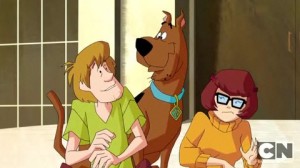
Cartoon Network’s “Scooby-Doo! Mystery Incorporated” is actually the eleventh adaption of the Hanna-Barbera’s Scooby-Doo series and it also stands as a reboot for the franchise. I have always been a fan of this series since it mixes horror themes with mystery and comedy. What I like most about this show is that each episode ends in a cliffhanger and makes you want to watch the next  one.  I watch quite a bit of animation and this series stand out as clever and also funny.  If you remember the live action films, Matthew Lillard reprises his role of Shaggy.  Other notable voice cast includes Gary Cole, Patrick Warburton and Lewis Black.

The episodes includes in this set are episode 9 through 12.  In “Battle of the Humungonauts”, focuses on a sibling rivalry that rises to monstrous heights.  “Howl of the Fright Hound” follows a robot dog tries to literally tear the gang apart. “The Secret Serum” is about a vampire who has a thirst for a beauty formula wants to sink her fangs into the kinds.  “The Shrieking Madness” releases a creature who comes alive from the cover of a science-fiction book. What I like about this series is that each episode are intertwined with some aspect from its prior episode.  I wish this release would have had more episodes in this volume.  This season includes 26 episodes and I look forward to future volumes.  Unfortunately there are no special features on this disc.

Synopsis:  The adventures of a talking dog and his four human pals as they try to unravel the strange and haunted history of their hometown. The tone is comedic, but it will never lose the edge that our heroes are in some frightening situations. The stakes are real.

Official Site: http://bit.ly/ogsJfG

Purchase “Scooby Doo! Mystery Incorporated: Season 1, Volume 3” and other volumes here.

“Get the inside scoop on WB movie & DVD releases! www.wbreelnews.com and be sure to sign up here.

Film Review “Fix: The Ministry Movie”

Starring: Al Jourgensen, Paul Barker, Trent Reznor, Maynard Keenan, Jonathan Davis, Dave Navarro and Lemmy Kilmister.
Studio: Gigantic Pictures
MPAA Rating: Not Rated
Running time: 97 minutes

Our score: 3 out of 5 stars

Go backstage with the scariest band EVER, Ministry, in this latest rockumentary. I have followed Ministry music in the early-mid 90’s and they are definitely not your typical band, especially not during their live performance. If you are not aware of Ministry, they are responsible for taking the genre of industrial rock and bringing it mainstream. If you enjoy behind the scenes in the music films then this is for you for sure. This film had me enthralled by its events almost so that I could not turn away.

This movie follow Al Jourgensen, founder of Ministry and his struggles with drugs and touring. Besides interviews from Al Jourgensen and other members and ex-members of Ministry, this is packed with interviews from many notable bands like Trent Reznor (NIN), Maynard Keenan (Tool), Jonathan Davis (Korn), Lemmy Kilmister (Motörhead) and Dave Navarro (Jane’s Addiction). They all talk about how they have been inspired by Ministry’s music at some point.

The film includes some really personal and up close interviews from Ministry’s tours in the mid-90’s. This really delves into the dark side of his music and his life. I am a big fan of Korn and its lead singer Jonathan Davis was quoted saying the following about Al, “When I first met Al he freaked me the fuck out… I had to leave.” This movie is not for the faint of heart as it is quite intense but is overall an interesting trip into the mind of Al Jourgensen.

CHECK OUT THE UPCOMING RELEASE SCHEDULE FOR THIS FILM:
09/23-29 @ The Clinton St. Theater, Portland, OR
09/28 @ The Regent Theatre, Boston, MA
10/01 @ Movies On The Mountain, Frackville, PA
10/03 @ The Echoplex, Los Angeles, CA
10/13 @ Riverview Theatre, Minneapolis, MN
10/19 @ CMJ – Clearview Cinema, New York, NY
10/24-25 @ Alamo Drafthouse Westlake, San Antonio, TX
10/26 @ Uptown Nightclub, Oakland, CA
10/27 @ Liberty Hall, Lawrence, KS
11/07 @ Alamo Draft House Ritz, Austin, TX
11/04-11/18 @ Alamo Draft House South Lamar, Austin, TX
11/11-11/12 @ Pickford Film Center, Bellingham, WA

Film Review “Pound of Flesh”

Directed by: Tamar Simon Hoffs
Starring:  Malcolm Mcdowell, Angus Macfadyen, Elizabeth Rodriguez, Timothy Bottoms, Dee Wallace, Bellamy Young, Taryn Southern, Whitney Able.
Distributed by: American World Pictures
MPAA Rating: Not Rated
Running Time: 96 minutes

Our Score: 2.5 out of 5 stars

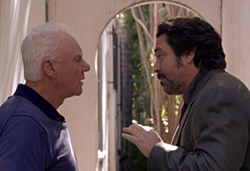
I am not sure how to really categorize this film.  I feel that it falls between a mix of character drama and a touch of thriller.  It it enjoyable to watch but leaves you with open ended questions. Malcolm McDowell is a hell of a fine actor and he gets to shine in this film.   Angus Macfadyen also gives an intense performance as well.  The subject matter is deep in the world of prostitution and cover-ups, though I feel it only really scratches the surface on each one.

If you unaware of the story this is based on true events.  Noah Melville (Malcolm McDowell), a college professor, is a favorite amongst his students but also runs a prostitution ring to promote scholarships.  When one of these meetings goes array the situation ends in murder and the cops start suspecting Noah. Detective Patrick Kelly (Angus Macfadyen) becomes obsessed with getting to the bottom of this mystery.

Overall I wanted to really enjoy this film and the performances were very good but I had a problem with it’s message.  We were left wanting to feel bad for Noah Melville claiming he is just looking to help his students and they want us to forget that he was selling them as services.   I would have liked to see more background in the story of why Noah was performing in the his acts of prostitution.

Interview with Victor Salva

Victor Salva is the man behind the “Jeepers Creepers” series. He has also directed the following films “Powder”, “Peaceful Warrior”, “Rites of Passage” and Clownhouse”. He is currently working on his latest film “Rosewood Lane”. Media Mikes had a chance to chat with Victor about his latest film and also his “Jeepers” series.

Mike Gencarelli: Give us some background on your latest film “Rosewood Lane”?
Victor Salva: Mike, “Rosewood Lane” is what I call a thriller in the vein of Carpenter’s “Halloween”, maybe the great grandfather of the kind of movies I call “killer in the shadows” thrillers, but in the case of “Rosewood” it is more like “the nightmare next door,” where the setting is your block, your neighborhood and the threat could literally be waiting for you out on the moonlit sidewalk just a few yards from your front door. I have always been a fan of suburban horror, because it always seemed the most likely. And the first trick of telling a good horror tale is telling one that draws you into it. Makes you believe. And convinces you, even if it is just for ninety minutes, that it is really happening. Or could really happen — to you. In the case of “Rosewood Lane”, right where you live. Those particular kinds of stories, the stories I saw of that nature on TV as a kid, say on “”The Twilight Zone”, “Night Gallery”, “Thriller”, “The Outer Limits”, “Tales from the Darkside” to name a few, and on the big screen like the original “Halloween”, or the original “Black Christmas”, or the original “Omen”, they have all informed “Rosewood Lane” which is my own entry into this genre.

MG: How does this film differ from your prior projects?
VS: “Rosewood Lane” is a character-driven, psychological thriller. I wouldn’t classify it as a horror film, though at the latest screening of the film, there were plenty of screams from the audience and a healthy number of jolts where the audience jumped out of their seats. I was also pleased to observe some couples at the preview, whose arms were being clutched by white-knuckled hands throughout most of the film. I know it sounds like I am some kind of mad sadist when I say this pleased me, but what it really meant to me was that the film was working and creating a very scary roller coaster ride for the folks who came to see it. Sometimes when you work in the horror genre you have to measure your success in screams, jumps, goose pimples and shivers. But Mike, the film does differ from just about every other film I have made. But how, really depends on how you yourself categorize films in the suspense and horror genre. “Rosewood Lane” is a very different kind of scare than the “Jeepers Creepers” films, or my upcoming horror entries “The Tattleman” or “Haunted”. “Rosewood Lane” sneaks up on you and gives you a series of goose pimple scenes before you start screaming and jumping out of your seat as the terror grows — where as a film with a creature that flies around every twenty-three years to nibble on us, falls into the more in-your-face, oh-my-god kind of monster movie tradition where the escalation is much less subtle. “Rosewood” has more story and more character than you are allowed in creature features. And in “Rosewood Lane”, a script I had written some time ago, my first and only screenplay with a female protagonist, I felt more permission to go to the psychological side of fear, and got to dip in a bit deeper (as I did in “Powder”, “Rites of Passage” and “Peaceful Warrior” some of my non horror films) to the inner journey of the characters — before I got to the really creepy and scary parts of the story.

MG: What was your biggest challenge during the production of this film?
VS: This was a small budget and a short shooting schedule as many of my early thrillers like “Clownhouse”, “The Nature of the Beast” and “Rites of Passage” were. When you work in that environment, everything is a challenge, because you are always what I call “running and gunning,” shooting as quickly as possible and moving onto the next scene. It is an exciting way to make movies, but also a dangerous and perilous one. You need to have a very well rehearsed cast and a very experienced crew, and on smaller budgets like this, you usually don’t. There is no time to rehearse and crew members, guys like you and me who have to bring a paycheck home each week to feed the family and pay the rent, don’t usually take smaller projects where the take home pay is much smaller as well. From a creative point of view, taking a few simple ideas, and not a lot of special FX, meaning you needed to create the scares without the benefit of a flying Creeper trying to eat people, and instead, create the scares with the rather the innocent image of a paperboy on his bike. I can tell you this, I was lucky to have been a student of all the wonderful Korean horror filmmakers these past few years, because I found myself working to create that kind of tone for “Rosewood Lane”, and executing the scares and shocks in much the same way as the Koreans, who I believe have elevated the art of the scare film. One of my favorite things to say about Korean horror is that those talented filmmakers, many of them, show us how to make something scary on a budget of 1.98. And in some ways I got to try my hand at that style and that scale of scaring people. This was the challenge, and like every strong challenge, an education for me.

MG: Tell us about working with Ray Wise after the “Jeepers Creepers” films?
VS: Ray and I have been good friends since I first worked with him back in 1994 on my film “Powder”. I had not seen “Twin Peaks”, but a lot of my friends had and said there was this phenomenon named Ray Wise on the show and that I needed to work with him. “Powder” was the first opportunity and I have tried to get Ray into just about every film I have ever made since. He is not only one of the most powerful and watchable actors I have had the pleasure of enhancing my body of work with, but he is also one of the kindest and most decent and wonderful human beings I have met on my journeys in Los Angeles. By the time “Rosewood Lane” came along, I hadn’t worked with Ray since my film “Peaceful Warrior” with Ray, Nick Nolte and Amy Smart. That was about seven years ago. It was great to see him again. I think we have a warm spot for each other (though I could be being presumptuous here) and I certainly have a great deal of respect for Ray and his quality of work. I am honored that he has deemed himself part of what I call my acting ensemble which I have been cultivating since ‘”The Nature of the Beast” back in 1994. But to answer your question more specifically: It’s always a pleasure to see Ray on your movie set. He gets it. He enjoys it. He comes prepared and delivers — every day. He to me is a rare find and I hope we work together until we are gray-haired old men.

MG: When casting for “Jeepers”, how did you know you found your Creeper with Jonathan Breck?
VS: Quite simply because he was the one, who at the Creeper auditions, walked in and scared the Bee-jeezus out of all of us. We still have that audition on tape (you can see it on the special features on the original DVD release of the first “Jeepers” film) where Jonathan had shaved his head, and came in sniffing around the room like the first thing that smelled good was going to be his dinner. If you go shopping for it on DVD – make sure you get the pressing of the DVD with all the original special features. I have been told that some “Jeepers” DVDs now available don’t have some of the programs we did for the first “Jeepers” DVD. But when it comes to knowing if an actor is right or wrong for a part, I usually know within about fifteen seconds of them walking into the room to audition, sometimes before they even opens their mouth, whether they are in the ballpark for booking the part they are there to read for. It is that fast sometimes. You are either right or not. You either get it or you don’t. I have always had an uncanny knack for recognizing if the right actor for the right part in my film has just walked in the door. It happens very quickly with me, and I don’t know if it is a sixth sense or just because it is my script and I have lived with these characters since I put them on the page, but I know when someone has walked in who understands what I understand about that character. I have been wrong on one or two occasions — I am not infallible. And I am also smart enough now, to go with an actor’s take on a character, when it turns out to be a better one than I originally had in mind. Sometimes you get an actor who has thought about the character in a totally different way than you have — and when you see it at an audition, after it throws you, you sometimes start to see it is fantastic, better than what you had written and you would be a fool not to make it part of the film. Being a writer/director is a high-wire act where you need to be a control freak, who doesn’t always have to be in control. The more confident I get that I am telling an interesting story, or the more comfortable I can be that the story may not turn out just the way I wanted — but maybe better or a bit different — the easier it is for me to see my actors as allies and not obstacles in telling my story. I have been very lucky at recognizing burgeoning talent, and seeing instantly that Justin Long and Gina Phillips were perfect for the brother and sister in “Jeepers”, or that Sean Patrick Flanery was just the right personification of “Powder”, or Jason Behr was the right boy to play Cambell Farley, a struggling and shattered gay kid, who was so lonely for his real father, that he fell right into the arms of a much more deadly version of him. I felt the same excitement when I saw Daniel Ross Owens read for the role of the very dark paperboy Derek Barber in “Rosewood Lane”. This was clearly another find, another perfect match. A strong actor with a great take on the character. In this case our “paperboy from Hell” who is in essence The Creeper of our suburban thriller. Every scary story needs its monster and Daniel filled those shoes — tennis shoes — nicely.

MG: Tell us if any of the rumors are true for “Jeepers Creepers 3” and when can we expect it?
VS: Mike, about the only thing I can tell you about it, is not to believe anything you hear or read about it. IMDB continually states that we are either already shooting it or that it is already completed. Readers of my blog know well and good the trials and tribulations of that film’s many starts and stops. And that pre-production hasn’t ever really started on this the third and last film of the “Jeepers” trilogy, though it has come close to going into production several times. I wish I could say when you would be seeing it. It is certainly something I would love to make and the script is very strong and has been written now for about five years. No one argues it is the best idea of all the “Jeepers” films, but it is still technically and independent feature, and getting it’s price tag of around 16 million together — especially now when money is more scarce in the movie biz than it ever has been, “Jeepers Threepers” as I like to call it, is still on the runaway, awaiting take-off orders from the tower. Ironic since it is one of the most requested horror sequels of all the current horror franchises and the Creeper himself was just voted fourth most scary movie monster in the history of cinema, according to a website poll. I can tell you that the script starts with a much-anticipated old west prologue that shows how the Creeper existed (and augmented his wardrobe) back before the days of the automobile. It is much bigger in scope that the two prior films, reintroduces Gina Philips character Trisha Jenner, reveals much more about the creature and his ancestry, and the film also brings the Creeper’s much missed Creeper Truck back into the mix. Everyone in the Creeper camp here, and fans from around the world, hopes this film will find its way to the big screen soon, but to venture when at this point seems unfair to all of us.

MG: Referring to “Jeepers Creepers”, would you consider it your greatest accomplishment?
VS: I am going to get a little philosophical with that question, Mike: I am not sure I would consider any of my films my greatest accomplishment in life, though in the timeline of my life they are all certainly points of great pride and accomplishment for me. I have no children to point to, as many of us who have become parents and made their lives about creating the next generation, to say: there is my greatest achievement. Some days I would argue that maybe my films, my art, are my children in some way. If I take that tact, would I consider “Jeepers” my greatest achievement? The “Jeepers” films are my most popular achievement, that is for certain, as well as two of my favorite accomplishments (since I am a horror film fan and have been since before I could shave). But my other children, “Powder”, “Peaceful Warrior”, “Rites of Passage”, Clownhouse”, and others, they all bring me great pride and joy as well. I also think the best is yet to come for me. I have more stories to tell and in all genres. Stories to make you jump, make you, think, and make you cry — or just take you on a good old-fashioned roller coaster ride. I am only sure of one thing: I am lucky to be able to dream my dreams on a big screen that shares them around the world.

“The Last Circus” Hits DVD and Blu-ray on October 18

A TWISTED TALE OF LOVE, REVENGE AND PSYCHOPATHIC CLOWNS…THE LAST CIRCUS

The 2010 Venice Film Festival Winner For Best Director And Best Screenplay
Makes Its DVD and Blu-ray™ Debut October 18 From
Magnolia Home Entertainment Under The Magnet Label

“Brilliant.”
– Ain’t It Cool News
“If the idea of an unholy collaboration between Guillermo del Toro, Federico Fellini and William Castle appeals to you, put near- masterpiece The Last Circus on your must-see list right now.”
– Salon

“Cult status is assured.”
– Variety

LOS ANGELES, CALIF. – Called “brilliant, bizarre, dazzling and utterly demented” (New York Times), the shocking tale of two murderous clowns in a twisted tale of love and vengeance, The Last Circus steps right up to Blu-ray and DVD October 18 from Magnolia Home Entertainment under the Magnet label. From cult director Álex de la Iglesia (The Oxford Murders, The Day of the Beast) and starring Antonio de la Torre (Volver, Che: Part Two), the “insane,” (Chud) “sinister and grotesquely funny” (Village Voice) film follows two clowns – one sad and one happy – as they enter into a peculiar and unforgettable love triangle.
The film follows Javier, a second generation clown who dreams to follow in his father’s footsteps as a Happy Clown but has seen too much tragedy and suffering in his life to be anything but its counterpart. He finds work in a circus where he befriends an outlandish cast of characters, but as the Sad Clown, he must take the abuse of the brutish Happy Clown, Sergio, who humiliates Javier daily in the name of entertainment. Included in the ménage is Natalia, a gorgeous acrobat and the abused wife of Sergio. Javier quickly falls deeply in love with her and attempts to rescue her from her tyrannical Happy Clown husband, however, Natalia is torn between her affection for Javier and her violent lust for Sergio.
Set in both the brutal Spanish Civil War and the tail end of the Franco regime, The Last Circus is a “a searing, intimate work riffing on Hitchcock, DePalma, Fellini, the Universal Monster films and German Expressionism” (Ain’t It Cool News). The DVD and Blu-ray contain bonus features including deleted scenes and the international trailer, and will be available for the suggested retail prices of $26.98 and $29.98 respectively.

Synopsis
Javier, a Sad Clown, finds work in a circus where he befriends an outlandish cast of characters, including the brutish Happy Clown, Sergio, who humiliates Javier daily in the name of entertainment. It is here that he meets Natalia, a gorgeous acrobat and abused wife of Sergio. Javier falls deeply in love with Natalia and tries to rescue her from her cruel and violent husband, unleashing Sergio’s jealousy. With neither man willing to back down, this twisted love triangle evolves into a ferocious battle between Sad Clown and Happy Clown, escalating to unbelievable heights in this shocking, irreverent and unforgettable film.

Bonus Features
Making of The Last Circus
Behind the Scenes Segments
Visual Effects
U.S. Trailer
International Teaser
International Trailer


Related Content

“Scream 4” Hits Digital Download on Oct.4th

SCREAM 4, the spine-chilling sequel to the trilogy that changed horror movies, will be available for digital download on iTunes, Amazon Instant Video, Xbox and Playstation starting October 4th, 2011 just in time for Halloween!  Scare yourself senseless instantly on your iPad, TV, computer or iPhone as Ghostface returns to Woodsboro with Neve Campbell, Courtney Cox, and David Arquette resurrecting their famous roles.  It’s a new decade, with new rules.

DON’T FORGET TO PRE-ORDER YOUR COPY NOW:
Amazon Prime and iTunes

Actor: Neve Campbell, Courtney Cox, David Arquette, Emma Roberts, Hayden Panettiere, Kristen Bell, Anna Paquin, Adam Brody, Shenae Grimes
Director: Wes Craven

DVD Review “George A. Romero Presents Deadtime Stories- Volume 2”

Directors: Jeff Monahan, Matt Walsh
Starring: George A. Romero
Studio: Millennium Entertainment
MPAA Rated: R
Run Time: 101 minutes

Our Score: 2.5 out of 5 stars

If you read my review for Volume 1 of this release then you would know that 2.5/5 is a RAVING review compared. I still am confused as to why George A. Romero decided to put his name on these films since they are not B movies and are lower than even Syfy originals (which I LOVE BTW). The acting and production value are so weak overall. Luckily the first two films in this series are good and really gory. The last one is lame but watchable.

The first film is called “THE GORGE”. It is about three best friends that go hiking but an avalanche trapped in a cave and resort to cannibalism. The second is called “ON SABBATH HILL” about a professor relationship with his student causes her to commit suicide, but still comes to class to haunt him. The last one is my least favorite “DUST” about a scientist that discovers dust from Mars that the ability to cure cancer but a security guard steals it for terminally ill wife and of course things go array.

Luckily this collection of horror films does not skimp on the gore. It is actually pretty intense especially in the first film. Since this is a zero budget project even though it shows it this is a major improvement from Volume 1’s films which I could barely even finish. Overall worth a watch but definitely not “Tales from the Crypt” quality.

Film Review “Dolphin Tale”

Starring: Harry Connick Jr, Ashley Judd and Morgan Freeman
Directed by: Charles Martin Smith
Rated: PG
Running time: 1 hour 53 mins
Warner Brothers

Our Score: 4 out of 5 stars

Hollywood is full of films with stories that inspire us. “Rudy.” “Rocky.” “The Shawshank Redemption.” These are movies that, when you leave the theatre, stick in your memory long after the lights have come up. A new film opens this week that joins this short list: Dolphin Tale.

Sawyer Nelson (Nathan Gamble) is a young boy living with his mother in Clearwater, Florida. His father having long deserted the family, he looks up to his older cousin Kyle (Austin Stowell). A champion swimmer Kyle seemingly has the world at his fingertips. But rather than accept the many scholarship offers he’s received, Kyle joins the Army. Feeling he’s being abandoned again, Sawyer is not happy with the decision. Kyle assures the boy he’ll be back and gives him a gift inscribed “Family is Forever.” With school out Sawyer happens down to the beach. While there he comes across a dolphin caught up in some netting. Soon the dolphin is rescued and taken to a nearby marine aquarium. Sawyer follows and soon begins an adventure that will change the lives of everyone, and everything, around him.

Based on a true story, “Dolphin Tale” is a smart, funny film that packs a solid message. The cast is strong across the board, with youngsters Gamble and Cozi Zuehlsdorff, who plays Hazel, the daughter of the aquarium director (Connick, Jr.), giving credible performances. On the adult side, Connick, Jr. excels as a father figure for Sawyer. Kris Kristofferson offers sage advice as the elder of the family. Freeman, who really should be declared a national treasure, brightens the film every moment he’s on screen. But the real star here is the real star: Winter the Dolphin. Playing herself, Winter is a natural performer. The bond she develops with Sawyer and the others feels real.

Because of her run in with the netting, Winter loses her tail. Freeman’s character embarks on a mission to create a prosthetic one for her. As Winter’s plight and circumstances become public the aquarium begins to attract visitors from all over the country, with a majority of them being families where one of the members has a handicap. It is these small moments, when a child in a wheel chair sees Winter overcome her hardship, that the film is at its most inspirational. Director Smith, probably best known to film fans for his roles in “American Graffiti” and “The Untouchables,” frames the film handsomely against the natural Florida beauty. If I have any quibble it’s that the 3D is practically non-existent and doesn’t really add anything to the story.

Read our interview with “Dolphin Tale” director Charles Martin Smith HERE

Interview with Scott Glosserman

Scott Glosserman is the man who created the horror film “Behind the Mask: The Rise of Leslie Vernon” and its iconic character Leslie Vernon. Scott is taking a unique approach in order to get “Before the Mask: The Return of Leslie Vernon” made, which is being a sequel, prequel and remake all rolled up in one or a “Spree-make” as he calls it. Instead of going through the studio, he is reaching out to the fans via Facebook to help raise money. Media Mikes had a chance to chat with Scott about this process and his plans for the new film.

Mike Gencarelli:  Tell us about your plans for “Before the Mask: The Return of Leslie Vernon?”
Scott Glosserman:  We’re calling it a “Spree-make” because it’s basically a sequel, prequel and remake all rolled up in one.  That’s why the title is “Before the Mask: The Return of Leslie Vernon.”  It’s trying to deconstruct the architecture of the horror prequels, sequels and remakes.  We’ve seen so much derivative horror come out in the past ten, twenty years and now we’re seeing almost a renaissance of remakes…whether we’re re-visioning “Halloween” or “Friday the 13th.”  “Texas Chainsaw”…”Nightmare on Elm Street.”  All of these guys are coming back.  And one of the jokes in the movie is that Leslie Vernon came along and did something so avant-garde…so interesting…that he really became kind of a muse for all of these guys that were just phoning it in.  He really reenergized a lot of these guys.  Since “Behind the Mask”  and what he had done in Glen Echo, a lot of these guys…Mike, Freddy, J…they’ve all said, “wow…I’m not done.  I’m going to go reapply myself.”  And they went out and re-imagined themselves.  And you see these franchises get a rebirth.  There’s a bit of a story line in the movie that talks about that.

MG:  Have you ever considered using sites like Kickstarter to help fund the film?
SG:  We haven’t used it for a couple of reasons.  First, Kickstarter takes 8%.  We’re not trying to raise thirteen thousand dollars we’re trying to raise a million dollars.  We’re doing different investment partners.  We’re doing domestic television and video on demand pre-sales.  But we want to raise a significant portion through Craft Funding, whether it’s a quarter million dollars up to half a million.  And again, the “Shocker” documentary that just raised a quarter million tells me that niche genre audiences can harness and create a groundswell and get up to the six figure numbers.  But, the eight percent that Kickstarter takes when you get up that high becomes a significant amount of money.  So we wanted to cut down on the commission.  Even at 4%, that’s $20,000.00 on a half million dollar movie.  That’s the difference between a Bruce Campbell cameo (though he’s probably much more expensive) and somebody else.  The point is, if we can do it all ourselves we can keep 100% of the proceeds and put them towards making the movie instead of paying a broker to do what we basically can do ourselves.  Yes, Kickstarter and similar places are doing a great job of creating a community of people who are interested in micro-financing.  But not all of those people might be film fans.  And if they’re film fans, they might especially not be horror fans.  We thought we had a better shot by going directly to our audience through Facebook because of the key words and because of the social networking aspect.  They’re all on Facebook and if somehow we could aggregate them we’d get to them quicker.  That may or may not be, in retrospect, correct.  It seems like Kickstarter does very, very well very, very quickly for people.  Right now we’ve only found three thousand people who like “Behind  the Mask” in three weeks.  Who knows how long it’s going to take to build to twenty or twenty-five thousand people.  Or if we ever will.  So this is all speculative.  And lastly, I think what we’re doing on Facebook, as opposed to Kickstarter, is press worthy.  So when we do come out with a press release about what we’re doing we’ll try to hit the Wall Street Journal or The New York Times or The Hollywood Reporter and try to do this in a slightly bigger way.  I think if we had done it on Kickstarter it wouldn’t have been as newsworthy while the fact that we are the first to do it on Facebook will really help us.

MG:  How did you create the character Leslie Vernon?  And did you think the character would be so popular?
SG:   There are two different answers.  First of all, the original script was written by David Stieve, a kind of “down on his luck” writer who is really, really talented but had never gotten his break.  He was watching a bunch of horror movies and he thought, “what if there was a slasher out there who hadn’t yet gotten his break?”  He’s just like everyone else.  He’s trying to go about his business just like I’m trying to go about mine and write a screenplay.  Dave thought he was just a normal guy, one he could be hanging out and playing poker with.  So the whole seed of the project came from…I wouldn’t say desperation but earnestness.  And that came out in the character.  By the time I got a hang of the script and started working with Dave, we really went from something that was a clever…something that was more of a lark…stream of consciousness idea to WOW!  There’s really something here.  You really have a framework and you can put a voice to the character.  I can bring in all of the true academic deconstruction architects of the horror genre.  And if we really layer in the true architections and conventions of horror on to what you’ve got here, not only can we create this really cute, clever type of way in to a horror film, we can also do it in a very sophisticated way.  We can say something about the horror genre.  And then to answer your second question, did we think it was going to be a hit…frankly it wasn’t a hit! (laughs)

MG:  I guess what I’m referring to is the popularity of the character today in the horror genre.
SG:  Duly noted.  I was pretty confident in my knowledge and understanding and passion for the horror genre, having written my thesis in a Conventions of Horror Architecture class on “The Shining.”  I studied Kubrick and studied the social and political commentary that informed horror films.  I knew that if I was able to accurately infuse that horror academia into what David had written,  into the voice of a character that David had created, that we would, at a minimum, be respected in the horror community because we were celebrating the horror genre.  We were sort of laughing with the horror genre, not laughing at it.  And I thought that at a minimum people who were as knowledgeable about the horror genre as I was wouldn’t have anything bad to say.  They would understand where we were coming from and be excited about the idea that we were really trying to demonstrate to the public at large how elevated horror, in fact, could be.  Among the tiny, but ardent, sub-genre horror community that is aware of this film…I think they’ve responded mostly positively to it.

MG:  Do you have a complete script for “Before the Mask: The Return of Leslie Vernon?”
SG:  Oh yeah!  We’ve got a great script.  We’re really, really excited about the script.  In fact, we released three pages of the script on Facebook.  We may do that again with other pages.  It’s hard to find pages that don’t give away a lot of what we’re doing in the movie.

MG:  You co-wrote, produced and directed the first film, and will be producing and directing the next one.   Out of all of your responsibilities which do you find most difficult?
SG:  The toughest thing is probably…when you’re producing you have to really break the film down into development, pre-production and financing phase.  One you’re producing on set, and you are both the producer and director, when the head make up guy begins bitching about the water filter not working or the generator getting turned off he’s usually bitching to the producer.  But when the producer is also the director he generally takes those gripes to someone else like the line producer.  Producing during the production was not that difficult even though I had to wear two hats.  I would say producing before the movie begins…what we’re doing right now…is the most difficult.  Once you get to set, once you’re on location, it’s like summer camp.  You’re with a great bunch of people and everyone is doing what they’ve really always wanted to do, which is make a movie.  It’s hard but it’s also creative and collaborative and it’s great.  Same thing with post-production.  You’re beginning to edit and you’re doing the special effects and sound mix and working with the composer.  You’re planning the festival run and you’re doing interviews.  But getting the movie financed is so hard.  Trying to trump up interest.  It’s gratifying to get so many nice comments on Facebook.  People seem to be really supportive.  But it’s also…I wouldn’t say disheartening…tough.  You’re getting three or four people committing to purchase a DVD per day.  At that rate it’s going to be a long time before we can get this thing going.  Or we might get someone to buy the domestic television rights but it’s not what we hope for.  So you keep trying to finance the movie.  Financing is the hardest thing.

MG:  What can fans do to help get this film made?
SG:  In this new century we’re living in, with social networking and crowd sourcing, I think corporations are beginning to say they’re not going to push content on people anymore.  When you go to HBO on line or HULU, you rely on people to curate content and display it for you and say “we suggest this.”  And you only watch what you’re given.  I think what’s going to happen is that the audience is going to be able to aggregate themselves and demand what they want.  And corporations are going to have to listen and provide that.  There’s going to be a paradigm shift as to who is deciding the content.  Maybe Anchor Bay is right…they’re not going to finance this one…not going to just give you a couple million dollars to make a movie.  I need to find out, by speaking to the horror community directly.  I now have the ability, through social networking, to appeal to the horror community directly.  I can ask if there are enough people in the horror community to merit my making another installment of the Leslie Vernon story?   If there are, the trick is how do I get to them and find out if they are even aware?  But if there are hopefully they will say so.  And they’ll say I’ll show you by committing to pre-order merchandise.  And if I can take that information and show it to studios and distributors then it’s as plain as day.  There are no more “gut feelings.”  It’s now “here’s the audience that says they want to see it.”  The horror community can reach out to their friends on Facebook and ask them to visit our page and commit to help me.  That will build a bigger community so we can get a groundswell of support.

Interview with Bob Bergen

Bob Bergen has been the voice of Porky Pig from “Looney Tunes”  for over 20 years.  He also has voiced numerous other character like Marvin the Martian and Tweety Bird.  He also done voice work for films like “Gremlins”, “Army of Darkness” and has worked with Disney and Pixar quite a bit.  In the world of anime he voices “Lupin” from “Lupin the Third” and characters from “Akira”.  Bob is currently voicing Porky Pig in the 2011 reboot of “The Looney Tunes Show”.  Media Mikes had a chance to chat with Bob about his his voice work and his long career with Porky Pig.

Mike Gencarelli: What was it like to follow Mel Blanc and step into the role of Porky Pig?
Bob Bergen: It was my goal since I was five years old to voice that one particular character. It’s funny, the day I got my first job….it was March 8, 1990…I remember the date because it was my birthday…I had just purchased a condo and my mom was house sitting waiting for a couch to be delivered because I was at an audition. And she happened to take the call from my agent…after a dozen or so auditions I had booked the job. And to be able to share that with my mom….I mean she’d put up with me since I was five doing Porky Pig everywhere I could…it was very surreal. I don’t think anybody gets into this business to play one character. I mean that’s stupid…the odds are against you. But this is what I wanted and I didn’t know NOT to want it. That night we went out to dinner and I had a huge wave of depression because I felt, “my God, I’m in my early 20s and I just booked my life-long goal…now what do I do?” It’s a roller coaster of emotions. And it’s also a huge responsibility. There will never be another Mel Blanc. I don’t think that anyone who does these characters today sounds like Mel. I do my best to keep the integrity of the original character. It’s a combination of a layer of emotions. But it’s also probably the most fun that anybody should be able to have.

MG: Which leads to my next question: why Porky Pig? What about that character stood out to you?
BB: That’s probably the most common question I’m asked. Why not Mickey Mouse? Why not Daffy Duck? The simple answer is because I could do him (Porky Pig). I found the formula in the writing. There’s a formula to Porky’s stutter in the writing that I discovered when I was about five. Even though my voice hadn’t changed and I didn’t sound like the character as a kid I’d figured out the heart and the personality of the character when I was a kid. And it was funny. While he’s stammering on one word he’s also fumbling for the next word. So it was the pure humor of the character that I was attracted to.

MG: You not only voiced Porky in the film “Space Jam,” but Marvin the Martian and Tweety Bird as well. Was it difficult for you voicing different characters?
BB: Not really…not really. A feature film takes several years to do while a half hour cartoon is a four hour session. So you’re in the studio one day doing four or five pages, then you’re back two months later doing four or five more pages. Then six months later you do twenty pages. It’s actually not that difficult of a job to do. The voice sessions for “Space Jam” were directed by Ivan Reitman, who produced the film. Jerry Rees and Steven Laiva, who were the animation producers and directors, were very good about saying, “here’s our script…what can you guys bring to it?” Fortunately, in the twenty one years doing these characters, I’ve never had a situation where they weren’t open to our creativity and ideas. I always follow the written word first but then it’s “what can you bring different to the scene?” For instance, there might be some lines where I’ll say, “I don’t think Porky would stutter like that…can I try it a different way,” and they’re always very open to it.

MG: You’ve been voicing Porky for the past two decades. Now that there is a new “Looney Tunes” show how do you feel the character has changed in those twenty years?
BB: It’s interesting…people will always ask me what the hardest thing is to do Porky Pig. Originally it was…everybody can say the classic phrases…”what’s up doc?,” “that’s all folks,” “I saw a puddycat”…give somebody a script with a brand new story with words that Mel Blanc never said in that situation…that’s when it becomes difficult. I can remember doing things early on and thinking, “wow…Porky has never discussed rap music before…Porky had never been in the 1990s discussing whatever was happening…the pop culture of the day. You have to be able to take the heart of the classic character and put it in contemporary situations. The “Looney Tunes” show does just that. I’ll be honest…when I got the job I was really concerned if they were going to uphold the integrity of these characters. And I’ve been so pleasantly surprised at how wonderful the writing is…how these producers get these characters…get the integrity of these characters…and are able to put them in situations that blend so well the classic and contemporary.

MG: How did you get involved in doing some of the darker comedies like “Gremlins” and “Army of Darkness?”
BB: Honest to God, I just auditioned. “Gremlins” was one of my first auditions. I remember being told “I can’t show you anything from this movie but what do you think it would sound like if a gremlin exploded in a microwave?” And I asked, “what’s a gremlin.” He said “remember the little laughing creature that hung out with Jabba the Hutt…something like that, but meaner.” So I did the sound of what I thought a gremlin would sound like if it exploded in a microwave. Then I did what I thought was the sound of gremlins having a drop of water dropped on them and creating more gremlins. I didn’t know what he was talking about, I just did funny sounds. And it was easily nine months later that I got the phone call telling me I got the job. For “Army of Darkness,” and I understand they’re doing a remake of “Evil Dead”…if anybody reading this is connected to that film I want to do it…I happened to work for the casting director of the film so I didn’t have to audition. He asked me if I could do the voice of a man-eating book and I said, “OK.” It’s really a collaborative thing. They throw their ideas at you and you give them your interpretation of their ideas.

MG: You’ve also done a lot of work for Disney and Pixar. How did those jobs come about?
BB: I think my first Disney feature was “The Hunchback of Notre Dame.” Disney and Pixar are probably some of the most loyal producers I’ve ever worked with. Once you prove yourself and they know that you’re reliable they’ll call you back over and over again. A lot of the jobs are ones I didn’t audition for. They would just call and ask, “can you work on this new Disney film next week” and I say, “okey-dokey!” They’re very particular on who they hire. I’m what they call a “utility player” on animated features. I’m not a celebrity so I’m not going to play Buzz Lightyear. I’m not going to play the lead in any major Disney feature. But I do play multiple characters in the films. They know that if they get me up there I can play five or six different characters in one scene. And once you’ve proved yourself that way, that you’re reliable, they call you over and over again. I didn’t do the first “The Santa Clause” movie. Comet the reindeer was in it. But for the second film they wanted to give him personality. So I actually had to audition for that. And fortunately they brought him back for the third film. A lot of it is just getting that audition and letting them know who you are. You have to be in the business. You have to have a solid agent who gets the calls from the powers that be. But then you still have to audition. I had to audition for the “Looney Tunes” show. Just because I’ve played a character for twenty years I don’t own it. So when a new producer comes in they may say, “hey, I know YOU’RE right for the part but let’s see who else is out there.” But an actors’ job is to audition. I mean for the “Looney Tunes” show I did the pilot. And then they held auditions. But I knew the reason. It was a brand new series and they wanted to see who else was out there. An actor has to check his ego at the door. You go in there and just have fun. I went in with the philosophy of “hey, if someone else is better they deserve this job.” I just go in and have fun with it. In the twenty one years I’ve done Porky I’ve had to re-audition four times. I had to audition for “Space Jam.” I had to audition for “Looney Tunes: Back in Action.” And I had to audition for the “Looney Tunes” show. That’s showbiz. That’s what we do. Actors audition and actors work.

MG: You’re also the man behind the voice of Luke Skywalker in everything from video games to “Robot Chicken.” How did you come to do that voice?
BB: Well it’s interesting because when I got the first audition I turned it down because I told my agent that I couldn’t “do” Mark Hamill. Mark Hamill is so freaking brilliant. He is one of the best voice actors in the business. Mark Hamill IS Luke Skywalker. But my agent said that the producers still wanted to see me. And I told them that I don’t DO Mark Hamill. And they said, “don’t DO Mark Hamill. Do Luke Skywalker.” They showed me clips from the various film and said, “here’s pre-Jedi Luke and post-Jedi Luke…his personality has completely changed.” My vocal tone was very close to Mark Hamill but they wanted me to get the character down. And once I went from trying to do an impression to an actor doing the role I was much more comfortable. I had several auditions before I booked my first job. But once I was able to…not mimic Mark but to get the character down…I became very comfortable with it. And the producers have been very good to me. But even though I did the games for many years I still had to audition for the first “Star Wars: Robot Chicken.” We’ve now done three of those specials. They are fantastic! The writing these guys do over at Seth Green’s office…they’re so good. It’s a pleasure to work on those specials.

MG: Let’s switch gears to anime. “Lupin III” (Lupin the Third) is one of my favorite shows. What can you tell us about voicing him?
BB: He’s one of my favorite characters. Such a layered, rich character. He’s a pompous, slob nerd and he just thinks he’s God’s gift to everything. What a great, rich character to play…in any genre of animation that I’ve done. He’s a blast. I would love to do more. It’s one of the characters that, like Porky, is one of my all time favorites.

MG: You did two voices in “Akira.” What can you tell us about that?
BB: It was my first anime job ever. I didn’t ever know what anime’ was. As a kid I loved “Speed Racer” but I didn’t know that was anime. I just thought it was a cool cartoon. I got the film and I realized that anime’ is very different from American animation because when they do “Looney Tunes” they record the voices first. They animate to your timing. For anime’ you have to match the screen. You have to watch the film, read the script and perform, staying in character, all at the same time. It’s a huge challenge. And the anime’ actors that work consistently are some of the most brilliant voice actors in the world. Normally you do a movie and move on. But Roger Ebert listed “Akira” as one of the best movies ever made. Not animated film…one of the best FILMS ever made. I probably get more fan mail from “Akira”…from “Spirited Away”…from “Lupin” then I get from anything I’ve done with Looney Tunes. It’s overwhelming and very much appreciated.

MG: What other projects do you have coming up?
BB: Fingers are crossed that we get a season two for the “Looney Tunes” show. I’m a gypsy. I’m an actor. I did a game yesterday. I did a pick up session for “Looney Tunes” last week. I just did a commercial. That’s my life. I never know what my next job is going to be. Some days the phone doesn’t ring and some days I wonder how I can fit it all in. That’s what we do. I’m writing a book on voice over agents right now. I’m up for an Emmy so I’m hoping to collect a trophy in a couple months. I’m amazed to be nominated. I’m having a fun ride!

Film Review “Moneyball”

Starring: Brad Pitt, Jonah Hill and Philip Seymour Hoffman
Directed by: Bennett Miller
Rated: PG 13
Running time: 2 hours 13 mins
Columbia

Our Score: 5 out of 5 stars

As a kid you always spent your summer memorizing the statistics on the backs of baseball cards. Even the casual fan recognizes certain numbers. 2131 – consecutive games played by Cal Ripken, Jr. (his streak ended at 2632), 755 – career home runs by home run king Hank Aaron (sorry, I don’t recognize Bar-roid Bonds). 4256 – career hits by Pete Rose. You get my point. But there are even more stats to be compiled, hundreds of them. And the way they’re used is the story behind “Moneyball.”

October 15, 2001. Game 5 of the American League Divisional Series pitted two very different teams against each other. In one corner sat the New York Yankees, winners of 97 games with a payroll just over $113 million. In the other corner, the surprising Oakland Athletics, winners of 102 games. Total payroll – under $40 million. The Yankees would go on to win the game and the series. The next season they opened the team wallet and signed the A’s best player, Jason Giambi, paying him $20 million a year, half of the A’s total team salaries. Realizing the hole he is in as a small market team, A’s general manager Billy Beane (Pitt) begins to search for replacements for the ones he lost. While speaking with another team he meets Peter Brand (Hill), a young Yale graduate who looks at the game via statistics. Impressed by Brand, Beane hires him as his assistant and the two begin to build a team not based on scouting reports but on such percentages as runs scored and on base percentage.

Adapted from the best selling book by two of Hollywood’s best, Academy Award winners Steven Zaillian (“Schindler’s List”) and Aaron Sorkin (“The Social Network”), “Moneyball” introduces us to the way baseball is now conducted. The A’s are truly the have nots of major league baseball. So strapped for cash that they charge the players for soda pop, they have to make the best out of what they can afford. By following the numbers they assemble a team that Brand refers to as coming from “the Island of Misfit Toys.” But between all of the number crunching is a film with heart…one that makes you want to root for the little guys.

Just as the fundamentals of Moneyball rest squarely on the real Billy Beane’s shoulders, the success of “Moneyball” rests on Pitt’s. He gives a many layered performance, one of humor and sadness. A former player who never lived up to the hype (Beane was chosen in the first round of the 1980 baseball draft – Brand tells him that, based on his research, he would have drafted him in the ninth), Beane has come to realize that money isn’t everything. You have to play the game for the love of the game. As head stat geek Brand, Hill gives a quiet yet solid performance. Oscar winner Hoffman is A’s manager Art Howe, the fly in Beane’s ointment. He doesn’t understand the numbers and is hesitant to do anything that will jeopardize his future as a big league manager. We are also introduced to Beane’s daughter, Casey (“Brother’s and Sister’s” Kerris Dorsey), and their scenes together are some of the film’s best.

Miller, who earned a Best Director Academy Award nomination for “Capote,” keeps the tone of the film flowing seamlessly. He works in archival footage brilliantly, giving the game sequences almost a documentary feel. That this is his first film since “Capote” is a travesty. Films need more Bennett Miller and a six year gap between projects, unless it was something Miller wanted, is unconscionable.

Copyright: MediaMikes.com © 2011 · Powered by: nGeneYes, Inc. · Login

All logos and images used on this website are registered trademarks of their respective companies. All Rights Reserved. Some of the content presented on our sites has been provided by contributors, other unofficial websites or online news sources, and is the sole responsibility of the source from which it was obtained. MediaMikes.com is not liable for inaccuracies, errors, or omissions found herein. For removal of copyrighted images, trademarks, or other issues, Contact Us.