Film Review: “Anaconda” (2025)


  • ANACONDA  (2025)
  • Starring:  Paul Rudd, Jack Black and Steve Zaun
  • Directed by:  Tom Gormican
  • Rated:  PG 13
  • Running time:  1 hr 39 mins
  • SONY Pictures

Our Score:  3.5 out of 5


In 1997, SONY released the film “Anaconda.”  Starring Jon Voight, Ice Cube, Jennifer Lopez and others, it was a modest hit.  My son was 13 when it came out, and he and his friends loved it.  Apparently they weren’t the only ones.  Other fans include Paul Rudd and Jack Black, who have set out to remake the film in their own way.  They should be proud of what they’ve done.


We first meet Ronald Griffin – Griff for short – (Rudd) at work.  Griff is an actor and the jobs are coming further and further apart.  Back home, his childhood friend Doug (Black) has given up on his dreams of being a filmmaker and now spends his days working for his father’s wedding video company.  When Griff surprises Doug by coming home for his birthday, he mentions that he has been given the rights to remake the film “Anaconda,” and wants to do it with his friends.  All they need is a big snake.


Both seriously funny and thrilling at the same time, “Anaconda” works thanks to the chemistry of its cast.  Doug and Griff are joined by pals Kenny (Zaun), their longtime cameraman, and Claire (Thandie Newton), Griff’s one time girlfriend who comes along to play the female lead.  The four have a genuine friendship which translates well to the big screen.  But the film is not just played for laughs.  There are some pretty intense moments, quite understandable when you’re trying to deal with a 20-foot-long snake!


The visual effects are pretty solid and they keep the screams (and the laughs) coming.


If you see one Snake movie this year, make it “Anaconda!”


On a scale of zero to five stars, I give “Anaconda” ★½


Film Review: “The Housemaid”


  • THE HOUSEMAID
  • Starring:  Sidney Sweeney and Amanda Seyfried
  • Directed by:  Paul Feig
  • Rated:  R
  • Running time:  2 hrs 10 mins
  • Lionsgate
  • Our Score:  4 out of 5


If the name Paul Feig sounds familiar, it’s probably because of his work in some well known comedies.  Besides directing several episodes of television’s “The Office,” he has worked extensively with Melissa McCarthy, directing such films as “Bridesmaids,” “The Heat,” “Spy” and the underappreciated 2016 “Ghostbusters.”  So to find him in charge of a psychological thriller may come as a surprise.  I’m happy to say it’s a good one.


Millie (Sweeney) is a woman on her own.  Flitting from job to job, she currently finds herself living in her car and applying for anything she can find.  One such job is as a housekeeper for a very posh socialite (Seyfried).  She interviews well and gets the job.  It should be the end of her troubles.  But it’s just the beginning.


Riding on the shoulders of it’s two leading actresses, “The Housemaid” is like a roller coaster ride, taking you in one direction until, unexpectedly, taking a turn so jarring you need to catch your breath.  Sweeney plays Millie as a tough, but seemingly goodhearted, woman with a past she’s trying to escape.  Seyfried, as Nina, seems genuinely kind, but she soon reveals she is also dealing with demons she can’t escape.  All of this plays out in a beautiful home, brightly lit and friendly, that slowly becomes darker and darker as secret after secret is revealed.  As Andrew, Nina’s husband, Brandon Sklenar does his best to keep the peace, but we soon learn he has secrets too.


The film is well paced, and director Feig wisely let’s the story play out without telegraphing the next twist.  All in all, this is a film I really recommend.


On a scale of zero to five, I give “The Housemaid”  ★★ 

Film Review: “Avatar: Fire and Ash”

Starring: Sam Worthington, Zoe Saldana and Stephen Lang
Directed by: James Cameron
Rated: PG-13
Running Time: 197 minutes
20th Century Studios


Our Score: 1.5 out of 5 Stars


As I walked out of the three-hour-and-seventeen-minute “Avatar: Fire and Ash,” I felt something I didn’t feel during “Avatar” or “The Way of Water”: pure exhaustion. And it wasn’t the runtime, or wearing 3D glasses over my regular glasses, or the fact that I spent an entire morning sitting in a dark theater. It’s because I simply do not care about anything that happens in these movies.


“Fire and Ash” picks up sometime after “Way of Water,” with the human-turned-Na’vi Jake (Sam Worthington) still living among the water Na’vi. He’s there with his wife, Neytiri (Zoe Saldana), their kids, and Spider (Jack Champion);  the human boy in the oxygen mask who’s the son of Jake’s archnemesis, Colonel Quaritch (Stephen Lang), who is also still alive inside a blue cat body. And honestly? I don’t remember how Quaritch became a 10-foot tall blue feline or why Spider lives with Jake and Neytiri. I also don’t remember if their kids are actually their kids, why their teenage daughter Kiri is played by 76-year-old Sigourney Weaver or why they’re living with the water tribe in the first place. I don’t remember half the characters I’m not mentioning. And the truth is: I don’t care.


That’s the fundamental issue with the “Avatar” franchise. These characters exist, but we never truly connect with them. Colonel Quaritch has died multiple times and keeps returning. It makes you wonder if death even means anything in this universe. Jake and Neytiri’s kids are new, but they don’t have personalities outside of disobeying orders, getting scolded, and then saving the day anyway. Jake and Neytiri seem like a couple on the rocks. Jake talks to everyone like they’re in the Marine Corps. Apparently Kate Winslet is in this movie, but if you asked me who she played, I’d stare at you like you asked me to explain quantum physics. Oona Chaplin plays Varang, a new Na’vi who loves fire (hence the title), but even she is just another power-hungry villain; indistinguishable from the humans trying to colonize Pandora. It’s just a lot of plot that I don’t care about.


The themes are all still here, like the prior films:  imperialism, environmentalism, spirituality, family, the broad allegory about Indigenous peoples and the military-industrial complex. But this third trip to Pandora doesn’t say anything new about any of it, nor does it change the story structure. It simply repackages old ideas with new chase scenes and polished fight sequences, which are the only reasons I didn’t fall asleep. It all looks gorgeous, great and visually stimulating when things are blowing up. Special effects and groundbreaking technology are still the big positive takeaways.


However, the exposition is endless. It revolves around characters and lore we’re never given a reason to care about. And the things that “might” be interesting, like the God-like thing in the water or the human colony, are barely explored. I’ve never rewatched any of the “Avatar” films, and now I understand why. It’s bizarre because I’ve rewatched every other James Cameron movie multiple times. Cameron usually balances spectacle, popcorn thrills, and human themes to deliver truly compelling blockbusters. But “Avatar” remains…alien. No pun intended. It didn’t click until the credits rolled that I haven’t rewatched “Avatar” because I feel like I have rewatched it twice under different names. No amount of budget money or visual spectacle can fix that.


Film Review: “Marty Supreme”

Starring: Timothee Chalamet, Gwyneth Paltrow and Odessa A’Zion
Directed by: Josh Safdie
Rated: R
Running Time: 149 minutes
A24


Our Score: 4.5 out of 5 Stars


I think it’s safe to say the Safdie brothers (Josh and Benny) love flawed, if not outright hateable, characters. 2025 only underlines that as they go solo. Earlier this year, Benny Safdie put out “The Smashing Machine,” a gritty sports biopic that mostly glazes over the troubled home life of its subject. Josh Safdie counters with “Marty Supreme,” a fictional sports biopic that dives headfirst into the multiple lows, and rare highs, of its title character.


Like me, you might hear that Marty Mauser (Timothee Chalamet) is loosely based on real-life table tennis player Marty Reisman. Just throw that knowledge out. Marty Mauser’s life and personality are the definition of piss and vinegar. The aspiring ping pong champion from New York City impregnates his lifelong best friend, who’s married, basically steals money from the shoe shop he works at to enter a competition in Britain, hits on a married, retired actress, and drops A-bomb and Holocaust jokes at swanky dinner parties. That’s all in the first 20 minutes. The movie never lets you take a breath.


“Marty Supreme” is defined by its chaotic flow, jumping from one crisis to the next like you’re fast-forwarding through ten sitcom plots at once. Riding this unregulated roller coaster is Chalamet, who owns every scene regardless of cameos from Penn Jillette, Kevin Leary, Tyler, the Creator, Abel Ferrara, and others. Chalamet plays Marty like Adam Sandler meets Jordan Belfort. His inability to handle a crisis like an adult is perfectly balanced with a snake-oil salesman’s confidence that he’ll always land on his feet.


A lot of the fun in “Marty Supreme” comes from not knowing where any of this is going. Whenever you’re sure Marty is about to drown in the mess he’s made, he finds some ridiculous silver lining that pulls him back to the surface. That madcap energy keeps the film from feeling like a slog as it pushes the two-and-a-half-hour mark. Oddly enough, the movie takes its breaths by watching Marty excel at the one thing he’s deservedly cocky about: table tennis.


Safdie shoots the film like a kaleidoscope of clashing styles, music, and tone. At different moments, it feels like a comedy, a crime thriller, an underdog story, a late-in-life coming-of-age tale, a narcissism study, and a sports movie that refuses to use sports movie tropes. There’s no big rousing speech, no training montage, no cartoonishly evil rival, and definitely no lovable, squeaky-clean hero. For all intents and purposes, Marty is kind of a prick. 


But only Chalamet could turn this clown into someone mildly worth rooting for, if not relatable. For every bit of schadenfreude and self-inflicted disaster, we find ourselves admiring his gusto. He’s not the kind of guy you’d normally want to see win, but watching this madcap journey unfold makes you respect his fearlessness. That fighting spirit gives his offensive jokes just enough charm to land with a smirk instead of a wince. It makes you want to see him become a better person, even if whether he actually does is entirely up to how you read the ending.


Maybe that’s why I kept thinking about “Marty Supreme” for days afterward: it hovers so close to reality that its absurdity feels weirdly genuine. Underneath Marty’s bluster and buried beneath his juvenile crimes is a layer of universal humanity. That stubborn belief that our existence is somehow unique, despite all the evidence and billions of other lives that have been lived and will be lived. We see Marty lash out and use people in self-serving ways, but we also see where he comes from: poverty, constant struggle, and a handful of fragile, flawed connections. Marty can’t stand the idea of being a footnote, and that’s the most relatable thing about him. That kind of desperate, blazing passion is what rockets “Marty Supreme” into the upper echelon of 2025 as one of the best films of the year.


Film Review: “Wicked: For Good” (Review 2)


  • WICKED:  FOR GOOD
  • Starring:  Cynthia Erivo, Ariana Grande and Jeff Goldblum
  • Directed by:  John M. Chu 
  • Rated:  PG
  • Running time:  2 hrs 17 mins
  • Universal


Our score:  4.5 out of 5


Let the joyous news be spread…”Wicked” is back!


When we last walked out of the theatre, Elphaba (the supremely talented Erivo) had flown off on her broom while Glinda (the equally good Grande) stayed behind in Oz.  We had many questions.  What’s up with the animals?  What’s up with the goofy Wizard?  And where in the hell is Dorothy?  With “Wicked:  For Good”  questions, and more, are soon answered.


“Wicked” was an amazing piece of filmmaking, transforming the spectacular story successfully from the Broadway stage.  It was full of fun and music, with with a story that didn’t take itself too seriously.  In the new film, those tables are turned.  Here the cast gets to display their many ranges of emotions, from happiness to despair, and they do it brilliantly.  There is more “meat” in this story, and the cast is most certainly up to the task.  Both Ms. Erivo and Ms. Grande carry the emotional weight of the film while Mr. Goldblum uses every quirky trick he’s ever had up his sleeve.

Musically, the score is fine, though, just as I thought with the Broadway show, the songs in Act II are not as strong as in Act I.  There is no “Popular” or “Defying Gravity” here, though in a way this works for the story as it gives the audience the opportunity to concentrate on the performances rather than simply sing along.  From the main cast to supporting actors like Bowen Yang and Ethan Slater, the cast is solid across the board.


Director Chu keeps the story moving at a fast pace, though nothing is rushed.  Production design is top notch, with the artistic crew bringing Oz to life!


It may be hard to believe but, like the beloved “West Side Story,” “Wicked” did not win the Best Musical Tony Award (it lost to “Avenue Q.”).  But I can safely say that “Wicked:  For Good” is the Best Musical of the Year!


On a scale of zero to five, I give “Wicked: For Good” ★★ ½ .   

Film Review: Zootopia 2

Starring the Voices of: Ginnifer Goodwin, Jason Bateman and Ke Huy Quan
Directed by: Jared Bush and Byron Howard
Rated: PG
Running Time: 108 minutes
Disney

Our Score: 4 out of 5 Stars

For years it seemed odd that, out of all the animated films from 2016, “Zootopia” wasn’t the one spawning a flurry of sequels. “The Secret Life of Pets” got two crappy sequels and a video game. “Moana” got a subpar sequel and an upcoming live-action remake. Even “Sausage Party” somehow got two seasons of cheap animation on Amazon Prime. So when Disney finally announced a “Zootopia” follow-up a few years ago, I wondered if they’d actually make a worthy sequel…or just churn out the same disposable, cash-grabby fluff the other 2016 movies received.

Since nearly a decade has passed, “Zootopia 2” starts by replaying the end of the first film, allowing us to pick up immediately after. Judy Hopps (Ginnifer Goodwin) and Nick Wilde (Jason Bateman) are still raising eyebrows at the ZPD. There are lingering doubts that a bunny and a fox can sustainably function as a police duo amongst their fellow officers, and even between the two of them. But after a chaotic smuggling bust, Judy thinks she’s caught the scent of their next big case: a snake in Zootopia.

Snakes, we learn, have been pariahs ever since one allegedly killed the city’s founder. As Zootopia prepares to celebrate its 100th anniversary, the founder’s descendants, a wealthy family of lynxes, that appear to have been written at the height of the popularity of “Succession,” worry snakes are plotting to ruin the festivities. Or worse, kill one of them. Of course, not everything is what it seems. Nick and Judy’s investigation takes them into new corners of the city they’ve never explored while putting a strain on their newfound partnership.

2016’s “Zootopia” was about societal discrimination; the sequel digs deeper into bias. “Zootopia 2” is a story about oppression, plain and simple. Yes, the plot mirrors the first film in several ways, if it’s not obvious by now that the snakes aren’t actually the bad guys. But the writers do an admirable job expanding the city while acknowledging that discrimination doesn’t disappear once the “bad guy” is locked up. Systems don’t magically fix themselves.

Judy and Nick’s journey through new locales, along with new characters and clever nods to old ones, keeps things fresh. We see how reptiles are treated in this mammal-dominated metropolis and how their cultural struggles mirror our own world. If reptiles represent anything, they’re Southerners: unfairly stereotyped as uneducated or backwards. The American melting-pot parallels are right there on the screen.

As with any animated sequel, the biggest worry is whether it justifies its own existence. “Zootopia 2” absolutely does. It never feels like a retread or a toy-commercial disguised as a movie. Writer and co-director Jared Bush refuses to turn characters into one-note jokes or nostalgia props. Danny Trejo, Andy Samberg, and the rest of the new voice cast add flavor without becoming animal caricatures. The old cast doesn’t appear to have missed a beat as we’re transported immediately back into this furry, adorable world. There’s clearly care and intention behind every creature, big and small.

Is it as good as the first film? Not quite. It runs a bit long and could have tightened some of its storytelling mechanics. But it’s a worthy successor because it cares about its characters’ journeys. “Zootopia 2” knows the expectations it carries, and it meets most of them quietly and confidently underneath the vibrant colors, animal jokes and bursts of adventurous joy. It feels like a natural continuation of Judy’s relentless optimism and Nick’s sly pragmatism, while showing that they, much like the world they inhabit, still have a lot of growing up to do.

Film Review: Wicked for Good

Starring: Ariana Grande, Cynthia Erivo and Jonathan Bailey
Directed by: Jon M. Chu
Running Time: 137 minutes
Rated: PG
Universal Pictures

Our Score: 3 out of 5 Stars

Ever since it was announced that the “Wicked” musical would be split into two films, and especially after watching last year’s first installment, I had my reservations that anyone without delusions of grandeur, and a bottomless appetite for merchandising, could stretch a two-and-a-half-hour musical into something enjoyable. Especially one just shy of five hours when stitched together. And while I was right about the runtime bloat, I found just enough magic in “Wicked for Good” to recommend this second installment.

The film picks up shortly after the events of the first. Elphaba (Cynthia Erivo) is freeing imprisoned animals, studying the Grimmerie, and keeping tabs on her sister, who now governs Munchkinland. Meanwhile, Glinda (Ariana Grande) is doing PR-by-bubble across Oz and planning her wedding with Fiyero (Jonathan Bailey); even though it’s painfully clear he’s still in love with Elphaba. The love triangle, along with several dangling plot threads, resurfaces as Elphaba’s mission to end the Wizard’s reign grows darker and more dangerous.

But the changes and the new songs disrupt the tone of what should be the heavier back half of the story. It’s easily my biggest complaint. Not only do these additions pad the runtime, but they don’t add much to the film beyond noise. The musical works because its first half is all bombastic spectacle, while the second half slips into quieter, somber reflections. “Wicked for Good” doesn’t always understand that balance.

Part of what makes “Wicked” work for fans of “The Wizard of Oz” is the winking and retooling of the larger classic narrative. At times, “Wicked for Good” seems to forget that. Without revealing too much, the film struggles with restraint: sometimes it refuses to show without telling, and other times it overexplains itself into exhaustion. A few crucial sequences are mishandled entirely. I had to stifle a chuckle during a pivotal scene or else risk the nearby theatergoers thinking I’m a sociopath.

And yet, despite two full paragraphs of criticisms, I can’t bring myself to dislike this movie. It’s still a competent, enjoyable time. That’s doubly true for whenever Grande and Erivo share the screen. They gravitate toward each other naturally, and we believe every scrap of tension between them. When they’re apart, the film leans on the magnetism of Jeff Goldblum as the Wizard, Jonathan Bailey as Fiyero, and Michelle Yeoh as the evil Madame Morrible. Everyone picks up the slack when scenes rest solely on Grande or Erivo.

The classic songs still land with power, and when the film hits more than just the right notes, it hums and tugs at your heartstrings. There’s a newfound maturity to the characters, and you can feel the raised emotional stakes. This time around, “Wicked for Good” hopes you’ve grown up alongside these characters. I just can’t help but wonder what might have been if “Wicked” had stayed a singular, tightly packed film instead of being stretched into two.

Film Review: Wake Up Dead Man: A Knives Out Mystery

Starring: Daniel Craig, Josh O’Connor and Josh Brolin
Directed by: Rian Johnson
Rated: PG-13
Running Time: 144 minutes
Netflix

Our Score: 4 out of 5 Stars

As someone who loved “Knives Out” but found “Glass Onion” underwhelming, I walked into “Wake Up Dead Man” with zero expectations. I’m not sure I would have sought it out on my own if not for review duties or awards consideration. Maybe that’s exactly why this latest entry blindsided me. It’s not just the best of the franchise, it’s one of the best whodunnits of the 21st century.

“Wake Up Dead Man” opens with Reverend Jud Duplenticy (Josh O’Connor) recounting the events leading up to the unexplainable murder of Monsignor Jefferson Wicks (Josh Brolin). We quickly learn Wicks is far from the holy man he pretends to be. He may believe he’s God’s messenger, but he uses his pulpit to bully, belittle, and shame the people of Chimney Rock. Those who remain in his congregation, a cast of misfits, zealots, and deeply miserable souls, adore him for his rage. So who killed Monsignor Wicks? That’s where Benoit Blanc (Daniel Craig) steps in.

In his third “Knives Out” mystery, Rian Johnson makes the smart choice to split the investigation between Blanc and Duplenticy. Blanc knows from the outset that the reverend didn’t commit the murder, which is why he needs his input into who it could be. It plays beautifully into Blanc’s know-it-all detective persona while positioning Duplenticy as a kind of spiritual Watson to his Holmes. The film wears its detective-novel influences proudly, referencing and playing with the very tropes it adores.

Brolin, for his part, storms through his scenes like a wrecking ball, so venomous you occasionally wonder if his murderer deserves a handshake more than a prison sentence. But the heart of “Wake Up Dead Man” lies with Blanc and Duplenticy. Duplenticy approaches the mystery through a religious lens, while Blanc leans on pure logic. Faith and reality clash, rebound, and circle each other. Based on how these movies go, it’s unfortunate because their chemistry becomes unexpectedly profound.

As we learn more about the ensemble, we see how faith has manipulated, entangled, and consumed them. Some believe out of genuine conviction. Others cling to it out of selfishness, fear, or a desperate need for identity. Some weaponize it. Others dissolve under its weight. The murder-mystery makes us suspect nearly everyone in the church, but the film itself nudges us toward a different question: what do we put our faith in and should we question it? That alone makes “Wake Up Dead Man” feel clever, timely, and strangely resonant. It’s a whodunnit made for a world divided by social media, disinformation, and the fragility of truth.

Film Review: “The Running Man”

Starring: Glen Powell, Josh Brolin and Colman Domingo
Directed by: Edgar Wright
Rated: R
Running Time: 133 minutes
Paramount Pictures

Our Score: 3.5 out of 5 Stars

When I heard Edgar Wright was tackling the second adaptation of Stephen King’s “The Running Man,” I couldn’t help but get excited about the possibilities. For every film he’s made, Wright has brought a frenetic, hyper-stylized energy that moves to the beat of its own schizophrenia. His flashy visuals collide with wordplay, genre satire, and toe-tapping soundtracks that make his films feel like cinematic, ADHD jazz.

Despite being a favorite among cinephiles, with gems like “Shaun of the Dead,” “Scott Pilgrim vs. the World,” and “Baby Driver,” Wright has never been a box office guarantee, nor has he had an undisputed smash. Maybe that’s why he sheds his usual veneer here. In “The Running Man,” he opts for something more faithful to King’s text, but also more conventional, a gritty, almost generic action aesthetic.

Ben Richards (Glen Powell) is the definition of desperate. He’s been laid off for basically having morals, his child is dying from the flu, and his wife works a service job that might be a front for prostitution. With no money and no way out, Richards turns to state-sponsored TV game shows as his last chance. Of course, he’s not doing the most popular show, “The Running Man” competition. Because that’s where contestants must evade government-sanctioned killers and informant civilians for 30 days to win a billion dollars. That’d be crazy, right?

Since we know exactly where this is going, Wright wastes no time throwing Powell to the wolves. Richards moves from city to city, fighting his way out of brutal ambushes, finding unlikely allies, and realizing that the televised bloodsport is only one piece of a much larger, state-controlled dystopia. The movie stays remarkably close to King’s vision. It has a fresh, commercial hellscape look (think Blade Runner meets rauncy YouTube ads) and Powell shines as the scrappy, relatable underdog. Everyone he encounters, from a conspiracy theory Michael Cera to a witty game show host in Colman Domingo, shines in their scenes as well. But it doesn’t feel like a Wright film.

That’s my biggest disappointment. The Wright ingenuity, the pulse, the rhythm…everything; it’s muted. When the movie needs to dump exposition, it still finds clever ways to do it, but it feels like someone else doing a Wright impression. The kinetic charge that usually courses through his scenes, that sense of chaos barely under control, just isn’t there. In his best work, exposition isn’t a hurdle; it’s part of the jazz. Maybe the adaptation held him back, but this one feels restrained, almost cautious.

And that’s really my only complaint. I never held the first “Running Man,” the Arnold Schwarzenegger version, in high regard, so I’m not worried about missing that 80s camp. But what we get here feels like watered-down Wright. Not bad, just… safe. Which is ironic, considering “The Running Man” is still a fun, dystopian middle finger to corporate authoritarianism.

It just feels like it could have been more. Could have been better. That said, if you’re not deep in the Wright fandom and just want solid, old-school action with a touch of satire, this will absolutely do the trick.

Film Review: “Die My Love”

Starring: Jennifer Lawrence, Robert Pattinson and LaKeith Stanfield
Directed by: Lynne Ramsay
Rated: R
Running Time: 118 minutes
Mubi


Our Score: 3 out of 5 Stars


How much does a performance really factor into a film? We point to Tom Hanks in The Ladykillers or Margot Robbie in Suicide Squad as examples of actors who outshine the movies around them. You could say the same for Jennifer Lawrence in mother!. And now, you can say it again in Die My Love.


When we meet Grace (Lawrence), she’s moving into her new home with Jackson (Robert Pattinson). The New York couple is looking for a quieter life in rural Montana as they prepare to start a family. We see them laugh, play, talk nonsense, screw, and then the baby arrives. Things start to unravel as Grace, a writer, hits a wall. She snaps at a cashier (and honestly, who wouldn’t?), grows increasingly hostile toward her husband, imagines an affair, tears apart the bathroom, and sometimes wields a gun. If you haven’t picked up on it yet, this film is #tradwifegonewrong. Or maybe it’s postpartum depression.


As someone who will never experience that firsthand, I can’t say for sure how authentic the depiction is. But “Die My Love” clearly has more on its mind than the psychological unraveling of motherhood. It’s also thumbing its nose at traditional family ideals. The kind where the mother is expected to handle everything while the husband works. That’s exactly what Jackson seems to want, and everyone around Grace reinforces it. As a free spirit, Grace wasn’t built for that life, and it appears it’s too late to abandon ship.


By the end, it’s difficult to tell what’s real, what’s imagined, or even when we are in Grace’s timeline. The film sprinkles in visual clues to keep us grounded, but by the third unexplained appearance from LaKeith Stanfield, I started wondering if “Die My Love” was less interested in coherence and more fascinated with seeing how far Lawrence could carry the chaos. Boy, does she ever.


She’s delivered plenty of great performances before, but this one is absolutely feral. Instead of chewing the scenery, she claws, nips, and digs her furious fingers into it with rage and childlike amusement. You can see emotions flash through her eyes like lightning. In seconds, Grace shifts from a rage-filled mother to a carefree teenager. It’s incredibly believable that Lawrence, a real-life mother, is channeling something carnal and unfiltered. It’s the kind of performance that feels ripped from a real person’s private spiral.


But the jumbled narrative never seems interested in telling or even hinting at what’s actually happening. It misuses its climax and ends with a whimper. “Die My Love” collapses under its own weight. The motherhood nightmare is too scattered to hold its own ideas. But Lawrence keeps it alive, barely, beautifully. It might not work as a story, but as a showcase for what she’s capable of, it’s magnetic. Sometimes that’s enough.


Film Review: “After the Hunt”

Starring: Julia Roberts, Ayo Edebiri and Andrew Garfield
Directed by: Luca Guadagnino
Rated: R
Running Time: 139 minutes
Amazon MGM Studios

Our Score: 1.5 out of 5 Stars

The last time I saw Julia Roberts on screen was “Ben is Back.” She’s still got it. The last time I saw a Luca Guadagnino film was last year’s “Challengers” and “Queer.” He’s still got it too. But despite those strengths, the two powerhouses find themselves stuck in the middle of a true mess with “After the Hunt.”

Roberts plays Alma Imhoff, an esteemed philosophy professor at Yale, whose world begins to unravel when one of her star students, Maggie (Ayo Edebiri), accuses Henrik Gibson (Andrew Garfield), a younger colleague of Alma’s, of sexual misconduct. Early on, we see that Maggie idolizes Alma; and the feeling appears mutual. That’s what makes Alma’s response so jarringly cold and standoffish. Instead of leaning in, she recoils.

The film sets itself up to tackle complex and timely themes like power, mentorship, and the #MeToo movement. But what follows is a series of disconnected moments and odd tonal choices. Character motivations feel vague or inconsistent. Dialogue is shallow. The entire production feels like no one, from director to composer, knew what kind of movie they were making.

Guadagnino’s direction is technically competent, but frequently puzzling. He lingers on characters without telling us why. He cuts to close-ups of hands fidgeting or flipping through pages as if trying to signal meaning, yet those moments never build toward any visual motif or narrative depth.

The cast is difficult to fault, given how erratically their characters are written. Take Frederick (Michael Stuhlbarg), Alma’s husband. Most of the time, he’s calm and supportive. But during a crucial dinner scene between Alma and Maggie, he suddenly transforms into an immature, attention-seeking pecker. He gets the feeling that he needs to excuse himself. Instead of confirming this suspicious, he externalizes his dissatisfaction, and blasts classical music in another room. But he’s not done. He mopes theatrically in and out of the dinner scene like a ghost. It’s not a scene that deepens the drama; it derails it.

And then there’s the score. Trent Reznor and Atticus Ross have delivered award-winning soundtracks before, but here their music feels confused and abrasive. It implies tension that never materializes or crashes into scenes with jarring intensity, like a kid slamming piano keys out of frustration. It’s the perfect metaphor for the film itself, noise without purpose.

Most frustrating is the absence of any resolution or thematic payoff. I kept waiting for the “ah-ha” moment, something that would recontextualize the chaos or clarify the muddled tone. But it never comes. Instead, the film ends with the same smug superficiality that defines its characters. “After the Hunt” wants to say something profound about power, privilege, and institutional silence, but it never earns its place in that conversation. It feels like a thesis paper written the hour before it’s due.

Film Review: “A House of Dynamite”

Starring: Idris Elba, Rebecca Ferguson and Gabriel Basso
Directed by: Kathryn Bigelow
Rated: NR
Running Time: 112 minutes
Netflix

Our Score: 4 out of 5 Stars

Anxiety is reaching a fever pitch. Economic instability, inflation, crime, war, political violence…seriously, take your pick. Meanwhile, social media fans all the flames, and in 2025, Kathryn Bigelow adds another spark to the blaze: nuclear dread. “A House of Dynamite” unfolds in near real-time over the course of about 30 minutes, as military officials, White House staff, and intelligence agencies scramble to respond to an ICBM launch from the Pacific. Who fired it? Why? Can it be stopped? Where is it headed? And, ultimately…does any of it even matter?

The genius of “A House of Dynamite” isn’t its story, which remains simple, but the slow, sinking pit it forms in your stomach. Bigelow has always enjoyed making you squirm in your seat. I watched her last film, “Detroit,” at home and it allowed me to pause the film so that I could take an emotional break. “A House of Dynamite” kept me trapped in a dark theater with its escalating discomfort as it became clear, alongside the characters, that answers may not prevent the inevitable: global nuclear war.

Told from three different perspectives, we watch key players and others react with human fragility: a trembling hand on a wedding ring, a silent phone call to a loved one, a stunned stare into nothing. Bigelow frames the film with such raw intensity that you feel trapped alongside them. And while the film runs only 112 minutes, its central premise, those first 30 minutes post-launch, does stretch thin by the final act. A tighter 90-minute runtime might have enhanced its claustrophobic urgency.

The film isn’t political; unless you’re pro-nuclear holocaust. “A House of Dynamite” offers no comfort in the face of crisis. We’re always told that adults are in charge and everything will be fine. With nukes on the line, even the adults in the room (fictional or otherwise) are powerless. They may know the protocols, have the plans, run the drills. But when it actually happens…does it make a difference? Does it even matter?

Bigelow doesn’t rely on post-apocalyptic horrors like “The Day After” or “Threads.” There’s no gallows humor à la “Dr. Strangelove,” and no morality play like “Oppenheimer.” Instead, she delivers a bleak, tension-drenched thriller that insists on one terrifying idea: tech fails, people lie, and when the moment comes, the response is tragically bureaucratic. “A House of Dynamite” doesn’t build toward a catharsis, it loops through dread.

It’s not the kind of film you’ll want to watch twice, unless you’re a glutton for punishment. There’s no reward in rewatching events you already know are futile. The outcome is clear from the first frame, and yet we, like the characters, continue trying to make sense of it. That’s Bigelow’s ultimate point. The danger isn’t just nuclear weapons, but how little time we’d have, how unprepared we’d still be, and how devastatingly human we remain when the clock starts ticking. In those 30ish minutes, “A House of Dynamite” explores military command, institutional reaction, and personal despair. Each is a different side of the same deadly die, one we may yet roll.

Film Review: “V/H/S Halloween”

Directed by: Bryan M. Ferguson, Casper Kelly, Micheline Pitt-Norman, R.H. Norman, Alex Ross Perry, Paco Plaza and Anna Zlokovic
Rated: NR
Running Time: 115 minutes
Shudder

Our Score: 4 out of 5 Stars

Any time a filmmaker invokes Halloween in the title, or sets a story on All Hallows’ Eve, they invite scrutiny. It’s a built-in promise: deliver ghouls, thrills, nostalgia, and enough mayhem to satisfy the most haunted corners of our brains. The eighth entry in the “V/H/S” anthology franchise embraces that challenge head-on. It seemed inevitable since 2021, when the series began dropping a new found footage anthology every October, mixing horror veterans and newcomers into a blender of unpredictable storytelling. Now that “V/H/S” has finally pulled the trigger on Halloween, did they pull off a trick or a treat?

The wraparound story, “Diet Phantasma,” feels like Sam Raimi directing “Halloween III.” It follows scientists testing a soda infused with poltergeists, with gloriously gruesome results. If you thought earlier V/H/S films lacked in body counts, this segment makes up for any shortfall with gleeful, over-the-top carnage. The simple premise is absurd and excessive in all the right ways. It doesn’t matter that it doesn’t connect all the others, it’s simply trying to one-up everyone.

If the wraparound didn’t knock you for a loop, then “Coochie Coochie Coo” will. It’s a nightmare of gestation and grotesquery. Two teens out trick-or-treating stumble into a postpartum hellscape filled with horrifying baby-faced creatures and graphic lactation visuals. It’s weird, unsettling, and will scar parents and teens in very different ways.

The next short, “Ut Supra Sic Infra,” from “REC” co-creator Paco Plaza, is sadly the weakest short of the bunch. It doesn’t take full advantage of the found footage format or bring anything new to the party. Cops, attempting to figure out what led up to a deadly scene, find themselves becoming a part of the next deadly scene. Nothing memorable. Fortunately, it’s short and quickly gives way to “Fun Size,” a demented Adult Swim–style fever dream about greedy teens who defy the classic “please take one” candy rule. Their punishment? A Willy Wonka–esque descent into candy-coated abandoned warehouse doom. It’s goofy, gory, and rewatchable in all its sugar-fueled chaos. Never have gumballs and silly costumed characters been this deadly.

Then comes “Kidprint,” the anthology’s darkest and most grounded short. This short unearths a horrifying truth behind missing children and a local video store. It’s the only segment that fully explores Halloween’s thematic potential: loss of innocence, hidden evil, and the darkness in everyday people. It’s a bleak breather, tonally distinct and all the better for it. While it may not have the same zippy fun as the others, it reminds us that any good Halloween should have some creeps and scares.

“Home Haunt” offers us a unique bow before letting “Diet Phantasma” close things out. This Halloween crowd-pleaser might trigger a lot of happy memories for viewers: a DIY haunted house. I definitely had one in my neighborhood, but this suburban house haunt becomes too real after the homeowner plays a mysterious vinyl record. It’s clever, campy, and carries the right mix of nostalgia and nastiness.

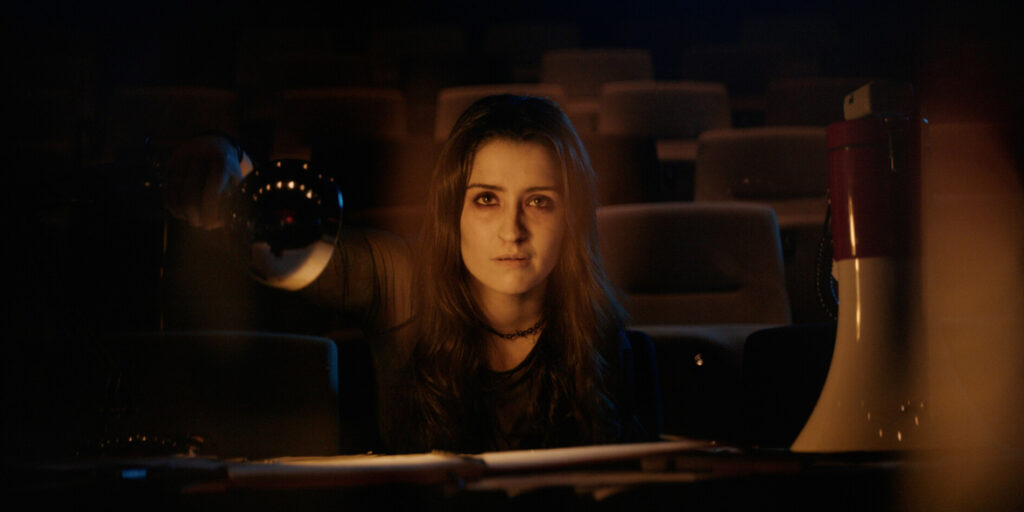
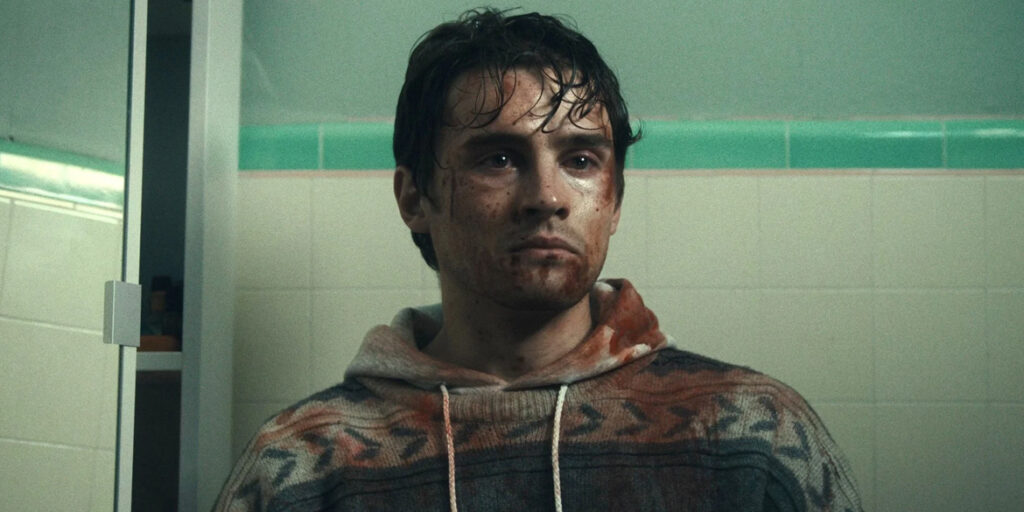
“V/H/S Halloween” captures the essence of this time of year by being consistently violent, funny and at times unsettling. Every short, with the exception of “Ut Supra Sic Infra,” leans into Halloween aesthetics, traditions, or anxieties. While the stories don’t connect narratively, the seasonal spirit binds them with orange-and-black twine. There’s a reckless energy here that captures what Halloween feels like for people like me, costumed chaos, sugar rushes, and the lurking fear that something in the dark is more real than you think.

Film Review: “The Smashing Machine”

Starring: Dwayne Johnson, Emily Blunt and Ryan Bader
Directed by: Benny Safdie
Rated: R
Running Time: 123 minutes
A24

Our Score: 3.5 out of 5 Stars

Every now and then, a film comes along that isn’t great in the traditional sense, but it features a performance that redefines how we view an actor. “The Whale,” “The Wrestler” and “Leaving Las Vegas” are the gold standard here. These films are remembered as much for their raw performances as their narratives. Add “The Smashing Machine” to that list.

Set between 1997 and 2000, the film follows real-life MMA fighter Mark Kerr (Dwayne Johnson), a powerhouse trying to stay relevant through the early days of the UFC and the Japanese PRIDE league. While Kerr trains and fights with intensity, he also battles drug addiction, feelings of inadequacy, and a volatile relationship with his on-again, off-again girlfriend Dawn (Emily Blunt).

“The Smashing Machine” doesn’t reinvent biopics. The cinematography and storytelling are fairly standard, even pedestrian at times. What elevates the movie is Johnson and Blunt’s fully committed performances. Their love is messy, obsessive, and often toxic. Every confrontation, every long silence, feels lived in. These are career-best moments for both actors. Blunt may actually be the true powerhouse of the film with her wild emotional swings, but Johnson isn’t too far behind. Even in his quieter moments, we sense and see the tension building inside the gentle giant.

Those expecting a deep dive into Kerr’s addiction or the psychology behind his relationship may leave disappointed. For that, you’ll need to queue up the 2002 HBO documentary “The Smashing Machine.” Director Benny Safdie clearly admires Kerr, but he often chooses mood over clarity. The film hints at trauma and dependency, but rarely explores them with depth. Johnson’s moments of vacant staring and trembling silence, while sometimes excellent in their own regard, beg for more context.

Still, as far as sports biopics go, this one makes a compelling choice: it zooms in on an inherently unheroic and specific three-year window. Most sports films focus on triumph or redemption, because that’s how a good sports movie is supposed to be, right? “The Smashing Machine” is more interested in the fracture point, when greatness begins to crumble. It’s a quiet descent from invincible to vulnerable, and Johnson sells every inch of that slide. While it may not be Safdie’s strongest effort, “The Smashing Machine” could be a defining moment in Johnson’s acting career. It’s not a knockout of a film, but it lands where it counts.

Film Review: “She Loved Blossoms More”

Starring: Panos Papadopoulos, Juli Katsis and Aris Balis
Directed by: Yannis Veslemes
Rated: NR
Running Time: 88 minutes
Dark Sky Films


Our Score: 3 out of 5 Stars


Lovecraftian. Horny. Bizarre. Carnal. Those are probably the four most prominent words that popped up in my mind during “She Loved Blossoms More,” a time-travel fever dream filled with vaginal-looking creatures, Freudian brothers, drugs, and enough “what the hell am I watching?” moments to last the rest of the year. Writer-director Yannis Veslemes takes a deceptively simple premise and goes absolutely hog wild with it for 88 minutes. Throughout its runtime, Veslemes refuses to tell you what’s going on while daring you to look away.


The plot, if you can call it that, revolves around three oddly-named brothers: Hedgehog (Panos Papadopoulos), Dummy (Juli Katsis) and Paris (Aris Balis). They’re attempting to bring their mother back-to-life with a time machine. Of course, we pick up towards the tail end of their experimentations, which involve a lot of unfortunate livestock. They live together in what feels like a gothic mausoleum of maternal obsession. The time machine? Looks like they borrowed design tips from “The Fly.” 


But what actually happens in this movie? A lot of inexplicable imagery is treated as disturbingly normal. One brother chats with a vulva snake. Another has sex while his sibling fingers a chicken (and not in the way you think). I’m not spelling cherrypicking out of context scenes either, the whole movie feels like this. If I gave any more examples, I’d be accused of watching a serial killer’s wet dream laced with mommy issues.


Is that what the film is ultimately about? Mommy issues? Maybe. “She Loved Blossoms More” doesn’t hand over answers easily. It demands your sharpest attention and maybe multiple viewings, but ironically, the shock of the visuals is also what makes it hard to revisit. Once that novelty wears off, you’re left hoping the film had given you more narrative breadcrumbs the first time around.


That’s my biggest gripe: Veslemes keeps you at arm’s length, withholding just enough to frustrate. Maybe there are culturally specific metaphors or symbols I’m missing as an American viewer. At one point, a trollish goblin pops up that looks like something out of Epcot’s Norway Pavilion. Does it mean anything? Is it just another weird detour? Who knows.


If I had to gamble (which I wouldn’t because this movie’s too chaotic to bet on), I’d say the message is that life is a deliriously silly thing to be enjoyed before it overwhelms us with grief. These brothers are trapped in memory loops, maybe even false ones fed to them by their father, who might be the brains behind the time machine. The boys aren’t remembering their mother. They’re recreating someone else’s haunted idea of her. They make off hand remarks like, “She loved horror movies.” That’s about as deep as her characterization goes, yet the boys appear to be hungry for something more tangible.


Still, for viewers looking for a cinematic challenge that aren’t afraid of grotesque sexual imagery, “She Loved Blossoms More” is a delight. It’s proudly alienating, arguably clever, and defiantly uninterested in mainstream attitudes, even the horror conventions that it’s clearly marketing to. It doesn’t care whether you like it or understand it; and that’s kind of the point. It feels like Veslemes is trying to decode his own nonsensical dream while letting you watch, gape-jawed.

Copyright: MediaMikes.com © 2025 · Powered by: nGeneYes, Inc. · Login

All logos and images used on this website are registered trademarks of their respective companies. All Rights Reserved. Some of the content presented on our sites has been provided by contributors, other unofficial websites or online news sources, and is the sole responsibility of the source from which it was obtained. MediaMikes.com is not liable for inaccuracies, errors, or omissions found herein. For removal of copyrighted images, trademarks, or other issues, Contact Us.