Film Review: “The Stranger”


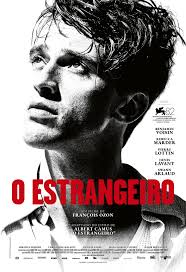
  • THE STRANGER
  • Satarring:  Benjamin Voison, Rebecca Marder, Pierre Lottin, Denis Lavant
  • Directed by:   François Ozon
  • Not Rated
  • Running time:  2 hrs 2 mins
  • Music Box Films


Our score:  4 out of 5

If you go through life with an air of indifference when you see people around you acting contemptibly, is it all that surprising when you do commit murder?

That’s the setup behind Albert Camus’ 1942 novella The Stranger. When I devoured the book in college, I was stuck by how a book with such an uncaring protagonist could be so engrossing.

Veteran French director François Ozon (Swimming Pool) and co-screenwriter Philippe Piazzo follow Camus’ storyline faithfully but also look at the story from a post-colonial perspective.

As Meursault (Benjamin Voisin) goes through the motions in colonial Algiers, there’s a sense that the native population have a justified feeling of resentment toward French occupation. The tensions that would lead to the the Algerian war for independence a decade later are seething in the background. As a side note, this movie would make a great double feature with The Battle of Algiers.

Even among the French, Meursault leaves an uncomfortable impression. When his mother dies, he sheds no tears and treats her passing as a mere nuisance. When one of her mourners collapses in the heat, he simply marches on while others tend to the fallen man.

He spots his foul-tempered neighbor Salamano (the redoubtable Denis Lavant) beating his dog, while Raymond (Pierre Lottin) another resident of his apartment complex gets into scuffles with Algerians in the street and treats his sex worker girlfriend terribly.

One wonders how an automaton like Meursault has managed to attract the vibrant Marie (Rebecca Marder). She has the energy and passion he lacks, but she seems drawn to the fact that he avoids glib declarations of love. She might be attracted to the lack of phony airs. Then again it could be because there isn’t much behind his blandly handsome exterior.

Before you can say “banality of evil,” he gradually gets involved with activities a wise person would avoid. Raymond isn’t much of a writer, Meursault happily polishes his prose for a letter of ill intent.

We know where this is going because Ozun begins with the Meursault being jailed for his eventual crime. There is still plenty of tension and curiosity because Voisin imbues Meursault with just enough hints of possible humanity to keep viewers from sharing his disregard for what’s happening around him. The novel is told in first person, and the protagonist never asks for sympathy. Without resorting to voiceover, Voisin and Ozun subtly hint there might be some inner life to the undemonstrative Meursault.

Marder’s passionate Marie is a welcome complement, and Manu Dacosse’s stark black-and-white photography effortlessly recounts the period and gives the performers plenty of room to work. You can more easily spot small changes in expression or hints at danger to come.

Ozun clearly loves his source material, but he thankfully treats it as something to bring alive instead of preserve in amber.

On a scale of zero to five, “The Stranger” receives ★★★   

Film Review: “Pressure” (Review # 2 – Dan)


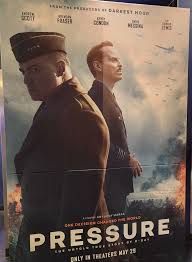
  • PRESSURE
  • Starring:  Brendan Fraser, Andrew Scott and Kerry Condon
  • Directed by:  Anthony Maras
  • Rated:  R
  • Running time:  1 hr 40 mins
  • Focus Features


Our score:  4 out of 5


Most people get mad if a weather forecast is wrong before a cookout or a football game.


It’s another matter if a storm could crush civilization.


That’s what almost happened on June 3, 1944, and as a result two hours of people arguing about weather makes for remarkably good cinema in Anthony Maras’ new offering Pressure.

His previous movie Hotel Mumbai, which is readily available on Netflix, expertly recalled the 2008 terror attack on India’s financial capital and made both the victims and the perpetrators seem remarkably human.


He achieves a similar feat with a similarly iconic historical event. The date might seem familiar, but the Maras and co-screenwriter David Haig (who also authored the play) reveal why a force of primarily British and American troops almost chose that day to invade Normandy.


As of this writing it is still the largest assault of its kind in the history of the world, but Haig and Maras almost make us forget it succeeded.


As the movie opens, we find out a test run ended with fatalities. The Allies led by Gen. Sir. Bernard L. Montgomery (Damian Lewis) and Gen. Dwight D Eisenhower (Brendan Fraser) have spent months assembling hundred of thousands of troops and creating clever diversions so that the invasion will have as few casualties as possible.


Even with all the preparations, getting all the people and equipment to the other side of English Channel offers a host of challenges.


One of them is Mother Nature.


If the wind and the sea refuse to cooperate, the troops will perish before boats and planes reach the French coast.


To ensure success, Eisenhower relies on both his usual meteorologist Col. Irving Krick (Chris Messina) and Capt. James Stagg (Andrew Scott, Ripley), a gruff Scotsman Winston Churchill has recommended.


The two scientists instantly clash. Krick has had a lucky streak in the Sahara, but Stagg knows Europe and current forecasting technology far better. Krick has apparently no idea how mercurial the north seas can be and relies too much on old maps. Unfortunately, his cheery disposition ingratiates him to the generals when they might be wiser to listen to the gloomy Stagg.


Fortunately, Scott manages to make Stagg more than a dour voice of reason. As the film progresses, we learn that he has more on his mind that simply ensuring the wind and the rain don’t stop the mission.


Scott ably conveys Stagg’s struggle to negotiate the hard facts of science with soft skills he has to learn if he wants to save lives. He often looks as if he hasn’t slept in days.


Similarly, Fraser carries a tone of authority and a sense that he has to listen to both advisors even if they are getting on his nerves. His boyish features seem a little distracting at first, but once he starts issuing orders it’s easy to believe he could lead a massive amphibious invasion. He also consistently makes the general seem like a commander instead of a face on currency.

As with Hotel Mumbai, Maras keeps the pace taut and prevents the familiar events from feeling etched in stone. Considering what Eisenhower and his troops did on D-Day, an indifferent, stilted film would be a disservice.


On a scale of zero to five, Pressure receives ★★

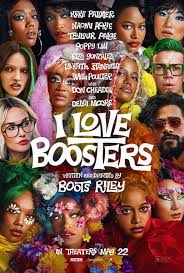
Film Review: “I Love Boosters”


  • I LOVE BOOSTERS
  • Starring:   Keke Palmer, Demi Moore, Taylor Paige, Naomi Ackie
  • Directed by:  Boots Riley
  • Rated:  R
  • Running time:  1 hr 53 mins
  • NEON


Our score:  4 out of 5


Imagine if The Devil Wears Prada had more on its mind than simply getting the latest issue of a fashion magazine out the door.


Actually, that’s only part of what writer-director Boots Riley has to offer with his consistently surprising and gutsy second movie I Love Boosters.


Riley makes no secret of his communist sympathies, but his case is persuasive, and his  presentation imaginative and often side splittingly funny. For those who haven’t kept up on their lingo, “boosters” shoplift clothes from high end retailers and sell them at steeply discounted rates elsewhere.


In Oakland, Corvette (Keke Palmer) leads a team of boosters called the Velvet Gang who specialize in hitting a chain of boutiques called Metro Designers, owned by Christie Smith (Demi Moore). Christie has long been a major designer as well as a corporate heavyweight.


Between heists Corvette has even entered contests that Christie has sponsored in order to design clothes instead of swipe them.


While coveting the possessions of others is certainly not right, Corvette and her pals Mariah (Taylor Paige) and Sade (Naomi Ackie) are selling merch that has a ridiculously high markup already. Their situation is also precarious because their home is an abandoned fried chicken restaurant.


Their popup sales allow their equally cash strapped friends to have decent clothes that aren’t available otherwise. As Corvette discovers, her original designs are now Metro Designer shelves, anyway. Apparently, Christie has decided to engage in a little larceny of her own.

At this point, the Velvet Gang decide to elevate their operation. They take gigs inside the stores, where the working conditions are absurdly draconian. The clerks have to wear Christie’s designs, and the costs come right out of their own paychecks.


Considering the cost of rent in Oakland, it’s no wonder that Violeta (Eliza González) is secretly organizing a union.


Conditions are also unbearable in China, where the clothes are made. A blasting process gives the workers asthma and cancer, so Jianhu (Poppy Hiu) and her cousin Li Pan (Alan Z) are sabotaging the company in their own way.


Riley combines all of these threads in an energetic and whimsical way, but developments that seem unrelated fall together nicely make far more sense on a second viewing.


Riley incorporates contemporary labor and economic issues, but he also tosses in a little science fiction and absurdist humor to make obvious but persuasive points. Many of the heists involve physical comedy and warped sets that recall M.C. Escher designs.


The warped angles that looked mesmerizing in books of his illustrations seem amusingly awkward when people try to walk in them. Luxury vistas don’t seem so glamorous if you can’t get from one side of the room to the other.


Riley uses old school techniques to make those images possible. There’s something charming about the use of stop-motion animation and miniatures instead of AI to pull off these illusions. For a story about people being denied their humanity, high-tech visual walls would’ve undermined the thesis. With its bright, gaudy colors, I Love Boosters proves that subtlety isn’t always a virtue.


Riley used to be part of the hip-hop combo The Coup, and his eclectic taste in music helps drive the film. The score by Tune-Yard sounds like a polka, but fits the physical humor perfectly. Similarly he fits The MC5 seamlessly with a chase scene and features some solid vocal tunes by Palmer.


Palmer carries the film easily, and Moore is terrific as a tycoon whose fortune is based on appropriation and slick talk. González is a riot as a chain vaping malcontent who says little until she’s aware it’s safe to reveal she’s the smartest person in the film.


More than a few people online have questioned Riley for making a movie that glorifies thieves. I would argue that he should be praised for delivering a film that delivers viewers far more entertainment and insight than the ticket price.


On a scale of zero to five, I Love Boosters receives  ★★★★

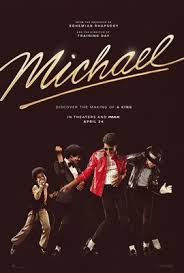
Film Review: “Michael” 2026 REVIEW #2 (Dan)


  • MICHAEL  (2026)
  • Starring:  Jafar Jackson, Nia Long and Colman Domingo
  • Directed by:  Antoine Fuqua
  • Rated:”  PG 13
  • Running time:  2 hrs 15 mins
  • Lionsgate/Universal

Our score:  2.5 out of 5


I don’t envy Jaafar Jackson.


His dad is Jermaine Jackson, and he looks and sounds uncannily like his uncle Michael. He can replicate the King of Pop’s dance moves, but the movie where he plays Wacko Jacko constantly feels like listening to an indifferent cover band playing his hits.


Screenwriter John Logan, who gave us Martin Scorsese’s The Aviator, struggles to tell viewers something they don’t already know about Michael Jackson. That’s almost impossible because so much of his Jackson’s was in front of cameras and microphones. As a result, Michael plays more like a PowerPoint presentation than an actual movie.


It’s not exactly a secret that his early success with the Jackson 5 denied him a childhood and friendships with others his age or that his father Joseph (Colman Domingo) was an abusive stage parent who could have given the Beach Boys’ Murray Wilson a run for his money.


Domingo is grossly overqualified to play such an overbearing heel, but the script never asks him to do anything else. Considering the nuanced performance he gave as civil rights pioneer Bayard Rustin, it’s shame to waste his skills on such a monotonously beligerernt role.


After all, you don’t have to work too hard to make a child beater unlikable.


Similarly, other essential figures in Jackson’s like merely appear. Nia Long doesn’t make much of an impression as his mother, other than providing the emotional support Joseph doesn’t. Motown patriarch Berry Gordy, who brought the Jacksons’ music to the world, and producer Quincy Jones who helped shape Jackson’s distinctive groove are reduced to walk ons.


Mike Myers plays CBS Records honcho Walter Yetnikoff the same way he played the record company flack in Bohemian Rhapsody, but he seems to be the one person enjoying himself in this enterprise. Yetnikoff was instrumental in ending MTV’s ridiculous exclusion of black artists, so this brief scene brings some welcome levity and purpose.


Director Antoine Fuquoa has made countless music videos but recreating the magic of Michael Jackon’s output is a lost cause. CBS Records spared no expense on what they shelled out for the clips that promoted “Thriller,” “Beat It” and other hits. His videos were events, so that MTV even announced when “Thriller” would be broadcast.


Director John Sayles who made music videos once lamented that many simply said that point of them was to show that if one became a rock star one could see lots of models in their underwear. Jackson’s videos were far slicker and more sophisticated. The budgets on the Bruce Springsteen videos Sayles shot were bigger than the ones for some of the movies he made.


Fuquoa doesn’t appear to have access to the excess that Micheal and Yetnikoff could summon so easily in the 1980s. The musical numbers here lack the energy and the gravity defying wonder of Jackson’s peak. If you wonder why people cared about this guy who spoke with such a high-pitched voice, go to YouTube and watch the videos for his hits. Seeing him dominate the camera while other performers were simply standing and strumming will be a treat.


Frankly, if you want to learn why his music, his stage act and his videos were so revolutionary, check out Spike Lee’s Bad 25, which expertly dissects the album and shows how he pieced it together through multiple overdubs and a careful ear for detail. Hearing characters in Michael casually discuss tunes that would be classics shortchanges them and the process it took to make them special.


At 2 hours and 15 minutes, Michael manages to feel both rushed and bloated. It’s light on the euphoria of his triumphs and misses the moments that made his human. There’s no discussion of his faith as a Jehovah’s Witness or the charges of child molestation. I can see wanting to celebrate the art not the terrible things he might have done, but much of the content of Michael is downright dull and about as imaginative as a conversation with ChatGPT.


Michael’s fight for control of his music has been copied and pasted from previous biopics (A Complete Unknown, etc) and lacks any real tension. Even if you’ve never heard a note of his music, you already know what’s going to happen.


In the end, no matter how valiantly Jaafar Jackson performs, the film that surrounds him feels more like a tomb than a tribute to his late uncle. There is little to justify leaving home for replicas of videos that will look better on your TV.


On a scale of zero to five, “Michael” receives ★★ ½

Theater Review: “Hamilton” (Kansas City)


  • HAMILTON
  • Music Hall
  • Kansas City, Missouri


Alexander Hamilton may have died in 1804, but his story seems more relevant than ever.

The current touring production of Lin-Manuel Miranda’s musical Hamilton playing at Kansas City’s Music Hall on February 19 shows the questions that the founding father wrestled with still challenge this country and provide the inspiration for an infectious hip hop beat.

Miranda’s play and music, inspired by Ron Chernow’s biography, follows Hamilton’s life from his teenage years, where he wrote his first essays advocating the American Revolution, through his tenure as an artillery officer in George Washington’s Army, to his  voluminous contributions to the Federalist Papers, which advocated for the new Constitution.

Miranda tells the founder’s tale from the point of view of Aaron Burr, the one-time Vice President who wound up killing Hamilton in a duel.

Sorry, it’s not a spoiler; it’s just history.

Their paths frequently cross, but Burr (Jimmy “JJ” Jeter) doesn’t get the Caribbean immigrant’s idealism and ambition.

Hamilton (Tyler Fauntleroy) does love his wife Eliza (Lauren Mariasoosay), but his eagerness to help a woman with a husband she says is abusive. His son Philip (Nathan Haydel) has a knack for getting himself into disputes like his dad does but may not be be dealing with the weighty matters that drove the older Hamilton.

While President George Washington (A.D. Weaver) trusts Hamilton completely as his Secretary of the Treasury, other founders like Thomas Jefferson (Christian Magby) don’t get his policies or him.

Having seen the original Broadway cast in the Disney+ presentation, I’m happy to report the current touring production fills their formidable shoes.  Weaver’s resonant baritone is perfect for this country’s first Commander in Chief. Similarly, Jeter is just charming enough to make viewers tolerate Burr’s duplicity.

While the Disney+ comes close to capturing the exhilaration the stage experience, it’s not the same as being, in the words of the play, “in the room where it happened.” It’s a delight to boo the oblivious King George III of England (Matt Bittner), who can’t quite quite grasp why the former colonials would rather rule themselves.

The rotating stage features elaborate choreography that doesn’t quite fit on a TV screen. Having seen the previous TV production, I was able to follow Miranda’s lyrics more closely and appreciate his dense, rapid-fire wordplay that would make Stephen Sondheim proud. Combined with the hip-hop accompaniment, debates about this country’s economic origins sound lively and engaging.

How much power the federal government still puzzles us, so it’s good that Miranda and the current production remind us that the question may never go away. The Constitution that Hamilton helped support would not allow him to run for President, but this country would not be what it is without his input. Immigrants may indeed get the job done, but can they truly be welcome? The question is currently being answered in our streets.

That may be why the play still draws viewers. After all, what is more American than a hip-hop musical that makes our founders and their ideas more than simply names and dates in a textbook?

Film Review: “Marty Supreme” (Review #2)


  • MARTY SUPREME
  • Starring: Timothée Chalamet, Gwyneth Paltrow and Odessa Azion)
  • Rated: R
  • Running Time: 149 minutes
  • A24        

Our score:  4.5 out of 5 

Like Benjamin “Bugsy” Siegel before him, Marty Mauser (Timothée Chalamet) has a single-minded confidence in his goal. The former knew for certain that the Las Vegas strip would eventually become an unstoppable geyser of cash. Marty believes his skills with a table tennis racket will lead him to riches and recognition.


While Siegel, despite a few setbacks that cost the gangster his life, was right about the future of Sin City, Marty’s less outwardly rewarding quest is consistently entertaining and occasionally poignant.


Like his protagonist, co-writer-director Josh Safdie takes some odd risks. Two of his leads aren’t full time actors, his story takes odd turns and its post-World War II setting seems an odd place to hear 80s bands like Tears for Fears. Thankfully for viewers, Safdie and screenwriter Ronald Bronstein appear to have consistently better judgement than their 23-year-old protagonist.


Marty is a day from being promoted as his uncle’s shoe store and isn’t lying when he says he can sell footware to amputees. He’s also gifted at frustrating Ping-Pong players across the world.


It’s easy to see why Marty might want to take long lunch breaks and neglect the gig that’s actually bringing in cash. His mother is ailing from a variety of non-existent illnesses, and his uncle has a habit of reneging on promised payments. Journalists are also indifferent to assistant managers at shoe stores and grub up his jaw-droppingly arrogant remarks. He boasts that as a Jew, his skills with a paddle are Hitler’s worst nightmare.


Survivors of the Holocaust might not find his attempts at wit successful.


He’s also assuming there’s a demand for the glory of table tennis that might not exist in the real world. He’s even gotten his friend Dion (Luke Manley) to produce a series of custom orange Ping-Pong balls proclaiming “Marty Supreme” on the outside. He tells anyone willing to listen that his face will be on the cover of a Wheaties box momentarily.


Now, if only he can get the money for his flight to the tournament in London.


Back in New York, he’s been romantically involved with Rachel (Odessa A’zion), who just happens to be married to someone else (Emory Cohen), and he runs cons on the side with cab driver named Wally (Tyler the Creator). His family offer him no support and are even enlisting the local cops to stunt Marty’s dreams. Marty also makes the mistake of tangling with a dog loving gangster (moonlighting director Abel Ferrara).


If Marty’s life weren’t already complicated enough, he flirts with a movie star (Gwyneth Paltrow) despite how his arrogance can make him off putting at times. Her husband Milton Rockwell (“Shark Tank” judge Kevin O’Leary) dislikes the cocky fellow but wants to use potential popularity to sell his company’s merchandise in Japan. He’ll pay Marty a king’s ransom if he’ll play against the Land of the Rising Sun’s fearsome champion (Koto Kawaguchi) and throw the match.

Safdie and Bronstein are loosely adapting the life of real life table tennis champ Marty Reisman, but their own tale is consistently engaging because Marty’s wish for something more than a mundane existence is relatable. The two also populate the film with dozens of great supporting characters and surprising twists that have greater weight than simply winning matches.


Chalamet has a gift for playing characters who can do despicable things while keeping an audience’s attention. A lesser performer might make viewers tire of Marty’s broken promises. As I mentioned earlier, the mob got tired of waiting for Siegel’s assurances about Vegas to materialize. Chalamet also has the right physique and looks at home behind a paddle.


As with “Uncut Gems,” which Safdie co-directed with his brother Benny, “Marty Supreme” benefits from a frantic pace that makes it’s two-and-a-half hour running time breeze by. He stages the matches well and handles some sharp changes in tone effortlessly. The movie goes from silly absurdity to moments of danger effortlessly.


It probably helps that Safdie has cast two antagonists who aren’t known actors, but who can play their roles better than most professional thespians. Kevin O’Leary is so appropriately cold and contemptuous that one might see why his wife might be tempted to stray with a naïve braggart like Marty, and it’s easy to believe he clawed his way to a fortune. Similarly, Ferrara projects a dangerous aura that his affection toward a dog can’t dissipate.


The real Marty Reisman had a long career, and Safdie ends his own tale while his athlete is still young. Perhaps he knew well enough wrap things up while the game was going well.


On a scale of zero to five, “Marty Supreme” receives ★★½    


Film Review: “Caught Stealing” REVIEW # 3

  • CAUGHT STEALING
  • Starring:  Austin Butler, Regina King and Zoe Kravitz
  • Directed by:  Darren Aronofsky
  • Rated:  R
  • Running time:  1 hr 47 mins
  • SONY/Columbia Pictures

Our score: 2 out of 5


If there is one thing that the pandemic and the advent of streaming have not changed about the entertainment industry, it’s that any movie entering the marketplace around Labor Day is going to be lacking.


If Sony suspected that this offering from auteur director Darren Aronofsky (Requiem for a Dream, The Wrestler) with an A-list cast had awards potential, they’d probably have released it in the summer or later in the fall.


They know this won’t be much competition to a holiday cookout or the more focused movies coming down the pipeline.

The script by Charlie Huston, working from his novel, features a menagerie of colorful New York lowlifes who torment a lowly bartender named Hank Thompson (Austin Butler) simply because a Mohawk-sporting Cockney named Russ (Matt Smith) has left the Big Apple for his hometown of London without informing anyone else.


Because Russ is out of town, his business partners in illicit trades want a return on their investments. Because Hank is around but Russ isn’t, a pair of sadistic Russian leg breakers (Nikita Kukushkin, Yuri Kololnikov) pummel Hank inches from death even though he has no idea how Russ affords to feed his violent cat or get his gets his well-maintained punk hairdos.


Hank’s smarter paramedic girlfriend Yvonne (Zoë Zravitz) picks him up at the hospital and suggests that he call the cops. The detective who arrives on the scene (Regina King) loves making wisecracks but does little more than warn Hank he’s inadvertently crossed two Hassidic brothers (Liev Schriber, Vincent D’Onofrio) so devout they won’t drive on Shabbos but will deal in chemical recreation and lethal force.


While Huston compiles a formidable body count from his ensemble cast and gives them lots of excentric and sometimes off-putting things to do, Aronofsky’s tone varies from gritty to eye-rollingly silly. When the actors seem to be playing a scene for laughs, Aronofsky dishes out some gore that might make David Cronenberg blush.


In Elvis and The Bikeriders, Butler has proven himself to be a formidable leading man, but here Huston and Aronofsky haven’t given him much of a role. For much of the film, he seems like a hapless bystander who inadvertently invites the fatalities that accumulate in his path.


With the possible exception of Schriber and D’Onofrio’s sibling drug mongers, who manage to be both funny and threatening, most of the oddballs in Caught Stealing aren’t engaging enough to make viewers wonder if they’ll make it to the end. Griffin Dunne as an aging hippie poet and Carol Kane Scriber and D’Onofrio’s matriarch are sadly underutilized. Aronofsky’s frantic pacing may be a disservice to his performers because it reduces their chance to shine.


The central McGuffin isn’t that well-conceived, and Hank’s eagerness for never making it into Major League Baseball can only carry the film so far.


Because this is Labor Day, we can take comfort that all involved will be working on something better soon. It’s a shame they wasted their talents on such an unworthy grift.


On a scale of zero to five, I give “Caught Stealing”   


Film Review: “Ballerina”


  • BALLERINA
  • Starring:  Ana de Armas, Keanu Reeves and Ian McShane
  • Directed by:  Len Wiseman
  • Rated:  R
  • Running time:  2 hrs 4 mins
  • Lionsgate


Our score:  3 out of 5


When I interviewed ballerina Moira Shearer who starred in “The Red Shoes,” she happily informed me, “Dancers and boxers lace their boots the same way.”


As the analogy indicates, deadly force can come in seemingly dainty packages.


That may explain why “From the World of John Wick: Ballerina” usually works. Ana de Armas proved she had what it took to be an action hero in “No Time to Die.” In her brief turn, her awkward demeanor belied formidable speed and agility. Her precision dagger was a nice complement of James Bond’s blunt instrumentation.


This time around she plays Eve, a young woman struggling to deal with being orphaned after trained killers murdered her dad. Winston (Ian McShane), who acts like a referee in the universe that Eve and John Wick (Keanu Reeves) inhabit, puts her in the care of the Director (Anjelica Huston).


Eve now has a unique regimen. Most of us don’t have to train for the rigors of both ballet, which can decimate a dancer’s feet, and for martial arts and target practice. Because she’s as sturdy as she is agile, it’s no surprise she spends less time on stage than she does guarding clients or selectively ending lives.


After a few successful missions, she discovers that the people who killed her father are still around. The Director has had a long truce with the rival troupe of killers and their leader The Chancellor (an appropriately chilly Gabriel Byrne).


Eve couldn’t care less about those arrangements. She wants revenge and is willing to charge into a village populated entirely with seasoned assassins.


If anyone could survive such a seeming act of folly, she would be the one. Her bravado is accompanied by the sort of creativity that comes from an education in the arts. This enables her to neutralize larger, stronger opponents.


Watching de Armas leap, kick and shoot is expectedly exhilarating. Screenwriter Shay Hatten, who wrote the last two John Wick films, comes up with a delightfully goofy solutions when Eve runs out of ammo.


Director Len Wiseman (“Underworld”) stages the mayhem with appropriate finesse, but he deviates little from the template that Chad Stahelsski established in the first two movies. “Ballerina” might have been more fun if it gave Eve a stamp of her own. The pneumatic tubes that send death warrants across the oceans in seconds are here, but it the idea of blending classical dance and combat is only partially realized.


Reeves, who produced, returns as Wick. He seems committed, but the script incorporates Wick as an afterthought. Reeves and de Armas share little screen time and don’t get a chance to play off each other much. It would have been more fun if their contrasting styles could have been clearly delineated.


De Armas at least shows that her lean shoulders can carry a shoot-em-up with confidence. Here’s hoping her next turn behind a gun is as nimble as she is.


On a scale of zero to five, “Ballerina” receives

Film Review: “Mission: Impossible – The Final Rekoning (Review #2)


  • MISSION: IMPOSSIBLE – THE FINAL RECKONING
  • Starring:  Tom Cruise, Hayley Atwell and Simon Pegg
  • Directed by:  Christopher McQuarrie
  • Rated:  PG 13
  • Running time:  2 hrs 49 mins
  • Paramount


Our score:  3 out of 5


It’s probably good that “Mission: Impossible—The Final Reckoning” acknowledges its predecessors. Co-writer and director Christopher McQuarrie loads the latest and reportedly final installment of the series with links to the previous films.


Nonetheless, it’s a lot to ask viewers to spend three hours following Ethan Hunt (Tom Cruise) and the Impossible Mission Force team resting on their laurels.


There are still some jaw dropping stunts, but the follow-up to “Mission: Impossible—Dead Reckoning Part One” has action scenes that play like outtakes or rough drafts of the scenes that worked in the previous movies. There are only so many times Cruise can hang from plane or other fast-moving vehicle.


Despite all the death defying moments in “Dead Reckoning,” a seemingly all-powerful artificial intelligence known as The Entity is still threatening humanity despite Ethan Hunt and company surviving time bombs and dangling train compartments. The Entity is worming its way into the nuclear arsenals of countries all over the world and doesn’t have qualms about destroying its flesh and blood creators.


It has even rejected its most fanatical disciple, Gabriel (Esai Morales), who now wants to use his insider knowledge to possibly control it. If he eventually takes over The Entity, the situation could potentially be worse than a nuclear wasteland.


The task is obviously bigger than Ethan himself can handle, so Benji Dunn (Simon Pegg), Paris (Pom Klementieff), Grace (Hayley Atwell) and Luther Stickwell (Ving Rhames) have to scramble behind the scenes while Ethan dashes, leaps, swims and hangs for dear life to prevent either enemy from gaining the upper hand.


With “Dead Reckoning,” McQuarrie was probably correct when he concluded that audiences would prefer watching Tom Cruise push his body (and his stunt doubles) to the limit than to figuring out the intricacies of artificial intelligence. He created just enough fresh obstacles for the IMF team to tackle to prevent viewers from wondering how conquering physical catastrophes can stop one that lives only online.


It took a lot of effort to fill three hours with stunts and Cruise’s trademark sprinting (in his early 60s, the actor might want to try out for the Olympics). One might feel inclined McQuarrie if he and co-writer Erik Jendresen have run out fresh ways to endanger their leading man.


In McQuarrie’s world, there seems to be a proliferation of time bombs, and the tension of seeing yet another countdown diminishes when Ethan and company discover yet another explosive with a digital fuse.


In a couple of sequences, McQuarrie cleverly switches between Ethan muscling his way past yet another impediment while Benji and company struggle to ensure that their teammate’s heroics won’t be for naught. This gives the new installment momentum it could have used when McQuarrie seems a little too content to follow the series template.


At times it seems as if McQuarrie was too eager to find ways to tie this chapter to its predecessors. The call backs are occasionally fun, but more thought seems to have gone into them than in the current tale.


Perhaps “The Final Reckoning” might have been more fun if McQuarrie and company had explored the logic behind The Entity and figured out how the IMF could potentially outsmart it. With two hackers on the squad and a thoughtful U.S. President (Angela Bassett) and the hair trigger General Sidney (Nick Offerman), one would think they’d create enough real ideas to combat their artificial foe.


McQuarrie won an Oscar for his head-twisting script for “The Usual Suspects,” so he could have taken a more cerebral approach and made a movie that still delivered thrills. Since “Jack Reacher,” he has shown a formidable eye for action scenes to go with his talent for word play. The exchanges between Bassett and Offerman demonstrate he hasn’t lost his dramatic chops, but it would have been nice if he had used them more frequently.


Watching Tom Cruise, who also produced the “M:I” series, dashing toward or from danger is usually fun, but with “The Final Reckoning,” he’s not dealing with a crisis worthy of his speed. Instead he seems be taking an unwarranted victory lap.


Overall, on a scale of zero to five, “Mission: Impossible – The FInal Reckoning” receives ★★★

Film Review: “Warfare”


  • WARFARE
  • Starring:  Will Poulter and Cosmo Jarvis
  • Directed by: Alex Garland and Ray Mendoza
  • Rated: R
  • Running time:  1 hr 35 mins
  • A24


Director Samuel Fuller helmed “The Big Red One” and “The Steel Helmet” and also served in World War II. In the press book for the former movie, he observed that “To make a real war movie would be to fire at the audience from behind the screen.”


Without putting a viewer in actual danger, Alex Garland (“Ex Machina”) and Iraq War veteran Ray Mendoza capture what a tense and frightening 95 minutes in Mendoza’s life was like.


Except for a brief moment where the troops ogle young women in a rather vigorous workout tape, “Warfare” follows them as they take over a building for surveillance. They see lots of potential attackers, but a lot of they people they’re watching are simply trying to get on with their days. As false alarms keep ringing, it’s still a shock when a real grenade explodes in their midst.


They have taken casualties, but getting back to base is challenging now that the enemy have decided to stop waiting patiently. Hostile fire is coming from unexpected directions. Getting the team out of the lethal quagmire borders on being a suicide mission.


Shot and edited in what amounts to real time, “Warfare” drops a viewer into urban combat and the horror it entails. Every shot or explosion reverberates around the auditorium. The dialogue is loaded with military jargon, and when vehicles are six minutes from the scene, you could potentially set your watch accordingly.


During these moments, “Warfare” brims with tension, but Garland and Mendoza don’t do much to orient the audience into 2004 Iraq or explain the banter. The characters and their relationships are also sketchy. We don’t know who is in charge of whom or why occupying a building that seems to be an obvious target would be such a smart move.


The cast, which includes solid performers like Will Poulter (“Detroit”), but we barely learn anything about Poulter’s Eric or his life outside the war zone. D’Pharaoh Woon-A-Tai plays a character clearly based on Mendoza himself, but we barely get to know him or how he and his unit interact.


If we knew more about they guys in the unit, it would be easier to get involved with their struggles and to care if they survive. The situation is inherently compelling, but “Warfare” misses some of its potential because it loses its energy whenever the lethal fireworks stop.


The Iraqi family inside the building are a little better drawn than in earlier films on the War on Terror and its era. Unlike, say “Blackhawk Down,” Garland and Mendoza express concern over what happens to the residents once the occupying armies are gone. “Warfare” features a coda where one of Mendoza’s former comrades in arms visits the set. It’s one of the rare moments in the movie where emotions other than fear come into play. “Warfare” succeeds at immersing viewers in Mendoza’s tour of duty, but it might have had more impact if he and Garland had come up for air more often.

Theater Review: “Parade”


  • PARADE
  • Music Hall, Kansas City, Missouri
  • February 4, 2025


People often assume that musicals simply provide audiences an escape from the misery and gloom of the world outside the theater, but Parade is an example of a play that wrestles with a thorny incident in 1913 Atlanta that still haunts our nation.


Although Parade, first hit stages in 1998, it feels curiously more urgent in the current touring revival, which played at the Muriel Kaufman on January 28, felt less like a period drama and more like a stirring account of how the issues that played America 112 years ago are still with us.


Having a sincere recorded introduction from U.S. Sen. Raphael Warnock, who now represents Georgia, makes the play seem anything but a fossil. The book by Alfred Uhry (Driving Miss Daisy) and songs by Jason Robert Brown (The Bridges of Madison County) recount the murder of a 13-year-old pencil factory worker named Mary Phagan (Olivia Goosman). One of the few people to see her on the day she was killed was a manager named Leo Frank (Max Chernin).


Frank was working when Atlanta residents were celebrating Confederate Memorial Day, and the Texas native had moved there from New York. Being a Jew also made him seem suspicious to his neighbors. 


Robert Knight and Ethan Riordan in the National Tour of PARADE, photo by Joan Marc

Parade recounts Frank’s trial and the sensational coverage news coverage that followed. While Frank was convicted, much of the evidence against him was circumstantial and seemed to be based on bad vibes and prejudice instead of hard evidence. Eventually, the governor commuted his sentence from death to life in prison, but Phagan’s murder wound up metastasizing into something far more horrific.


While happy endings aren’t going to happen in this situation, the current touring production of Parade is still consistently engrossing. It unfolds in an almost cinematic manner with dates and images of the real participants projected on the stage and lightning fast transitions between locales.


Chernin is terrific as Leo demonstrating both a stellar singing voice and an outsider persona that makes the ill-starred manager inherently sympathetic. Talia Suskauer is equally solid as Leo’s determined wife Lucille. Her quest to get Leo acquitted even after the trial gives the story a crucial momentum. 


Even though you could look up the people and events in Wikipedia, Parade moves like a rocket and is buoyed by a dark humor that never feels like a history lesson. Because this is a musical, having the yellow journalists recount the crime with copious embellishments, seems even more fulsome and grandiose. Similarly, having the questionable police investigations sung instead of spoken makes that toxic folly feel even more real. 


It’s easy to tell the tale is personal for Uhry because his great uncle owned the factory where the murder took place. The fact that he could fit a love story into the tale of a hate crime is remarkable. It’s little wonder that the 2023 revival won a Tony and that new tour is so rewarding.

Film Review: “September 5” (Review #2)


Starring: Peter Sarsgaard, John Magaro, Ben Chaplin, Leonie Benesch
Directed by: Tim Fehlbaum
Rated: R
Running Time: 1 hr 35 mins
Paramount Pictures

Our score:  4 out of 5

George Orwell once lamented, “To see what is in front of one’s nose needs a constant struggle.”

It’s even more challenging when you’re also the one deciding how the rest of the world sees.

That’s the engrossing setup behind September 5, a recounting of how the Palestinian terrorist group Black September held members of the Israeli Olympic team hostage in 1972. The incident was the basis of Kevin Macdonald’s Oscar-winning documentary One Day in September and Steven Spielberg and Tony Kushner’s gripping Munich.

Despite covering well-trodden territory, September 5 still feels fresh because it covers how ABC Sports found themselves in the middle of the crisis. Keeping on top of it proved Herculean and required the broadcasters to jerry rig technology where it hadn’t gone before. They also wrestled with ethical issues that would vex experienced hard news reporters.

At the beginning of September 5, the most newsworthy events for ABC’s audience had been the spectacular performance of American swimmer Mark Spitz. Things seem to be so settled that the head of operations, Roone Arledge (Peter Sarsgaard) thinks he can catch up on his sleep.

In his place is the relatively inexperienced Geoffrey Mason (John Magaro) and an overworked German translator Marianne Gebhardt (Leonie Benesch). The expected drudgery turns into relentless anxiety when gunshots ring out from inside the Olympic Village.

Instantly, the crew has a more urgent concern than Spitz’s next medal. Reporter Peter Jennings (Benjamin Walker) has to improvise ways to find out how to get the near the scene of the action and how to get heavy cameras and recording equipment where they were never designed to go.

Some of the tensions that worked its way from the Middle East also erupt in the control room when Jasques Lesgards (Zinedine Soualem), a Frenchman of Algerian descent, briefly clashes with ABC executive Marvin Bader (Ben Chaplin), who’s Jewish. Of course, it’s a given that both realize the story in front of their eyes is more important.

Sportscasters today make placing a distant event in your living room look easy. Much of the thrill of September 5 is that it shows how much effort goes into making something seem effortless. Bader, Arledge and Mason have to sneak 16mm film past guards (who failed to keep Black September out) so that viewers can see how pressing the situation is.

Because the heavens are littered with satellites these days, it’s shocking to learn that ABC Sports had to negotiate with other networks for access to the one satellite available in 1972. Simply staying on the air was almost impossible.

Knowing these facts helps make September 5 exciting. Tim Fehlbaum’s taut direction also helps. In a brisk 95 minutes, Fehlbaum, who wrote the Oscar-nominated script with Mortitz Binder and Alex David, never gives viewers a chance to catch their breaths.

The three acknowledge that ABC Sports completed a formidable achievement in September 5, but they also make Arledge and company completely human. When two technicians successfully figure out how to tap into the Munich police frequency, one makes the mistake of sending Gebhardt out for coffee when she’s the only person in the building who can understand what the cops are saying. Real, flawed people were working that day, and much of the vitality of the story comes wondering which mistakes they can afford to make.

One clever touch Fehlbaum ads is not casting an actor to play Olympics anchor Jim McKay. Instead the director incorporates the actual footage of McKay relaying the story as it came to him. It’s hard to imagine even the best of thespians replicating the power of McKay’s faithful announcements, and Fehlbaum and company seamlessly replicate what the people in the control booth might have been feeding him.

The movie also acknowledges that sometimes doing a good job isn’t always satisfying. Perhaps we don’t get more coverage of the kind ABC Sports provided is because tragedies like the one in September 5 affect the witnesses as well as the participants. Benesch’s turn as Gebhardt is especially moving because she and other Germans hoped the games would be a way for Germans to atone for their homicidal tyranny.

If September 5 is a fascinating look at the past, it’s also a chilly reminder of how terrorism hasn’t gone away and why we need alert and capable people to cover it.

“September 5” receives ♣♣♣♣ out of 5.  

Theater Review: “Clue – A New Comedy”

  • CLUE – A New Comedy
  • The Kauffman Center, Kansas City, Missouri
  • April 2, 2024


Last week audiences at the Kaufman Center for the Performing Arts in Kansas City learned the answer to a mystery: Could the laughs from Jonathan Lynn’s 1985 movie adaptation of the game Clue work on stage?


It didn’t take Sherlock Holmes, Jessica Marple or even Beniot Blanc to know the answer was yes. Because Lynn’s movie had a single location and was set in roughly real time, it didn’t take much effort for Sandy Rustin, Hunter Foster and Eric Prince to make the tale work in another medium.


In many ways Clue is funnier live. Watching the cast scampering from a potential killer seems sillier on stage because there isn’t far for them to run. In addition, any fisticuffs that occur during the play seem amusingly innocuous. Greg Balla’s fight choreography ensures the struggles don’t stray into the sadistic or macabre.


Lynn’s storyline and much of his dialogue remains. A group of anonymous strangers have been lured to a mansion by a series for letters. Professor Plum (Jonathan Spivey), Mr. Green (John Shartzer), Miss Scarlet (Michelle Elaine), Mrs. White (Tari Kelly), Mrs. Peacock (Joanna Glushak) and Col. Mustard (Jon Treacy Egan) are not using their real names, and there is a good reason for it. All have managed to run afoul McCarthy-ite witch hunts in 1954 and have additional issues that would be golden for a blackmailer.


Their host, the butler Wadsworth (Mark Price), reveals that they are the victims of a blackmailer named Mr. Body (Alex Syiek). He appears and informs them his demands are going to increase. When the lights in the New England mansion go out, so does the chaos that ensues receives some help from Lee Savage’s sets, which morph into different rooms with interrupting the action. As a result the story leaps floors and covers more ground.


The original movie featured a dream team of character actors (Tim Curry, Madeline Kahn), but the current touring cast is up for the task as well. Shartzer and Elaine, in particular, seem to enjoy sinking their teeth into their roles and lead viewers to hope their characters aren’t the ones who made Mr. Body live up to his name. There are no intermissions in the current production, so the play is a test of the cast’s endurance, and they handle the demand of being “on” constantly effortlessly.


For fans of the game there are dozens of little nods to how a round of it would proceed. The weapons come straight for the box that Hasbro sells.


As of this writing, the current producing is in Cleveland, and audiences there are in for a treat. Clue manages to be a frothy delight despite the fact it involves fatalities. If the game Ais afoot in your city, you won’t have to be a Hasbro stockholder to enjoy the fiendish plot unraveling.


Concert Review: Roger Waters: This is Not a Drill


Roger Waters: This is Not a Drill

T-mobile Center/Kansas City, MO

September 3, 2022


IN THE FLESH AND OUTSIDE THE WALL


Near the ceiling of the T-Mobile Center, the electronic signs warned patrons not to use offensive language and advised reporting people who engaged in that sort of discourse to management.


Thankfully, Roger Waters missed that note before hitting the stage last Saturday night. There were enough F-bombs to flatten Moscow.


Throughout his 2½ hour set, the former Pink Floyd bassist, lyricist, singer and driving force made his views on politics explicit. When some Pink Floyd fans lament the activist bent in his more recent music, it’s tempting to wonder if they had simply been using the Floyd for chemical recreation and missed Waters’ agitation in the words for “Us and Them” and the entire George Orwell-inspired album Animals.


At 78, Waters may be campaigning for the release of Wikileaks founder Julian Assange during his performances, and his set seemed like a refutation of some of the themes he and his former bandmates explored in The Wall.


This was for the best.


Waters conceived The Wall because he was disturbed by how fame and massive area shows (like the one he was giving when I saw him) had separated Pink Floyd from their audience.


Nearly 4½ decades later, Waters seemed sociable. The slender Englishman bounced around the stage. He quoted Wilbert Harrison’s “Kansas City” and made a point of thanking fans who had held onto their tickets for two years. Covid ruined a lot of plans. He even left the T-Mobile Center marching through the crowd with the band. He repeatedly acknowledged that his shows were for the fans, and they clearly returned the love.


For a guy who has written tunes about grief, alienation and even the price of nuclear war, Water came off as contagiously giddy. Even when he briefly tripped over the words to one of his newer songs, Waters’ enthusiasm buoyed the entire night.


Opening with “Comfortably Numb,” the performance of the offering from The Wall missed David Gilmour’s soaring and then ominous guitars solos. Nonetheless, it still sounded captivatingly eerie.


That song came with unsettling images of bombed out rooftops and people mindlessly waking through lines as the walked through lines mindlessly. The screens would be raised and lowered at strategic moments and supplemented the newer songs to illustrate why Waters had written pointed tunes line “The Powers That Be” and “The Bravery of Being Out of Range.” He ran a slide show of unarmed people across the world who had died in police shootings. The list seemed even more urgent that night because it included Donnie Sanders, who had died here in Kansas City.


The screens also enabled Waters to add backstory to songs he was performing from Wish You Were Here. Waters still mourns original Pink Floyd leader Syd Barrett and slides of the band’s early lineup made the tunes even more poignant. Seamus Blake’s passionate sax solos on those tunes and on “Money” and “Us and Them” certainly helped. The rest of the band delivered a solid, tightly rehearsed set. Apart from “Comfortably Numb,” they followed Gilmour, Nick Mason and Richard Wright’s original playing on the Floyd songs.


The dancing animated pigs on “Money” made of up for any lack of spontaneity.


In addition, longtime fans were rewarded with the expected lasers, giant inflatable pigs and sheep and theatrics that recalled Alan Parker’s movie of The Wall.


When Waters broke into songs from Amused to Death or Is This the Life We Really Want, the crowd lost none of its enthusiasm. It probably helped that the enormous screens displayed a disclaimer letting anyone who objected to his takes on indigenous rights or police shootings to “f**k off to the bar.”


It’s a nod to his newer song “The Bar,” which deals with being able to freely discuss difficult topics. Waters clearly knows how to entertain (who doesn’t love giant, floating pigs?), and much of his outrage is sadly warranted. His songs may have launched a thousand bong hits, but if Bob Dylan, whom he cited in his show, can write “Blowin’ in the Wind,” Waters can warn us about the urgency of addressing nuclear war.


I attended the show as a guest of Kansas City Veterans for Peace, Chapter 97. I’m merely a former military contractor (a cubicle jockey) who doesn’t want troops being put into peril for a fool’s errand, and nuclear conflict certainly qualifies. Waters correctly cited Kansas’ Dwight D. Eisenhower, who repeatedly expressed many of the same concerns.


That said, I’d like to have a beer with him at a bar sometime. I’m not sure how we’d get along, or if alcohol would be conducive to the topics at hand. I have quibbles about Mr. Assange, but challenging subjects don’t get the attention they need when people simply shut up and sing.

Kansas City Theater Review: “Anastasia”


  • ANASTASIA
  • Starlight Theater – Kansas City, Missouri
  • August 11, 2022


Ever since I was a teenager, I’ve been obsessed with the fall of the Romanov dynasty in Russia. Whenever I see works for fiction and literature ignoring the facts, I simply assume it’s a day and go back to the books I have on my shelf like Edvard Radzinsky’s The Last Tsar: The Life and Death of Nicholas II.


It’s doubtful that anyone who watched the Starlight Theater’s current production of Anastasia expected a history less. Thankfully, the touring play consistently delivers eye candy worthy of a Faberge egg.


The musical from writer Terrence McNsally, composer Stephen Flaherty and lyricist Lynn Ahrens (the trio behind Ragtime) draws its inspiration from 1997 cartoon, so the visual pizazz is to be expected. Thanks to a series of backdrops and projection, the play can change location and time as easily as movies can.


The history be damned tale starts in 1917 St. Petersburg, just before the Russian Revolution and quickly moves ahead a decade where the renamed city Leningrad is abuzz because the heir to the Russian throne , the Grand Duchess Anastasia might still be alive.


The play never answers how she survived when the rest of her family perished, but the ambitious Deputy Commissioner Gleb (Ben Edquist) sees her as a threat to the fragile order of the new Soviet Union. Meanwhile, two struggling con artists Dmitry (Sam McLellan) and Vlad (Bryan Seastrom) think they can convince the still-grieving Dowager Empress (Gerri Weagraff) that just about any woman living in the streets of Leningrad could pass as her missing granddaughter.


The search for the proper imposter proves more difficult than anticipated even though Vlad himself has spent decades posing as an aristocrat. Their most promising candidate is a street sweeper named Anya ((Kyla Stone), who takes to Vlad’s instruction with astonishing ease. Ironically, the ruse may be easier for her because she’s an amnesiac, so the invented history might actually be true.


Because she projects the right blend of innocence and latent sophistication, Stone effortlessly anchors this current touring production. Her clear, confident singing voice certainly doesn’t hurt.


The late McNally has retooled the storyline of the animated movie in a manner that is both more logical and entertaining. The less said about the cartoon’s version of Rasputin, the better. Gleb makes a lot more sense as an antagonist and Edquist has just enough charm to make viewers tolerate how slimy and single-mined he can be.


The romance between Anya and Dmitry feels as if it were copied and pasted from another musical. It’s more fun to watch the wily Vlad woo a countess (Madeline Raube) than it is to watch the leads discover each other.


The weather on Tuesday night was pleasant, but occasionally motorcycles reminded me why the outdoors and musicals may not be the best of combinations.


At the same time it was rewarding to see the play in the Swope Park surroundings where the scenery could compete with the images on stage.