

Film Review “Keanu”

Starring: Keegan-Michael Key, Jordan Peele and Tiffany Haddish
Directed by: Peter Atencio
Rated: R
Running time: 1 hr 38 mins
New Line Cinema

Our Score: 4 out of 5 stars

Abbott and Costello. Laurel and Hardy. Martin and Lewis. Cheech and Chong. Just four of some of the most popular comedy teams that went on to success on the big screen. Time to add a new team to the list: Keegan-Michael Key and Jordan Peele, who take over your local multiplex this weekend in the new film “Keanu.”

Rell Williams (Peele) is feeling down. His woman has just left him and he’s hit rock bottom. At least until he finds a cute little kitten outside his door. Taking him in and giving him milk, he names the cat Keanu, which he believes means “cool breeze.” Artistic at heart, he begins taking photos of the cat recreating various movie scenes for a calendar. This strikes his friend Clarence Goobril (Key) just a little bit odd. When Rell’s house is broken into by drug dealers, who mistake it for his pot-selling neighbors’ home, Keanu turns up missing. Obsessed with finding his new friend, Rell convinces Clarence to pose as rival drug dealers in an attempt to retrieve their feline friend.

I’ve been a huge fan of Key and Peele from the time I caught their skit, “I Said Bitch” on Comedy Central. Like their popular show, the jokes in the film fly fast and furious, as the two take on the persona of the “Allentown brothers,” a pair well known for their bloody battles with rivals, in order to do business with the “Blips,” the gang that defeated both the Bloods and the Crips! Rell also meets a lady member of the Blips, the tough but tender Hi-C (Haddish). As Rell and Clarence go deeper to find Keanu, the action picks up to a tornadic level.

Teaming with their former television show’s director, and relying on a script co-written by Peele, the two leads are comfortable on the big screen. Each has their own individual moments to shine, but it’s when they are together that they work best. Whether they’re staring down a rival gang leader or instructing others on the impact of the music of George Michael, Key and Peele are a welcome addition to the big screen. If you aren’t familiar with their work, I urge you to head to YouTube. If you are, I urge you to head to the theatre. You won’t be disappointed.

Make sure to check out our interview with Keegan-Michael Key
 

Related Content

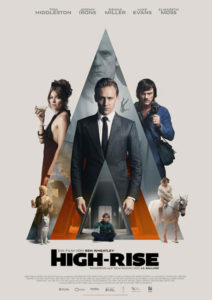
TFF Film Review: “High-Rise”

Starring: Tom Hiddleston, Jeremy Irons, Sienna Miller, Luke Evans, Elisabeth Moss
Directed By: Ben Wheatley
Rated: R
Running Time: 119 minutes
Magnet

Our Score: 4 out of 5 Stars

Late in the chaos that engulfs Ben Wheatley’s new film High-Rise, Dr. Robert Laing (Tom Hiddleston) welcomes a woman into his paint splattered flat exclaiming “I think I finally found the right tone!” Against all odds, he may as well be describing the film itself. An adaptation of JG Ballard’s 1975 novel that was long thought unfilmable (producer Jeremy Thomas tried 30 years ago), Wheatley and Co. have managed to create a wonderfully anarchic microcosm of a society breaking down as it builds upwards. If the social commentary–the hazards of worshiping material wealth, the “1%” literally living it up on the top floors–is simplistic, Wheatley’s production team offers it up in the most absurdly beautiful ways. From the brutalist production design to a stunning score by Clint Mansell (Requiem for a Dream), High-Rise is a darkly humorous, sexy, and oftentimes grotesque cinematic experience.

The film opens with a bearded, bedraggled Laing foraging for supplies in the corpse-strewn detritus of his high-rise apartment building. “For all its inconveniences,” a civilized sounding Hiddleston narrates, “Laing was satisfied with life in the high-rise.” Laing then rotisserie roasts a dog for supper. As one does. From here we go back to simpler times three months ago, when Laing was just moving into the shiny new development. At floor 25 out of 40, the good doctor quickly learns the strict class divide of the upper and lower residents between which he sits–or, nude sunbathes actually–nearly smack in the middle. Laing is welcomed into the upper echelons by Charlotte Melville (Miller) as she dallies with lower-leveled married man Richard Wilder (Evans). Laing’s even invited to the penthouse occupied by mysterious architect Royal (Jeremy Irons, regal in all white). Royal views what he has wrought, one tower in a series of five, as a “crucible for change” while brain surgeon Laing pleases Royal when he describes it more as a “diagram of an unconscious psychic event.” Royal is so impressed with Laing he attempts to invite him to a decadent fancy dress party thrown by his wife. Laing is roundly rejected by Royal’s peers and experiences the first of many power outages from within an elevator he’s been unceremoniously shoved into. The honeymoon is over.

These early sequences of life in the High-Rise had me enthralled. Laing’s exploration of the tower is paired perfectly with Clint Mansell’s driving orchestra music, which manages to capture the entrepreneurial spirit of the shiny all inclusive tower while suggesting the underlying tensions of the residents pulsing through the structure. One tiny inconvenience is enough to upset this flow and set everyone off into rage. To top it off, everyone is impeccably tailored. Meanwhile, from his place in the middle, Laing is able to interact with all levels of residents who can’t seem to grasp which ‘slot’ he is meant to fill.

Hiddleston’s Laing is a hard one to pin down and makes for a fascinating entry into the film’s madness. He initially tells Charlotte he doesn’t think he can change (he’s speaking of getting into a swimsuit but the line, like so many in Amy Jump’s script, is delivered with more weight than that) and for a while that’s true. Laing seems a neutral character, claiming he desires a blank slate in the wake of his sister’s death. When confronted with quarreling residents, he seeks to pacify the tensions between lower floor residents, the maintenance man and the architect who has accepted him. But the longer he’s in the building the more Laing’s crueler tendencies come to light. Mouthing off at a child, casually implying a deathly prognosis to a social rival–Laing’s mean streak is comparatively subtle in the shadow of Evans’s aptly named Wilder but Hiddleston is quietly menacing throughout. And his desperate need to keep his dress shirt and tie on is a nice touch.

As the tower devolves into darkness, murder and crammed garbage shoots, your enjoyment of the latter half of the film may depend upon whether you buy into the notion that the residents do not run screaming to the authorities. After all there is an outside world to this tower, this isn’t Snowpiercer. However Wheatley crams enough absurdist humor into these late stages that I, like the looney residents drolly contemplating lobotomizing their rivals, surrendered to a logic more powerful than reason. Or just damn stylish film making.

This film received its New York premiere at last week’s Tribeca Film Fest and is available to rent now onDemand, Amazon and iTunes–though for the best experience, hold out for its theatrical release May 13th!  

Film Review “Papa: Hemingway in Cuba”

Starring: Giovanni Ribisi, Joely Richardson and Adrian Sparks
Directed By: Bob Yari
Rated: R
Running Time: 109 minutes
Yari Film Group

Our Score: 2.5 out of 5 Stars

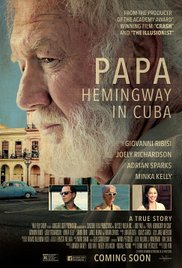
Having to write about Ernest Hemingway is a daunting task, but having to write about “Papa: Hemingway in Cuba” is fairly simple task considering how humdrum it is about its biographical choice. So I’m lucky in the sense that I’m going to be telling you about the latter. I’m not lucky in having to admit I’ve never ready anything by Ernest Hemingway or know that much about the Pulitzer Prize winning author, so I can’t refute anything in this movie or speak about Hemingway with any familiarity.

Ed Myers (Ribisi) is a Boston Globe reporter that became infatuated with writing after reading Ernest Hemingway’s (Sparks) works. He’s too timid to write Hemingway a letter, but a co-worker, behind his back, sends off a letter he’s been mulling over for years. Much to Myers’ surprise, Hemingway responds and gladly picks him up in his own boat off the coast of Florida. From there they head off to Cuba to enjoy drinks, laughs and musings.

The movie follows Myers and Hemingway’s relationship over the course of 1959. The problem that arises from the get-go of the movie is that the film never knows how to settle and focus. The movie reflects on Hemingway’s alcoholism, suicidal tendencies, funding and supplying of Cuban rebels, his possible PTSD, his tumultuous marriage, his writer’s block, and probably more that I’m forgetting. Hemingway was known for saying a lot within a few short words. “Papa: Hemingway in Cuba” barely say anything in 109 minutes.

The most interesting conflict, at least the bit that the actors chomp at, is Hemingway’s alcoholism and his seemingly toxic marriage with Mary (Richardson). Some of the tensest scenes involve Myers and the Hemingway’s. Their conversation goes from passive aggressive jabs to violent outbursts. Because so much happens within one scene, there’s the unshakeable feeling that “Papa: Hemingway in Cuba” may have been better off as a dramatic stage play. The theory is given further credence by presence of Adrian Sparks, a renowned stage actor.

Bob Yari may have not been the man to direct this movie since he only has one other credit to his name. He has produced some magnificent movies, but then he’s credited as the executive producer for the “Agent Cody Banks” movies. My research online yields articles and interviews about how this movie has been in the works for years, but “Papa: Hemingway in Cuba” seems like a passion project without any passion.

Yari doesn’t have the director’s touch. So much of “Papa: Hemingway in Cuba” feels like a TV movie with a few ‘F’ bombs to spice it up. There are transitions that feel like they should be followed by commercials or a spokesman for PBS asking me to donate money. Even the casual viewer will be able to notice awkward cutting in between scenes. It begs the question if Yari was a simple fill-in.

For all its faults, it’s well acted and has a lot of gripping ideas. For those who don’t know much about Hemingway, this could serve as a bridge to learning more about one of America’s greatest authors. If that’s the case, this movie does serve some importance. For Hemingway fans and those familiar with American literature, they’ll be scratching their heads and wondering if Hemingway is turning and tossing in his grave.

Film Review “Mother’s Day”

Starring: Jennifer Aniston, Kate Hudson and Julia Roberts
Directed By: Garry Marshall
Rated: PG-13
Running Time: 118 minutes
Open Road Films

Our Score: 1.5 out of 5 Stars

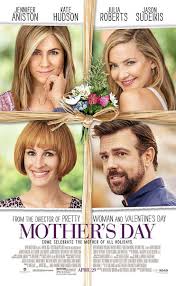
I typed out, “Are ensemble holiday-related movies doomed to be forever bad?” and realized that I answered my own question with the phrasing, ensemble holiday-related movies. Every time I watch them, I feel like I’m watching sitcom leftovers. So it only makes sense that Garry Marshall, who’s worked on dozens of sitcoms, would make “Mother’s Day”, a sappy, cornball movie. Of course this isn’t Marshall’s first rodeo, but I certainly hope it’s his last.

Like most of these movies, there are too many characters to go over, but they all have one thing in common, they’re dealing with some matriarchal problem. Sandy (Aniston) has to cope with her boys becoming attached to her ex-husband’s new squeeze. Jesse (Hudson) is dealing with avoiding telling her mom that she married an Indian man. Jesse’s sister, Gabi (Sarah Chalke) has the same problem, but instead it’s her inability to show off her life partner. The 81-year-old director surely must have thought a lesbian couple and a white woman marrying someone of a different race was groundbreaking material.

Then there’s Bradley (Jason Sudeikis), who’s dealing with the year anniversary of the loss of his wife. There’s also Kristin (Britt Robertson) who can’t handle that her boyfriend, and the father to her child, is proposing to her. Then Julia Roberts is kind of just floating around in the background as the “popular” HSN host. There are a lot more characters and a lot more actors looking for a paycheck that I’m sure I’m neglecting. Some of them connect and some of them don’t and live in their own personal bubble hell without having to bring anyone else into it.

The only thing this movie is missing is canned laughter or the gratuitous audience applause after someone stands up for themselves. The conflicts are forced, outdated, and their resolutions are equally as audacious to reality. I’ll go ahead and gloss over the fact that there’s obnoxious product placement. I mean, how many eight and 10-year-old siblings are going to get excited about going to IHOP? And don’t forget that any beverage must be drunk, has the label on the outside so that the camera can read it.

At times I did find it sentimental, oddly enough. Maybe it’s because I set my brain to cruise control or because there is a universal feeling that moms do go underappreciated. “Mother’s Day” does kind of touch on that, but it could be by accident. As for all you hard working moms in the world out there, you do deserve a movie that loves and supports you, but “Mother’s Day” is not that movie. Let’s spend Mother’s Day with our mom and stop attending these recycled holiday movies.

Film Review “Green Room”

Starring: Anton Yelchin, Imogen Poots and Patrick Stewart
Directed By: Jeremy Saulnier
Rated: R
Running Time: 94 minutes
A24 Films

Our Score: 2 out of 5 Stars

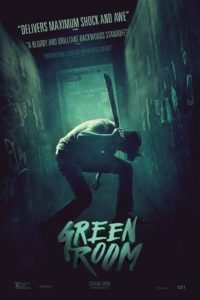
You’d think killing neo-Nazis would be more fun, or at the very least, more savagely joyful and campy. “Green Room” has the extreme close-ups of graphic violence, like broken bones and lacerations, which we’re accustomed to. We also get to watch characters use multiple tools for stabbing and pit bulls chewing out people’s throats. Sure, that’s not everyone’s cup of tea. But some movies find that gruesome sweet spot and have a lot of fun with it. However, “Green Room” feels devoid of any purpose, in its excessive gore and in its story.

The Ain’t Rights, made up of Pat (Yelchin), Sam (Alia Shawkat), Reece (Joe Cole), and Tiger (Callum Turner), find themselves playing to a room full of tattooed freaks at a white supremacist club. They’re in the middle of nowhere Oregon, playing for some pissed off skinheads, after a series of poor gig scheduling events on their end. Their current predicament isn’t helped by the fact that their setlist starts with a cover of the Dead Kennedy’s song, “Nazi Punks Fuck Off”.

After miraculously escaping their set unharmed, they prepare to leave, but accidentally witness the post-fallout of a murder in their green room. Things deteriorate quickly for the punk quartet and the hate group organizers. Weapons are drawn, hostages are taken, and the neo-Nazi leader is called in to get everything squared away. It’s only after the leader, Darcy Banker (Stewart), arrives that the Ain’t Rights truly recognize the severity of their situation.

Despite Stewart’s performance as a cold and calculating killer, there’s not a lot of tension in this concert version of “Panic Room”. Which is really unfortunate since the band is in the vast and quiet wilderness, with sociopaths at every turn. The setting is there, but the mood is lacking. A lot of it has to do with the fact that the band isn’t necessarily the brightest or most likeable. The band siphons gas because they don’t make enough money and they’re unnecessarily bitter and violent towards people they just met.

Darcy maps out every intricate detail to the neo-Nazi’s clean-up plan, which is constantly evolving and shifting based on the reactions of the band barricaded in his bar. He’s the most interesting of the characters and the movie would have benefitted more following him around a little more. But instead we’re trapped in the green room, listening to poor attempts at exposition, humor, and back story to a handful of dopey characters.

“Green Room” viewers may benefit from beers, pals, and a twisted sense of humor, but that same trio of items may have helped when writing it. Director/Writer Jeremy Saulnier definitely displays his visual prowess and his ability to create ocular terror and Yelchin and gang yam it up and find plenty of scenery to chew up, but it’s simply not enough. Once we get our fill of Nazi symbolism, hidden drug rooms, and knives to the stomach and throat, the “Green Room” is forgettable.

Tribeca Film Fest Review: “Holidays”

Starring: Seth Green, Clare Grant, Harley Quinn Smith
Directed by: Anthony Scott Burns, Nicholas McCarthy, Adam Egypt Mortimer, Gary Shore, Kevin Smith, Sarah Adina Smith, Scott Stewart, Kevin Kölsch, and Dennis Widmyer
Rated: R
Running Time: 144 mins
Vertical Entertainment

Our score: 1/2 star out of 5 stars

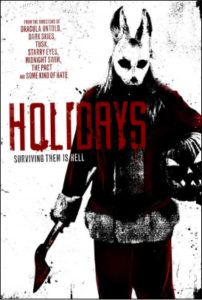
There’s no place like home for the holidays. As in stay in yours, do not flock to theaters to see the horror anthology dubbed simply Holidays which is out there today. The anthology film boasts a familiar roster of horror directors—though arguably the ‘biggest’ name, Kevin Smith, offers only Tusk on his horror resumé…so take that how you will— who gather here to tell short stories from Valentine’s Day to New Year’s Eve in chronological order. Horror anthologies thrive on bringing a lot of different things to the table. Shorts can be shocking, funny, twisted, even confusing, but if there’s one thing they shouldn’t be, it’s boring. And for seven out of eight of these, I was just plain bored.

When I called the entirety of what was going to happen in the opening short, “Valentine’s Day”, I immediately felt uneasy. Tethered to the order of the calendar year, it had to be their starting point, but it wasn’t a strong one. In short, a lovestruck-Carrie-looking outcast on a swim team is bullied by a blonde-haired Mean Girl. Commence the ten minute slog to her comeuppance. And this waiting occurs time and time again. Most egregiously in Father’s Day—a story, I admit I wholly forgot I sat through until I counted out the holidays and found I was short one. If it’s not waiting a full ten to fifteen minutes for a short’s singular predictable jump scare, it’s hitting the point of the story too fast and dragging it out. Kevin Smith’s “Halloween” is not only torturous to its main character—a Hollywood sleazebag getting what he deserves from a team of his webcam girls— but it brings the audience along with him.

The ‘scheduling’ of the holidays also hampers the flow of the film. I guess putting them in calendar order makes sense on paper but then Christmas and New Year’s wind up sharing the same murderous psycho-female trope. Neither really shocks but viewed back to back, it’s also redundant. Similarly there’s two tales revolving around pregnancy-as-horror. Really? You have all the folklore of all the holidays and twice you come up with fertility problems? It’s as if the directors didn’t realize they were making an anthology until after the fact.

Nicholas McCarthy’s “Easter”, the one in the eight that peaked my interest, offered a sick bit of creature humor in the form of the nocturnal Easter-Bunny-Jesus (complete with stigmata!) Unfortunately, we can’t follow that story down its rabbit hole and the inevitable holiday card blackout that cut off each story appeared to bring us back to the rest of the unpleasant lineup.

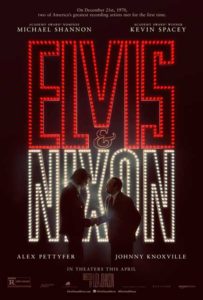
Film Review “Elvis & Nixon”

Starring: Michael Shannon, Kevin Spacey and Colin Hanks
Directed by: Liza Johnson
Rated: R
Running time: 1 hr 26 mins
Bleecker Street Films

Our Score: 3.5 out of 5 stars

December 21, 1970. As he goes over his schedule in the White House, President Richard Nixon (Spacey) is informed that he has a meeting with one Elvis Presley. He eyes his aide and calmly asks, “Who the f*** set this up?”

It’s the most requested photo from the National Archives. Richard Nixon and Elvis Presley shaking hands in the Oval Office. But what is the story behind the photo? The new film, “Elvis and Nixon,” may or not be the whole truth but it is an entertaining tale that sheds a light on the meeting between two of the most famous men of their time.

While watching television in his home one night, Elvis Presley (Shannon) is horrified by the various news stories he sees. Black Panthers. Drugs. Draft cards being burned. It’s more than the King can take and he hops a plane to L.A. to visit an old friend, Jerry Schilling (Alex Pettyfer). It’s while on the plane that Presley conceives a plan. He will go to Washington D.C. and ask the President to make him a “Federal-agent-at-large,” with the idea of using his fame to infiltrate the youth culture of the day. In 1970 Elvis was in the midst of a huge comeback started two years earlier. Still amazingly popular, Presley and Schilling run across a couple of Elvis impersonators in the airport, who mistake Presley as being one of them. They congratulate him for making an effort to look like the King, even though they tell him, “Elvis would never wear that,” which is pretty funny when you remember the outfits he used to wear. Jump suits and capes anyone?

The film moves quickly, buoyed by the performances of its stars. I’ve always enjoyed Michael Shannon as an actor, but this is really the first time he hasn’t been over-the-top crazy that I can remember. Wearing giant sideburns and gold-framed sunglasses, Shannon makes Elvis a vulnerable character who truly wants to do the right thing. A great mimic, Spacey is spot on as our 37th President, vulnerable to the country he feels doesn’t admire him as much as they do handsome people, like John Kennedy. Both men get down into their respective characters, giving the film a somewhat documentary feel, which gives the film an air of familiarity.

Film Review “The Invitation”

Starring: Logan Marshall-Green, Tammy Blanchard and Michiel Huisman
Directed By: Karyn Kusama
Rated: R
Running Time: 100 minutes
Drafthouse Films

Our Score: 4 out of 5 Stars

How long are you willing to let little inconsistencies nag at you before you passive aggressively leave, or better yet, uncomfortably point them out in a room full of people? “The Invitation” doesn’t necessarily ask that question, but depending on how you’d react in that situation, it’s certainly something to ponder. “The Invitation” us a slow-burning thriller that picks at Will (Marshall-Green), causing him to question himself and everyone around him

Will, and his current squeeze, Kira (Emayatzy Corinealdi) are heading to his ex-wife’s house for a small get together. Will hasn’t seen Eden (Blanchard) in years. Their marriage ended after the accidental death of their son and her inability to cope with the tragic loss. Eden moved on and met David (Huisman), who helped her recover in a unique way. Not only will it be the first time Eden and Will have seen each other in two years, but the first time many of their friends will have seen both of them in the same room.

It’s a relatable circumstance, attempting to reconcile or keep up appearances with a former flame because of mutual friends. But Will starts noticing that the smallest things are amiss. For instance, a bottle of pills in a medicine cabinet, a door that shouldn’t be locked, and a dinner party guest that never arrived. Every time Will, and the audience, is about to burst at the seams, the tension is ratcheted down and the minor irregular is laughed off. The movie does this several times, cranking up Will’s erratic behavior. But is it erratic or justified?

Fans of the horror movie genre might be able to pick up on what’s going on, but not without a lot of fight and sway by “The Invitation”. There’s credence to Will’s paranoia, but credence to everyone seeing Will’s outbursts as irrational inklings. Will could easily be suffering from buried emotions, linked to the death of his son. Or maybe Will’s suspicions are correct and something far more nefarious is afoot. As long as you’re willing to invite “The Invitation” to the inside of your head, you’re going to have an uncomforting blast.

“The Invitation” instinctively knows when to knock us off balance just when we think we’ve got it all figured out. A lot of that can be credited to the director, whose previous theatrical contributions don’t really hint towards the creepy unsettling nature of every shot. Even the actors here put full faith behind their characters, the motivations of their characters, as well as the story. Everyone is on the same page, even when the audience is still trying to piece it all together.

It’s difficult to discuss a movie like this because so much of its tension and story requires you knowing nearly nothing at all. “The Invitation” relies so much on the fear of the unknown, even if you think you know what’s happening. Obviously the disturbing nature of what’s going on won’t happen until the very end, but “The Invitation” is so chillingly effective, you’ll want the end to come as quickly as possible.


Related Content

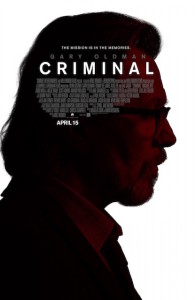
Film Review “Criminal”

Starring: Kevin Costner, Ryan Reynolds and Gal Gadot
Directed By: Ariel Vromen
Rated: R
Running Time: 113 minutes
Summit Entertainment

Our Score: 2.5 out of 5 stars

When it comes to groundbreaking scientific advancements, you want the sharpest minds on the case experimenting on the most eligible people. So when doctors plan on transferring the memories from the mind of a dead CIA operative, so that they can acquire highly classified information, they would obviously want the most qualified of human test subjects. In “Criminal”, the best they can do is an murderous inmate.

Jericho (Costner) lacks empathy, has never experienced any human emotion outside of hate and revenge and has killed numerous, if not dozens, of people. His sociopathic tendencies, as he puts it, are because he was thrown from a moving car by his father as a child. The doctors say it disabled the frontal lobe of his brain and doctors say that makes him the “perfect” candidate to accept the memories of undercover agent, Bill (Reynolds). If you’re willing to ignore the irrational set-up, then you might like “Criminal”.

But “Criminal” takes itself too seriously to be enjoyably farcical and its characters are too inherently silly to be earnest. “Criminal” falls flat half the time, but it manages to find a couple of entertaining nuggets when Jericho combines his angry drunken fighting technique with the precise killing method of Bill’s CIA training. It’s rarely there, but Costner in various scenes highlights the carefree nature of a petty thief and the calculating nature of a trained killing machine.

There are actually quite a few other actors that Costner gets to play with, including Bill’s wife played by Gal Gadot, a short tempered higher-up played by Gary Oldman, and a doctor that performs the memory transfer, played by Tommy Lee Jones. All the characters are interesting, but none of them really add much depth to the story or to Jericho. Costner is entertaining enough without us being distracted by the surrounding star power. On the surface it may seem like a waste of talent, but it’s more the case of a movie with unnecessary add-ons.

As the movie goes on, we learn that the CIA wants to find out the location of a master hacker, known as the Dutchman. The government wants to keep the Dutchman out of the hands of the Russians and a rogue anarchist who wants to hit the reset button on society. The plot is vague with details, but gets the point across visually without drowning the audience in tedious exposition, which I’m thankful for. Because of that, the nearly two hour runtime goes unnoticed.

Jericho is the focal point of the movie and “Criminal” attempts to make him sympathetic by showing how he adapts to emotions like love, affection, and genuine human concern for the first time in his life. On paper, he’s a despicable human who still kills people and is obsessed with his own wants and needs, but Costner adds some level of believability to the rehabilitation credence. But that might be because the American public commonly knows him as an Iowa farmer that plays baseball with ghosts.

“Criminal” could have been really fun if it avoided the pitfalls of humanizing its main character. Costner is a decent enough anti-hero without the sappy injunction of his wife. In a different universe, “Criminal” is a good movie. It’s a sci-fi movie instead though. Kevin Costner remains foul-mouthed, learning to show some compassion, but still remaining crass and blood hungry. In this world though, he’s a predictable character stuck in a generic action movie.

Film Review “The Jungle Book”

Starring: Neel Sethi
Directed by: Jon Favreau
Rated: PG
Running time: 1 hr 45 mins
Walt Disney Pictures

Our Score: 3.5 out of 5 stars

Here are some facts about the 1967 animated film “The Jungle Book:” It was one of the last films to be personally supervised by Walt Disney; Disney was so unhappy with the musical score that he had it re-written – only keeping the song “The Bare Necessities” at the urging of others – the song would go on to be nominated for an Oscar. Now comes a live-action version of the Kipling story, one that is not necessarily meant for its intended audience.

The story begins with young Mowgli (Sethi) running through the jungle with his adopted wolf brothers. Try as he might, he is not able to win the race, much to the chagrin of his “father,” who is trying to raise him like one of the pack. Trouble begins when the Tiger named Shere Khan (voiced by the amazing Idris Elba) shows up hoping to make a snack of the young boy. However, he is deflected by others, causing him to become angry. Knowing the little guy isn’t safe, the panther Bagheera (Ben Kingsley) decides that Mowgli must leave the jungle and return to man. However Shere Khan has other plans.

Told through the amazing use of computer generation, “The Jungle Book” is very faithful to the animated film that precedes it. Young Mr. Sethi is the only human being in the cast (and on film), with the rest being brought to life through the magic of special effects. And brought to life they are. From the mean and angry tiger to the funny and understanding bear, the characters leap off the screen. Which may present a problem to younger viewers, many who may be horrified at the image of Shere Khan murdering Mowgli’s wolf “father.” And if that doesn’t terrify you, there is a great wildebeest stampede that will surely get their attention.

An attempt is made to tone down the darkness by keeping two of the songs made popular in the 1967 animated feature. However, both Bill Murray voicing “The Bare Necessities” and Christopher Walken performing “I Wanna Be Like You” seem like they belong in a film less intense. You’ve been warned!

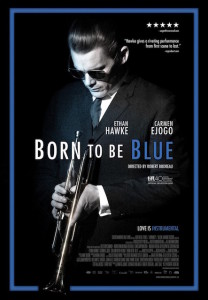
Film Review “Born to Be Blue”

Starring: Ethan Hawke and Carmen Ejogo
Directed by: Robert Budreau
Rated: R
Running time: 1 hr 37 mins
IFC Films

Our Score: 4 out of 5 stars

OK music fans, here’s a name for you: Chet Baker. Anyone? Anyone? Bueller? No?
Too bad. How about Miles Davis or Dizzy Gillespie? Oh, those guys you know. Would you be surprised if I told you that Chet Baker was, for a short time in the 1950’s, their musical equal? Sadly, it was the demon called Heroin that took away both his talent and his fame.

We first meet Baker (a well-cast Ethan Hawke) sprawled out on the floor of an Italian prison cell. While ruminating on his life we travel back to the mid 1950’s and the iconic jazz club known as Birdland. There we get a taste of Baker’s talent. Shot in black and white and full of billowy smoke, the scene sets the stage for what might have been. A decade later, his career floundering, he takes a job playing himself in a feature film. However, a beating by muggers leaves him minus his front teeth. And for a horn player, no teeth means no music. Reduced to pumping gas, Baker finds himself on the verge of redemption. If only he can keep the demon away.

A bio-pic that flits around, “Born to Be Blue” takes its name from one of Baker’s best known songs. Though other characters are featured, the film mostly concentrates on Baker and his girlfriend, Elaine (Ejogo), who we originally meet when she is cast as Baker’s ex-wife in the ill-fated movie. We learn that the creator of West Coast Swing had a hard time handling his father, also a musician. Referred to as the “James Dean of Jazz,” he is a junkie that hates needles. “Hello Fear, Hello Death, F*** You,” is his mantra as a friend sticks the needle in his arm. One of the first recovering drug addicts to be prescribed methadone, Baker takes his life one day at a time.

There are two stars in this film. The first is Hawke, who finds a way to make an unsympathetic character sympathetic. Extra points for doing his own vocal work. Second is the music. The soundtrack is full of some of the best jazz standards of the time, each one telling a story that accompanies the one on-screen. With Don Cheadle’s upcoming Miles Davis film on the horizon, it looks like jazz is making a comeback. Give it, and the film, a chance.

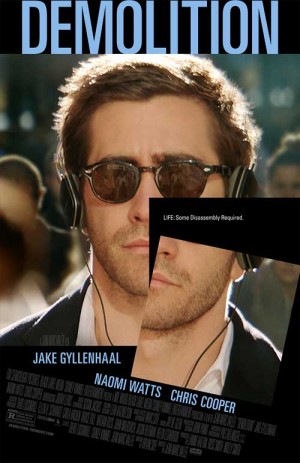
Film Review “Demolition”

Starring: Jake Gyllenhaal, Naomi Watts and Chris Cooper
Directed By: Jean-Marc Vallee
Rated: R
Running Time: 100 mins
Fox Searchlight Pictures
Our Score: 4 out of 5 stars

Falling in love with a Jake Gyllenhaal character is proving to be deadly. Last year his wife in Southpaw died, then there’s the ill-fated passenger aboard a train in Source Code and now we have Demolition. Gyllenhaal plays Davis,
whose main squeeze, Julia (Heather Lind), dies right off the bat in Demolition. A fatal car crash takes her young life, sparing Davis. The incident is a blur, which is a testament to how Davis has lived his life up until this point.

There’s a very telling scene at the hospital immediately after the accident, as Davis is awoken from a nap by Julia’s father, Phil (Cooper). Phil’s eyes are bloodshot from crying while Davis’ eyes simply have the remnants of sleep in them. If anything, Phil is more distraught over losing out on a pocket change from the hospital vending machine. But oddly enough he finds comfort when he begins to pen handwritten letters to the vending machine company that cheated  him out of some much needed candy.

His letters detail his adult life descent into apathy towards everything and everyone around him. He casually details his decomposition of his most simplistic of human emotions. Meanwhile, in robotic fashion, Davis watches and skirts around other people mourning the death of Julia. Verbally, he says the right things, but physically, his reactions are lethargic to the whole grieving process. The numbness he feels is the lack of love he had for his wife. He can’t even remember why he even married her in the first place.

Demolition casually, and sometimes very abruptly, takes some very surreal turns to show Davis’ unraveling. The death of his wife turns out to be a rebirth of sorts. Davis reflects on everything he’s done and soon his natural curiosity for life takes over. He socializes with people he would have normally disregarded and dismantles things around him, wondering how they work or simply, what’s on the inside of them.

At times Demolition plays like a fever dream, matching its heavy material with a heavy rock drumming on the soundtrack. The overpowering and sorrowful guitar soundtrack and music video-like sequences are cliché at times. Much like taking replacing a lightbulb with a sledgehammer, Demolition can be a little bit too blunt with its overall meaning about deconstructing life and rebuilding it. But it never takes away from its tragic message about how sometimes our lives are stuck on auto-pilot.

Every performance is spot on, especially Gyllenhaal who is still in a never ending quest for an Oscar, or at the very least, another nomination. Naomi Watts in turn provides a subtle innocence to an emotionally battled mom, Karen, struggling with her feelings over Davis. It’s odd that their sweet, yet non-physical, relationship stems from exchanging messages over a broken hospital vending machine, but their acting and their on-screen magic makes it believable. Judah Lewis plays Karen’s adolescent son, who ends up propelling Gyllenhaal’s character forward while providing his own character study on Chris, a boy struggling to come to terms with who he is.

Demolition is poignant, yet emotionally rejuvenating. It’s a visually entertaining story, with an at-times confusing narrative. It may take a couple of viewings to fully comprehend it’s multi-level message about society, the people in it, and the tendencies that those people have to become emotionally distant from everything. Nearly everyone in Demolition go through some complex changes, especially Davis, and it’s interesting to watch that growth, whether the changes be big or small.

Film Review “The Boss”

Starring: Melissa McCarthy, Kristen Bell and Peter Dinklage
Directed by: Ben Falcone
Rated: R
Running time: 1 hr 39 mins
Universal
Our Score: 3.5 out of 5 stars

Ever since she broke out with an Oscar nominated performance in the film Bridesmaids, Melissa McCarthy’s film choices have been very hit or miss. She scored big in hits like The Heat and SPY. She missed terribly in Tammy, which she co-wrote with her husband, who also directed. This is their second project together and I’m happy to report it’s no Tammy 2!

When we first meet Michelle Darnell, she is a little girl living in an orphanage who is about to go home with her new family. Sadly, they return her. This happens a few times during her life until she swears that she won’t need a family to make it straight to the top.

Present day we find Michelle (McCarthy) addressing a crowd of 20,000 on her achievements, urging them to follow her lead to a life of wealth and opulence. A combination of Oprah and Susan Powter, Michelle is probably the most famous business-woman in the country, much to the chagrin of Renault (Dinklage), a business rival and former lover. A few calls later and she finds herself in prison, accused of insider trading. When she gets out, broke and destitute, she makes her way to her former assistant Claire’s (Bell) apartment and coerces her way into a place to stay.

Wanting to pull her own weight, Michelle takes Claire’s daughter, Rachel , to a local scout troop meeting and soon has the whole bunch selling brownies quicker than you can say Martha Stewart.

Very funny in certain parts, the film is a combination of McCarthy working with a great cast and a very funny script. Tammy was a collaboration between McCarthy and her husband, actor Ben Falcone. It had some funny moments but it wasn’t FUNNY. This time the couple have added long-time friend Steve Mallory to the list of writers and have found a film that is both funny and works to McCarthy’s strengths. It is a little over the top at times (and a little more “adult” than you might expect) but it’s definitely a film that will make you laugh out loud.


Related Content

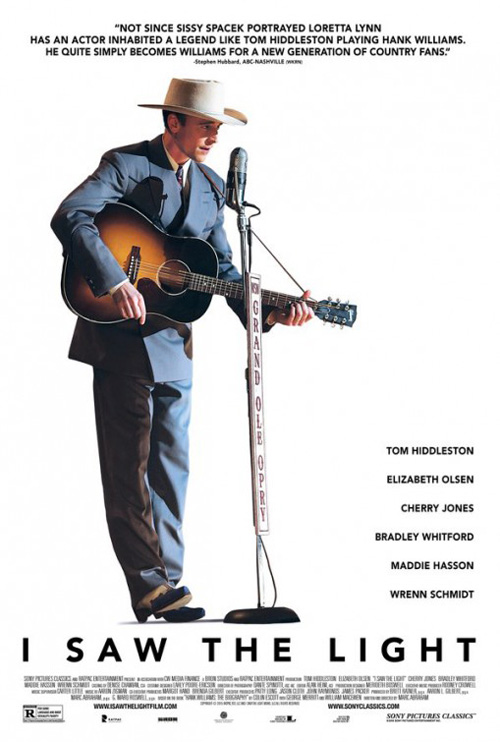
Film Review “I Saw the Light”

Starring: Tom Hiddleston, Elizabeth Olsen, Bradley Whitford, Cherry Jones
Directed by: Marc Abraham
Rated: R
123 minutes
Sony Picture Classics

Our score: 3 out of 5 stars

There was a big fuss made last fall by Shenton Hank Williams over the casting of classically trained English actor Tom Hiddleston as his grandfather Hank Sr. Hank3 asserted the country legend should be played by an American who had ‘soul’. It is therefore a smart move that I Saw The Light frees audiences’ doubtful minds about this casting in a gorgeous opening performance of his classic “Cold Cold Heart”. Bathed in a spotlight and shadows, Hiddleston’s Hank is backed by no instrumentals as he croons the classic with all the soul you could ask for. Unfortunately, from this smooth opening, writer-director Marc Abraham launches into a biopic whose rhythm is at times overly choppy. Still, as a showcase for the versatile Hiddleston and fiery Olsen, I Saw the Light impresses.

The structurally episodic film launches straight into Williams’s first marriage to fellow aspiring singer Audrey Mae (Elizabeth Olsen) at a gas station in 1944 before bouncing onto scenes at local dive bars and radio gigs. Abraham skips over Hank’s formative years and we see him with eyes already set on the Grand Ole Opry. That is when they’re not wandering to other women or to the bottom of a bottle. The briefly happy pairing of Audrey Mae and Hank is immediately threatened by Williams’s overbearing mother (Cherry Jones) and Audrey Mae’s desire to share in Hank’s career despite her own lackluster voice. Abraham piles on these personal problems that beset Williams early and heavily before he gradually works in the mentions of Williams’s spina bifida pain which further drove his drug addiction. The trouble with this onslaught of darkness in I Saw the Light is it makes Williams’s untimely passing at age 29 feel like a foregone conclusion with little relief found in his musical achievements.

Thank goodness then for Hiddleston. No stranger to darkness (fresh off of Crimson Peak and about to engage in tv spy thriller “The Night Manager”), he’s magnetic in scenes that require him to rein in his demons–or let them loose. Pity the New York reporter who tries to raise tabloid rumors with Hank or the Hollywood exec who wants him to remove his iconic cowboy hat. He’s particularly chill inducing when invoking Hank’s on stage alter ego “Luke the Drifter,” in a scary recitation to some confused picnic goers. More importantly though he can mine the joy to be found in performing Williams’s work. Yodeling and gyrating–for all intents and purposes flirting with the audience–his striking stage presence goes a long way to selling Williams’s enduring charm despite the emphasis Abraham’s script puts on many terrible relationship choices.

In this arena at least, for most of the film Hiddleston is ably matched by Olsen’s Audrey Mae. A divorcee herself already at the time of their marriage, Audrey Mae is wont to serve Hank the divorce papers when his screwing around becomes too much. Their heated arguments make for some of the most charged interactions in the film, each nailing their southern twangs. More importantly, their tender moments–Hank’s charming as hell plea for Audrey to come back to him, his finding out about impending fatherhood–are truly touching and give the film the heart it needs. As Hank and Audrey Mae drift apart, the chemistry with Olsen is sorely missed. Wrenn Schmidt as Williams’s friend-zoned fling Bobbie Jett briefly rekindles sparks later when Hank’s regretting being a “professional of making a mess of things.” Schmidt is as world weary as Hank in their shared scenes and brings a welcome sense of humor to the ever encroaching darkness of the latter stages of the film.

Said latter stages become riddled with odd choices from Abraham such as increasingly frequent black and white “interviews” or a sudden audio narration whose presence suggests a documentary format we haven’t been privy to for the majority of the film. It undermines the brilliant work of his actors. Here, Hiddleston’s rendition of “Your Cheatin’ Heart” will make you weep. He undoubtedly gets to the heart of Williams’s appeal even as I Saw The Light struggles to illuminate it properly.

I Saw the Light is now playing in New York, LA and Nashville, it expands nationally this Friday.

Film Review “My Big Fat Greek Wedding 2”

Starring: Nia Vardalos, John Corbett and Michael Constantine
Directed by: Kirk Jones
Rated: PG 13
Running time: 1 hr 34 mins
Universal

Our Score: 3 out of 5 stars

In 2002, “My Big Fat Greek Wedding” came out of nowhere to become one of the most successful, and beloved, romantic comedies of this young century. The film told the story of Toula Portokalos (Vardalos) and her search for love. The film ended with her marrying the very handsome Ian (Corbett) and living happily ever after in the house next door to her parents. 14 years later she’s still there.

If I had to sum up this film in one word it would be “familiar.” With most of the same cast doing a lot of the same things, the film depends a lot on the fact that you have seen the original. If not you won’t understand family patriarch Gus’ penchant for using Windex for everything, or why the hilarious Andrea Martin as Aunt Voula is the film’s comedic highlight. The story, in a nutshell: Toula and Ian have a teenage daughter. Her name is Paris (Elena Kampouris) and like other kids her age she’s looking for someone to go to prom with. School is hard because Ian is the principal. Toula continues to help out at the family restaurant, run by her parents. While Gus appears to be in charge, it is his wife, Maria (Lainie Kazan) that runs things. Proud of his Greek heritage, Gus is convinced that he is a direct descendent of Alexander the Great. In researching his family tree he finds his wedding certificate and notices that the priest that performed the service didn’t sign it. Does this mean he and Maria are not married? I sense a wedding in their future. Perhaps a big, fat Greek one.

If the film has anything going for it it’s the cast. As I said, many of the cast are from the first film and your familiarity with them is a plus. As a big fan of both Lainie Kazan and Michael Constantine, I enjoyed most of the film. As a couple they are perfectly matched, and even when they are fighting it’s easy to see the love. And the film is filled with everything Greek. From John Stamos, who is wasted in a cameo as the local weatherman married to Rita Wilson (who in real life is a full seven-years older than Stamos). The film also features a nice montage with the Billy Idol song “White Wedding” blasting out on a Greek bouzouki! Opa!


Related Content

Copyright: MediaMikes.com © 2016 · Powered by: nGeneYes, Inc. · Login

All logos and images used on this website are registered trademarks of their respective companies. All Rights Reserved. Some of the content presented on our sites has been provided by contributors, other unofficial websites or online news sources, and is the sole responsibility of the source from which it was obtained. MediaMikes.com is not liable for inaccuracies, errors, or omissions found herein. For removal of copyrighted images, trademarks, or other issues, Contact Us.