

Film Review “Children of the Corn (2023)”

“Children of the Corn” has a long history, original written as a short story by iconic horror author Stephen King back in 1977. The story was first adapted to the big-screen in 1984 since then it has inspired nine sequels and one remake. While the 2023 film doesn’t break the mold, it takes the story in a new direction by serving as a prequel while expanding upon the mythology.

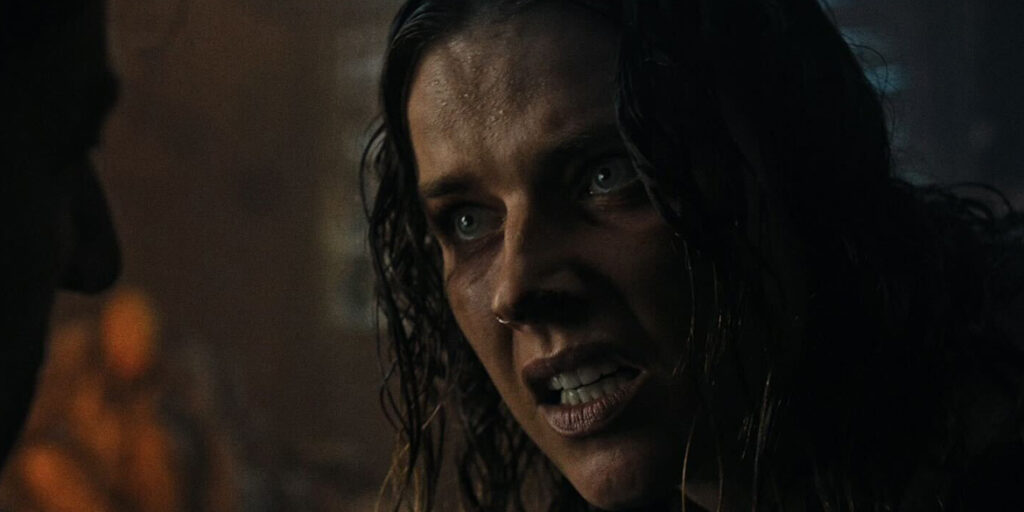
Official Synopsis: Possessed by a spirit in a dying cornfield, a twelve-year-old girl in Nebraska recruits the other children in her small town to go on a bloody rampage and kill all the adults and anyone else who opposes her. A bright high schooler who won’t go along with the plan is the town’s only hope of survival.

This film lines up “Equilibrium” director Kurt Wimmer taking the helm. I am a fan of his work and I like where he takes this story and dives deeper into the mythos of He Who Walks Behind the Rows. This film hasn’t had an easy road as it was shot right at the start of the pandemic in March of 2020 and has its world premiere right here in Florida back in October 2020 and until now there hasn’t been any peep.

The cast is impressive including Elena Kampouris, who does a solid job in the lead role. Kate Moyer nails the creepy role of Eden. There are a few known faces that pop up, Callan Mulvey, who has appeared in the Marvel Universe with “Captain America: The Winter Soldier” and “Avengers: Endgame” and Bruce Spence from “Mad Max 2”, “Finding Nemo”, “Star Wars Episode III” round out the cast.

“Children of the Corn” hits theaters on March 3rd from RLJE Films. While it doesn’t pack the scares of the first film and features some cheap CGI, it is worth a watch still. After 11 films, I am still craving for more, so I am sure we haven’t seen the end of this franchise just yet.

FIlm Review: “Puss in Boots: the Last Wish”


  • PUSS IN BOOTS:  THE LAST WISH
  • Starring the voices of:  Antonia Banderas, Salma Hayek and Harvey Guillen
  • Directed by:  Joel Crawford and Januel Mercado
  • Rated:  PG
  • Running time:
  • Universal


Ah, to be a cat.  I mean, sure, we can all lap up milk and, if we so desire, play with a ball of yarn.  But we only live once.  Cats have nine lives, which gives them the unique opportunity to be a little more reckless than you and I.  That is, of course, unless they only have one life left.


An off-shoot of the very popular SHREK series, “Puss in Boots: the Last Wish” brings us the swashbuckling cat (the always smooth Banderas) at his most vulnerable.  He is now overwhelmed with the one feeling he’s never had.  Fear.  Genuine fear.  With a long standing bounty on his head, he is now running from a very large wolf and a “family” gang made up of Goldilocks and the Three Bers.  Deciding to play it safe, he strips himself of his boots, lets his fur grow out and goes to live with a woman who LOVES cats.  There he is befriended by Perro (Guillen), a dog who has disguised himself as a cat in order to eat.  And, despite Puss’ protests, a true friendship is developed.


Well animated, and ever more well voiced, “Puss in Boots: the Last Wish” is a nice return to the screen for the boastful feline.  The script is full of some great lines, most of them aimed at Puss who now really is more of a pussy cat then a lion.  The story is a little dark, with one villain chuckling while his minions – no, not those guys – are sent to their death.  One in joke is that this baddy is known as Big Jack Horner, having grown from Little Jack Horner due to his love of pie.


Things begin to get exciting when Kitty Soft Paws (Hayek) arrives on the scene.  It seems everyone concerned is searching for a magical map that will take them to a place where they can have a wish granted.  The enjoyment in this adventure comes from the fact that the map reacts to the person holding it.  Bears and other baddies are sent through fire pits and thorn infested forests.  Those good at heart get to romp through fields of posies! 

As with most of the films in the SHREK universe, the performances are first-rate and the animation is beaufiul.  Here’s hoping this cat has more lives in him.

Film Review: “A Man Called Otto”


  • A MAN CALLED OTTO
  • Starring: Tom Hanks and Mariana Trevino
  • Directred by: Marc Forster
  • Rated: PG 13
  • Running time: 2 hrs 6 mins
  • STX Entertainment

Otto (Hanks) is a man set in his ways. Every day he arises and make his rounds through his small neighborhood, doing his best to keep his neighbors united in not selling to a large property management firm. When he’s not picking up trash or yelling at people to slow down as they drive past, Otto mourns for his late wife, the only person he feels understood him. When a new family moves in across the street, Otto learns that maybe his way isn’t always the right way.

Based on “A Man Called Ove,” a 2015 Swedish film, “A Man Called Otto” is well intntioned but a little too heavy handed at times. Hanks plays Otto as if he is the mellower brother of Clint Eastwood’s Walt from “Grand Torino.” His way is the way it should be and all others be damned. The new family across the street, headed by Mom Marisol (Trevino) begin to wear Otto down until he’s actually giving driving lessons and trying to make amends with friends he has wronged. Otto is keepoing a secret from everyone, one that we slowly begin to learn. He’s not a bad man. He’s just lonely and wishes to be in what he thinks is a better place.

As the seasons go by, from the warmth of spring to the fresh snow of winter, the characters become more familiar to the audience and each other. Otto may not be a saint, but he is a good man at heart, and heart is what this film is all about.

Film Review: “80 for Brady”


  • 80 FOR BRADY
  • Starring: Lily Tomlin, Jane Fonda, Sally Field and Rita Moreno
  • Directed by: Kyle Martin
  • Rated: PG 13
  • Running time: 1 hour 38 min
  • Paramount

For years I lived under the illusion that Tom Brady was a cheater. Then he went to my Tampa Bay Buccaneers and brought them a Super Bowl victory so now I see he was just misunderstood. Brady has since retired (again) but his legend lives on in “80 for Brady.”

Every Sunday a group of friends gathers in the home of Lou (Tomlin) to get their game on. Football that is. It’s been a tradition for these women for years, and started when Lou was battling cancer. The other women also have some issues. Trish (Fonda) cannot accept the fact that she is getting old, Maura (Moreno) is recently widowed and Betty (Field) is tired of doing everything for others and nothing for herself. When the Patriots once again advance to the Super Bowl in 2017, Lou gets them all tickets to the game so that they can celebrate in person.

A an almost too-sweet story held together by a group of actres with (5) Oscars and (12) nominations between them, “80 for Brady” is, in reality, a story about following your drams and never giving up. Football fans may recall that Super Bowl LI featured a game where, at one time, the Patriots were down 28-3 only to score (31) unanswered points to emerge victorious.

Along the way the ladies learn more about themselves then they expected, as they conspire to get as close to the action as posible. Brady, also a producer, shows up a few times on screen and has a natural screen presence, also featured in “Ted 2.” Nice to see he has a sense of humor.

For football fans, the film is a must see thanks to the incredible game footage shown on screen. Angles and highlights not seen on television are amazing to follow when they’re 40 feet high. Besides, now that the NFL season is over, “80 for Brady” is a way to get in a little more football before baseball season rolls along.

Film Review: “All Quiet on the Western Front”


  • ALL QUIET ON THE WESTERN FRONT
  • Starring: Felix Kammerer, Daniel Bruhl
  • Directed by: Edward Berger
  • Rating: R
  • Running Time: 2 hrs 28 mins
  • Amusement Park
Nominated for nine Academy Awards, including Best Picture, Best Adapted Screenplay and Best International Feature, “All Quiet on the Western Front” is a cinematic masterpiece and one of the few truly stand-out films of 2022. A superb script, terrific acting by the entire cast and flawless direction makes this film a must-see before your March 12th Oscar watch party.
“All Quiet on the Western Front” is based upon the 1929 novel of the same name by German-born novelist Erich Maria Remarque (1898-1970), whose inspiration came from his experiences as a soldier in the Imperial German Army during World War I. It was first adapted to the silver screen in 1930 and has been routinely regarded as a cinematic classic and was the first film to win an Oscar for both Best Picture and Best Director. The 2022 version had some big shoes to fill, and it does not disappoint.
When 17-year-old Paul Bäumer (Felix Kammerer) enlists in the Imperial German Army in 1917, he and three of his friends share a romantic view of war. Brimming with patriotic zeal fueled by a school official, they are excited to experience the glory of combat in the defense of Germany. Soon after their deployment to the western front in northern France, the quartet discover just how terrible the realities of war are.
As time passes, Paul loses an increasing number of comrades as the German High Command tries to press forward with one bloody, pointless assault after another. By November 1918, Paul and all of Germany had become war weary to the point of exhaustion. It is what spurs German official Matthias Erzberger (Daniel Bruhl) to persuade the German military to pursue armistice talks with the Allied powers. Germany’s surrender means an end to the carnage, but one German general refuses to accept defeat and orders one last meaningless charge before the deadline that results in even more tragedy.
Like its 1929 predecessor, “All Quiet on the Western Front” does everything it can to demonstrate how horrific war is, which unfortunately is being played out daily on the battlefields of Ukraine. The film is darkly sobering, punctuated by battle sequences that are as close to real as cinema can make them. German-born director Edward Berger has created nothing less than a classic. Kammerer is nothing short of mesmerizing as he deftly portrays a young man who becomes a bruise and battered old soul within a short amount of time. It’s certainly an Oscar caliber performance even if he wasn’t nominated.
Overall, “All Quiet on the Western Front” should be a part of any cinephile’s movie collection.

Film Review: “Cocaine Bear”


  • COCAINE BEAR
  • Starring: Keri Russelll, O’shea Jackson, Jr. and Ray Liotta
  • Directed by: Elizabeth Banks
  • Rated: R
  • Running time: 1 hr 35 mins
  • Universal


Normally when a film is advertised as “based/inspired by a true story,” you think to yourself, cool. However, when I first heard this comment used about “Cocaine Bear” I had to chuckle. Really? A beat that goes on a cocaine bender? Yeah, right. Then I spoke with a friend of mine who lives in Knoxville, Tennessee. She knew all about the story BECAUSE IT’S TRUE!

It’s sometime in the 1980s. America is in the middle of a huge drug epidemic. “Just say no,” is the message related by everyone from Nancy Reagan to Pee Wee Herman. Sadly there are no television in the woods.

A plane flies overhead in the darkness. Aboard is a man packaging up bundles of cocaine to drop into the woods below for his associates to recover and put on the street. An onboard mishap causes the plane to crash, with the wreckage (and durgs) strewn all over. Anyone could come along and find the illicit cargo. Hikers. Kids. A bear.

A film that mixes dark humor and horror perfectily is indeed a rarity, but “Cocaine Bear” pulls this mixture off almost seamlessly. Director Banks and screenwriter Jimmy Warden have woven together a film that is both funny and terrifying.

The cast is full of colollrful characters, ranging from Russell’s frantic mom searching for her daughter to Jackson’s almost too responsible drug runner to Margo Maartindale as a park ranger with romance on her mind. Throw in recent Tony award winner Jesse Tyler Ferguson as a local wildlife expert and the late Ray Liotta in one of his final performances and you have a group of actors who, instead of going for camp, play the situations straight. And don’t forget the bear, who shows an amazing range of emotions. Add a soundtrack consisting of some of the era’s greatest hits and you have the formula for an entertaining night at the movies.

Film Review: “Nocebo”

Starring: Eva Green, Mark Strong and Chai Fonacier
Directed by: Lorcan Finnegan
Rated: NR
Running Time: 96 minutes
Shudder

Our Score: 2.5 out of 5 stars

The first 15 minutes of “Nocebo” could serve as a summary for the film. When we meet Christine (Green), she is a successful English fashion designer for children’s clothes. At work one day, she receives a troubling phone call. Even though we can’t hear what she’s being told, the contortions of fright on her face tell us she’s receiving horrific news. Compounding the scenario, is a tick infested dog that wanders into the office building, staring at her with blind milky eyes. The film cuts to months later, where Christine is sick at home, suffering from an unknown illness and struggling to find work. That’s when Diana (Fonacier), a Filipino woman, knocks on the door.

“Nocebo” effectively draws you in, making you wonder why a tick infested dog is in an office building, haunting Christine after she receives presumably terrible news over the phone. Diana’s entrance serves as an even stranger rabbit hole to stumble down because she says Christine has summoned her, even though Christine doesn’t remember this and her husband Felix (Strong) is equally suspicious. Unfortunately I’ve watched enough horror films to deduce what’s going on and the rest of the movie just serves as an exercise in style over substance.

I’m not saying it’s a bad thing when your movies are predictable because inherently a lot of films can be figured out through a very analytical lens. The problem with “Nocebo” is it doesn’t do anything new with it’s folk horror cliches and instead kind of drifts towards the predicted ending without any kind of red herrings or diversions that make you second guess the nature of the film. That being said, “Nocebo” does work in some surprising ways, mainly atmosphere and acting.

While there are no jump scares, “Nocebo” creeps around Christine’s house as Christine works with Diana and Felix watches suspiciously in the background. In these instances, it’s fascinating watching the perception of Christine’s reality change, and it helps that Green ravenously gnaws on scenery with wild hunger. Green is like a female Nicolas Cage, the movie she’s in is immediately elevated simply by her presence and willingness to immerse herself in even the most absurd stories, plotlines or scenarios. “Nocebo” would effectively be weaker without Green penetrating every scene with her acting chops.

Ultimately the film feels more telegraphed rather than a natural flow. “Nocebo” has the right ingredients, but director Lorcan Finnegan can’t combine them all into a cohesive treat. At times I found myself unable to look away from “Nocebo” while at other times the itch to look at my phone creeped into the back of my mind.

Film Review: Ant-Man and the Wasp: Quantumania


  • ANT-MAN AND THE WASP: QUANTUMANIA
  • Starring: Paul Rudd, Evangeline Lilly
  • Directed by: Peyton Reed
  • Rating: PG-13
  • Running Time: 125 minutes
  • Marvel Studios
After a long and sometimes lackluster collection of full-length movies and Disney+ series, Marvel’s Phase 4 came to an end with “Black Panther: Wakanda Forever,” which was a high note for the franchise as it nabbed five Academy Award nominations. The dawn of a new phase of Marvel movies has arrived with “Ant-Man and the Wasp: Quantumania,” again featuring Kansas City’s own Paul Rudd as the titular hero. While “Quantumania” lacks the dramatic depth of “Black Panther,” it does showcase an entertaining story with good character development, particularly with Rudd’s character, and a great performance by Jonathan Majors as the time traveling villain Kang the Conqueror.
We find Scott living a peaceful life with his teenage daughter, Cassie (Kathryn Newton) while his girlfriend, Hope Van Dyne (Evangeline Lilly) aka The Wasp has become a corporate executive. During a visit at the home of Dr. Hank Pym (Michael Douglas) and Janet Van Dyne (Michelle Pfeiffer), Cassie, with encouragement of Hank, has somehow pulled a Tony Stark by building a device that can act as a satellite in the Quantum Realm. This is much to the chagrin of Janet who demands to have it turned off, but alas she is too late as a portal opens up and sucks them all down to the Quantum Realm.
Scott and his annoying daughter stumble into a rebel camp where they are initially treated as prisoners. Meanwhile, Hank, Janet, and Hope travel to a city where Janet divulges secrets from her 30 years in the Quantum Relam, including her relationship with the time traveler known as Kang the Conqueror (Jonathan Majors). As it turns out, Kang, the Quantum Realm’s despotic ruler, is trapped and needs a complex power core to escape.
After being captured by his subordinate, M.O.D.O.K. (Corey Stoll), formerly Darren Cross who was thought to be dead, Scott is forced to reacquire the power core so Kang can enact his revenge against those who banished him. Scott soon learns the hard way that Kang was right in telling him that he is out of his league.
The first appealing thing about “Quantumania” is Scott’s development as a character during the course of the three films featuring him. Unlike Thor, who has become regressed into a buffoon and Peter Parker, who can’t seem to grow up, Scott has grown from just being a bumbling burglar. Of course, it could be more but there is obviously a reluctance to get too far away from having comedic elements in his story.
Pfeiffer is also a delight to watch as she simply takes over her scenes as the story peels away the layers of her character. However, the true star of the entire film is Majors, who already played a version of Kang in the outstanding Disney+ “Loki” series. Majors plays him with an ease as Kang vacillates between stoicism and pure rage. His Kang is easily on par with Thanos as the greatest villains in the Marvel franchise.
While the special effects are outstanding, they are simply window dressing as sometimes the settings and the story itself appear to have been copycatted elements of a pair of “Star Wars” films. The pacing is a little disjointed at times, but the biggest grievance is Cassie. She is arguably the most annoying character in any Marvel movie or series. While Newton is obviously a talented actress because she did get the part, her performance is akin to listening to someone running their nails down a chalkboard. Poorly written character and an equally unlikable performance that drains some of the life out of the film.
Overall, “Quantumania” is an entertaining flick that at least lays the groundwork for a hopefully a much better and well-rounded slate of Phase 5 films.

Film Review: Guilermo del Toro’s PINNOCHIO

  •  GUILLERMO del TORO’S PINNOCHIO 
  • Starring: Ewan McGregor, Gregory Mann
  • Directed by: Guillermo del Toro
  • Rated: PG
  • Running time:  1 hr 57 mins
  • Netflix
Nominated for an Oscar in the Best Animated Feature Film category, “Guillermo del Toro’s Pinocchio,” or just “GDT’s Pinocchio” from here on out for brevity’s sake, is a delightful, stop-motion animated take on the 1883 Italian novel “The Adventures of Pinocchio” by Carlo Collodi (1826-90). Packed with talented voiceover work, del Toro’s effort often pulls at the heartstrings. However, it is a much darker version than the 1940 Walt Disney film and should probably be viewed by slightly older children.
The story begins in Italy during World War I when talented yet humble carpenter Geppetto (David Bradley, best known as Argus Fitch in the “Harry Potter” series) loses his son and only child, Carlo during an aerial bombardment of his village by the Austro-Hungarian air force. Devastate, Geppetto plants a pine cone at Carlo’s grave and for the next 20 years as the tree grows he grieves continuously for him.
Enter Sebastian J. Cricket (Ewan McGregor) who establishes his new home inside the pine tree only to see it cut down by a drunk Geppetto. Filled with rage, Geppetto begins to carve a wooden puppet boy from the pine tree, but passes out before he is finished. While he is asleep, a wood sprite (Tilda Swinton) brings Pinocchio to life and grants Sebastian a wish so long as he acts as the wooden boy’s guide.
When Geppetto wakes up he is terrified at what he sees as Pinocchio exhibits an uncontrollable zest to ask questions, get into trouble and not do what he is told since he has no sense of right and wrong, despite Sebastian and Geppetto’ best efforts. What follows are a series of misadventures for Pinocchio that include becoming an enslaved circus attraction and later a trainee in Mussolini’s fascist army.
The director of such previous works as “Hellboy,” “Pacific Rim,” and “The Shape of Water,” del Toro once again delves into a world with fantastical beings and how humans interact with them. And once again his story, which is also part musical, is intriguing to watch as it unfolds. Filled with tragedies and triumphs as Pinocchio learns the hard way what it means to be human, del Toro’s effort is bolstered by wonderful voiceovers that include other notables as Cate Blanchett, Ron Perlman, John Turturro and Christoph Waltz.
Overall, “GDT’s Pinocchio” is an imaginative, darkly whimsical film that will set you on an emotional pendulum from start to finish.

Film Review: “Attachment”

Starring: Sofie Grabol, Josephine Park and Ellie Kendrick
Directed by: Gabriel Bier Gislason
Rated: NR
Running Time: 105 minutes
Shudder

Our Score: 3 out of 5 stars

On paper, “Attachment” reads like a meet-cute sitcom episode. Maya (Park) is a washed up Danish actress making ends meet as a children’s entertainer at a library when she bumps into Leah (Kendrick), a youthful Jewish student who is exploring the world in her studies. The two immediately connect as they go back to Maya’s place for some cute glances and steamy sex. Things are off to an incredibly fast and amazing start when Leah suffers a bizarre seizure at night which results in a leg injury. So Maya goes with Leah back to her home in London where Maya meets Leah’s overbearing mother, Chana (Grabol). Definitely a meet-cute formula that’s about to get gobsmacked by something evil.

Without spoiling anything, “Attachment” is a movie we’ve seen before, utilizing several clichés to move the plot along, but what elevates the story is the unique qualities it brings to the table. Very rarely do we see these kinds of films with LGBTQ+ characters and Judaism as the subtext. That’s not to say the film intentionally includes these elements to be unique. Matter of fact, the film interweaves the nuances of these elements with clichés so that the clichés don’t feel nearly as prevalent. They’re still there, and at times give away what’s happening in Chana’s home.

The biggest thing I enjoyed about “Attachment” is how deep, even with how brief it sometimes is, we go in-depth with these characters. We learn more about Maya to where we understand why she feels the way she does about Leah. We also begin to recognize the toxic codependency between Leah and her mother. It’s difficult at first to tell which one is the most toxic and which one is potentially responsible for the increasingly paranormal things happening in the house. But like I stated before, if you’re a horror aficionado, you might be able to figure out what’ll happen in the final act because of the clichés.

Thankfully the film focuses more on mood than jump scares for its horror so that the film never feels cheap. Even when the runtime begins to feel a bit too long, the story continues to chug thanks to an effective atmosphere and believable performances. For me, it was difficult at times to figure out if this film works better as a horror with romance elements or a romance with horror elements because at times the film does both effectively and sometimes poorly. For the sake of the genre argument, I’ll say that this is a fine addition to the growing LGBTQ+ and Judaism horror collection. Maybe it’s because we haven’t seen these kinds of people in these stories, but “Attachment” feels fresh, even when it’s doing a juggling act we’ve seen dozens of times before.


Film Review: “The Last Deal”

Starring: Anthony Molinari, Sala Baker and Gigi Gustin
Directed by: Jonathan Salemi
Rated: R
Running Time: 91 minutes
Scatena & Rosner Films

Our score: 1.5 out of 5 Stars

Very rarely do I start a film and begin to wonder how long it’s been sitting on a shelf, whether it’s the finished project or just the mere concept of the film “The Last Deal” is about Vincent (Molinari), a black market marijuana dealer who goes from being the king of the street to just another cog in the machine when marijuana is legalized in California. Doesn’t this seem like the kind of film you’d hear about or see pre-pandemic?

“The Last Deal” opens with Vincent narrating the first 10-15 minutes so that we can understand his life and business. As to why we need Vincent to narrate what we’re already seeing or having it take that long is a telltale sign that the film is going to have a lot of head scratching narrative and storytelling choices. The issues that arrive in Vincent’s life is when he realizes that he can’t play the marijuana game legitimately. So before being squeezed out of the market he decides to make one final score with rotten money from a rotten person. That’s where things begin to take a nosedive for Vincent.

How do we know Vincent borrowed money from the wrong person? That person, in the credits, is named “The Boss” (Baker). He’s such a bad guy, supposedly, he has a henchman for when he plays poker, for when he enjoys a beverage on his patio outside and even a henchman that watches TV while “The Boss” messes around in another room. He also threatens to kill Vincent and everyone he knows when the money and drugs are suddenly stolen from Vincent. It’s not that the story or even the idea of the whole story is bad, it’s just executed poorly.

For one, we never really care about Vincent. At times he seems to lack a personality. I say that because the only time we get an inside view into his mind and life, he’s complaining about how difficult it is and how it lacks certain joys. He has a girlfriend and a place to live, but he doesn’t like living in an apartment and the relationship with his girlfriend is on the rocks; so much so that at multiple points in the film, Vincent seems to view her as an afterthought. I’m sure there is an intention to make it seem like his life is nothing but drug dealing or that he’s unable to see its beauty, but even in casual interactions, Vincent seems devoid of basic human emotion. The only time we see him emote is when one of his colleagues is murdered, but even that rare instance of emotion is brief. I would generally say it’s the acting, but when I think about Vincent as a character, he really is a one-dimensional creation.

When the film’s third act finally rolls up, you should know what’s going to happen because the story is very painted by numbers. There are several surprises, however, they feel more like plot convenience than anything. I really wanted to sit back and enjoy this film because the plot allows for that, but the film has too many noticeable issues for me to ignore and mindlessly enjoy. “The Last Deal” should be your last option when picking what to watch.

Film Review: “Eo”

Starring: Sandra Drzymalska, Lorenzo Zurzolo and Isabelle Huppert
Directed by: Jerzy Skolimowski
Rated: NR
Running Time: 88 minutes
Janus Films

Our Score: 4 out of 5 stars

You hang around animals long enough, you begin to notice things like expressions in their face and how much personality they have. Despite the obvious language/species barrier, it’s fascinating that animals and humans alike are able to understand certain aspects of each other whether that’s happiness or fear. We’re also able to recognize each other’s body language when we’re angry, depressed or joyful. You’d think we’d get along better, but a film like “Eo” shows how that bond is at times oceans apart or beautifully close.

“Eo” is pretty straightforward. It’s about a donkey named Eo, who is a circus donkey when we first meet him. He has a loving owner and doesn’t seem to mind the outdated spectacle, but some animal rights activists are about to “free” him. There’s something comical about watching Eo quietly roaming around amongst angry humans yelling for it to be free, even though the concept of freedom is probably alien to Eo. After being “freed,” we see the folly of the animal rights activists who believe their job is done and let Eo roam freely to potentially be harmed or maimed. The rest of the film serves as a journey that’s heartwarming, tear-jerking, thoughtful, sad and ultimate meditation about life.

Despite being a donkey, Eo should have probably earned an Oscar nomination for delivering a world of emotion through his eyes. At times the camera hovers just inches from Eo’s eyes and we see thousands of words etched into them as he encounters friends, foes and the utterly bizarre, like a soccer match where Eo becomes the focal point through no actions of his own. The film is brief which helps with a lot of the moments where the camera simply follows Eo on his voiceless journey in Europe.

I found myself entranced by Eo’s journey even though there wasn’t anything specifically thrilling about it. It is just a donkey, after all, but Eo is more than that. He represents that soft spot that all humans have for animals. Even when we don’t like a specific creature, we still don’t necessarily wish them harm or want to see harm come their way. I think that’s what makes Eo so fascinating to watch and that’s because his encounters would tell you no person is safe, but all humans you encounter could be potentially safe. Eo sometimes feels like a representation of humanity, going through the motions, encountering adventures that may or may not be the best thing for our soul. We blindly go through life hoping everyone and everything we encounter is good-natured, but unfortunately that’s not always the case.

“Eo” is a film I thought about for days after watching. Personally I know it’s because I attempt to view humanity through these kinds of films. I feel like there’s poor ways of conveying the importance of creatures and the bond we share with them, like “A Dog’s Purpose,” but films like “Babe” help ground us in the reality of coexisting with creatures on this blue marble. “Eo” goes way deeper than I thought. What does coexistence mean when one side mistreats the other? What does life mean when sometimes a singular purpose for one’s existence is ultimately the consumption of the other? What does coexistence mean when we attach ourselves to them in toxic ways? Sure, some animals that aren’t donkeys have a poor temperament and just aren’t cuddly or loveable, but neither are all humans. “Eo” will make you smile, cry and ponder what exactly is going on in this crazy world and you’ll be a better person after all of it. Good donkey.

Film Review: “Women Talking”

Starring: Claire Foy, Jessie Buckley and Rooney Mara
Directed by: Sarah Polley
Rated: PG-13
Running Time: 104 minutes
United Artists Releasing

Our Score: 4.5 out of 5 stars

George Carlin once said, “There’s no such thing as rights. They’re imaginary. We made ’em up. Like the boogie man.” I open my review with that quote for two reasons. First being that 2022 was the year that women experienced the loss of their body autonomy rights. Second being that the women in “Women Talking,” never had rights because of the boogie man.

“Women Talking” opens with a group of women in an unnamed religious colony discussing the revelation over the prior days/weeks that ghosts or Satan aren’t behind the drugging and raping they’re experiencing. Nope. It’s the men who live among them. Their friends, their neighbors, their fathers, their spouses, etc. For years, those men have been the ones who have been drugging the women so that they can sneak in at night and rape them only to tell them the next day it’s the boogie man. With this revelation, something has to happen, right? The men are caught and arrested, but the rapists post bail and are on their way back home as if nothing happened. The women at this discussion represent different houses of thought on what to do before the rapists return. Some women believe they should do nothing and continue to be the subservient class in this community. Others believe it’s time to stay and get their fists and noses bloodied. A good portion believe that it’s simply time to leave.

Unfortunately the above scenario is not the work of Hollywood, it is based on a book written by Miriam Toews, a former Mennonite girl who fled her Canadian Mennonite community when she turned 18. “Women Talking” isn’t looking to bash one of the more peculiar sects of Christianity though. Outside of showing the horrific reality that women are still second-class citizens in portions of the world, “Women Talking” also examines a very key question in trauma, “What now?” The three options above spur fascinating on-screen discussions that cross the proverbial universe of these women. The revelations are handled differently, with some women still drinking the flavor aid that the best option is to ignore the crimes because…God’s “wishes?” Other women want to leave, but then wonder if that means taking their children. Some of their children are boys, does that mean their boys will grow up to become rapist monsters? Do they leave the boys? Can any man be trusted? If the women stay and fight, how will the community as a whole react? What will stop the men from banding together and retaliating if it’s a war between the sexes?

A film like “Women Talking,” which thankfully spares the audience the visuals of the rapes, relies heavily on its actors and script, and both are a cannon shot across the bow. Not only are the perpetrators called out in the story, but the real world is called into question by these discussions. I could break down the stellar performances and moments, but “Women Talking” is truly a film that demands attention and silences you with the power of words. At times the film is an emotional wrecking ball, making the words of these women more powerful than any scene featuring the crimes themselves. The casting is truly spotless because even the lone man (played by Ben Wishaw) in the community, who is helping the women by keeping record of their discussions and chiming in when called upon, adds emotional layers to the women debating something they’ve probably never debated or even discussed before.

In a lot of ways, “Women Talking” plants its feet in the past and in the present day. In some regards you can view the film as a historic look at how women finally release themselves from the shackles of their oppressors to give rise to a movement and help create the birth of a new society, one in which both sexes are equal. You can also see the modern commentary hidden in the tearful debates between our characters. Either that or the old idiom is true, history is doomed to repeat itself. Foy, Buckley and Mara lead the way for this ensemble cast tasked with not only conveying a powerful message, but doing it in a riveting way where the viewer will either find themselves teary eyed, aghast or silent. For some viewers, those who have already seen the movie, “Women Talking” bookended a rough 2022 for women in America, and for some viewers, this film is your rallying cry in 2023.

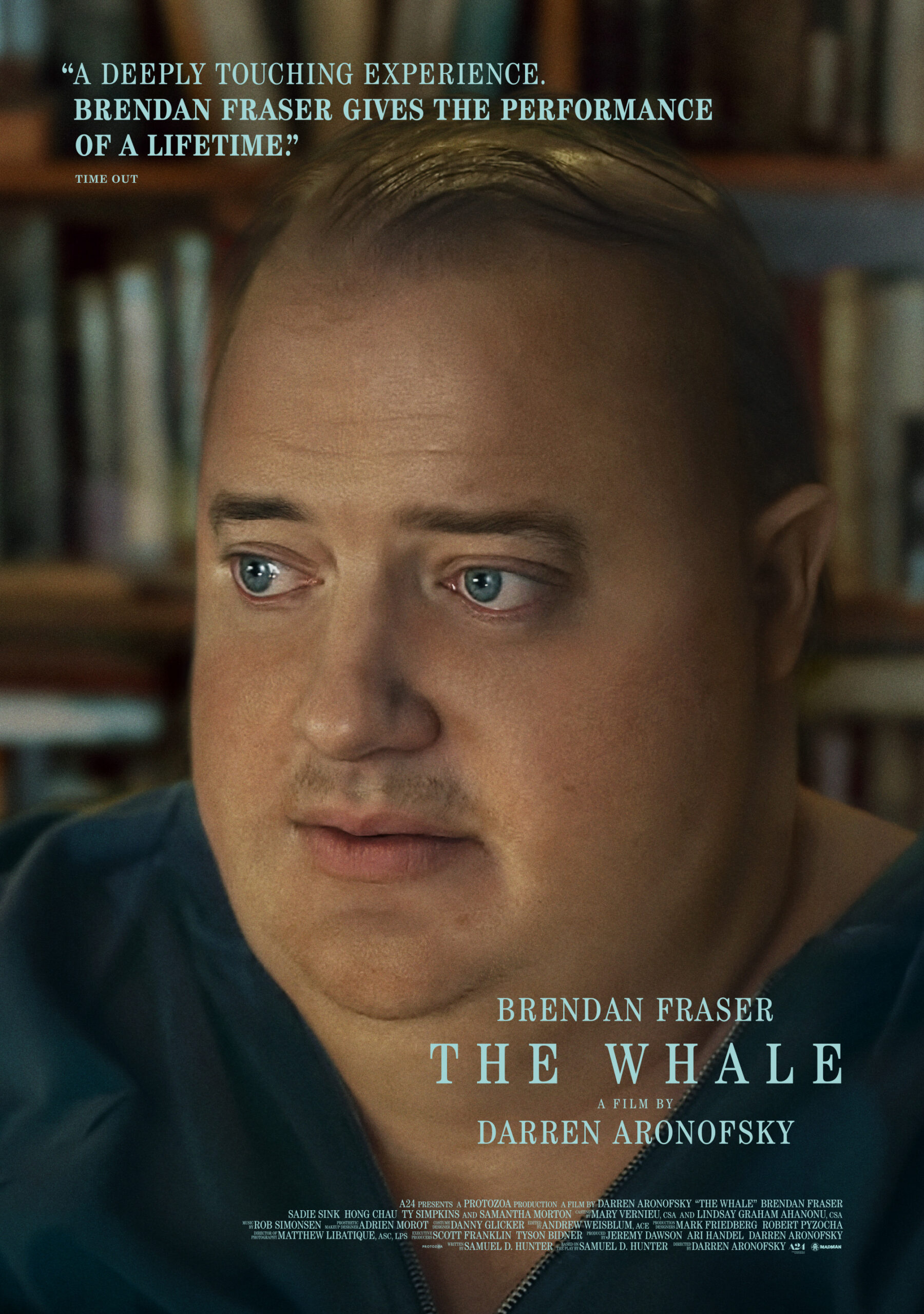
Film Review: “The Whale”


  • THE WHALE
  • Starring:  Brendan Fraser, Sadie Sink and Hong Chau
  • Directed by:  Darren Aronofsky
  • Rated:  R
  • Running time:  1 hr 57 mins
  • A24


And the Oscar goes to…..  Brendan Fraser.  That is all.


OK, I’m getting a little bit ahead of myself here.


An online class is in progress.  The main screen is filled with the faces of all of the students.  The only black frame belongs to the instructor, who informs the others that the camera on his laptop is broken.  But it isn’t. He’s just afraid of being seen.


Driven by Brendan Fraser, who gives a performance that is both brilliant and emotional, “The Whale” tells the story of a man whose life has spiraled downward as his waistline has increased.  Charlie (Fraser) was once a happy man with a wife and daughter.  A college professor, he was able to share his love of literature and of writing.  But Charlie had a secret and that secret destroyed not only his life, but the lives of those that loved him.  Now it is only through food that Charlie can achieve any semblance of happiness, finding consolation in a bucket of chicken or a couple of giant meatball and cheese subs.  He is looked after by his friend, Liz (Chau), who drops by often offering dinner and some companionship.  Liz knows that Charlie is slowly killing himself, but he refuses to seek medical help.  Only after receiving a couple of unexpected visitors does Charlie begin to think of happiness.  But not for himself.


I’m a big guy.  I can always afford to lose a few pounds.  And I can admit here that I have had people refer to me as fat.  But I’m Audrey Hepburn compared to Charlie.  Usually, a large person is played for laughs on screen.  Think Eddie Murphy in “The Nutty Professor,” Martin Lawrence in “Big Momma’s House” or the final scene in “Dodgeball” where a very hefty Ben Stiller makes a self-depreciating joke and remarks to the audience, “Are you happy?  Fatty made a funny.”  But with “The Whale” you have no desire to laugh at Charlie.  You sympathize with him.  When he struggles to take a few steps, you feel his exhaustion.  And when he strains to pick something up off the floor, you can feel your fingers reaching out as well.  But Charlie doesn’t want your sympathy.  He just wants to be.


I have always been a fan of Brendan Fraser.  From “School Ties” to the “Mummy” series to the underappreciated baseball comedy “The Scout,” he has always appeared genuine on screen.  His performance here is no different.  You feel sad for Charlie.  Not because he’s heavy but because he’s a human being.  It doesn’t matter if Charlie weighs 400 pounds or a buck twenty-five, the hurt he feels is evident in his eyes.  And the ability to express such emotion with only a glance is the hallmark of a great actor. 


Fraser is supported ably by his co-stars, including Ms. Chau, Sadie Sink as Charlie’s estranged daughter and Ty Simpkins as a man literally on a mission who knocks on Charlie’s door.  There is not a false performance in this film.


As a filmmaker, director Darren Aronofsky can be very hit or miss.  On one side of the spectrum, he created a masterpiece with “Requiem for a Dream.”  On the other hand, I give you “The Fountain.”  “The Whale” is another fine achievement and one that should be seen and appreciated. 

Film Review: “The Fabelmans”


  • THE FABELMANS
  • Starring:  Michelle Williams, Gabriel LaBelle and Judd Hirsch
  • Directed by:  Steven Spielberg
  • Rated:  PG 13
  • Running time:  2 hrs 31 mins
  • Universal


A young boy goes to the movies.  What he see’s has such an impression on him that he makes film a major part of his life.  That young boy could never have known that 2 hours in the dark would change his life forever.  I should point out here that the young boy in question is me and the movie in question was “Jaws.”


New Jersey.  1952.  Young Sammy Fableman (LaBelle) is taken to the movies to see “The Greatest Show on Earth” by his parents, Mitzi (Williams, in an Oscar-worthy performance) and Burt (Paul Dano).  Burt is a scientific engineer, so instead of explaining movies in terms of enjoyment he spouts off about how the film runs 24 frames per second, giving still images the illusion of movement.  Despite his father’s description, Sam is mesmerized by the film, especially the famous train crash (oops, SPOILER ALERT!).  He plays the scene over and over in his head when he gets home.  When he receives a train set for Hanukkah you can see the wheels turning in his head.  Especially when he picks up his fathers 8mm movie camera. 


An obviously very personal film for Steven Spielberg, “The Fabelmans” could easily be compared to Bob Fosse’s “All That Jazz” – without the naked women, of course.  It is rare for any filmmaker to give such an inside look at his life, and while this isn’t a true bio-pic, there are many similarities between Sam and Steven.  His mother was a very talented pianist and his father instrumental in the development of the computer.  Williams even wears her hair in the same style as Leah Spielberg.  But there are enough little changes in the story to make the audience wonder “did that really happen?”


The film is buoyed by an amazing cast, all at the top of their game.  Williams is stellar as a woman who has put her own creativity on hold to encourage her husband.  Dano excels as a man who truly loves his wife but can’t see the proverbial forest through the trees.  He constantly refers to Sam’s passion as a “hobby” and it’s obvious he doesn’t understand.  Supporting work by Seth Rogen and Judd Hirsch helps flesh out the story.  And special praise indeed for young Mr. LaBelle, who just turned 20 this past weekend.  It would be nerve wracking enough to have your second major film directed by Steven Spielberg but to ALSO be playing the director…Yikes!  LaBelle approaches the role with the same wonder that Spielberg must have had as a young man.  It’s a beautiful performance.


With all Spielberg films, the production values are first rate.  And it’s so nice to once again see a Spielberg film accompanied by a beautiful musical score by the great John Williams.  Spielberg and Williams.  Takes me back to “Jaws.”


Like Spielberg, I made short films throughout high school but that’s pretty much all we have in common.  Though I did notice that he’s #22 on the Internet Movie Data Base STAR METER while I’m listed as #965,422.  Close. 

Copyright: MediaMikes.com © 2022 · Powered by: nGeneYes, Inc. · Login

All logos and images used on this website are registered trademarks of their respective companies. All Rights Reserved. Some of the content presented on our sites has been provided by contributors, other unofficial websites or online news sources, and is the sole responsibility of the source from which it was obtained. MediaMikes.com is not liable for inaccuracies, errors, or omissions found herein. For removal of copyrighted images, trademarks, or other issues, Contact Us.