Roy Scheider: The Lost Interview!

In September 1977 I was given permission by Roy Scheider to start his Official Fan Club. As a 16 year old kid whose favorite film was (and still is) “JAWS,” I was in the proverbial hog heaven. Roy passed away on February 10, 2008 at the age of 75. This weekend I was going through a box of some old fan club material (fan letters, etc) and came across an interview I did through the mail with Roy in February 1980 shortly after he was nominated for an Academy Award for “All That Jazz.” He was also appearing on Broadway with Blythe Danner and Raul Julia in the play “Betrayal.” The papers are yellowed but Roy’s handwritten answers to my question are still bold. Unless you were a member of the Fan Club you are reading this for the first time in what is truly a MovieMikes exclusive. Enjoy!

Mr. Scheider, let me first say congratulations on your Academy Award nomination!! I found your performance to be fantastic!! (NOTE TO THE READERS: Please excuse all of the exclamation points. I was 19 years old at the time) I am crossing my fingers from now until April 14th (the night the awards were presented) Though your ability is all that’s necessary to win the Oscar a little luck also helps! Congrats again!

Q: There is much talk of “All That Jazz” being almost a Bob Fosse biography. What is your opinion? I noticed some similarities.
ROY SCHEIDER: Yes – in New York there is too much “bio” talk. It is somewhat biographical but only 1/3. The rest of the nation identifies with the character of “Joe Gideon” as just another crazy workaholic.
Q: You were nominated for an Oscar for Best Supporting Actor for “The French Connection” but lost out to Ben Johnson in “The Last Picture Show.” Now you’re nominated as Best Actor for “All That Jazz.” What do you think, truthfully, your chances are for the Oscar? I personally think your closest competition is Dustin Hoffman (nominated that year for “Kramer vs Kramer”), who you worked with in “Marathon Man,” and the closest he is second!
RS: Ben Johnson won because he had a very dramatic private scene and because he was a veteran actor. We all pay our dues. Dustin will win – – -he has paid his dues. (Of course, Roy was right. The winner on Oscar night was Dustin Hoffman)
Q: I recently saw your first film, “The Curse of the Living Corpse,” on television. What, in your opinion, have been the major breakthroughs in films and production qualities since then and “All That Jazz?”
RS: “Living Corpse” was my first. It cost $35,000. “Jazz,” my last, cost $10.5 million and was directed by a genius filmmaker.
Q: There was talk some time ago about a film from the people who did “Animal House” and Zanuck/Brown to be titled “Jaws 3, People 0.” Were you approached to perform in this film and, if you weren’t, would you? I am aware of your reluctance to do “Jaws 2.” Also, hope you didn’t mind the “All that JAWS” poster!! (I had sent Roy a mock up poster combining his characters from “JAWS” and “All that Jazz” entitled “All That JAWS.” As this was early 1980 I’m going to go ahead and lay claim to being the first person to come up with that).
RS: 1. Definitely NO! 2. Not bad – – “J’s” seem to be lucky for me.
Q: What was the hardest part of making “All that Jazz?” I’ll assume it was the dancing.
RS: Yes. Not the learning or the doing but the repeating, again and again, for the camera angles. I’m getting older and those were muscles I’d never used.
Q: What was it like returning to the stage in “Betrayal?” Did you realize you had missed the live audience? Would you like to do another play in the near future?
RS: It is refreshing. Like getting on a bicycle again. It’s good to be dealing with ideas. I’ll be tired of it by June. Yes – – I’ll do it again in the future.
Q: What other projects do you have in the works? Films, plays…giving dance lessons?
RS: Reading film scripts.
Q: Finally, when you win the Oscar can I have the carnation you wear in your lapel?
RS: I won’t, so there goes your carnation. If I do you’ll get it!

Interview with Nancy Allen

Though Jamie Lee Curtis often is referred to as the “scream queen” of the late 1970s and 80s, there was an actress who earned that throne by not only starring in some of the greatest horror films of that time, but in some of the best films period! That actress is Nancy Allen.

Click here to purchase Nancy’s movies

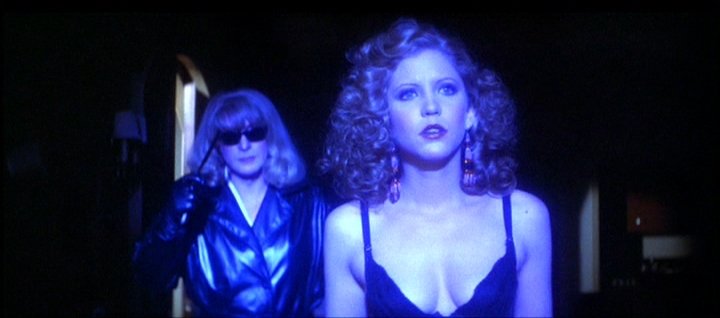
Ms. Allen first came to my (and most of my 16 year old friends’) attention with her performance as bad girl Chris Hargensen in Brian De Palma’s adaptation of Stephen King’s novel “Carrie.” This was her first of four films with De Palma, who she later married (they have since divorced). She did a complete turn around in her next role, a crazy Beatles fan, in “I Want to Hold Your Hand.” It was on this film that she met fellow actress Wendie Jo Sperber. The two began a friendship that would grow and last until Ms. Sperber’s tragic death from breast cancer at the all too young age of 47. After appearing in Steven Spielberg’s “1941” and De Palma’s “Dressed to Kill” (which earned her a Golden Globe nomination for “New Star of the Year” in a Motion Picture) Ms. Allen reunited with her “Carrie” co-star John Travolta for the film “Blow Out.” Dumped into theatres in the summer of 1981, the film was poorly marketed, with the studio practically ignoring the audience it was meant for. Despite rave reviews by such film critics as Roger Ebert, Vincent Canby and Pauline Kael the film came and went in a matter of weeks. However, thanks to home video, 30 years later the film is recognized as one of the greatest political thrillers ever made.

In 1987 she starred as police officer Anne Lewis in the futuristic “RoboCop” and has also starred in films like “The Buddy System,” “The Philadelphia Experiment” and “Out of Sight,” as well as the two “RoboCop” sequels and numerous television programs (“JAG,” “Judging Amy”). Today she devotes the majority of her time and energy to weSPARK, the cancer support center founded by Wendie Jo Sperber. Over the holidays Ms. Allen graciously took time out from her busy schedule to talk with MovieMikes about her career and her determination to carry on her friend’s work:

Mike Smith: You attended the New York High School of the Performing Arts, which was featured in the film “FAME.” High school is hard enough. Was it tough to compete with your classmates both academically and talent wise?
Nancy Allen: It was tough on a lot of levels. Through the ninth grade I had attended an all girls private school with the same group of girls. A very small group. And all of a sudden I’m in a co-ed school. It was wild… there was a lot of pressure. But I think more than anything…I had danced my whole life because I loved it. And it suddenly became something that I was graded on. It really took the joy out it for me. And more importantly it revealed to me that dancing wasn’t my path. I didn’t know what my path was at that point but you have to be so disciplined and so dedicated and such a hard worker…I danced because I loved it. I didn’t have the obsession with it you had to have. So even though it was a one year foray it was fun.

MS: You made four films with Brian De Palma, who you later married. Did you find it easier or harder to work on a project with someone you’re basically spending 24 hours a day with?
NA: We met working on “Carrie,” so my initial relationship with him was a professional one. And quite honestly we didn’t spend a lot of time together on the set because he and I had different responsibilities. So you’re not really together 24 hours a day. Maybe you find time to grab a bite to eat afterwards but you’re so tired that it’s almost like you’re not there. And that, I think, is the challenging part… to find the moments. Because whether you’re working together or not working together, you have to find those moments. On a professional level, there’s a kind of short hand you develop because you really do know each other so well. The communication is much simpler. He knew me and he knew how to get the performance he needed from me and I trusted his direction. Of course, the toughest part is everybody else’s conversations about it! (laughs)

MS: You had the rare opportunity of working with John Travolta just as his career was beginning to take off and then immediately after he exploded onto the scene. Did you notice any difference in the way he approached his work?
NA: No. John is very particular and meticulous about his work. His career actually started exploding at the end of filming “Carrie.” His show (television’s “Welcome Back, Kotter”) had just started airing. I hadn’t seen it but I could sense things on the set. The week we shot the car crash scene the police had to put up barricades. He and I drove to the set together and I was like, “Oh my gosh, who are all of these people waiting for?” On “Blow Out” I had a little trepidation because it had been a few years and a lot had happened. He had already had some high highs but also a few low lows so I really didn’t know what to expect. But the minute he came in we sat down, had something to eat and talked about the movie…started doing some improv. We always had great chemistry and John was John. He was still fun. He was still adorable. I loved working with him. He’s really one of the favorite people that I worked with in my career.

MS: You were both brilliant in “Blow Out.” It kills me that the film was virtually ignored when it came out and is so under appreciated.
NA: It’s actually become a phenomenon in France. People there are crazy for that movie. And I think over the years that people have caught on to it. But it had so many problems. How it was released was a problem and when it was released was a problem. Back then you had summer movies and fall movies. Films were really released a specific way then. Brian tried to convince them that the film wasn’t a big summer block buster. But because the studio had John Travolta they wanted to try and make it a summer blockbuster. And it didn’t work. But it’s got a great cast, an amazing script…it’s a piece I’m really proud of.

MS: You followed “Carrie” with two very strong comedy performances in “I Want To Hold Your Hand” and “1941.” Do you have a preference between drama and comedy?
NA: I love them both. Comedy seems easier because you’re getting the chance to be funny and have fun. When you’re doing a dramatic piece, a lot of times you have to go to those dark places so when you’re doing the work it’s a lot more taxing on your spirit. And a lot of it is the tone…the tone of the set is certainly affected by the piece. Though I have to say that on “Blow Out” we laughed an awful lot. You have to. It’s exhausting to bring up those tears and all of that. So sometimes you have to just be silly.

MS: Like “Blow Out,” I personally think “1941” is underrated. Steven Spielberg was coming off the one/two punch of “Jaws” and “Close Encounters” when it was released. Was there any sense on the set that Spielberg felt uncomfortable doing such a broad comedy?
NA: I think one of the problems was that even though there were “producers” on the set there were no producers on the set. Steven had been so successful that nobody would say no to him. I think the script we started with (written by Bob Gale and Robert Zemeckis) was darn near perfect. But people kept saying to Steven “I want to be in it” and they kept re-writing it and creating new parts and story lines. And from a cast perspective we would ask each other “this is funny, right? I mean it’s Steven Spielberg…he knows what he’s doing, right?” I know a lot of us sensed that things were a little bit off the track. I mean, we started with a fourteen week shooting schedule. Everyone was booked for fourteen weeks. We shot for six months! So that will give you a little idea of things having gone a little bit off the beam. I think there are some really good things in the movie…things that had been in the original script. I’m happy that you enjoy the movie. I have a hard time watching it myself (laughs).

MS: You co-starred in both of those films with the late Wendie Jo Sperber, who sadly passed away five years ago this month (Ms. Sperber died on November 29, 2005). What are your memories of working with her? Are you still active in promoting her weSPARK Cancer Support Center?
NA: That is what I do. That is what my life is dedicated to. I’m there, I run it. I’ve created the whole program format… I fund raise. It is my life’s work. When I first met Wendie we were immediately kindred spirits. I loved working with her. I didn’t get to work with her enough. We just had the best time working together. Especially on “I Want To Hold Your Hand.” In “1941” even though we’re in the same movie we really didn’t work together. She was the kind of friend…everybody has one of them…that even if you don’t see each other for months when you finally talk to them you pick up…it’s almost like you never skipped a beat. Knowing her changed my life. Her asking me to participate and help launch her weSPARK Cancer Support Center came at a time in my life where I was not really happy with the work that I was doing. I didn’t like the projects that were coming my way. I was very unfulfilled. And I had a lot of changes in my family life, my perspectives had shifted. And lo and behold! If someone had told me ten years ago that this is what I would be dedicating my life to now I would have said, “are you kidding? I don’t know anything about this stuff. I don’t know how to do that!” (pauses) I miss her dearly.

MS: Going back to the comedy or drama question, do you think that because you may have been perceived as a certain type of actress – lots of screaming, lots of suspense – that you may have been typecast in some filmmakers’ opinions?
NA: I think it’s something that just happened. “I Want to Hold Your Hand” is a fantastic movie. It just wasn’t a big hit. I think that when you’re successful in a certain genre – more so even then than now – and if you’re a woman, they think “that’s what she’s successful at…let’s get her to do more of that.” You have no idea how many of those kinds of scripts I was sent after I did “Carrie.” I mean I waited a year and a half before I did “I Want to Hold Your Hand.” I think it’s a case where some people don’t even think of you along those lines. Even on “1941.” Steven had cast almost the whole movie and pretty much everybody I knew was in it. And they’d tell me “there’s a perfect part for you in it.” And I’d tell them, “well, Steven knows me. I’m sure he’d be calling me if he thought that.” He finally did call and when I went in to meet with him he said, “I don’t know if it’s because I know you from your work or because I know you personally but I didn’t think of you and you’re perfect for this. I don’t even have to read you.” So there’s a case of someone who knew my work and knew me personally and professionally and didn’t think of me. So I think we remember people for what they’re successful in and we want them to repeat it. Then we beat them up for it…“why do you always do this…it’s not as good as the last one!” (laughs)

MS: Kind of like Jim Carrey. He’s done some fantastic dramatic work and, unless he’s talking out of his butt, he gets panned for it
NA: If you are great at comedy you can do anything. Comedy is THE hardest…really the hardest. It’s unfortunate because he’s really good.

MS: You appeared in all three of the “RoboCop” films? Any talk of making an appearance in the proposed reboot?
NA: I’ve heard about it through fans but no one has approached me. I hate that they’re re-doing the first one. The second and third one I don’t care about but the first film is such a perfect movie, why re-do it? Find something else that didn’t work and fix it.

MS: You recently appeared as a guest at the Chiller Theatre convention? Do you enjoy having the opportunity to meet your fans?
NA: Yes! A group of us (who appeared at the convention) were heading to the airport afterwards and talking about that. There is something so sweet…people have collected things…it’s their memories. They would talk to me about films and certain scenes or certain movies and it’s really a sweet experience. I have to say that I thoroughly enjoyed it. I really did. I love when the share their memories.

MS: I was 16 years old and a theatre usher when “Carrie” came out and I can remember a woman fainting and falling out of her seat at the end of the first show. We were sold out the entire weekend and I can still remember the applause and cheers from the audience when the car explodes and Chris and Billy meet their end. You certainly convinced everyone that Chris was not a good person.
NA: (laughing) She actually was. She was just misunderstood! (laughs)

MS: Are you currently working on anything?
NA: Right now I’m doing a lot of fundraising for weSPARK. I get sent things and I read them but it will have to be really something absolutely fabulous. And I don’t mean it has to be for a ton of money. It has to be something really, really good to take me away for a period of time.

Check out the weSPARK website: http://www.wespark.org/

Click here to purchase Nancy’s movies

Interview with Keith Gordon

Director Keith Gordon is more recognizable then most filmmakers. That’s because before he went behind the camera he starred in some of the most popular films of the 1970s and 80s. His first film was 1978s “Jaws 2,” in which he and his fellow teens are terrorized by a great white shark until police chief Roy Scheider once again saves the day. He shared the credits with Scheider in his next film, playing the young Joe Gideon in Bob Fosse’s Oscar winning “All That Jazz.” Roles in films like “Dressed to Kill,” “Christine,” “The Legend of Billie Jean” and “Back to School” kept him busy until, in 1988, he went behind the camera to direct “The Chocolate War.” He followed that film up with his adaptation of William Wharton’s “A Midnight Clear.” The film was a critical success, earning comments like “Gordon shows the kind of filmmaking talent that creates genuine excitement” from the Washington Post and “Gordon is uncanny in the way he suggests the eerie forest mysteries that permeate all of the action” from Roger Ebert. His other films include “Mother Night,” starring Nick Nolte, “Waking the Dead” and “The Singing Detective,” which stars his “Back to School” co-star Robert Downey, Jr. as well as Robin Wright, Mel Gibson and Adrien Brody.

Currently you can catch his work on television, where he has directed episodes of “House,” “Rubicon” and “Dexter,” even scratching the actor’s itch by appearing in one of his “Dexter” episodes. While planning his next project, and anticipating his 50th birthday on February 3rd, Mr. Gordon graciously took time out of his schedule to sit down with MovieMikes:

Click here to purchase Keith’s movies

Michael Smith: Let me start by wishing you an early happy 50th birthday!
Keith Gordon: Well thank you! It’s a strange one coming up. I usually don’t think much about birthdays but I will say that 50 gives one pause. I does make you reflect on your life and what you’re doing and what you have done…where you want to go. It’s really my first birthday ever where I’ve thought, “wow, this is kind of wild!” It’s really a big number. Half a century. You realize you’ve lived more of your life then you have left to live. I find it very perspective changing. And again, I still haven’t fully digested it. But it’s the first one where I’ve thought, “Wow!” I’m going to be 50 and I realize I only have so many vibrant years left. Hopefully 30 or 40 of them. Hopefully there will be many. My father died this year and that also reminded me of my own mortality. So there’s a lot of thought about what do I want to do with my days? What’s important to me? What’s valuable to me…what do I want to focus on? How much money do I want to make versus what do I want to do to satisfy myself artistically? It really makes you wonder where you want to be.

MS: Both of your parents (Mark and Barbara Gordon) were successful stage actors. Did they influence your decision to make acting your profession?
KG: Obviously when you grow up in a theatrical household you’re going to be influenced by it one way or another. You’ll probably end up running and screaming from it and become an investment banker! I went into it. It’s an interesting irony with my parents because they were always very verbally discouraging of my going into this field because they felt, and it is, a cruel and harsh business. So few people make a living at it. So they would always give me the speeches… “you don’t want this life”…and yet I saw in my father the artistic joy that he had, even when he was struggling, and how much it meant to him to be part of that creative process. And I learned a lot from him. My mother was not really a working actress when I was growing up. She quit when I was born and really only did bits and pieces much later after I left home. Most of her career was before and after my childhood. But my dad…that was his thing. If you grow up with a father who’s a preacher you’re going to learn a lot about the Bible. I grew up with a father who was not only an actor but an acting teacher and a director. So that was the subject of conversation around the dinner table a lot. I absorbed a lot through osmosis and found that I was truly drawn to it instead of being bored by it. If my folks were alive today they’d tell you, “No! We never told him to do it,” but I think being around it and seeing the good sides, as well as the bad, certainly drew me to it. And of course it was my own interests as well. I’ve always primarily focused on film while my father was mostly a man of the theater. He did T.V. commercials and films and episodes of T.V. shows to make money but his passion was really the theater. I was the other way around. I worked in theater as a training ground but I’ve always really been in love with films from a very young age. Even before I thought about it as a career I was a movie geek!

MS: You co-starred as Doug Fetterman in “Jaws 2.” What are your memories of the production? Were you part of the original group of kids cast for the film?
KG: I was one of the few people to make it through the incredible carnage of that film…not so much on screen as off screen. As often happens with Hollywood blockbusters, when things aren’t working people get fired left and right. I think it was because my part was originally so small that no one thought to fire me! I had friends on the set that got fired without shooting a foot of film. They hadn’t had time to do anything wrong. It was really a panic. They had already put so much money into the movie…the shark wasn’t working right…John Hancock wasn’t working out. So they had to let him go and throw out the footage he had done. (NOTE: John Hancock was the original director of “Jaws 2.” Unhappy with his work, the producers replaced him with Jeannot Szwarc. As Hancock’s wife, Dorothy Tristan, had written the script, there was a great delay in the filming schedule. For more on the making of “Jaws 2” please see my interviews with Joe Alves and Carl Gottlieb). So the studio went into a panic state, which will happen when you’re suddenly spending millions and millions of dollars that you hadn’t planned on. I mean, as it turned out, “Jaws 2” made a ton of money and was very successful but I don’t think they were convinced it was going to be. Sequels were not as common at that point…certainly not blockbuster sequels. I think that as our budget doubled and more from what they had planned on there was a lot of fear. And the funny thing about making movies is that fearful thinking about wasting money always leads to wasting more money. You jump on one solution then you jump off of that one to another solution. They brought in new writers to re-do the script but they kept all of us on location during that time, which was something I never really understood. There were all kinds of strange decisions being made, mostly I think because they were in scramble mode.

Click here to view our ‘Jaws” interview with Carl Gottlieb
Click here to view our ‘Jaws” interview with Joe Alves

MS: Your next movie also put you back on screen with Roy Scheider when you portrayed his character, Joe Gideon, as a young man in “All That Jazz.” What are your memories of working for Bob Fosse?
KG: That was a film I begged to be a part of. A friend of mine was working in the art department and I read the script long before production started. I read the part of the young Joe Gideon and called my agent and said, “look, can you get me in?” They were looking for a dancer, which I’m certainly not. I almost fall down walking (laughs). But somehow they convinced Bob to let me read. He liked my reading enough that he said, “we’ll make the dancing part work.” And that’s his genius because when you watch the movie it actually looks like I’m dancing and that I know what I’m doing. And that’s a combination of brilliant cinematography, brilliant direction and brilliant use of a double for a couple of wide shots of the harder stuff. It was interesting to work with him because he was a huge hero of mine. Yet he worked in a way that as an actor…and I think this was because I wasn’t there long and I was young…that was very challenging. If somebody who wasn’t such a genius and directed me the way Bob directed me I think I probably would have bristled at it. But I think that when you work for a Bob Fosse…or a Martin Scorsese or a Stanley Kubrick…and they say “stand on your head and quack” you do it. You don’t question. Bob directed me very much like a choreographer. He was really obsessed with my body language. It was always, “ok, after this line count to three and then move your left hand from this bottle to that bottle and let it sit there for five beats…” My physicality was super choreographed. We didn’t talk a lot about the emotions of the scene, which I thought was an odd technique. But it worked and the scenes came out really well. Obviously the guy knew what he was doing. Another thing he did, which I later learned was a classic “Bob” thing to do…there’s the moment with the strippers where they have me in a corner and they’re sort of molesting me…it’s sort of erotic and terrifying at the same time. For me as an actor…I was seventeen years old when I shot that scene and either a virgin or close to it! The women in the scene were overwhelming…they were real strippers…one was a transsexual…they were a little creepy for somebody that young. Bob came over to me just before we shot and said, “it would really be good if you could actually get hard for this scene.” Then he walked away. And I was terrified. All I could think was that I was now a failure on every level because there was no way I was going to. And I realized later that what he was doing was getting the fear in me…he did it with that manipulation. And I heard lots of stories later about him from people…he would kind of play mind games to get actors into states that way. But he did it magnificently and got brilliant results out of it. So many actors give their best performances in his films. And part of that was because he found ways to push buttons, even if they weren’t conventional and a little disturbing at times.

MS: You had a great horror film double feature with roles in “Dressed to Kill” and “Christine.” Are you a fan of the genre?
KG: Yeah I am! Or I should say I’m a fan of really good horror films. There’s a massive amount of schlock out there…I’m not one of those people that like horror films just because they’re horror films. I think a well made horror film is a great movie. But then I like every great movie. I don’t think there’s a genre that I prefer. I just like great movies.
MS: What was the best part about working with Rodney Dangerfield in “Back to School?”
KG: Obviously he was hysterically funny. There was nobody quite like him. He was arguably the best stand up comedian of his era. There was a new kind of comedy coming out with people like Richard Pryor which was genius in its own way. But Rodney was really the last of the classic stand up comics. In terms of working with him it was challenging because Rodney wasn’t the most comfortable at making movies. I don’t think the process of acting was something that he enjoyed that much. I think the person who really deserves a lot of credit on that movie and doesn’t get it is Alan Metter (the director of “Back to School”). He got a great performance out of Rodney and really got a performance out of Rodney that was not only funny but very human. You really liked him. And that was hard because Rodney was not comfortable revealing anything. He was most comfortable hiding behind a wall of jokes. And if you asked him to show anything that was more “human”…that was scary for him. It was difficult for him and I think Alan really did a beautiful job of getting him confident enough to let him have a handful of moments in the film that were more human…that balanced out all of the wackiness. I think that’s why the film works so well. It’s extremely funny but you also care about Rodney as a character. And I think Alan did a remarkable job working with him to allow that.

MS: You made your feature film directing debut with “The Chocolate War?” Having worked for some great filmmakers in the past (Fosse, Brian De Palma, John Carpenter), did you use anything you may have learned by studying them on set in your approach to directing?
KG: Sure! I could give you a two hour answer to that question. Everything I did was influenced by the directors I worked with. They were my teachers…I never went to film school. I learned a lot about directing actors from my dad…he did a lot of that. I was a nooge on the set. I followed De Palma and Carpenter around on the set. I did it with Fosse but he was a little more stand-offish and busy. I went to all of them and told them “I want to do what you do. Can I come into the editing room? Can I watch dailies? Can I ask you questions? Can I be annoying?” (laughs) And they were all incredibly gracious. Brian especially because he was a teacher…he taught filmmaking at college. In fact the first film we did together, “Home Movies,” was a college project. He directed and the students did everything else. I acted in it and it was an amazing learning experience. It was set up to be a learning experience. I was hired as a professional actor but I ended up acting like one of the students…like I was part of his class. He would literally be directing the film and at the same time explain the choices he was making. Even on “Dressed to Kill” he was endlessly patient in explaining to me why he was doing a certain thing with the lights or a camera movement or a filter. He’s such a brilliant technician in how he uses visuals. I really think I learned a lot from him. So by the time I got to my first set I was ready. I learned from all of them. I loved the way John Carpenter ran the set of “Christine.” It wasn’t like the crew was here and the actors were over there. He constantly works with the same people so the set has a very familial feeling to it. People were laughing and having a good time. You got the feeling that people wanted to be there. And I remember thinking when we were shooting the movie, “God, if I ever do get the chance to direct I want my set to feel like this!” Making movies is hard. Sometimes you’re working fourteen or fifteen hours a day. It’s draining. And my feeling is, if you can’t make it fun people are just going to burn out on you. Before the movie is over you’re going to start losing the focus and loyalty and enthusiasm of your crew and cast. And I think that John did a magnificent job on a film full of stunts and effects and long hours. That was a huge lesson and I try as a director to set that kind of tone with my crew and my cast when we’re on set.

MS: You earned high praise for your WWII film “A Midnight Clear,” which I once declared in a poll as my fourth favorite Christmas movie of all time (behind “A Christmas Story,” “Die Hard” and “Love Actually”). What drew you to that project?
KG: That was actually a project that somebody approached me on. I had made “The Chocolate War.” It wasn’t like people were throwing offers at me. It was an odd little indie movie that had gotten some good reviews. It didn’t make a lot of money or anything. So mostly I was approached with things that were kind of schlocky and didn’t interest me at all…bad horror movies…whatever. I had been approached by one producer with a very Hollywood movie, but it was not me. It was an action/teen movie…not something that I was drawn to. It wasn’t horrible and would have been a very “smart” career move. I was kind of heading towards doing that but not really excited about it. Of course, like what happens with so many studio movies, that movie never even got made. But somewhere along the line A&M, the studio that had made “Birdy,” bought the rights to several other of William Wharton’s books , “A Midnight Clear” among them. (NOTE: like “A Midnight Clear,” the film “Birdy,” which starred Nicolas Cage and Matthew Modine, was based on a novel by William Wharton) But it was hard to set up as a studio film. I believe that Tom Cruise was attached for a time. He wasn’t at the top of his fame yet but he was climbing. He had already done “Risky Business.” I forget who the director attached was but he was somebody who had already made a real splash. But none of the studios wanted to make it because it was too subtle…too sad. Meanwhile, A&M is saying that they don’t want to keep spending expensive option money on this book if we’re not going to get it made…we need to do something with it or let it go. And they had the idea of doing it like it was an independent film. At the time independent films were just starting to get a lot of attention…it was a fairly new concept. After “Sex, Lies and Videotape” it started to catch on but it wasn’t as much a part of the lingo as it is now. They had liked “The Chocolate War” and asked me to come in and share my approach to the material. I liked the book a lot and one of the things I said was that I didn’t think I would change much about it. It works very well…it’s a very cinematic book. And in a funny way I think that’s what got me the job. A lot of times in Hollywood when you come in as a writer or a writer/director they want to hear all of the ways you’re going to make the story different. That makes it seem like you’ve got a lot to say. But because I thought of myself as a director first and a writer second I didn’t feel like I had to try to out-write William Wharton. He was a brilliant writer. I told them “this is a great story.” Yes, I would try to do things with images to mirror what he did with words but I would keep the basic story the way it is and use a lot of his dialogue, which is really well written. I would function more as an editor rather than a writer because they had a really good book on their hands. I think the liked somebody coming in an saying THAT instead of saying, “well, let’s change the setting to Vietnam…let’s do this…let’s do that.” That’s sort of the Hollywood thing. You get the job by showing that you’re going to make it better. But I think when you’re working with great writers…and I’ve worked with some great ones…Kurt Vonnegut and William Wharton and Scott Spencer…you don’t necessarily have to try and out think those guys! They’re pretty smart. All you want to do is help it work in a new medium. So A&M took me on. I wrote a script and they seemed really happy with it. And then there was the very slow process of putting the money together. It came together and fell apart a whole bunch of times. We thought it was happening…it didn’t happen. We thought it was happening…it didn’t happen. And it really came down to where the teen motorcycle movie I was supposed to do for the studio was getting closer to happening. They needed an answer from me and they gave me 48 hours. I told A&M that they better close something fast because I couldn’t afford to turn the other movie down. And in that 48 hours they found the rest of the finances needed to do the film. It was really cobbled together. There were probably eight or nine different sources of money. But they were able to meet the deadline and I was able to do the film I wanted to do.

MS: You returned to the great war, and its aftermath, with “Mother Night.” Do you see this as almost a bookend to “A Midnight Clear?”
KG: I didn’t think of it that way going in because they’re just different kinds of stories. I was aware that I was back in WWII again but it was such a different universe. I wasn’t on the battle field. It was really a different kind of character study. So to me it was an interesting irony that I was in the same universe but it wasn’t something I intended or set up for. I think the reality of most filmmakers lives, certainly mine, is that I think people see patterns. They see you did “this” movie and connect it to “that” movie but they don’t realize that at any given time you probably have five or six movies that you really want to make and it’s just the luck of the draw when one of them actually gets going. And if a different film had gotten going people would be drawing very different conclusions about what you were interested in or what your body of work was trying to say. Because at the same time I was trying to make “Mother Night” I was also trying to make a broad, black comedy about the U.S. justice system. And if I had made that movie people would have said, “ah, he’s interested in ‘X’ instead of ‘Y’.” It’s a funny thing. People look at somebody’s work and they don’t realize that, there but for a role of the dice, you could have had a very different career at any given moment.

MS: Any truth to the rumor that you got a job on the film “I Love Trouble” just so you could give the “Mother Night” script to Nick Nolte?
KG: That is absolutely true. That was basically a lesson in what you have to do to get independent films made. It was such a character piece that we needed a big actor to carry the lead role. Fine Line, which was New Line Cinema’s now defunct art film arm, loved the script and wanted to make it. But they basically said that there were only three actors that they’d do it with: Nick Nolte, Robert DeNiro or Daniel Day Lewis. So we went to Nick first and his agent told us that he was absolutely not interested. “Nick makes $8 million a movie and he has no desire to make a small film. Thank you very much but no thank you.” So then we went to DeNiro and we waited FOREVER for an answer. Finally we heard from his company that he was interested in directing it but not acting in it, which didn’t do me any favors! Daniel Day Lewis we could never reach…he was literally hitchhiking around Europe. He’s known for that…he doesn’t want to live an actor’s life. He was hitchhiking around Europe and his agent couldn’t reach him. Months went by. And then, as sometimes happens, luck becomes part of your career. I wasn’t really acting much anymore but a casting director who knew me was casting “I Love Trouble.” She told me they were trying to get some cool, interesting people in cameo roles in the movie and asked if I’d do it. I asked her to tell me more about it and she told me that Nick Nolte and Julia Roberts were in it. And I immediately said “if you can get me in a scene with Nick Nolte I’ll absolutely do it!” She asked me why and I told her I was a big fan. And I embarrassingly showed up for my couple of line part with a copy of the script under my arm. And Nick…he could have been a top of the line jerk but he turned out to be a real sweetheart. He could have screamed at me or thrown me off the set but he was really nice and extremely gracious. Another big piece of luck is that his then assistant had seen “The Chocolate War” and “A Midnight Clear” and knew my work and said to Nick that this was somebody he should take seriously and look at it. It took months. Nick is famous for losing things. Months went by and we didn’t hear anything so we figured he’d passed. Then his assistant called and asked if we could send another copy of the script because it had “just disappeared.” So we did. And a few days after that I got a message on my answering machine: “It’s Nick…I love the script. It’s great. Come on up to the house and we’ll talk about it.” Now Nick on the phone sounds like me doing a bad imitation of Nick. I figured it was Bob Weide, one of my oldest friends, who had written the script and was producing the film with me. And it took me a while to realize that it really was Nick. I went up and we met. We had a great time. We hit it off immediately and we talked about how we liked to work. We were really in sync with the character and the script and he was in. Much to his agent’s consternation. He wasn’t happy that Nick, who was making $8 million a movie, was going to take a tiny fraction of that to come do this film. But Nick was at the point where he just wanted to do work that he was excited about. And really, if you look at his career since then, that’s really what he’s focused on. He kind of burned out on the Hollywood thing. He went on to do “Affliction” and a lot of amazing movies. He didn’t really care about making a lot of money anymore. He was someone who wanted to do challenging work. I feel glad that we helped him get back to that part of himself. I think he had a really great time doing the film. I think he enjoyed having the freedom to work on a role that was that complicated and dark and full of taking chances. I think he really had fun doing it.

MS: You pretty much gave up acting to concentrate on directing, though you did appear in an episode of “Dexter”. Is there a role out there that would get you back in front of the camera?
KG: I haven’t put a sign up saying “Will Not Act.” I still enjoy acting. But there just wasn’t time to pursue a career as a director and as an actor. I like acting. Acting is a lot of fun. But the life of an actor…the audition process…going back three or four or five or six times for a part…having to be available at a moment’s notice. That didn’t fit with me trying to be a filmmaker. I was putting my time and effort into trying to put movies together. Would I have loved to have had Sean Penn’s career? Would I love to be in the position where people say, “not only will we pay you to be the lead in our movie but we’ll wait until you’re free and work around your schedule?” That would’ve been amazing. But I just didn’t have the time to take on two careers. But if I had to pick, the writing/directing side is more rewarding then the acting side. Now if somebody called me tomorrow and said “here’s a wonderful role…come do it,” I would have a blast. I just don’t feel like doing what it takes to get that. Which is a major time commitment. I don’t think people realize how hard the life of a non-superstar actor is. You’re constantly chasing roles. Doing audition after audition. Getting one out of the thirty or forty things you go up for. It’s a grind unless you’re a big star who’s always getting offered stuff. But if somebody called me and said, “hey, we’re doing a film of “Hamlet,” do you want to be in it,” I’d say “yeah, sure… of course!”

MS: What are you working on now?
KG: As any indie director does, I have a number of projects that are in the “close but not there” situation. I teach a lot too and one of the things I always teach is that the hardest thing about independent filmmaking…what makes it very seductive…is that getting from nowhere to close is really not that hard. Getting from close to “here’s a check, go make the movie” is what’s impossible. I have a lot of things that are one phone call away from happening. But that one phone call may never happen. Or it may be two years from now. You never know.

Click here to purchase Keith’s movies

Interview with Art LaFleur

If you’re a fan of baseball movies then you have to be a fan of Art LaFleur.  He’s appeared in three of my favorites:  “The Sandlot,” “Mr. Baseball” and, of course, “Field Of Dreams.”  After college Mr. LaFleur, an Indiana native, moved to Chicago until a friend convinced him to try his luck in California.  He slowly built a resume that continues to grow today.  Mr. LaFleur took time out recently to speak with 日本のオンラインカジノ.com:

Click here to purchase Art’s movies

Michael Smith: You played football at the University of Kentucky.  Any thoughts of going pro?
Art LaFleur: I was too small, even then, it seemed to me.  I was about six foot and weighed 210 pounds.  Halfbacks were bigger then I was! (laughs)  I held my own but they just kicked the hell out of us.  It was one of those things where I just knew it was not going to happen as far as the pros were concerned.  And actually I’m glad about it now because I can still walk.  There are guys I know that played pro ball, especially back then, that had their knees messed up.  Not a good thing.

MS: What made you decide to pursue acting?
AF: I came out to California in 1975.  I was 32 years old.  A friend of mine convinced me.  I thought I wanted to be a writer and the only person I knew out here was an actor that I had known in Chicago.  He convinced me that an acting class would help my writing.  So I started studying acting with that in mind.  And after about six months I just got more interested in the acting side of it.  In 1978 I got into my first union, which was Equity.  I did an Equity play at the Mark Taper Forum.  And within a couple months of that I got my SAG card and my AFTRA card, so by the end of 1978 I was in all three unions.  I was a working actor.

MS: You studied under Gordon Hunt (father of Oscar winner Helen Hunt).  What is the best advice he gave you that has benefited you most?
AF: Gordon gave us a lot of good stuff but I think one of the most positive things that Gordon did was…every once in a while Gordon would be talking to somebody on the stage…actors who had just done a scene or a monologue.  And every once in a while he would turn around to us, the class, and say, “Remember.  Acting is fun.  And an audition is a chance to act.  It’s not adversarial, because the people at the audition are hoping you’re going to be the one, because if you are the one that they’re looking for…their job is solved.”  He really introduced a very positive attitude toward acting that was great.  And it’s served me well through the years.

MS: You had a brief part in “Any Which Way You Can,” which starred Clint Eastwood.  Later you worked with him in “City Heat.”  Did he remember you?
AL: I’ve worked with Clint on three different films and he’s always been very nice.  But because I had small parts I didn’t really know him that well.  It’s not like I could walk up and say, “Hey, Clint, how are you?” and he’d say, “Hey, Art, how are you?”  Finally on “City Heat” I had a little bit more to do.  Clint kept to himself and of course I didn’t want to bother him.

MS: You worked with Stallone on both “Cobra” and “Oscar,” two very different films.  How was his approach to the two roles?
AL: When we worked together on “Oscar” we had already done “Cobra.”  When we did “Cobra” he was nice.  He was aloof…he was falling in love.  His girlfriend at the time (later Stallone’s wife, Brigitte Nielsen) was appearing in the film so he of course had his own agenda.  But then when I did “Oscar” I walked onto the set the first day and he was sitting at a table, in between takes.  I saw him from a distance and when he saw me he said (in a great Stallone voice), “Arthur.  How you doing, man?”  (laughs)  He’s always been very nice to me.  I like Sly.  He’s a very intelligent guy.  You know, we had just finished the first week of “Oscar” here (California) at Universal when they had a big fire on the back lot.  It completely burned the whole set.  We were shooting on “New York” street, where they had all kinds of antique cars.  They lost everything.  So I was put on “force majeure” for about a week and then we moved the production to Universal and Disney in Florida.  (Readers, “force majeure” is a clause in a contract that covers unexpected problems, including “acts of God,” which the fire would be classified as.  In this case, had the production of “Oscar” been cancelled due to the fire, the studio would not be liable to pay the actors or filmmakers the balance of money owed).

MS: You played Chick Gandil in “Field of Dreams.”  Did you have any sense about the effect the film would have on the public when released?
AL: You know, it was a really great script.  I mean they didn’t change hardly anything.  There was one scene, where James Earl Jones gets ready to go out into the corn, where they changed the lines a little bit to make the scene work better.  But other than that, as far as I know, it was pretty much shot as written.  It was such a good script that we knew it really had a chance of doing well.  But did we know it was going to be as well received as it was?  No.  We didn’t know that but we knew we were doing something special.  When I went to audition for the film, after I read for the part, they had all of the guys that were being considered to meet at a park at nine in the morning and try out…play some baseball so they could see how we handled ourselves.  There were maybe 10 or 12 of us and they were looking for three or four actors…Ray Liotta was already cast as “Shoeless” Joe so they were looking for another three or four guys.  They gathered us up on the infield and told us to go the base that we felt most comfortable at.  They hit us some ground balls and had us throw the ball around so they could see how we could play.  I immediately ran over to first base and there was one other guy, who was younger than I was…he was going to be my competition.  There was just the two of us at first base.  They hit a ground ball to me and I fielded it and threw it back.  They hit another ground ball and I fielded it and threw it back.  Then it was his turn.  They hit him a ground ball, he fielded it…but the guy couldn’t throw.  It was like he never played baseball before.  And I remember standing outside the baseline watching and thinking to myself, “I think I’m going to get this job!”  (laughs)  We got to use modern day gloves then but for the film they had us report to Iowa about ten days before we were supposed to start shooting and we practiced using the older stuff.  Wood bats and older gloves.  And the old gloves were like holding a piece of leather.  Someone threw a ball to you and it was like putting a piece of leather between you and the ball.  So we put these big foam pads inside the mitts.  Chick Gandil was known as “Iron Hands” because, in order to make ends meet, when he wasn’t playing baseball he was a fighter.  There were times when Chick would be at first base and there would be a ground ball to the infield.  He’d go over to cover first base and the ball would be thrown out of reach of his glove hand.  But by stretching he could catch the ball barehanded in his other hand.  Of course, everyone back then had to have iron hands because the mitts were nothing.

MS: Another film that is cherished by baseball fans young and old is “The Sandlot.”  Were you nervous about stepping into the Babe’s spikes?
AL: When I went to read for the part…I had just read “The Babe,” a biography of Babe Ruth.  So when I went into the audition I went in “as” Babe.  I wore a newsboy kind of hat.  I went in with a cigar…the Babe always had a cigar.  Babe Ruth, when he would see kids, he would always say, “hi keed.”  He would always use the word “keed” for kid.  And he had a habit of slurring his words.  When he would talk about baseball he would say “baysh-baw.”  I went to read for Mickey David Evans (the writer/director of the film) and about halfway through he said, “he’s the guy!”

MS: What film gets you recognized most: “Field of Dreams” or “The Santa Clause?”
AL: It used to be “Field of Dreams,” then later “Santa Clause” but lately it’s been “The Sandlot.”  You know it’s funny, every once in a while someone will come up and say, “Hey, you’re Art LaFleur!”  They’ll use my real name.  And I’m so shocked at that.  I can understand somebody recognizing me from one of those films we’ve talked about but knowing my actual name?  When they say, “you’re Art LaFleur, aren’t you,” I’m always surprised.  I’m always recognized for “The Sandlot.”  In fact, just yesterday, I had somebody say, “Hey, Babe Ruth!  How ya’ doing, Babe?”  I was at Wrigley Field in Chicago with my family many years ago.  It was like one of the hottest days ever in Chicago.  The Cubs had won that day, thank God, and we were downstairs after the game in one of the men’s room.  Inside there is a big circular hand washing trough and people were putting their heads underneath the spray of water because it was so hot.  So I put my head under and when I take it out I start drying my dripping face with paper towels.  And I look into the doorway and catch three guys all looking at me.  Finally, one of them says, “Hey, you look just like that guy from “Field of Dreams.”  And with a dripping head I look up at him and say, “well, I was in that movie.”  And the guy says, “Nah!  But you look just like him.”  (laughs)

MS: You worked on “Hill Street Blues.”  The producers never revealed what city the show was set in, though I’ve always thought it was Chicago.  Any idea?
AL: No.  I’ve always assumed it was more like Los Angeles but it’s interesting that you say that because that’s an aspect I never really thought about.  It never came up.  Interesting.

MS: You appeared in my all time favorite episode of “The John Larroquette Show.”  Which do you prefer doing: comedy or drama?
AL: I like comedy and, if it’s the right script, I like drama.  I think when playing comedy you have to play it just a little more broadly.  You need to really be assertive and convinced that you’re the person when you’re playing comedy.  And the more sincere you are…that makes you a little more broader.  But the more sincere you are and the more convinced you are doing the right thing…if it’s funny it’s funny and if it’s not it’s not.

MS: Would you prefer to spend several months on one film role, developing the character or to have several television roles in the same period?
AL: Obviously I think that the more time you have to spend with a character the more you find out about him.  When I did the movie “Air America” I had time before each audition…I did like three or four auditions for that film…and finally, on the last one I read with Robert Downey, Jr.  and I got the part.  But I had three auditions leading up to the last one and each time I had the time to explore the character…to make it my own.  And then when I got the part I had a few weeks prior to us going to Thailand.  Then we did the cockpit stuff in England for five weeks.  So I think the more time you have the better.  You can make the character more interesting.

MS: As a former football player did you give the cast any tips on “The Replacements”?
AL: No. (laughs)  Alan Graff was the second unit director and also the football coordinator and adviser on the film.  When all of the good hits happened on the field, he was the guy behind them.   Alan had played for USC and was on one of the national championship teams of the early 1970s.  I had known Alan because I had seen him on commercial auditions for the past 15-20 years prior to shooting the film.  So one day Alan asked me if I’d like to come out with the second unit.  So we went out and he had all of the different outfits that were worn depending on the team that we played.  Alan would have me get in wardrobe and stand on the sidelines with all of these extras and he would have me go through all of these different gyrations…the ones a defensive coordinator would go through.  Sending signals, that kind of thing.  They would have me throw my hat down…I was elated…I was pissed off.  So I’m in these different outfits and he shot almost little vignettes of me doing different stuff on the sidelines.  The only thing I asked was that he make me look like I knew what the hell I was doing!  Because playing football is one thing.  Being a coach is another.  I’ve always thought I was a good football player.  Football coach…I’m not so sure.  But I was very committed to looking like I knew what I was doing.  We worked on some hand signals and had fun with it.  And when the final film came out they used a lot of it.  During the games they would cut to me and I’d either be happy or sad or whatever.  I was very grateful to Alan for that because he made me look like I knew what I was doing. Having played the stuff where I’m on the sled and yelling at the players…I already knew how to do that!

MS: What do you have coming up?
AL: I just did a pilot presentation called “The Guy Suave’ Project.”  What they are doing more and more is something called a pilot presentation.  Rather than having a $15 million budget to shoot an actual full hour pilot, what they do is take a couple million bucks and have a three day shoot where they shoot a 10-12 minute version…a short scenario of what the show could be like.  “The Guy Suave’ Project” is for the Cartoon Network.  It was a four day shoot and it’s a live action spoof on the spy genre…the 007 genre.  When I first read the script I saw there was a lot of foul language.  The first scene has Guy Suave’ parachuting into some compound and as he’s landing he’s shooting the guards.  And as he shoots the first guard he says, “F*** you!”  Boom.  “Asshole!”  Boom.  And when I read it I thought, “what the hell is this?”  This is never going to make prime time…”Pussy!”  Boom.  (laughs)  There was all of this foul language.  So I called my agent and said, “What is this?”  And he told me it was a legitimate thing for the Cartoon Network.  It will only run late at night for adult viewing.  So I went and auditioned for it and then I did the call back and I got the job.  So I’m waiting to hear on that.  And I’m also getting ready to do a webisode project…a short scenario that the writer/director will take and try to sell.  And I’m still auditioning for commercials and whatever comes up.  I’m looking for work!

Click here to purchase Art’s movies

Interview with Kevin Conway

You may not recognize the name Kevin Conway but you surely know his work.  Of course, if you saw him in “Funny Farm” or “Mystic River” you still might not have known his name because he doesn’t appear in the credits.  Billing counts in Hollywood and if you can’t be featured it’s best not to be mentioned at all!  After beginning his professional life working with IBM he pursued acting by studying at the Dramatic Workshop at New York’s famed Carnagie Hall, later moving on to the famed HB Studio.  He soon found himself doing regional theatre, including what he calls his favorite role, that of Randal P. McMurphy in “One Flew Over the Cuckoo’s Nest.”  He made his Broadway debut opposite Charles Durning, Stacy Keach, Sam Waterson and Raul Julia in the play “Indians.”  In 1973 he won critical acclaim for his role as Vietnam veteran Teddy in Mark Medoff’s play “When You Comin’ Back, Red Ryder.”  Among his other theatre triumphs:  the role of Dr. Frederick Treves in the Broadway production of “The Elephant Man” and Lawrence Garfinkle in both the New York and Los Angeles productions of “Other People’s Money.”  He made his film debut in 1971’s “Believe In Me” and gained recognition as Weary in “Slaughterhouse-Five” that same year.  He also has the distinction of having starred in the first film made exclusively for PBS, “The Lathe of Heaven.”  Mr. Conway has appeared recently on the popular CBS television program “The Good Wife.”  When he’s not working he devotes his time and celebrity to a great cause: the rescue and adoption of animals.  He recently appeared in a PSA to benefit the Best Friends Animal Society (you can view here) and encourages his fans to either visit their web site – www.bestfriends.org – or their local no-kill shelter and find a home for a new friend.  He also recently started his own web site – www.kevinconway.com – which is currently under construction.  Mr. Conway recently took the time to sit down with MovieMikes and talk about his career:

Michael Smith: You won an Obie and a Drama Desk Award for your performance in the off-Broadway show “When You Coming Back, Red Ryder?”  Did you feel like you had “made at” after being recognized for your work?
Kevin Conway: Absolutely.  Before that even.  I had done several plays before “Red Ryder,” including my favorite role, McMurphy in “One Flew Over the Cuckoo’s Nest,” which I did for almost two years in New York and Philadelphia.  I couldn’t wait to get on stage every night.  It’s really American mythology,  that whole play.  McMurphy being the tragic figure…not that something bad has happened to you but knowing in advance that something bad IS going to happen to you.  But you have to do what you have to do anyway.  It’s like Oedipus…just don’t ask who your mother is.  Let it go.  And he can’t let it go.  That role is still the most satisfying I’ve had.  I’ve been very lucky.  Even before that.  My first play in New York was a John Guare play, which wasn’t too shabby.  And the second one was a play called “Saved,” directed by Alan Schneider, one of the great stage directors of that era.  Alan did the premieres of all of the Becket and Albee and Pinter plays.  And it was an important play.  It was an English play and at the time England had a person called the Lord High Chamberlain.  The Lord High Chamberlain would go to a play and if he didn’t like it…if he didn’t think it was a suitable play for the public…it was over.  Gone.  He would withdraw their license to perform.  Edward Bond was the writer of “Saved” and other plays.  He went to court over “Saved” and the court ruled that his work was free speech.  Nobody forces you to go to a play.  If you don’t want to go see it don’t go see it.  The play has a right to be performed.  And I did the play in the states with James Woods.  It was a very controversial play.  So that was really the first time I did anything that got noticed.  I then did a play called “Moonchildren.”  I was a little long in the tooth to be playing a college kid, but then so was the rest of the cast, which included James Woods, Stephen Collins, Christopher Guest, Edward Hermann, Jill Eikenberry, Michael Tucker and Robert Prosky.  And even though it didn’t make it to Broadway there was a big hue and cry because of the way it was mishandled…the way it was publicized.  We started off in Washington D.C.  I had just finished filming “Slaughterhouse-Five” in Czechoslovakia and went right into the show.  I spent one day in New York and then went down to Washington.  From there I moved on to “Cuckoo’s Nest” and then to “Red Ryder.”  Then I did “Of Mice and Men” (with James Earl Jones) and then I went Hollywood for a few years! (laughs)  I came back to New York and did “The Elephant Man” for two years, than I did the television production of “The Elephant Man.”  Then back to film and television for most of the 1980s.  Then “Other People’s Money” came along and I did that for two and a half years.  I also directed the show in Chicago and San Francisco and starred and directed the show in Los Angeles, which was very successful.  It ran almost a year there.  And I have to tell you it all went by fast.  I turned around and it seemed like I had just done “Red Ryder” the other day!

MS: Your first major film role was as gangster Vince Doyle in “F.I.S.T,” which was Sylvester Stallone’s follow up to “Rocky.”  What are your memories of that production?
KC: Well, the film was shot in Dubuque, Iowa and one of the reasons they chose Dubuque was that the film took place in the 1930s.  They needed a place where there weren’t a lot of television antennas.  Dubuque was one of the first towns in the country to have cable television.  It was like an experiment to see if cable was viable.  So because of that the town was perfect architecturally to play the 1930s.  Lots of old trucks and warehouses.  It was perfect.  I was a little nervous, being the big city kid, thinking I was going to go crazy spending months in Dubuque.  But it turned out to be a very friendly town with lots of great things to do…mainly involving alcohol.  (laughs)  On our off days.   So we filmed there and then went to California for a lot of the interior work.  And that’s how I ended up in Hollywood.  I just stayed there for a couple of years.

MS: You worked with Stallone again when, as director, he cast you in “Paradise Alley.”  As “Paradise Alley” ends it’s revealed that your character, Stitch Mahoney, secretly wears women’s undergarments.  Can you share how that came about.
KC: That came about because I have a big mouth!  We were having lunch and I was talking about what a strange, repressed little Irish guy Stitch is.  He’s always talking about his mother and he’s got his gang of thugs.  But on the other hand, there’s something a little “off” about him.  So I said to Sly, “you know, I bet that under all the black clothes and the fedora…the stickpins and the black gloves and the gold teeth…I bet he wears garter belts and women’s underwear.  Stallone stopped eating and looked at me.  “I love it!” (delivered,  I should say,  in a perfect Stallone voice).  So we wound up shooting two endings.  One where there is a big battle in the ring and I get thrown out.  And one where I’m wearing break away pants, which come off when the guy grabs me.  And it had to be ME getting thrown out of the ring, because I had a line to say as the guy holds me over his head.  So we did about ten takes of me being thrown out of the ring from various angles.  And I became an honorary stunt man.  Stunts Unlimited gave me a hat that said that.  And they were incredible.  They basically had to catch me each time and it’s almost like a science.  Each one of them takes a different part of your body as their responsibility so that when you come flying out of the ring somebody goes for your hips and somebody grabs your head and neck and somebody grabs your legs and you fall on them and they act like they’re being crushed but they are really taking care of you.  I didn’t get a scratch on me.

MS: I visited NYC the day AFTER “The Elephant Man” closed on Broadway!  You starred in the production as Dr. Treves and later reprised the role in the television version.  How do you continue to perform a role for so long without losing focus?
KC: People ask me that question a lot.  “How can you do the same play eight days a week?”  And I tell them it’s like walking into a party or some kind of event.  You get a sense of the atmosphere.  Sometimes you feel like the party is going to be a dud.  You can just tell…there’s no energy in the room.  The next one you walk into you can feel a spirit going on.  It’s always different.  Different people create different energy.  So each audience is different.  And I always approach the theatre as if I’m doing it for the very first time.  It’s always an investigation.  And any good actor will tell you that from the moment the play gets started and you begin doing it over and over again you’re really not doing exactly the same play.  Your own mood, your own sense of the energy you have that day…you start investigating the moments in the play and you find that they change.  Sometimes in subtle ways…sometimes in pretty big ways.  The very last performance I did of “The Elephant Man” with Philip Anglim…we found a moment.  We got off stage and looked at each other and said, “Damn, why didn’t we do that? Why didn’t we find this nine months ago?”  It was a great little moment that we had and we found it in the very last performance.  Of course we found others during the course of the show as well.  But there is something about theatre that has an immediacy.  And it’s really your life.  If you’re doing live theatre you’re not going to be able to stay home and watch “Jeopardy” every night.

MS: Can you tell us about how “The Elephant Man” came about?
KC: The show started out as a small play in London called “Deformed.”  It played at one of the smaller fringe theatres…almost a warehouse really.  It was a small, fringe theatre production and it didn’t go anywhere.  But it happened to be seen by Philip Anglim, who was on vacation in London.  And he saw it and realized there was a good part for him (Anglim, like Mr. Conway an American actor,  would go on to receive Drama Desk and Theater World Awards for his work in “The Elephant Man,” as well as a Tony Award nomination.  When the show was performed for television he also earned Emmy and Golden Globe nominations).  He persuaded a producer friend of his to bring it over here.  It started out as a very limited production.  It was only scheduled to run for about two weeks.  And at the last minute the producer got a special off-Broadway contract so that, if we could, we could make it an open ended run.  There was no theater.  When the show started we were working in the basement of a church on Lexington Avenue that had about 60 seats.  He had to rent chairs for people to sit in.  We opened up and I never had this experience…by the second or third night I knew it was going to be a hit just from the audience reaction.  We opened and the reviews were fantastic.  So we moved to Broadway.  But because where we originally were was so small, the set had to be totally reconceived  for the bigger Broadway stage.  And we wanted to wait for the Booth theatre, which is the primary theatre on Shubert Alley.  And so while we waited for the Booth to come available  I went down to Texas to make “The Lathe of Heaven.”  I had about ten days before we re-opened on Broadway so I flew to Dallas and shot the film.

MS: You also played Johnny Friendly in the Broadway production of “On the Waterfront,” a role played so memorably in the film by Lee J. Cobb.  Was it hard to step into a role that so many people already have a preconceived notion of?
KC: The thing about Johnny Friendly…Lee J. Cobb was perfect.  Nobody could do it better than him.  He’s in the movie that’s the classic.  Nobody could top it.  In the original Budd Schulberg story there is no happy ending.  It’s based on a true incident that really happened about a guy like Terry Malloy (Marlon Brando in the film, played in this production by Ron Eldard).  He really did do what happens in the film…he testified.  But in real life not long afterwards he disappeared.  And nobody ever saw him again.  And the character that Johnny Friendly was based on, he wasn’t that big.  Not like Cobb, who was physically imposing himself.  There was something a little off with him.  They hinted almost that there was a kind of homo-erotic relationship with boxers.  And his power came from the position he had, not from his own physical strength.  So we went more for that.  There was still a big fight at the end of the play…I got my ribs cracked during that fight with Ron Eldard.  But we went for it…we tried to do a good stage fight, which is difficult.  You have to be careful when you have a knock down dirty fight on stage…you can’t just go for it because you’re doing it eight times a week.  You don’t want to make a mistake.  I mean look at “Spider-man.”  You make a mistake and you don’t have a show anymore. (Mr. Conway is referring to the new Broadway production “Spider-man: Turn Off the Dark,” which has had several cast mishaps and has gone through constant delays).  We choreographed something that was pretty brutal for Broadway and one night I got hit in the ribs.  Ron used to box so he could punch!  So I wore a protective vest after that.  But it was more that Johnny Friendly was dangerous because of what he could have done, not what he could physically do.  And Ron also played Terry much differently than Brando.  Which I think was right because you can’t imitate the roles of a classic film that almost can’t be improved on.  James Gandolfini was in the show, as well as David Morse, who was playing the Karl Malden part.  I really think the show could have been good but there was just too many backstage problems between financing and switching directors.  The show never really gelled, never came together.  I was hoping it would succeed because when you looked at the drama that was being performed on Broadway at the time it was primarily British plays.  They would import them over with the British cast.  The British cast would play for awhile then leave.  They’d re-cast the show with American actors and then the show would close in a month.  And “On the Waterfront” was purely and American story.  And it had a cast that wasn’t movie stars.    When I won the Drama League award for the show I made a speech that might have been ill advised.  I didn’t have to but I did.  All of the producers were there and I said, “you know, it used to be that Hollywood would come to Broadway to look for talent.”  That’s where Jimmy Stewart and Henry Fonda and Jimmy Cagney…Bette Davis, Katherine Hepburn.  These people all came from Broadway.  They were brought out to Hollywood by the studios because the studios wanted the “class” that came with having a Broadway actor.  Cagney and Joan Blondell were brought out to reprise a small role they had in a show that was owned by Al Jolson.  Jolson agreed to give the studio the rights to make the film if they agreed to take Cagney and Blondell.  And I said what’s happening now is that you have a play with me and Ron Eldard and Penelope Ann Miller and David Morse…we’re not well known actors.  We don’t necessarily sell tickets.  But we have good reputations.  We’ve all done theatre.  I’d probably done more than all of them.  But the mindset became “if we can get a Hollywood actor who’s between movies and get him to play this part for a couple of months we can get a big advance sale on his or her name.”  And if that actor leaves they’ll get another, hopefully cheaper actor with a name.  A play is about chemistry.  You have to find the right chemistry between actors.  You rehearse.  If you can bring in a movie star and make your money back, that’s fine.  But don’t forget to do plays that are worth doing with the right actors in them.  And I said now it looks like Broadway is looking to Hollywood for actors to come slumming for a few months, when it used to be the other way around.  I said I’m not really holding my breath to see Kevin Costner’s  “Coriolanus.”  These are movie actors…very good movie actors, but movie actors.

MS: You directed and appeared in the film “The Sun and the Moon.”  As an actor, what was your hardest challenge as a director and vice versa?
KC: I had a small part in the film.  I did it to save money because I was very inexpensive.  Zero.  I didn’t have to pay myself anything.  It was the first, and last, narrative film I’d ever directed.  I didn’t expect to direct it but the original director fell ill and I had to jump in and do it.  I helped them raise the money for it.  It was a nice little film and I’m still proud of it.  It’s a film about the Puerto Rican experience in New York City and how, among all the Hispanics, the Puerto Ricans are the only ones who are American citizens.  They can freely travel back and forth to Puerto Rico…they’re not aliens, if you will.  And it’s caused a cultural schizophrenia.  People have emigrated here from the island to get jobs and raise their kids, but then they want to go home.  They want to go back to the island.  But the kids don’t.  The kids become “Americanized.”  In New York they call them “Nuevo Ricans.”  And this causes an interesting dynamic because the parents tend to be more old fashioned and conservative in their values while the children were wilder.   The story is about a woman who is from Puerto Rican heritage who lives with my character, a sort of Phil Donahue type who is a talk show host.  And I’m a terrible husband…I cheat on her and everything.  So she runs away from her comfortable Manhattan life style and the only place she knows to go to is where she was born, which was the South Bronx.  And when she gets there she becomes involved with the people who live in her building…very different characters.  The film got some very nice reviews but by the time it came to be released it was almost, may I say, too soft for the market.  Even though it took place in the South Bronx there was no crime in it.  No rats.  There was a problem with the landlord but that was it.

MS: What do you have coming up?
KC: I’m leaning toward the theater.  That’s what I want to do next.  I’m always open to offers.  I was just offered something but I didn’t like the part.  I’m very lucky in that I don’t have to take every part that comes along.  This one was for a pilot and I really didn’t want to do it…I didn’t want to lock myself in.  I’m really looking to do some theater.  That’s what I like to do.  A short run…no two year shows anymore.  If I could find a show here in New York and get those muscles going again, that would be great.  And hopefully a big movie somewhere in Paris or Morocco or someplace else I’ve never been.  I’ve been to Paris but I’ve never been to South America.  Maybe something in Buenos Aires!?

Interview with Vincenzo Natali

“Wow!” If I truly transcribed my interview with “Splice” director Vincenzo Natali properly, each of my questions would have been preceded with the word “Wow!” Almost every question opened up the possibility in my mind that what I saw on screen in “Splice” may very soon one day be a reality. With “Splice” scheduled to open this Friday, Mr. Natali sat down with MovieMikes and talked about his new film, what inspired him and his one day plans for the Swamp Thing.

Click here to purchase Vincenzo’s movies

Michael Smith: Where did the idea for the film come from?
Vincenzo Natali: It actually came from a real M.I.T (Massachusetts Institute of Technology) experiment. I saw a photograph of a thing called the Vacanti Mouse. It was a mouse that appeared to have a human ear growing out of its back.

Michael Smith: Oh wow!
Vincenzo Natali: It was quite a shocking image. It wasn’t a genetic experiment…it just looked like one. And I immediately felt that, somewhere in that mouse there was a movie. And that’s how it began. And I have to say that on almost a weekly basis I read about developments that echo our film. Just today I read that Craig Venter, who is your prototypical rock and roll geneticist, has created the first completely artificial life form. It’s pretty amazing.

Mike Smith: Is Venter the basis for Adrien Brody’s character? I noticed in the film that, while most of the scientists were very stoic and wore white coats, Clive (Brody’s character) had the cool apartment…the cool t-shirts.
Vincenzo Natali: Venter is actually an older guy. But, yeah, when I first read about him…I felt justified in how I was writing Clive. I intuitively felt that, when my generation gets involved in this stuff, that’s what they’re going to be like. And that was later confirmed when I went to real labs…the mean age of the people working in the labs was around thirty. There were quite a few Clives and Elsas (Sarah Polley’s character in the film, also a geneticist). They were really great people (laughs). I really liked them.

MS: I’m sure you had technical advisers on the film for a lot of the scientific stuff. Did any of them ever tell you, “Wow, you know, what you’ve conceived here can, or might, one day be a possibility?
VN: Yeah. You know, I co-wrote the script (with Antoinette Terry Bryant and Doug Taylor), but we did it in consultation with a geneticist. We would present him with ideas and, what was really shocking to me, was that he would invariably say, “yes, that’s possible.” So what I learned is that there’s a pretty wide bandwidth between what is possible in this science. And so there is nothing in “Splice” that is completely beyond the pale of possibility. Now some of it might be unlikely. Some of it may not quite be possible yet. But there is no doubt in my mind that they’re getting very close.

MS: Where did you get your inspiration for the story of your film “Cube?”
VN: I would love to say that it was some divine inspiration (laughs) but it just came out of the fact that I was trying to make a low budget movie on one set. I knew that it would be hard for me, as a filmmaker, to do a movie like “My Dinner With Andre” … that’s the kind of movie most attempt to do with a limited location. And it suddenly occurred to me, what if one set could double as many? And that led me to think of a maze of identical rooms. And then I thought it should be a symmetrical maze and, therefore, a cube. So really, necessity was the mother of invention in the case of “Cube.”

MS: How did you come up with the concept…with the look…of DREN? Did you intend her to have, say, the certain traits of one creature and then different traits of another?
VN: I always thought DREN should be a genetically engineered angel. And I was really fascinated with the thought that…you know, the concept of animal hybrids and animal/human hybrids. These have been a staple of mythology that transcends all borders and cultures. And now here we are in the 21st Century on the cusp of actually making these animals with new technology. So I really felt that DREN should have her roots in myth. And even though she wouldn’t be a typical kind of angel, there would be certain aspects of those mythical beings. But, having said that, the number one priority for myself and all of the designers and effects artists involved in the creation of DREN was to make her real. We really wanted a creature on-screen that an audience can believe.

MS: Well it sure worked for me!
VN: (laughs)

MS: Was there any scenes shot that gave a back story to Elsa? I take it from the scenes that are in the film that Elsa had a very negligent mother…she wasn’t loved, she wasn’t appreciated. Which is why I think she really overdoes the nurturing of DREN.
VN: That’s exactly right. We flirted with the idea of having more of Elsa’s background but at the end of the day our fear was that it would be over the top. It would just be maudlin and melodramatic. So we sided with the idea that less is more. Because all you need to know is that she had an unhappy childhood and that her mother was a very bad mother. Beyond that we just leave it to the audience to draw their own conclusions.

(I mention a particular scene in the film – no sense spoiling it for you)

VN: That’s really all you need to know.

MS: Is it true that you are remaking “Swamp Thing” in 3D?
VN: No, not yet. I wish that were the case unfortunately. I’ve done a lot of research on this and “Swamp Thing” is really in the swamp! (laughs) A legal swamp…a legal quagmire. There are all kinds of entities involved in controlling the rights and I’ve been told it just can’t happen anytime soon. So sadly we’ll have to wait for “Swamp Thing.” I loved that comic book…in particular I liked the Alan Moore take on “Swamp Thing” which is really very different than what Wes Craven did with his film. It would have been something really new and cool. But I think we’ll have to wait a little while.

MS: Speaking of Wes Craven, and I have to say that I almost consider “Splice” more of a horror film than a fantasy film, did you have anyone who really inspired you when you were younger and going to the movies?
VN: Many. When we talk about creatures I immediately think of Ray Harryhausen…a great animator who did all of the “Sinbad” films…all of the stop-motion monsters in (the original) “Clash of the Titans.” I thought his creatures really “humanized” the monster…they were creatures that had character. He clearly was a filmmaker who had tremendous empathy for these things. And that was really the guiding principal with writing DREN…that she be a character who would, in many respects, demonstrate more humanity then the human beings in the story. Ray Harryhausen would definitely be at the top of the list.

MS: That’s a great start to the list. Since “Swamp Thing” is not an option right now, do you have anything else in the pipeline?
VN: Well, you know you have to scatter a lot of seeds these days when trying to get a movie made. It’s always a challenge. What I have, actually, are all book adaptations. There’s a J.G. Ballard novel I very much want to make called “High Rise.” I’ve been working on it for a number of years. It’s about a super high rise, very much like the Burj in Dubai…the world’s tallest building. It’s about how the building, which is almost like a vertical city…populated with a vertically integrated society, which then collapses. I consider it a “social-disaster” film. It’s really an amazing story. There’s also a kids book I’m working on called “Tunnels,” which is kind of a fantasy that takes place under the streets of London. And then, recently, I believe I’ve got my hands on “Neuromancer,” the William Gibson novel. Which is really one of the greatest works of science fiction…in my opinion one of the most influential science fiction novels of the last 25 years. It’s pretty exciting.

MS: Thank you so much for your time. I hope “Splice” finds it’s audience. I hope it doesn’t get lost in the summer shuffle. It’s that rare movie that…it draws you in…it excites you. And when it’s over and you’re leaving the theatre it makes you think. And that’s certainly a rarity these days.
VN: Wow. That’s high praise. Thank you so much. I really appreciate that.

Click here to purchase Vincenzo’s movies

Interview with Carl Gottlieb

As a fan of the movie “Jaws” I was overjoyed to have the opportunity to interview Carl Gottlieb. Not only had Mr. Gottlieb co-written my favorite film but he had also written a great book that told the story of the making of that film. First released in 1975 “The Jaws Log” is regarded by both film fans and Hollywood insiders as one of the best books ever written that document the making of a major motion picture. The book went through 17 printings and sold over two million copies (I know that I own at least three of them). The book was introduced to a new generation of “Jaws” fans when it was reissued, with updated notes by the author, in 2005. A brief introduction to Mr. Gottlieb will tell you that he had plans to be a playwright and critic. While attending Syracuse University he studied drama, working alongside fellow students Frank Langella and Larry Hankin. Making his way West to San Francisco Mr. Gottlieb soon joined the popular improvisational comedy troupe known as The Committee. Among the group’s more esteemed members: Alan and Jessica Meyerson, Richard Stahl, Howard Hesseman (who performed under the name Don Sturdy), Peter Bonerz, Barbara Bosson, Rob Reiner and David Ogden Stiers. Fans of the film “Billy Jack” will notice several members of “The Committee,” including the Meyersons and Hesseman. In 1968 Mr. Gottlieb became a member of the Writer’s Guild of America and began writing for “The Smother’s Brothers Comedy Hour,” sharing an Emmy award for his work with several other young writers on the cusp of fame including Bob Einstein (now better known as Super Dave Osborne), Steve Martin, Lorenzo Music and Mason Williams, who would later become better known for composing and performing the classic guitar instrumental “Classical Gas.”

Gottlieb also kept himself busy with the acting side of his career, appearing on such television shows as “I Spy,” “Chico & The Man,” “Laverne & Shirley, and “Mork and Mindy”. He also appeared in the Academy Award winning film “M*A*S*H.” But his career really rocketed skyward after he was hired to play local newspaper editor Harry Meadows in “Jaws.” A friend of director Steven Spielberg, Gottlieb was asked to redraft author Peter Benchley’s script, giving the film more well developed characters and, more importantly, humor. Ironically, the more Gottlieb tightened up the script the fewer scenes he found necessary for Meadows to appear in. Not to worry. When “Jaws” was released it was met with almost unanimous acclaim, with Benchley and Gottlieb earning BAFTA, Golden Globe and Writer’s Guild nominations for Best Screenplay. And, as noted above, Mr. Gottlieb shared his experiences on the film in the best selling “Jaws Log.” His next writing gig found him adapting Lina Wurtmuller’s film “The Seduction of Mimi” into a comedy set to star Richard Pryor. That film, “Which Way Is Up?,” was recently named the funniest Black comedy of all time by ILoveBlackMovies.com, a web site devoted to preserving and presenting the history of African American filmmaking, both past and present. Following the release of “Which Way Is Up?,” Gottlieb found himself contacted by the producers of “Jaws 2,” whose production was in dire straits, having just fired the director one week into filming. Gottlieb was brought in to once again enliven the screenplay. He then teamed up with old pal Steve Martin for two projects. The first put Gottlieb behind the camera for the first time as director. The result, “The Absent Minded Waiter,” earned an Academy Award nomination for Best Live Action Short Film. Project number two was Martin’s big screen debut as “The Jerk.” (Note to readers: please do not write me to point out that Martin had actually been on screen the previous year in “Sgt Pepper.” Though he was the best thing about that movie, 10 minutes on screen does not a movie star make. Thank you). Gottlieb not only helped co-write the film but had a memorable moment as Iron Balls McGinty.

In 1981 Gottlieb co-wrote (with the very funny Rudy DeLuca) and directed the well-received comedy “Caveman,” starring Ringo Starr, Barbara Bach and two newcomers about to hit the big time: Dennis Quaid and Shelly Long. Later in the decade he contributed to the screenplays of “Doctor Detroit” and “Jaws 3-D.” He later made his way into television directing, crafting episodes of shows like “Hooperman.” He has also returned to book writing, most notably releasing two books co-written with musician David Crosby: “Since Then: How I Survived Everything and Lived to Tell About It” and “Long Time Gone.” Mr. Gottlieb has been active in the politics of the Writer’s Guild for over three decades, serving on both the Board of Directors and as the Guild’s Vice President. Still writing at age 72, Mr. Gottlieb graciously took time out to talk to MovieMikes:

Click here to view our ‘Jaws” interview with Joe Alves
Click here to view our ‘Jaws” interview with Keith Gordon

Click here to purchase “Jaws” merchandise

Mike Smith: You attended Syracuse University and studied acting with Frank Langella and Larry Hankin. Did you make a conscience decision to make writing your main vocation or was that just something that occurred naturally?
Carl Gottlieb: It occurred naturally. Even though I went to school with Frank and Larry, I was a dual major, in drama and journalism. I thought I was going to be a playwright or critic. I acted because it was convenient. I don’t know if you remember school plays 50 years ago but there was always a shortage of guys…so there was always a part for me to play. I drifted into acting. My first love was always writing, and when I was at the City College of New York, I was editor at The Mercury, which was CCNY’s humor magazine, back in the mid-50s. So I was always a writer.

MS: You won an Emmy award for your work on “The Smother’s Brothers Comedy Hour.” Your fellow writers included Steve Martin and Lorenzo Music. The film “My Favorite Year” really gives a great behind the scenes look at television writers, especially comedy writers. With all of the talent in the room, how were the shows written. Was it a group effort or did each writer submit material that the others would later help fine tune?
CG: Very much so a group effort. We had a writer’s common area with individual cubicles opening off it where writers could go off and work on their own or as partners. Lorenzo and I would go off and write Tom and Dick’s monologues and we wound up writing a piece for Bob Newhart when he was a guest on the show. Newhart liked the piece so much he made it part of his act. And later Lorenzo went with another partner (David Davis) and created “The Bob Newhart Show.” (Readers, if the name Lorenzo Music sounds familiar it could be because you know his voice. He has played everyone from Carlton the Doorman on “Rhoda” to the voice of the animated cat Garfield). The atmosphere in the room was always collaborative…a bunch of writers pitching ideas and jokes. That part of comedy writing hasn’t changed since radio.

MS: You appeared in the feature film “M*A*S*H.” Gary Burghoff was the only member of the film cast to reprise his role in the television series. Were you approached to do the series?
CG: No. None of us were. We never understood that. I don’t know what kind of magical power Gary Burghoff’s agent held but he was the only one who was asked to be in the series. I think Roger Bowen (he played Lt. Colonel Henry Blake in the film), who went on to do other series, was a perfect Henry Blake. To me the guy who created the role in the film should clearly have gone on to do the TV series. John Schuck should have been asked. A lot of the people ended up on television anyway, but I never understood that casting.

MS: Ironically, both Roger Bowen and Maclean Stevenson (TV’s Henry Blake) passed away within a day of each other.
CG: Yes. I spoke at Roger’s memorial service because I had known him from “The Committee” days. And I said at the service, “When Maclean Stevenson showed up at the pearly gates God took one look at him and said, ‘no, no, no….the guy from the MOVIE.”

MS: Here is a question I’ve been dying to ask for 30 years. Your most famous scene in “Jaws” was left on the cutting room floor when, during an earlier version of the discovery of Ben Gardner’s boat you accidentally fell out of the boat. I meant to ask you this at JAWSFest but my mind went blank the moment I met you. You note in “The Jaws Log” that the scene of the dead fisherman’s head popping out was added much later in the film process, with director Steven Spielberg hoping to get an extra scare out of the audience. In the film, when questioned about the discovered shark tooth by Murray Hamilton, Richard Dreyfuss explains that he “dropped it.” Can you recall what initially happened to the tooth?
CG: It was the appearance of the head. The original shot was effective but it wasn’t as effective as it could be. Steven had an intuitive grasp of what really worked and decided he needed that underwater angle. If you notice in the film…I don’t watch it frame by frame but I know a lot of people do…he pries the tooth out of the hull of the boat…the head appears…he recoils in horror and at that moment the tooth drops. It was actually written as the scene happened. We needed a reason for him not to have it. When we shot the scene on the Vineyard (Martha’s Vineyard) where he says “I dropped it” we hadn’t shot the scene. The Ben Gardner’s head scene hadn’t been shot yet. The whole point being he didn’t have the tooth with him to argue with the mayor. Chronologically they cut the shark apart, find the tooth and then go to the mayor. In June 1974 he didn’t have the shark tooth to show the mayor and then in 1975, when we shot the replacement scene, it was shot so he didn’t have the tooth in his hand when he popped back to the surface.

MS: Thank you. That was worth 35 years of wondering.
CG: : (laughs)

MS: You became responsible for one of Hollywood’s most successful marriages when you cast Ringo Starr and Barbara Bach in your film “Cave Man.” I’ve always found Ringo to be a natural on film. Was he easy to work with?
CG: Very easy, but a little erratic. I knew Richard Lester (director of the Beatles films “A Hard Day’s Night” and “Help”) because I had appeared in his film “Petulia,” which had been shot in San Francisco. He was a fan of “The Committee” and we knew each other through the world of comedy. So when I considered casting Ringo in “Cave Man” I called Richard Lester in London and asked him “what can you tell me about working with Ringo?” And he said, “I always give him his own camera because he’s not that good at repeating things…so make sure you’ve always got him.” And I followed that advice. And Ringo, of course, was inventive and relaxed and funny on camera and we got everything we needed.

MS: You co-wrote and appear in “The Jerk” with Steve Martin. But earlier you directed him in the Oscar nominated short “The Absent Minded Waiter.” Were you two friendly before working on “The Smother’s Brothers” show?
CG: I’ve stayed friends with almost all of the writers on the “Smother’s Brothers” show. The Class of ‘68/’69. It was me and Steve Martin and Rob Reiner and Bob Einstein and Lorenzo Music and Mason Williams. We were all roughly the same age…had the same interests in girls and pop music. We all stayed friends. I was working on a script and I house sat Steve’s house in Aspen. I watched his house and fed his cat while he was on the road. We all just stayed friends since the summer of ‘68. We all met on “The Summer Brothers Smother Show“, which was the Glen Campbell replacement summer show. That’s where we met and we just stayed professional and social friends. And since I was already going to be writing “The Jerk” with Steve the short made sense for me to direct since I might direct the movie.

MS: There is a Kansas City based web site called ILoveBlackMovies.com which does a great job honoring the various genre’s in African American cinema. Recently “Which Way is Up?” was chosen as the funniest Black comedy of all time. Was it hard, for want of a better word, to write for what I’m sure was perceived as a predominantly black audience?
CG: Richard Pryor was just breaking out at that moment. He had done a film called “Greased Lightning” about the first black NASCAR driver, directed by Michael Schultz. And that pairing of Michael and Richard seemed potent as “Greased Lightning” turned out well in the studios’ eyes. So a producer who had bought the rights to Lina Wurtmuller’s film “The Seduction of Mimi” hired a black novelist named Cecil Brown to write the first draft. I had known Richard from the world of comedy, from his stand up. And I had worked on the Flip Wilson television specials that Richard had appeared on as a guest. Between the time “Jaws” was written and “Jaws” was released I did four Flip Wilson specials, two which featured Richard as a guest. I knew him and I was comfortable working with him. I wrote some comedy for him that played very, very well. I had an ear for the vernacular. The producer suggested we work together and I listened to what Richard wanted to do. He and I went to Barbados. I went with my wife and Richard went with Pam Grier, who he was dating at the time. He rented a villa for two weeks and we spent the time there writing…talking about the characters. He thought he could have fun playing several different characters instead of just the lead role. So when we came back and the film went into pre-production Richard said, “I can do Mudbone…I can do the preacher” and Michael Schultz thought that was a great idea. So I re-wrote the script to accommodate those characters. And ultimately, at the first table read, I was introduced as the writer and people kept looking past me for the African-American and I kept saying, “no no, it’s me.” Everybody was kind of taken aback because the cast and crew were predominantly black and Hispanic. I got a lot of street cred for being able to – quote – “write black.” Though it’s not really “writing black.” It’s more to having an ear for dialogue and sympathy for the characters. The color of the writer is almost immaterial.

MS: I was actually thinking when I re-read that question, I was a movie theatre usher and we played the film forever. It’s one of my favorite films and I can probably quote the movie line for line. And I guess it’s safe to say that comedy really has no color. If it’s funny, it’s funny.
CG: That’s true…that’s true. “Which Way is Up?” is a very socially conscious movie. It’s about farm labor and agribusiness and the exploitation of workers, which came directly out of Lina Wurtmuller’s particular brand of Italian socialism. The original title of Lina’s film was “Mimì metallurgico ferito nell’onore” (“Mimi the Metalworker”) then it was released here as “The Seduction of Mimi.” I was happy to write it because I came from political theater. I was very happy to get as much politics as I could into the movie, especially with a spokesman like Richard, who really spoke across class lines but whose experience was with the underclass…black or white, it didn’t matter. Real blue collar. Still, he was very funny. All I had to do was listen to the cadences of his speech and reproduce it as a screenwriter. The same with the other actors. I knew several of the Hispanic actors from the LA comedy scene…it all worked out fine.

MS: Several years ago I had the chance to interview Daniel and Luis Valdez (actors in “Which Way Is Up?” and talented writers in their own rite. Luis Valdez wrote and directed “La Bamba”) and they spoke very highly about their experience on the film. When I interviewed Joe Alves (production designer on both “Jaws” and “Jaws 2” – director of “Jaws 3-D”) I learned that the original concept of “Jaws 2” was that the town of Amity was pretty much a wasteland and decimated because of the original shark. After the director (John Hancock) and writer (Dorothy Tristan, Hancock’s wife) were fired and you came aboard how much of the story did you have to change to fit the vision the producers and new director wanted?
CG: A pretty large amount. As always, when you come on a picture late and they’re already shooting, you have to accommodate yourself to the sets. They’re not going to build a new lighthouse…a new dead orca…a new power station in the middle of Nantucket Sound. So you have to write to the existing sets but you’re free to move the characters around. I added this whole thing about the kids cruising in sailboats the way they used to cruise in hot rods, which gave us a device to get all of the kids together and put them in jeopardy as a group. It was a pretty substantial rewrite. The original “Jaws 2” script had some great writers, including Howard Sackler, which was probably his reward for being uncredited for the work he did on “Jaws.” But, the director and his wife started tampering with the script. The director was not particularly competent. The first week of principal photography was just so problematic that he was taken off the picture and they junked his wife’s script.

MS: Earlier this year you received the Morgan Cox award from the Writer’s Guild of America in recognition of your vital ideas, continuing efforts and personal sacrifices in ensuring the success of the Guild. How did it feel to be recognized by your peers? Not only those you may have worked with but those whose careers you may have inspired?
CG: It was a wonderful evening and a great honor. Guild service – or any kind of service work where you give your time and energy as a volunteer to a cause – that’s usually its own reward. It’s nice to be honored. It’s nice to have a dinner. That particular evening was special because it was also the night of the annual Writer’s Guild Awards, so there were the winners of Best Screenplay, Best Series, Best Comedy….all of those awards were given out the same night as mine so I was in the company of people whose work I admired and respected and people who I had known for years and who also worked on behalf of the Guild and on behalf of writers. It was touching and very satisfying. Needless to say I would have done the work even with no reward– you never start anything with the notion you’re going to get a trophy 25 years later. You just show up and do the work.

MS: I know you’ve concentrated recently on books, including two with David Crosby. Anything else on the horizon?
CG: I’m finishing what will be called “The Little Blue Book for Directors.” It’s essentially a handbook for young directors, whether they’re a film student or someone making their first YouTube video. It’s basically everything you need to know to direct a movie (laughs) (readers, it should be pointed out that “X-men” director Bryan Singer refers to “The Jaws Log” as being ‘”like a little movie director bible.”) I’ve also just finished a screenplay about the early Tin Pan Alley vaudeville songwriters during the first world war, called “The Stowaways.” And a year or two ago I wrote a screenplay that I thought would be totally original and new, that nobody had ever seen anything about this area…I researched it and was so proud of myself because I was the only one who knew about it…Pirates off Somalia. (laughs) The script still exists but now all the time and pages that I took to explain why there were pirates in Somalia…I don’t have to do that anymore. So I’m rewriting the script to accommodate current realities. It’s called “Privateers.”

Click here to purchase “Jaws” merchandise

Interview with Chris Sanders & Dean DeBlois

The directors of “How To Train Your Dragon” come from very different backgrounds. Chris Sanders hails from Colorado while Dean DeBlois hails from Canada. Though a decade older, they both began their professional careers around the same time, working for two of Hollywood’s legends: Jim Henson and Don Bluth. Sanders began working for the Walt Disney Company in 1990, where he served as a character designer on “The Rescuers Down Under.” In 1991 he helped write and create an impressive string of animated films regarded today as classics, including “Beauty and the Beast,” “Aladdin,” “The Lion King,” “Mulan” and “Lilo and Stitch,” which he also co-directed. Finding the work with Don Bluth not to his liking (“A Troll in Central Park” was a long fall from the heights of “An American Tail”), DeBlois joined Disney and soon found himself paired with Sanders on “Mulan.” Their next project, which both men wrote and directed, was “Lilo and Stitch,” which earned an Academy Award nomination as Best Animated Film. The film, and it’s various animated spin-offs, also kept Sanders busy as he provided the voice of Stitch. Their next project, which opens this week, is the 3D adventure “How To Train Your Dragon.” I recently shared a phone call with the two filmmakers, who were promoting the film in our nation’s capital. I was tempted to ask Sanders to answer my questions as Stitch but realized I would never understand his answers!

Click here to purchase “How to Train Your Dragon”

MS: You worked on “The Muppet Babies” television show. Was that your first professional job?

CS: (surprised) Oh my gosh! Yes. I drew models for that.

MS; Was (Muppet Creator) Jim Henson someone that had inspired you growing up?

CS: When I was a kid? Yes. My two big influences were Carl Barks (who drew the popular “Donald Duck” comics) and Charles Schultz (the creator of “Peanuts”). Carl not only drew Donald Duck but he told some great stories.

MS: Though you have a few directing credits the majority of your film work has been writing. I mean, you’ve written or helped write five modern animated classics. Was your intention to make writing a career or is it just something that you discovered you were good at?

CS: That’s interesting. When I got to Disney I started in the story department. And to my surprise, I discovered that there is a little bit of writing you can do all the time when you’re in “story” because when you’re given little sequences to movies you always have to do a little customizing, so it becomes very natural to start writing sequences when you’re in the story department. On “Mulan” I started out as the head of story and actually ended up doing quite a bit of writing for the movie. And from there I went to “Lilo and Stitch.” I should mention that Dean and I met on “Mulan, where we both were writing the story. And then from “Lilo and Stitch” we went on to the “Dragon” movie, where we’ve continued our relationship.

MS: What is the time frame from sitting down and knocking out a script to the finished animated feature?

CS: Animated films, in both traditional animation and CG, tend to go about three years average. They can go four years, a little bit longer or they can go shorter. The interesting thing about “How To Train Your Dragon” for Dean and I is that we actually joined the film after it was being developed, so we came on fairly late in the process. By the time we were asked to come on and write and direct the film it had about fourteen months to go until the start of production. So that was a very fast schedule by anybody’s standards. But the amazing thing is that the crew we worked with was able to pull it off. We really did re-writes and started the film, story-wise at least, from scratch, fourteen months before the end of production.

MS: That’s some serious speed. Do you enjoy spending that much time on one project or are you looking forward to doing something that’s live action with a much shorter production schedule?

CS: (laughing) We definitely look forward to doing that at some point. We’re very interested in trying out as many things in the business as possible. We love animation. We love live action. One of the amazing things, of course, is now-a-days when you’re doing CG you really are taking your first steps towards the live action realm, because so many live action films are now a hybrid…half CG…it’s all mixed in. And we’re interested in doing…you name it!

MS: I really enjoyed the film. I must tell you that I wasn’t thrilled with “Avatar.” Technically brilliant, but there was just too much…STUFF…happening. I couldn’t keep up with it. Plus your film actually has a story…

CS: (laughs)

MS: When you both came on board, was the original story concept based around a dragon? Or was that something that evolved in the writing stage?

CS: The story came from a children’s book written by Cressida Cowell. Dreamworks had optioned the book so we did have some source material to work with. We did do a bit of changing. The fact is you can get into more details with a book then you can with a film so there’s always an adaptation you have to do. The trick is to try to stay true to the spirit of the book and to keep as many things that keep the flavor of the book in the movie. It was also a very unique experience for Dean and I because, of all the projects we’ve worked on, this is the first one where we knew we’d eventually run into the author! Of course we were very anxious to see if she liked what we did. At the same time, we had to make some big changes, some big choices, to make the story work for the screen. We did finally meet her when she came out from England to watch the movie. She was actually very, very excited about what we did…she totally understood why we made the changes we made and has been incredibly supportive of the direction that we took.

MS: When two people direct a film…I know on a live action film one person will be responsible for one area, one for another…how does it work on an animated film in deciding which vocal take to use, what to feature in the background?

CS: That’s a really good question. (Thank you) There are different ways to do it and different people do it differently. Dean and I actually share all of the responsibilities. One thing we found is that we both have a very similar taste…similar tone with what we like. So we are almost always making the very same movie. In fact that’s what makes the whole thing easy. If we do have a disagreement we learn very quickly…who’s the most serious about this? Who wants this change the most? Almost always one of us wants it more then the other one, so whoever wants it most gets it. We always write together and we always record the voices together. And we’re also in animation together. Because we need to be there for the most important aspects of the film…and it’s also important to keep in touch with the story. We pretty much share all the responsibilities.

MS: When you are directing the voice talent, do you have them do various takes….try it sad, try it happy, because you’re still not sure visually how you’re going to portray the scene?

CS: For the most part, we know the general tone of the scene, and we pitch that to the actor. But that being said, we always encourage the actors to bring as much to the party as they want. We always encourage them to experiment with things…to put things in their own voice. Every once in a while an actor will say, “you know, I don’t think I would have said it this way.” And you encourage them to put it in their own voice. But for the most part you are telling them what angle to take on a particular scene and they will follow that angle.

MS: When Wes Anderson recorded the voices for “The Fabulous Mr. Fox,” he had all of the actors in the same room, encouraging them to play off each other. Is that something you would like to do, or do you have to grab them based upon their availability?

CS: A little bit of both, but you said the right thing. The best way to do it is to have as many people as possible in the same recording session, because then you don’t have to direct as much…they’re going to play off of each other. And you’re going to get better – and more happy – accidents that way. I think you’ll also get a better interlocking of emotions between the two or three voices you have in the room. We definitely do record people on their own. A lot of people are busy…we might be under a tight schedule and not have the time to wait for everyone to get together. The nice thing about this movie was that all of the key moments between Stoic (Gerard Butler), Hiccup (Jay Baruchel) and Gobber (Craig Ferguson)…we were able to record them in different combinations in New York City over the course of one weekend. That was especially valuable for us. It just made those scenes that much better.

MS: Is there perhaps a dragon or two in the background with Stitch’s head on it?

CS: (laughs loudly) We weren’t able to hide anything inside the film like that, though it would have been fun. I just don’t think we had time!

With a final laugh Mr. Sanders handed the phone to his creative partner, Dean DeBlois.

MS: Good afternoon. Or actually “good evening,” since you’re in D.C.

DD: Good evening.

MS: You began your career working with Don Bluth (“An American Tail”).

DD: Yes, that was my first studio job coming out of college. I went to work at his studio in Ireland.

MS: I know Chris had admired Jim Henson and then got to work with him. Were you a fan of Don Bluth?

DD: Absolutely. I loved “Secret of N.I.M.H.” And I liked his style…his character design style in particular. And when I was in my first year of college “All Dogs Go To Heaven” came out…the same time as (Disney’s) “Oliver and Company” came out. I though the design of the characters in “Dogs” was superior. It was clear that they were holding their own quality wise. Of course, this story grows increasingly worse because eventually I was really excited to go to Disney where I could work on films I was actually proud of. (I can hear Chris Sanders laughing along with Mr. DeBlois in the background).

MS: Chris mentioned an admiration for Charles Schultz. Did you have any animators or cartoonists that influenced you?

DD: I wanted to be a comic book artist. I was a fan of many different comics, but my favorite was “The Savage Sword of Conan.” (Interviewer note: among the many artists who contributed to this publication: Neal Adams, Dick Giordano, John Buscema, Ernie Chan and Jim Starlin). I really learned to draw anatomy. Most of my drawing skills come from emulating people like Ernie Chan, who I think was my favorite “Conan” illustrator. I just realized at age 16 going on 17 that it was time to think about what I was going to pursue as a college path. I started looking around and found a program that taught animation just outside of Toronto, which wasn’t far from where I lived. I decided to give it a try over the summer session. And it contained everything I really liked. It had story telling, character design. It had elements of comic book artistry…you got to compose frames. It all appealed to me. Plus the whole illusion of animation was pretty exciting. So I stuck with it. And I got hired right out of school to go work for Don.

MS: “How To Train Your Dragon” is in 3D. Was that something that was decided on at the start of production or was that a process that was added later?

DD: No, let me clarify that our film was authored in 3D as opposed to retroactively made 3D. There’s a big difference on screen because when it’s organically authored it means your elements from the beginning are separated in depth layers. And it’s so ingrained in the Dreamworks pipeline that all films going forward have the 3D option built into them and, for the foreseeable future anyway they’re all going to be 3D. It’s not something you have to think a lot about. It’s there…it’s a tool in the box. We realized we could go ahead and make the movie we wanted to make and dial up those moments that felt very dynamic and a good use of 3D and let the other ones, the private, intimate moments, flatten out so your eyes get a little rest and refresh for the 3D effect throughout the movie.

MS: I told Mr. Sanders that “Avatar” drove me crazy because everything was jumping around, and you watch the film and your eyes are darting to this and that…

DD: Right.

MS: … but as you said, in “Dragon” you have moments where the 3D is very important to the story…it draws you into the story…and then in the more emotional scenes, especially those between Hiccup and Stoic…

DD: I have to tell you, they kept giving us lists of all the things you could and couldn’t do in 3D and a lot of them felt like we were having our hands tied as filmmakers. So we just decided to hold hands on the idea that we would make the best film we could make and then let 3D find its’ way into the story. And that’s what we did. In areas that weren’t conducive to 3D we just didn’t push it. We allowed it to soften and let your eyes re-adjust and take a break. And moments that were exhilarating and exciting and organically seemed to beg for more dimension, that’s where we put it into effect. It’s like music. It should draw you in and make the experience better without ever reminding you of itself. Gimmicky was not the route we took.

MS: This is a two part question: do you both intend to keep directing as a team? And do you have any interest in doing live action?

DD: Well the first part is absolutely. We love working as a team and I think we will continue to do so. We absolutely love it because, in a way, we inspire each other to go a little further and push beyond the cliche’s that we sort of carry with us in a sense. I can always rely on Chris to read anything I am working on and know that he has a great nose for anything that feels a little to cliched. And the moment he points it out I know it’s been discovered and I have to go back and work on it a little harder. And I do the same for him. I just make sure that I am his kind but stern critic and make sure that the stuff we’re putting out together…and even separately when we read each other’s work…is the best we can do. You get a lot of notes when you work in film but there are very few people whose notes you trust implicitly and I think that’s the case with Chris. I know I can trust him because he always “gets” where I’m going. His notes are usually always additive and never detractive. We enjoy working together and will continue to do so. We have plenty of ideas in our hopper.

MS: The things you mention are very important not only for a working relationship but for a friendship.

DD: Yes. As for the live action side, absolutely. I have a whole bunch of projects. Some of them certainly much better suited to live action. I’ve been pursuing that since “Lilo and Stitch.” I’ve set up a couple of projects at both Disney and Universal and maybe, with the momentum of Dreamworks, can probably get some of those re-stoked and some new ones set up as well. The one thing that working in 3D and CG taught me is that I love expanding the tool box. I love that the medium can be appropriate to the story and not something that you are encumbered by. It’s great that we’re not just known as traditional animators. Now we can be the “3D animation” guys. And hopefully, the “live action” guys. Stop motion animation guys. (laughs). I hope it’s all there. That would be great.

MS: Since you mentioned your hopper, do you know what your next project will be?

DD: Well, I’ve written my script and, fingers crossed, it will get going. But beyond that it’s kind of like lining up your planes on the runway. It’s good to have several that are ready to go. So there are several things being talked about and absolutely nothing committed to just yet. We’ll be sure to talk to you when we do have something.

MS: That would be great!

Click here to purchase “How to Train Your Dragon”

Interview with Henry Winkler

I’ve had the very good fortune to meet many of the stars I’ve admired in my various jobs in the movie business. Sean Connery. Charlton Heston. Of course the late, great Roy Scheider. But it wasn’t until I met Henry Winkler that I realized a person’s on-screen persona can be so similar to the one he lives off-screen. Most celebrities are usually courteous when greeted by a fan (I can name a couple who aren’t but that would be indiscreet). However sometimes the courtesy is forced. In 1989 I attended an event featuring Mickey Mantle. Hoping to get a baseball autographed by the Yankee great, I stood in line for almost 2 hours. When I got to his table, an assistant took my ball from me, passed it down to Mantle, who signed it and passed it to another assistant, who handed it back to me. As I took my ball I said, “Thank you, Mr. Mantle.” Mantle gave me a quick glance and went back to signing the next item. “Did you see that,” another person in the line said to me, “Mick looked at you!” It was at a similar promotional event that I met Henry Winkler. Rather then sit behind a table and surround himself with assistants, Mr. Winkler stood and greeted each fan personally, not only shaking their hand or giving them a hug, but exchanging a quick story or two. And after more then three decades of stardom, there are plenty of stories to share. From the iconic Arthur Fonzarelli on “Happy Days” to a successful career as producer and director, Henry Winkler has seemingly done it all. And with style.


Mr. Winkler graciously answered some questions before catching a plane.

Click here to purchase Henry’s books and movies

Michael Smith: You’re a graduate of the Yale Drama School, Class of 1970. Did you have any classmates that went on to fame? Also, I see your 40th Reunion Celebration is coming in June…will you be attending?

Henry Winkler: Twenty-five actors started with me at Yale. Eleven finished the program. Three were asked into the company. James Naughton, who went on to win Tony Awards on Broadway (for “City of Angels” and “Chicago.” TV fans may also recognize him from the “Planet of the Apes” television series), Jill Eikenberry of “LA Law” fame, and me.

I almost never go to reunions. I’m not exactly sure why, but I have an aversion to them. I think I noticed that I break out in a rash thinking about them.


MS: You were very close friends with John Ritter, and you both got an early break by appearing on “The Mary Tyler Moore Show.” How did you two meet?

HW: We met at the 25th anniversary of the ABC network. There was a big party. John’s table was directly next to mine. Our chairs were back to back. I leaned over and whispered to him that I thought the promo for his new show “Three’s Company” was very funny and that his physical comedy in it was fantastic. That started a long and loving friendship.

MS: In 1974 you appeared alongside Perry King and Sylvester Stallone in “The Lords of Flatbush.” Could you tell by working with them that they would both go on to pretty successful careers?

HW: Sly Stallone hid in this big, over the top persona of a street-tough. But underneath was an articulate, dedicated, very funny, successful writer.

When we were doing the movie, I had the opportunity to walk him home to his apartment. It was in a walk-up building with no elevator on Lexington Ave. He shared it with his wife, Sasha, and their bull mastiff. He painted the windows black so that he would not be disturbed by time while he wrote. A year later, he and his wife drove across country with their dog. The car broke down on Sunset Blvd. He called me and said he’s got a problem. I went and picked them up and took them to the apartment they were renting in Hollywood, north of Sunset Blvd.

MS: Stephen Verona recently released a book on the making of “Lords.” I was unaware that Richard Gere was the original choice to play Chico. That’s even more of an impressive cast. Was there a reason Perry King replaced him?

HW: I replaced him.

Interviewer’s mea culpa! Mr. Winkler’s character in the film is “Butchie.”

MS: Of course 1974 also brought about “Happy Days.” If memory serves me correctly, the character of Fonzie was very minor at the beginning of the series and wore a blue windbreaker. When was it suddenly ok to break out the leather?

HW: Garry Marshall made a deal with the powers that be at ABC that the Fonz would only wear leather when he was near his motorcycle or riding his motorcycle. Garry then called all of the script writers on our show and said, “Never write a scene for the Fonz without his motorcycle”.

MS: You went from ensemble player to second billing. Were there any hard feelings among your co-stars?

HW: No. The cast of “Happy Days,” no matter what their age, were completely professional. There was no attitude, not even for a moment for the ten years of the show’s run. We played charades together, played baseball together, traveled all over the world for the USO together and worked very hard together to make the show as funny as it could possibly be.

MS: Let’s talk about one of my favorite films, “Heroes.” I was a movie theatre usher when the film came out and even today, every time I hear Kansas’ “Carry On Wayward Son” I think about the coming attraction. I’ve read that after “Happy Days” made you a star you were offered many different parts, from the role William Kaat would eventually play in “First Love” to Danny Zuko in “Grease.” What made you choose “Heroes?”

HW: A lot of the opportunities were very “Fonz” like, so I wanted not to be type cast.

Of course, hindsight makes us all brilliant. If I had to do it over again, the one decision I would have changed- I would have done “Grease”. I went home and had a Coca-Cola. John Travolta went home and bought a plane.

MS: You won back to back Golden Globe awards in 1977 and 1978 for your work on “Happy Days.” In 1978 you were also nominated as Best Motion Picture Actor for “Heroes.” So many television actors try features and fail miserably. Did the nomination give you a sense of validity?

HW: No. I don’t think so. I was very appreciative but I think validity is not defined by awards, but rather by longevity. The most difficult part of being an actor is remaining relevant.

MS: You did 255 episodes of “Happy Days.” Plus, the show spun off four more series and an animated show. You made appearances on “Laverne and Shirley,” “Mork and Mindy” and “Joanie Loves Chachi” plus voiced the Fonzie character on “The Fonz and the Happy Days Gang” cartoon. AND you pitched on the “Happy Days” softball team. When did you find time to sleep? 🙂

HW: I always believed in the phrase, “If you want something done, give it to a busy man.”
I so enjoy the fact that I get to do my work everyday, that sleep becomes irrelevant.

MS: Ron Howard left “Happy Days” to pursue his directing career but you stayed with the show the entire 10 years, even though you had a very successful movie career. Did you ever entertain the idea of leaving?

HW: No. I never thought of leaving. I thought, “If I sign my name to the paper, I’m going to honor my commitment.” Ron’s choice was completely different. He knew from a very early age, maybe 15, that directing was going to be his path. So after his commitment of 5 years was over, he left to pursue his passion. And luckily for us, he did, because he is truly one of the most successful directors in the world. And TRULY great at what he does.

With that question answered, it was time to head for his plane. There are many more questions to ask and, schedule permitting, perhaps Mr. Winkler will grant us some of his time again. Our sincere thanks to Mr. Winkler for participating in our interview series.

Click here to purchase Henry’s books and movies

Interview with Joe Alves

As a child, there are moments that stick out in your life and often lead you in directions you would never have considered. For me, the date September 23, 1975 is one that will stay with me forever. It was on that day that I first saw the film, “Jaws.” For someone that wasn’t really a big movie-goer, I came out of that film with an enthusiasm for films that gave me both a career and a passion for more than 30 years. November 2007 saw the 30th Anniversary of another film favorite of mine, Steven Spielberg’s “Close Encounters of the Third Kind.” Spielberg, of course, also directed “Jaws” but the films also share another major talent, that of production designer Joe Alves.Artistically talented since he was a young man, Alves knew at a young age what career he wanted to pursue. A summer job got his foot in the door and from there he worked his way to the top of his profession, earning an Academy Award nomination for his work on “Close Encounters of the Third Kind.” He also designed the look of some of the most popular films of all time and even now his ideas help form the look of today’s films, most recently “I Am Legend.” From the famed Disney animation studio to “Night Gallery.” From Elvis to Jagger. From Junior Set Designer to Director, there isn’t anything Joe Alves hasn’t done on film. While preparing for a film seminar in Denmark, Mr. Alves took some time out to discuss his career and some of his best known films.

Click here to view our ‘Jaws” interview with Carl Gottlieb
Click here to view our ‘Jaws” interview with Keith Gordon

Click here to purchase “Jaws” merchandise

Mike Smith: It’s been 30 years since the release of “Close Encounters.” Did you think while you were filming that you would be talking about it three decades later?

Joe Alves: That’s always a hard question. I get the same question about “Jaws.” Let me just say that “Jaws” was different in the physical sense. With “Close Encounters,” there was a lot of buzz about it because the studio was behind it. The studio was having some financial problems and they needed a big picture. (note: The studio in question, Columbia, was in the middle of a mini-scandal after studio head David Begelman forged a $10,000 studio check he had written to Cliff Robertson. This incident caused a major upheaval at Columbia, both financially and artistically, that lasted for some time. Mr. Begelman committed suicide in 1995. The facts of this matter were documented in an excellent book, “Indecent Exposure.”) The movie started out very, very small. Steven (Spielberg) and I were skiing and preparing for a movie he was going to direct called “Bingo Long and His Traveling All-Stars,” which was a story about black baseball in the 1930s. I had taken a bunch of LIFE magazines and other research and we got snowed in. One night he started talking about “Watch the Skies,” which was based on a chapter of Dr. Hynek’s book (Dr. J. Allen Hynek, author of “The UFO Experience: A Scientific Study”), the chapter on Close Encounters of the Third Kind, where you had actual physical contact with aliens. And I didn’t know if he had a solid script yet or not but I said this sounds much more fascinating then this black baseball movie. Steven said, “yeah, but I don’t have a deal.” Anyway, when we got back to L.A. he got out of his deal to do “Bingo Long” and pursued a deal to do “Close Encounters.” Ironically another director I knew, John Badham, ended up getting “Bingo Long” and asked me to work on it. Steven got Julia and Michael Phillips (the producers of “CE3K”) interested and that was for Columbia. We had always worked at Universal. Anyway, eventually Steven got a deal and he put me on “Close Encounters.” I went over to Columbia and met John Veach, who was the head of production, and he said, “here’s what were going to do. It’s a $4 1/2 million picture. It’s a sci fi movie. And were going to do pretty much everything on the back lot.” But we needed an unusual piece of topography, since the script called for some kind of strange mountain. So they sent me off by myself to scout locations. And right at that time, “Jaws” opened, and Steven got very busy promoting “Jaws.” So I flew to Rapid City, South Dakota and I started driving all over what they call “scenic USA” looking for various odd pieces of topography. I had some notes to see various places; Devil’s Tower, Chimney Rock. So that was basically it, it was a small sci fi movie. Back then sci fi movies weren’t really big movies. They were important movies, films like “War of the Worlds” and “Forbidden Planet” were part of a cult following. Anyway, to answer your question the long way: no. We just thought we were making a very interesting movie.

MS: I’m glad you mentioned John Badham. I love John Badham. I wish he’d do more. (Readers: among my favorite John Badham films: “Saturday Night Fever,” “Dracula,” “Blue Thunder” and “American Fliers.” These days he works mostly in television, most recently on the series “Heroes.”)

JA: I’d known John for quite some time, in fact we worked on “Night Gallery” together, as did a lot of young directors at that time like Jeannot Szwarc. I did “Drop Zone” with John not too many years ago and we’ve always really had good communication. What happened with “Close Encounters” is what happens in Hollywood. “Jaws” became a big hit and that gave Steven confidence that he could make a bigger movie out of it, which got the studio thinking, “wow, we’ve got this brilliant director who made this movie about a shark that everybody thought was going to tank…the studio tried to cancel it four times…so maybe we have hope with “Close Encounters.” And it got bigger. We had started to break down the script to see what sets were needed and I came up with a huge arena and models of it. And the studio head took me to stage 15 and 16 at Warner Brothers, which is the “Camelot” stage, where they had made “Camelot,” and I said to him, “I don’t know if it’s big enough.” And he said “ah, you guys are just inflated by your “Jaws” movie,” and I said no, I’ll make up a model to fit in the stage and I’ll let you judge if it’s going to be big enough, because this is going to be an EVENT. A spaceship is going to come and land. This is going to be one of the most important events in world history. So I made the model and all of the executives came. Begelman was just starting with his problems so it was some of the old guard and some of the new guard…they all came in to look at the model. Now this movie was going to be the saving of the studio. So I gave my pitch and Steven and I told them we didn’t think the stages were big enough and they agreed. When they asked how big we thought it should be we told them four times bigger. So I made a model four times bigger, they came in and looked at it and said “this looks terrific, where are you going to do it?” And I said ‘I don’t have a clue.’ So then we started looking at airplane hangers and finally found the one in Mobile, Alabama. And that’s, briefly, how the thing sort of escalated. What was really difficult was that we needed new technology. We didn’t have that person. We had Lawrence Butler, who was the effects guy for Howard Hughes. He helped bring us up to what was available, like matte shots. We fumbled around for about six months and I did a lot of sketches of alien ships and finally we brought in Doug Trumbull, which escalated the budget more. In the meantime, down the street we had (George) Lucas doing “Star Wars” and they were developing some new technology. I mean we had John Dykstra and Doug Trumbull (working on separate projects) both developing this motion control technology. So it started very, very slow, first with just Steven and myself. Then they assigned a studio manager to do the budget. Michael Phillip was more active at the beginning then Julia Phillips. And after I came back with photographs of Devil’s Tower and other places Steven picked Devil’s Tower, which was my choice too. So I went and started scouting locations. I knew Vilmos (cinematographer Vilmos Zsigmond, who went on to win an Oscar for his work on “CE3K”) was going to be involved because he had done “Sugarland Express” with Steven. I think Steven originally asked him to do “Jaws” but he didn’t want to do a shark movie. And so Vilmos, Michael Phillips, Steven and I went to look at Devil’s Tower. When we came back I got the art department to start making models and that went on for a number of months. Six months later Trumbull came in with his group. We had decided we would use front projection, which created certain requirements from the art department regarding set pieces and things. But Larry Butler was important because he was the bridge between old technology and new technology.

MS: What led you to a career in film?

JA: Interesting question. I go back a long ways. High school in the early 50s. And I could always draw, from the time I can remember I was always drawing. In fact when I was in the fourth grade I drew all of the seven dwarfs. I can remember going to school and pinning them up on the wall. I was also a musician, I played piano. And in high school they would always have a rainy day amateur session. I’d play piano and others would twirl batons. And I ended up directing the senior extravaganza, which was a lot of different acts. So while I wasn’t really interested in acting I was interested in dramatics…music and art. And I saw a lot of movies. The movie that impressed me most was “An American In Paris.” And I remember coming out with the girl from up the street and I said, “Boy. That’s what I want to do.” I wanted to make movies and design things. So I pretty much decided at 15 or 16 that that’s what I wanted to do. When I went to college I majored in architecture and minored in drama. I then came down to L.A. and went to the Chouinard Art Institute, which was a fairly prestigious art school. It’s now become CalArts. Disney bought the thing. (Note: In 1961 brothers Walt and Roy Disney merged Chouinard and the Los Angeles Conservatory of Music into what is now CalArts). There I majored in motion picture design. Then it’s a real fluke. I needed a summer job and when I came home I talked to a fraternity brother whose father-in-law worked at Disney. So I thought I could give him a call and maybe get a job sweeping the stages. But, he happened to be the guy who did the hiring for the Disney artists and he asked me to bring in a portfolio. I didn’t think I was ready but he hired me and I was at Disney animation for a couple of years. That got me started but I decided I really wanted to work on live action. I started designing sets for a theater called the Hollywood Playhouse and got some recognition there. I built a portfolio and went to the studios. I started off as a junior set designer, then eventually assistant art director. Then art director. Production designer and occasional jobs as a director. And that’s how it went.

MS: You were 19 when you worked on “Forbidden Planet.” Did you look back on that experience when you were designing ideas for “Close Encounters?”

JA: Yes. It’s interesting that something I did so many years ago came back. Even more recently I did two animated movies (one being “Sinbad: Beyond the Veil of Mists”) and even though it was all computer it was the same process where we did a lot of rotoscoping and cell animation. But what you’re really doing is taking two items and putting them together. You’re taking live action and animation and putting them together. It’s the same with CGI, only it’s a little more trickier today. We used blue screen then. Today it’s green screen. We rotoscoped more then but today with CGI you can just blot things out… you don’t have to worry about the background so much. So the same technology applied to “Close Encounters” as to how we were going to put the spaceships in with the front projection. You’re still laying two elements on top of each other, but now you can layer multiple elements because you don’t lose generation. In fact, when we did “Close Encounters” we shot all of the effects in 65 mm so even though we lost a generation we’d be down to 35 mm so you wouldn’t get the degration in the film quality. And that’s the key. Of course, today, with digital, you don’t have to worry about it. When we did “Forbidden Planet,” we wanted to separate the animation…the cell animation with ink and paint…so we rendered everything on paper and we photographed it with the three color strips. So we never got that hard line of animation. We got a more realistic look.

MS: Like most people, I applauded at the end of “Jaws” when the shark is destroyed. But “Close Encounters” was actually the first film that I actually applauded when it ended. The mothership takes off, there is a few moments of silence and you’re sitting there stunned. And then “Directed by Steven Spielberg” hit the screen and the theater literally exploded. It’s a moment I’ll never forget. No matter how many times I watch it I still remember that moment.

JA: Which versions have you seen? All of them? (note: After the success of the film, Spielberg convinced the studio to finance a “Special Edition,” which allowed viewers to journey inside the mothership. Unfortunately, some of the funnier scenes from the original were edited out in this version. The recent 30th anniversary DVD release includes three versions of the film: the 1977 original, the 1980 special edition and a new version combining the 1977 original with five scenes from the Special Edition)

MS: I’ve seen all of them. I remember the original, we stood in line a total of six hours opening night between waiting to buy my ticket and then waiting to get into the auditorium. Getting back to the audience reaction, even though you worked on the film did you have the same kind of reaction when you finally saw the completed film?

JA: Oh yeah. You have all the elements. When you’re working on a film you see the dailies. Of course you don’t see them with music or with the color timing and the sound effects. And you don’t see them in continuity. So we’d see pieces of stuff. And then Doug’s (Trumbull) stuff came in so much later after we’d finished shooting. We were supposed to release “Close Encounters” before “Star Wars.” We were supposed to release it in late April but Doug didn’t get his stuff finished in time. And so we didn’t release until November. And we lost a little bit of impact because “Star Wars” had come out and blown everybody away with the visual effects. And I think because of the delay we lost the Academy Award for visual effects and art direction. I won the British Academy Award against “Star Wars.” A group of Brits, which was sort of interesting. Even Lucas, who came on our set, was blown away. He was like, “God, we never did anything like this…on this scale. We just did little sets and painted them. Most of it was visual effects.” But they were both well done and credible movies. To answer your question, I wasn’t happy with what Steven did later with the special edition.

MS:Thank you.

JA:I didn’t think there was a reason to go into the space ship.

MS:Thank you.

JA:Pardon?

MS:Thank you.

JA:To me it looked like a Holiday Inn I stayed at in Atlanta. You walk in and see all of these floors going up and I just didn’t know what the heck he was doing.

MS: And then they throw confetti on you.

JA: Yeah. I don’t know why but Steven went through a strange period where he kept redoing things. I don’t know why he did that…I just don’t have a clue. Because the ending was the end. There was nothing left to explain. In fact, I don’t even know why he did the last alien coming out. After I finished Steven kept redoing things. Rimbaldi (Carlo Rimbaldi, who designed the main alien for “CE3K” as well as the title creature in “Alien”) created that special alien which was really against what we had originally thought about. In the beginning we had thought about these really playful childlike aliens, which is why we used all these little kids. At one time we had them flying around all over the place touching people. It was a very scary looking alien which was contrary to what the little childlike aliens represented. That’s just my feeling about it. Some directors get to re-cut a movie because they get prestigious enough that they can release the cut that they wanted and not the one the studio wanted. But that wasn’t the case of “Close Encounters.” It was a movie that Steven couldn’t finish. You know what I mean?

MS:Sure. I mean, with Columbia needing the money at the time, “Close Encounters” was it’s big Christmas picture and they HAD to release it then. “Jaws” was delayed during shooting due to the many problems with the mechanical shark, yet you still turned out a pretty good movie. Did the knowledge that “Jaws” did so well despite problems make it easier on the “CE3K” set when the effects weren’t finished in time or you had to deal with unexpected delays?

JA: Not really, since most of Trumbull’s stuff was post production. I was on the film for almost a year before we started shooting. What Trumbull did on the first unit photography was get involved when we did the front projection in the hangar. The set was 450 feet long. When we shot over the set the front projection was important. There was a mountain that we called the “notch.” When Neary and Jillian climb up to the top of a knoll and look down and see the arena, I built that big rock they stand on. It was about seven stories high and was on big rollers. So when they climbed up, what they saw…what we see…is a front projection shot of the main set. We shot the main shots of the arena, with everybody walking around, in 65 mm. and then projected them. Doug was involved with that and with the shots of cars going off the road, things like that. So there wasn’t a lot of delays. After we wrapped principal photography we went back to L.A. and shot some more stuff there. A couple months later, after I was already working on “Jaws 2,” they shot a few more effects sequences, but the effects didn’t really delay principal photography at all.

MS: My understanding is that when Zanuck/Brown asked Spielberg to direct “Jaws 2” he agreed with the provision he be given another six months to finish “CE3K” before he started production. Did he ever bring up “Jaws 2” to you?

JA: Roy (Scheider) didn’t want to do “Jaws 2” but he was under contract. (Note: After “Jaws,” Scheider signed a three picture deal with Universal. His first film was William Friedkin’s “Sorcerer.” Film number two was supposed to be “The Deer Hunter.” However, after the script changed Scheider dropped out and was replaced by Robert DeNiro. Anxious for some continuity between the films, Universal offered to count Roy’s contract as fulfilled if he did “Jaws 2”). I think Richard (Dreyfuss) refused to be involved in it. And Zanuck/Brown, who were the hottest producers in Hollywood at the time with “The Sting” and “Jaws,” had asked me to work on “Jaws 2” and also be an associate producer of theirs, which was sort of prestigious at the time because they didn’t have associate producers like they do today and Zanuck and Brown never did. The also wanted me to direct the 2nd unit. So I went to Steven and he said, “I’d really like you to do “1941.” And he offered me the same thing Zanuck/Brown did. So I said OK but then he said he didn’t have a deal yet. And in Hollywood that’s sort of an awkward thing. You don’t turn down a sure film for a maybe. And I told Steven that I’d rather stick with him but I went on to do “Jaws 2.” And after the 2nd or 3rd week of shooting, they fired the director (John Hancock) and talked about canceling the picture. They asked me if I would go to Steven and show him the sketches I’d done and see if he would do “Jaws 2.” He said he’d consider it but wanted a million dollars and a big percentage and they said “no way.” So I’m working on “Jaws 2” when “Close Encounters” comes out. When I came back to California he asked me again to work on “1941.” He wanted to get rid of the production designer but I wasn’t comfortable. Then Steven went off to do “Raiders” and had to use a primarily British crew. He eventually started using different people which was fine because I wanted to direct.

MS:Which brings me to my next question. As the director of “Jaws 3-D,” was the original concept of the film to be presented in 3-D or was that developed later?

JA: I was in Japan working on a film called “The Ninja” for Zanuck/Brown. Marvin Davis bought 20th Century Fox studios, it was a Fox movie, and ended up canceling most of the films that hadn’t started shooting. So I came back to Hollywood and Verna Fields (the Oscar-winning film editor of “Jaws,” later an executive at Universal) called me and said, “you know, they’re doing “Jaws 3″ and they’re making a mess. They’ve got a dumb script and Zanuck/Brown don’t want anything to do with it. I really think you should get involved. They’ve got a TV producer who bought the rights doing it.” So I went to see Alan Landsberg and he asked if I wanted to produce it. I said no, I’d already done that. I directed 100 days of the 2nd unit on “Jaws 2” and I’d be interested in directing it. He said he’d think about it and asked if I’d work with Richard Matheson, the writer, and see what develops. Richard and I were scouting theme parks because the film was written with a Sea World type theme park environment. And while we were at a park in Florida we saw an exhibit of underwater 3-D photography. And I just loved it, the depth of it. It really bothered me that we were doing a “3.” There weren’t really a lot of “3’s” out there, maybe “Rocky III,” people weren’t as gracious to sequels at that time, which has really changed in recent years. Then it just hit me…JAWS…3…D. That would take the onus off of the “3.” So I made a sketch of the shark coming at us and put “3-D” around it and he liked it and said to take the idea to Sid Sheinberg (the head of Universal at the time). Sid said “this is great, let me show it to Wasserman (Universal/MCA big man Lew Wasserman). So now Universal was very interested in the project. So now I’m going to direct it and I discover that there is no new 3-D equipment…nothing since “Bwana Devil” in the 1950s. So we had to make new cameras. So, no, it didn’t start off as “Jaws 3-D.”

MS: Another film you designed the look for was John Carpenter’s “Escape From New York.” I recently saw “I Am Legend” and couldn’t help but notice a great similarity between their futuristic view of Manhattan and yours, especially in the night scenes. Is it a good feeling to know that your work is still influencing filmmakers a quarter century later?

JA: “Escape” was a very interesting movie. It was a low budget film and my agency was also the agency for John and Debra (the late Debra Hill, Carpenter’s producer). I had just gone through some unfortunate things. I was going to direct a big budget Formula One racing movie. We had scouted locations and were ready to go but then the financing fell apart so the picture wasn’t made. My agent called me and said he had the young filmmakers of “Halloween.” They were going to make a bigger movie and he thought they could use my help. So it turned out to be a good thing. The film’s look was well received by the critics.

MS:This past summer I was on Martha’s Vineyard and Edith Blake (local photographer/journalist who wrote a book detailing the making of “JAWS”) showed me some photos she had taken during the early production days of “Jaws 2” when John Hancock was still on board. The town looked deserted and the mood was pretty dark. How much of the film’s tone changed when Jeannot Szwarc took over?

JA: A lot. John’s concept, and one Jeannot held onto for awhile, was to make a very depressing movie…the shark had put everything into the depths of hell. The economy died because no one was visiting the beaches anymore. It was maybe a little over the top…the colors we had were very somber. Zanuck was never really happy with that concept anyway so when Jeannot came in we threw it out and made it so three years had passed and everything was back together except for Brody, who was paranoid. So we just played on Roy’s paranoia, that the shark was always out there and people were just ignoring it and the kids were having fun. So definitely a big concept change.”

MS:Looking back on “Night Gallery,” was Rod Serling as brilliant in person as he was in his writing?

JA:He was an extremely nice guy. We would see Rod every once in awhile when he would come in to film the introductions. He was a very, very positive guy. I liked him a lot. He was very complimentary to us in the art department…what we were doing visually. He’d always say “you guys are terrific.” Which was very uplifting for me being one of the younger guys on the crew.

MS:I must confess that one of my favorite Elvis films is “Change of Habit.”

JA:Are you serious?

MS:Yes. I don’t know why. Maybe it’s the whole “rage reduction” scene. Did you get a chance to talk with him?

JA:Elvis was not the friendliest of guys. He was not very well prepared and Mary Tyler Moore was always sort of pissed at him because he didn’t know his lines. When I worked on “Freejack” with Mick Jagger, Mick was very friendly. Elvis was constantly guarded by his entourage. I know he came off like a warm person but he was pretty well guarded so you didn’t have a chance to hang with him. He would be with his entourage, come on the set, do his lines and then head back to his trailer. Even his fellow actors felt distant from him.

MS:Finally, what’s next for you? When we spoke earlier you were preparing to give a seminar in Denmark.

JA: I’m going to Denmark. A film composer there met a friend of mine and started naming off some of his favorite films and somehow my name came up. My friend told him he had gone to school with me and had played in my band. So here’s a guy in Copenhagen that had played trumpet for me 50 years ago talking to a composer who knows my name. The composer came over here to look for work and we met and he said, boy, it would be great if you could come do a seminar in Denmark. So he contacted the film institute there and they asked if I could come so I’m going to go do an eleven hour lecture, which is going to be a handful. I’ll probably do a day on “Jaws” and a day on “Close Encounters.” I did a five-hour lecture in Kuala Lampoor, Malaysia, a few years ago, so I think I’ll be OK.

Photos on this page are used for illustrative and promotional purposes only and are the property of the copyright holders.

Click here to purchase “Jaws” merchandise
Interview with John Lee Hancock

It’s quite a distance from Waco, Texas to Hollywood, but John Lee Hancock not only took the journey, he completed it. Sports was always a focus in the Hancock family. His father, John Lee, Sr. played college ball for Baylor and had a brief run with the Chicago Cardinals in the NFL. Brothers Joe and Kevin also played college ball (at Vanderbilt and Baylor, respectively), with Kevin playing professionally for the Indianapolis Colts. But when John went to college, it was to study. Armed with an English degree from Baylor as well as a law degree from Baylor’s school of law, Hancock practiced law for four years before he found himself drawn to the world of films. In 1991 he wrote and directed a romantic comedy set against the backdrop of the rodeo entitled “Hard Time Romance.” In 1993 he wrote the screenplay for the Clint Eastwood/Kevin Costner film “A Perfect World.” A few years later Eastwood asked him to adapt the book “Midnight in the Garden of Good and Evil.” Finally the time came for another shot in the director’s chair and he chose “The Rookie,” the true story of fellow Texan Jim Morris, who at age 35 made his major league debut as a pitcher for the Tampa Bay Devil Rays. He followed “The Rookie” with a tale close to every native Texan’s heart: the story of “The Alamo.” For his third feature he sticks to reality by highlighting the incredible story of Baltimore Raven Michael Oher in the new film, “The Blind Side.”

While preparing for the film’s Nashville premiere Mr. Hancock took the time to talk with Michael Smith:

Click here to purchase John’s movies

Mike Smith: It’s a long way from the Alamo to Tennessee. What attracted you to the project?
John Lee Hancock: I’m a big Michael Lewis fan (Lewis is the author of several books, including “The Blind Side: Evolution of a Game” on which the film is based). I was aware the book was coming out and I was a little bit aware of the story. Gil Netter (a producer on the film) sent it to me to gage my interest and I thought, ‘well it’s got a sports component to it so I doubt I’ll be interested’ because I’d done “The Rookie,” I’d already done a sports movie. But when I started reading it I realized that, to me, like all good movies it was a relationship drama in some ways and it was an unconventional mother-son story that kind of grabbed me so I threw my name in the hat.

MS: With “The Rookie” and “The Alamo” this is your third film dealing with real people and actual events. Is there something about telling a true story that attracts you to them?

JLH: It’s not on purpose. I love true stories. There’s the element of mortality and living days that doesn’t necessarily exist for me quite as much in fiction. That said, I’ve got other scripts that I’ve written and would love to get made that are made up. But these three happened to come to me. I think we as a society embrace true stories because these people are our neighbors or legends from the past. But they are people like us…flesh and blood. So I do have a soft spot for true stories.

MS: You’ve tackled both baseball and football on film, and your father and brothers had pretty successful college football careers. Were you active in sports?

JLH: I played all the way through high school. My football scholarship offers were to junior colleges so I decided I would go off and have a regular university experience as opposed to playing football. My dad and brother Kevin played both in college and in the NFL and my other brother Joe played at Vanderbilt.

MS: Is your interest, and your family’s background, in sports what drew you to “The Rookie” and “The Blind Side?”

JLH: They both have that component…the engine driving the movie is sports. My dad was also a high school football coach and I grew up around it. I’ve always loved sports. But I never thought that I would do a sports movie. I love sports movies but I just never thought I would do one. Then I did “The Rookie.” I enjoyed it and swore I’d never do another one. I kind of look at this (“The Blind Side”) like it’s a sports movie the way “Jerry Maguire” is a sports movie. It’s a relationship drama that has a sub-plot of achievement in sports. What it’s really about is something else. But it certainly has a sports component no doubt about it. I would tell you I’ll never do another sports movie but then I said that after “The Rookie” and I know myself well enough not to lie to you.

MS: Well I have to tell you that “The Rookie” is required viewing for my American Legion baseball team.

JLH: Fantastic.

MS: You’ve written two films for Clint Eastwood. Has he influenced you in your work?

JLH: Oh gosh yes. I consider Clint my film school…my mentor. He was kind enough to allow me to be on the set for both of those movies. I have an English degree and a law degree and I practiced law and never went to film school and Clint became my mentor. Those days on the sets of those two movies I learned a whole lot, from the artistic angle to the “how to run a set” angle. Practical to pragmatic, he’s a legend for a reason and I owe him a lot.

MS: When you were casting “The Blind Side” how easy was it to find someone as large as Michael Oher to play him convincingly. Were you looking for big guys who could act or actors who were big?

JLH: (laughing) It was very difficult. We set out on a nationwide search that took a long time. Because not only do you have to find someone of that stature (Oher is 6’6″ and weighs over 300 pounds) they have to be able to act and they have to have some of the qualities that Michael had at that time in his life…the gentle giant of it all. It was very difficult because you’re playing a certain age as well. We couldn’t just call an agency and say “Hey, send over all of your six foot six African-American kids who are athletic and can play 17-18 years old.” There are actors that big but most of them are older. So it was pretty much going into the realm of the undiscovered. Quentin Aaron (who plays Oher in the film) had done a couple of videos and a few days on the movie “Be Kind, Rewind” so he had a little bit of experience but not a lot.

MS: I was so impressed with Tim McGraw in this film. As good as he was in “Friday Night Lights,” he has grown so much as an actor. Was he easy to cast? Were there other actors that the studio wanted?

JLH: In casting the character of Sean Touhy I knew it would be difficult because Leigh Anne Touhy is such a spitfire that you want a husband that doesn’t become wallpaper. He has to have his own quiet strength and a good sense of humor. And as I hung around Sean I kept thinking gosh, who is like Sean? Southern boy. Ex athlete. Comfortable in his own skin. A good sense of humor and can laugh at himself. And I thought, ‘you know, Tim McGraw can do this.’ I’d really enjoyed his performances in the things I’d seen him in. We had some chats and I knew he could do it. I really liked their (McGraw’s and Sandra Bullock’s) chemistry as a couple.

MS: Were you given any unsolicited advice from your fellow Texans when you were signed to direct “The Alamo?”

JLH: (laughs) I was steamrolled with unsolicited advice! Everybody has their own distinct opinion as to exactly what happened at the Alamo and everybody holds that story so dear that they treat it as if it’s their own. But I love that. That’s why they’re Texans.

MS: Finally, what’s next for you? Any upcoming projects?

JLH: I have several things that I’ve written that I’d love to do. Hopefully one of them will take. I’m currently doing a re-write on something called “The American Can” to direct, which is a true story set in New Orleans. I’m working with Overbrook, which is Will Smith’s company.

Click here to purchase John’s movies

MS: Once again, another true story.

JLH: Another true one. How about that?

Photos on this page are used for illustrative and promotional purposes only and are the property of the copyright holders.