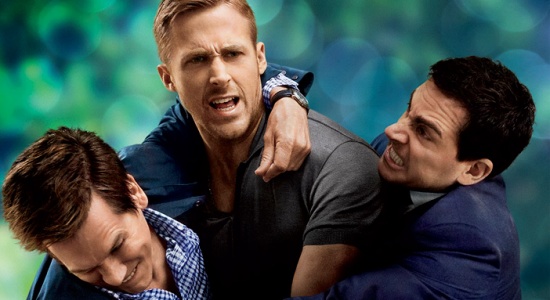
Film Review “Crazy, Stupid, Love”

Starring:  Steve Carell, Julianne Moore, Emma Stone and Ryan Gosling
Directed by:  Glenn Ficarra and John Requa
Rated:  PG 13
Running time:  1 hour 58 mins
Warner Brothers

Our Score: 5 out of 5 stars

Fans of the television program “The Office” (the US version) were pretty sad this season when Steve Carell left the show.  After seven successful seasons Carell decided to do what countless actors have done before:  make that successful transition from tv star to MOVIE STAR!  In the past Carell has done some solid work in comedies like “The 40 Year Old Virgin” and “Anchorman,” as well as showing some serious chops in “Little Miss Sunshine” and “Dan In Real Life.”  Many actors before Carell have taken that big step.  From Clint Eastwood, Ryan O’Neal and Tom Selleck (good choice) to Shelly Long and David Caruso (not so good), many have taken that great leap only to land hard.  Not Carell.  As a man who must learn how to deal with all that life throws at him after his wife asks for a divorce, Carell gives, in my opinion, the best performance of his career.

Cal (Carell) and Emily (Moore) have been married for two plus decades.  One night at dinner, unable to decide what they want, Cal suggests they count down from three and then say it out loud.  Cal is floored when Emily orders “a divorce.”  He moves out of the house, leaving behind two very sweet children, Molly (Joey King) and Robbie (Jonah Bobo, truly the emotional heart of the film).  While drinking away his sorrows in the local singles bar Cal is befriended by Jacob (Gosling), who can see in Cal a defeated man who needs to discover life again.  While helping Cal Jacob is mystified by a beautiful woman (Stone) who resists his advances.  By the time the film is over, everyone will have, hopefully, found what they were looking for.

Brilliantly written by Dan Fogleman, “Crazy, Stupid, Love” is the perfect romantic comedy and the best one to come along since “Love Actually.”  The characters are fully developed and as you watch them you can easily identify them as someone you know.  It also helps that the film is perfectly cast.  As I mentioned above, the sky is the limit for Steve Carell on the big screen.  He proves himself a true romantic leading man here, as well as a fine actor.  Same with Gosling.  So great in heavier roles like “Half Nelson,” which earned him an Oscar nomination for Best Actor and “Blue Valentine,” which criminally didn’t,  here he gets to have a few laughs, some at his expense.  Like Matt Damon before him, Gosling is beginning to become one of my favorite actors to watch on screen.  Moore and Stone are also strong characters, a rarity in this genre’.  The supporting cast, including Kevin Bacon, Marisa Tomei, Analeigh Tipton and a hilarious Josh Grobin, help the film maintain it’s fast pace.  But it is young Mr. Bobo that surprises with a performance that belies his 14 years.  His Robbie, more than anyone else in the film, has a handle on what love is and how it should be. And everything is held together by the strong direction of Ficarra and Requa, who crafted last year’s “I Love You Phillip Morris” with a deft hand.  No sophomore slump here!

In a summer of romantic comedies both good and bad, it’s nice to see that Hollywood saved the best for last.

Film Review “Captain America: The First Avenger”

Starring: Chris Evans, Hugo Weaving and Tommy Lee Jones
Directed by: Joe Johnston
Rated: PG 13
Running time: 2 hours 5 mins
Paramount

Our Score: 4 out of 5 stars

>
Finally! After years of teasing and Samuel L. Jackson cameos, the “Avengers” movie is almost ready. We just needed to meet the one that started it all. And here he is. Ladies and gentlemen, standing a robust 5’ tall and weighing a whopping 120 pounds, I give you “Captain America!” But I’m getting ahead of myself.

In what appears to be present day Antarctica, a discovery has been made. A large item is buried in the ice. When a team is lowered inside, they come across a lot of frost and a large metal disc emblazoned with a single star. Hmmm. Jump back to Norway in 1942. In a near empty castle lies a secret. A secret that Adolph Hitler wants for himself. However, while the fuehrer’s men are “out in the desert looking for religious artifacts” (a nice “Raiders of the Lost Ark” reference, thank you very much), one of his most treacherous henchmen searches for that secret: the Cosmic Cube, one of the most powerful jewels of Odin and seen briefly during the afore-mentioned Samuel L. Jackson cameo earlier this year in “Thor.” Said henchman, Johann Schmidt (Weaving) has another name in Hitler’s Third Reich: the Red Skull. Meanwhile, in New York City, Steve Rogers (Evans) is attempting, for the fourth time, to enlist in the Army. Due to his slight frame and penchant for attracting practically every ailment known to man, Steve is classified 4F, making him unsuitable for military service. This is upsetting to Steve whose best friend, James “Bucky” Barnes (Sebastian Stan) is heading off to Europe to battle the Nazis. A chance meeting with Dr. Erskine (Stanley Tucci) gives Steve one more chance, a chance that changes the course of the war for good.

Like “Spider-Man” and “Thor” before it, “Captain America: The First Avenger” is the story of a genuinely good man thrust into something he doesn’t fully comprehend. In order to serve his country, Steve agrees to be part of an experiment being conducted by Dr. Erskine and Colonel Phillips (Jones). Unknown to Rogers, Herr Schmidt was also a guinea pig for Dr. Erskine, with less than spectacular results. That’s why they call him the Red Skull!

As the final piece of the “Avengers” puzzle, “Captain America” is a film that keeps the audience up to date on the upcoming “Avengers” film. Colonel Phillips and Dr. Erskine have a third partner in their work, military defense specialist Howard Stark, better known as Tony (Iron Man) Stark’s father. Steve is told that Schmidt’s experiment was a failure because of the man involved. The experiment is triggered by what you are as a person. “Good people become great,” he’s told. “Bad people become worse.” Indeed. After the experiment Steve, whose unscheduled chasing of a Nazi spy gains him the cover of most newspapers, is swept off by a local congressman to dress up as the highly patriotic “Captain America” and sell war bonds. The gig works until Steve is sent to entertain a unit overseas. This is Bucky’s unit, and Steve learns that 80% of the men in the unit have been presumed dead. Not believing this, Steve dons his bond selling suit and heads out to comic book immortality.

As directed by Joe Johnston, who has helmed popular fanboy films including “The Rocketeer” and “The Wolfman,” “Captain America: The First Avenger” is a comic book truly brought to life. The heroes are colorful, the villains are nasty and the gadgets most impressive. The cast does a fine job of giving life to their characters, making them more then 2D drawings on a page. Evans, who has gone down the super hero route before in “The Fantastic Four” films, gives Steve a quiet humanity that is needed to make the character believable. He truly IS a good man. Weaving, his face recalling Harry Potter’s Lord Voldermort with a bad sun burn, is commanding as the man who believes he and he alone is meant to rule the world. The supporting cast handle their roles well, especially a group that Steve rescues who form an almost “Hogan’s Heroes” like band of merry men. The special effects are well done, as are the many battle scenes between “Cap” and the Red Skulls’ toadies. Though not the best of the “Avenger” films, it’s certainly not the worse.

Film Review “Friends with Benefits”

Starring: Justin Timberlake, Mila Kunis and Woody Harrelson
Directed by: Will Gluck
Rated: R
Running time: 1 hour 49 mins
Screen Gems

Our Score: 3 out of 5 stars

At first I thought this would be an easy review. Just go back to my review of this year’s earlier “No Strings Attached,” substitute some names, and head off to see “Captain America!” I was wrong. Though “Friends with Benefits” has a very similar plot line (attractive friends decide to just be sex partners with no emotional involvement) the films are very different. So I’ll put some effort into this one.

Dylan (a getting better every time I see him on screen Timberlake) runs a successful web site in Los Angeles. His work has caught the eye of GQ magazine, who want him to become the magazine’s art director. Having just been dumped by his girlfriend (Emma Stone) for being too distant he agrees to fly to New York City for an interview.

Jamie (Kunis who, after her award worthy work in last year’s “Black Swan” needs no further encouragement from me) is a head hunter in New York City. She’s just been dumped by her boyfriend (Andy Samberg), who feels she’s always looking for her prince charming. That he does it outside a retro theatre playing “Pretty Woman” pretty much confirms his thoughts. She is also the one who is bringing Dylan to the Big Apple to fill the GQ job. When he decides to take the job they become friends. And, after a quick discussion, friends with benefits.

You have to give credit to a romantic comedy that spends several moments making fun of romantic comedies! “Friends with Benefits” is a smart, funny film that gives new life to a very tried and true story. But it also has some of the problems that the film makes fun of. First the highlights…

The script, which is pretty funny during the “comedy” parts of the film. It took three different people to write it (four if you count an additional “story by” credit) and it reads like it. What sounds like a good idea to one may not be to another and, as someone who tries to be a good writer, it’s best to write alone whenever possible. However, any film that can make not one, but two, jokes at John Mayer’s expense (“he’s the Sheryl Crow of our generation”) deserves a little slack. The leads are terrific but there’s also great work turned in by Harrelson, Patricia Clarkson, Jenna Elfman and a hilarious recurring cameo by Winter Sport expert Shaun White. In a more serious role, Richard Jenkins is his usual reliable self as Dylan’s dad. Now the lowlight…

The script, which pretty much stops the film dead in its tracks when the “romantic” part rears up. We learn that both of the leads have battled problems in their past but have persevered. Yet, when things begin to turn serious, they magically reappear. Suddenly Dylan can’t add 2 + 2 and stutters like Michael Palin in “A Fish Called Wanda” while Jamie’s “prince charming” desires return again, with predictable consequences. And it’s sad to see that Hollywood seems to have only one way to deal with “R” rated sex. Though the in-bed jokes are some of the films’ funniest, it’s almost guaranteed that, like most in this genre, the film will feature the same “boy kisses down girls body/girl kisses up boy’s body” shot that’s been a staple of “R” rated films since “Caddyshack.” No surprises here. Still, the good outweighs the bad. And the comedy outweighs the romance.

Interview with Lee Thompson Young

Lee Thompson Young is currently co-starring as Barry Frost on “Rizzoli and Isles”.  The show is beginning its second season July 11th.  Lee Took some time to chat with Movie Mikes about the season two and what we can expect from his character.

Mike Smith: What do you like most about playing Barry Frost on “Rizzoli and Isles”?
Lee Thompson Young: I really enjoy portraying his technical and computer knowledge.  It’s really fun to be sitting at a computer and breaking down video footage or researching terrorists’ criminal records.  It give me something fun to play and those scenes have the energy of a mystery being solved.  It’s almost like a Sherlock Holmes moment.  To me those things are the most fun about playing Detective Frost.

MS: What can fans expect from your character this season?  Anything jaw dropping?
LTY: I certainly hope there is some jaw dropping stuff.  We definitely learn more about my character this season.  My father comes to visit us in the office.  I won’t go into detail why but it’s all geared and woven into one of the cases we’re dealing with.  We learn a lot about his family and who he is…his growing up and his relationship with his family.  There’s definitely a lot more history about Detective Frost this season.

MS: What is the most challenging aspect for you working on the show?
LTY: The most challenging thing, and it’s similar on all television shows, is that we’re doing fifteen episodes and the challenge is to come in on episode ten with the same intensity and freshness and excitement that you had in episode one.  Keeping it alive and staying 100% involved in your character over six months.  On a feature you just have that one story and you can perfect each moment and it’s done.  But we do one story every week and a half so just keeping it fresh is a challenge.

MS: You’ve got two very strong actresses (Angie Harmon and Sasha Alexander) leading the cast.  How is it working with them?
LTY: What I take away most is the skill that they have and the job they do.  If they’re women or men, it doesn’t really play that much into the experience.  Everyone in the cast is a professional.  Having Angie and Sasha there is like going to a master acting class every day.  They are both very skilled and when I watch them I try to take away things…I notice the choices that they make.  The only major difference in having two girls or two guys in the lead is that sometimes hair and make up takes a little longer (laughs).

MS: How do you prepare for a role?
LTY: I love doing research for my roles.  To me it’s one of the best parts of the job.  For this role I went to Boston and spent about a week with the homicide unit.  They gave me the rundown on how they work and how they live.  It was really eye opening and probably the most valuable investment I’ve made over the past two years.  It’s given me so much fuel to play this character.

MS: How was your experience working on the film “The Hills Have Eyes II?”
LTY: That was great.  That was great!  We shot it in Morocco, which was a mind blowing experience.  I loved Morocco…I was surprised at how much I loved it….because I thought it was just in the desert, no big deal.  But the rocks..the mountains, the sky at night…everything was very beautiful.  But it was a tough shoot.  A hundred degrees plus temperatures in the day time…running around all day in a full National Guard Army uniform.  A lot of long hours doing very intense stuff…running, screaming, getting shot…shooting people.  But because it was so intense I think it was a very strong bonding experience with the cast.  But we had a lot of laughs.  We worked hard and we played hard and we had a good time.

MS: Do you have a preference between television and film?
LTY: I think that there are pros and cons to each medium.  But what it ultimately boils down to me is the quality of the story that I’m going to be involved in, be it t.v. or film.  With TV the schedule sometimes pushes you to move a little faster and you might not get as much time as you’d like to get a moment right.  But you also have a lot of time to develop the character over a series of episodes.  On a movie you sometimes can’t reach the same level of depth but…you know the script five months in advance…you can study each moment and spend the time to get it just the way you want it.  When it’s done it’s done and you can put it to rest.  Both mediums have their benefits.

MS: Besides the new season what other projects do you have coming up?
LTY: We shoot the show for six months and a lot of the time stuff that comes up in the middle of the year I’m not available for.  I don’t have anything lined up right now but I’ll try and have something lined up by the end of the season.  I’ll get with my representation and try to see what’s going on and hopefully there will be some things that come out of that.

Interview with Matt Taylor & Jim Beller

June 2005. On the island of Martha’s Vineyard I meet Jim Beller at JAWSFest. As a fellow “Jaws” fan I have been well aware of the man they call Jimmy Jaws for the better part of a decade. But we hadn’t met face to face until that summer. During our conversation Jim tells me an idea he has. A coffee table book consisting of behind the scene photos telling the story of the making of our favorite film. “Good idea,” I say.

June 2007. Back on the Vineyard and moments after I propose to my future wife in a room filled with “Jaws” fans, I am introduced to Matt Taylor, who Jim has told me will be writing the coffee table book.

April 2011. I am as giddy as a school boy as I am given the first look at the new book, “Jaws: Memories From Martha’s Vineyard.” Did I mention that I thought it was a good idea?

Over this past 4th of July weekend I had the unique opportunity to shadow book author Matt Taylor and conceptualist Jim Beller on Martha’s Vineyard as they met with film fans and discussed their new project. During some rare down time in their whirlwind schedule, as fans gathered for a screening of the film, they took a few moments to sit down with MovieMikes and talk about the book.

Mike Smith: Why “Jaws?”
Jim Beller: Why not “Jaws?” (laughs)

MS: What is it about that film that, 36 years later, you and I and all of the people standing in line behind us still love it?
JB: I think it’s because it’s a movie that still holds up today and will still hold up 20 or 30 years from now. People will always have that fear of not knowing what’s under them when they’re swimming in the ocean. It’s a movie that has everything: great directing, great acting…editing, score, art direction, great writing…it’s a film that has everything. It’s a comedy, it’s a drama, it’s a horror movie, it’s a thriller. It’s a movie that will go on and on. Like (“Jaws” production designer) Joe Alves says, it’s like “The Wizard of Oz.” Years from now other generations are going to watch it and love it.

MS: Matt, you spent three years traveling across Martha’s Vineyard and discovering stories that even serious “Jaws” fans had not heard. Was it an easy task tracking down people?
Matt Taylor: It was an easy task tracking down the people I knew. Islanders are very set in their ways. They may not do things the same way that off-Islanders would. Often times it was very difficult to lock them down for a time to talk or to show up. They might say “yes” to something then keep you waiting for five months. It was either very easy or extremely difficult.

MS: Did the fact that you yourself are an Islander…you’re family has lived here for 15 generations…did that give you an advantage that another author might not have had?
MT: I think so. I didn’t think Hershel West was even going to answer the door. So I dropped my grandfather’s name and after about 20 seconds I heard him undoing the latch. (NOTE: Mr. West played Quint’s first mate early in the film) It helped that I could drop the name of a family member that they were familiar with. Lynn and Susan Murphy have been friends with various family members from way, way back. Susan told me that as soon as Lynn realized who my relatives were he really opened up. So yes, it definitely worked to my advantage.

MS: Is the book your first writing project?
MT: Actually I’ve written a lot. I’ve had three screenplays read by major studios, though nothing yet has seen the light of day. But the book is the first thing that’s been published.

MS: Jim, what is your rarest “Jaws” item?
JB: I have a “Bruce” tooth. It’s not really rare but it’s up there as far as collectibles go. I really have two very rare items. The first is a standee that stood in theatre lobbies in 1975. For years I had no idea it even existed…I had never seen one. But then I saw a photo of another fans collection and I was like, “what is THAT…where did you get THAT?” (I should note here Jim was talking about MY collection and finally did track down the standee in question). The other item is a hard back copy of the novel, “Jaws,” which spent the summer of 1974 on board the U.S.S. Loreno, which was the name of one of the sea sleds that carried the sharks used by the crew during filming. The crew member that had it would have everyone that came aboard sign it. There are probably close to 75 autographs in it, including Bob Mattey, who created “Bruce.”

MS: Matt, what are you working on now?
MT: I have a film that I have to go back and finish. I shot it in 2007 and was assembling a rough cut when I decided to drop everything and concentrate on the book full tilt. I put it on the back burner but now I’m going to go back and finish it up. It’s a documentary on the history of agriculture on Martha’s Vineyard.

MS: I know that the book was a roller coaster ride for you both, with lots of ups and downs. Now that you’ve climbed that last hill it should be all fun on the way down. What do you hope for next?
MT: Money.
JB: [Laughs]
JB: For me it’s knowing that I can finally talk with fellow fans about stuff I’ve known for years but couldn’t talk about because of the book. It’s great to finally have this book out…with over 1,000 never-before-seen photos and probably as many unheard stories…that “Jaws” fans will be completely blown away by. It will be great to talk with fellow “Jaws” fans about their favorite new stories. [Laughs] And money.

MS: Any chance you two will collaborate on another project?
JB: We’ve talked about a couple things. There are still many photos…and stories…that the fans haven’t seen or heard.
MT: I had to cut about 50 pages out of the book. Two months before we turned it over to the publisher it was 50 pages longer. I had to trim a lot of it and find a way to rearrange the photos after all of the cuts had been made. There are still completely edited stories and photos that were once part of the book that we didn’t use because we had to get it down to 300 pages. And they were great stories!


Related Content
  • Book Review: “Access All Areas: Stories from a Hard Rock Life” by Scott Ian
  • Reading a Book vs Watching a Movie
  • Interview with Steve Alten
  • Interview with D.J. Qualls

    D.J. Qualls is known best for his roles in the films like “Road Trip” and “The New Guy”. D.J. is currently starring opposite Jason Lee in TNT’s hit show “Memphis Beat”. Movie Mikes had a chance to attend a conference call to chat about the show with D.J. and how his character, Davey Sutton, is stepping up in season two.

    Mike Smith: In the recent episode “Flesh and Blood”, you find an abandoned baby in your car, how does that shape Sutton for the future of this show? Will the baby experience stick with him?
    D.J. Qualls: It definitely does. I mean it changes who he is as a man. Sutton has some realizations about himself and about what he wants for his future based on this experience with the baby. Actually, it kind of changed me a little bit as well. It changed how I feel about myself. I started making me think maybe it’s the time to start thinking about moving in a different direction in my life and settling down. So maybe that’s something that I’m going to start looking at soon.

    MS: How has it been working with Jason Lee?
    DJQ: Well, I think it helps a lot, the fact that this is the third job I’ve had with Jason.  I think it was my second or third movie with Jason, and then I was on “Earl” for a few episodes, and then, now, this show.  So I’ve known him a long time.  He was a friend before I did the show, which I think it makes chemistry easier. What I like about working with him most is that he keeps the mood on the set light.  We work very long hours.  We shoot in a lot of our show on location outside in New Orleans in the summer time and that’s brutal.  You’re pretty gnarly and he still always has a smile on his face.  He’s number 1 on the call sheet.  He’s you know our hero, essentially, on the show.  So working with him and when he’s in a good mood, we can’t help but be infected by that.

    Q: What challenges you about playing as a police officer on “Memphis Beat”?
    A: Well, this year the show has totally changed. We shifted more to a more serious, procedural kind of show. We’re still trying to fix the quirks that we had last season but this year we are focusing more on the crime, a little less on the quirk of being in the south.  Also last year my character was sort of, finding his footing, you know as a brand new cop.  So this year, I’m actually getting to do more cop work. I find that more interesting because I don’t often get to play a lot of serious roles.   Especially with the episode “Flesh and Blood”, which is, every year, I get one episode that’s a Sutton episode on my character. So in episode four you see I find a baby.  It’s probably one of the hardest things I’ve ever had to do, but it was beautiful. I have seen it and I’m so excited for the audience to see it.

    Q: Why do you think people keep tuning in to watch Memphis Beat?
    A: Well, I think that we have become more of a standard procedural this year, but also we have maintained that character focus kind of show.  We really try to create a show where people just want to tune in an hour with these people. I think that there is a lot of heart in our show.  I read the message boards.  Some people don’t but if you don’t read your message boards, I think you’re stupid because you want to know what’s working and what’s not working about your show.  People just seem to respond to the heart of it.

    Q: Can you talk about filming the shooting range scenes with Whitehead and are we going to see more Sutton helping them out in the future?
    A: Those were really fun to shoot. Those shooting range scenes were awesome. Yes, this year, you see Sutton and Whitehead – because last year, Sutton and White Head really didn’t have a lot of interaction. Whitehead just sort of didn’t like how green he was. This year, Sutton really starts to prove himself and Whitehead responds to it. The actual shooting of the scenes were great. We had several days of prep. I don’t know why they were so nervous about me shooting a gun. I’m from the South and I got a gun when I was 12 years old. But we got to shoot in an actual police shooting range where all of the New Orleans Police Department trained.  It took about, maybe 6 hours and I shot probably 150 rounds during the filming of that. I’ve got to say, personally, I don’t really like guns. But it made me think, maybe I could own a gun. But then I walk away from it going, “You do not need a gun in your house.”

    Q: I wanted to ask about the music on this show. It’s such a big part of creating the feeling. I’m wondering if you could just talk a little bit about how that fits in and your feelings about the music?
    A: Yes, it definitely is a component. The music is a big component to this show because Memphis, if you’ve ever been there, the city is all music, all the time. You have these people who have been performing for 30 years on Beal Street in these barbecue joints and blues clubs. They are doing it for the pure love of it.  They aren’t doing it thinking cause they are going to get famous for doing it. That is a big difference from what you see in cities like L.A., where you come here and if you’re good at something, you want to be famous for it. These people just do it for the love of it.  I think that’s been a Memphis tradition you know from the birth. We actually don’t do the show in Memphis – we shoot it in New Orleans – I think that that music is a really important component to the show to make it have a more authentic feel.

    Q: I was wondering if your character would see any romance on the show any time soon.
    A: I do have a little bit of a romantic interest this season. We have a crime later in the season where somebody is doing identity theft and the person from the bank who’s brought on to help us solve the crime and I have a little bit of a romantic situation. It is sort of left open, but it was really sweet to play. The actress, Jennifer Masala, who plays the lady from the bank, was wonderful and sweet and cute. It was really fun.

    Q: So you have been involved in a lot of different projects. What would you say you’ve learned and taken away from Sutton and “Memphis Beat”, in particular?
    A: Well, when I first got the script sent to me, I was like, “There’s no way I can pull this off. There’s no way I can play a cop.” So much so that – and I’ve spoken about this before – but so much so that I didn’t even – I turned down the initial audition for this show. I just walked away from it. I had a crisis of confidence and said, “No.”  But luckily, the producers pursued me.  So I went in and I did my initial reading and they offered the show to me because they believed that I could do it. So what I’m taking away from this is keeping myself open and that I’m only limited by my own imagination. And we all are. So that’s what I’ll take away from this show. I have great relationships from this show as well.  I get to work with Alfre Woodard, who I have known for 10 years.  Jason, who like I said have known for about the same amount of time.  It is the best show I have ever had. It’s a feeling of a family like I have never known professionally. When you do a movie, you know there is an end. The show is open-ended and going for a very long time.  So you let your guard down in a different way than you do in a film. People really do become very close to you; I mean, your crew, also. I think that I’m going to take away from this experience just how wonderful it was to have that feeling of belonging.

    Interview with Kevin Pike

    It’s said that there is no such thing as fate. Don’t tell Kevin Pike that. As a 22 year old living in New England he had a choice to make as spring approached – head down to Florida to resume a previous job or take the ferry to Martha’s Vineyard, where a friend offered to get him a job as a waiter. It was early 1974 and the country was in the middle of an oil crisis (for those readers not old enough to remember, in 1973/74 gasoline was in short supply. If your license plate ended in an even number you could only fill your tank on certain days. The other days were reserved for those with an odd number. It got so bad that the government printed ration tickets, though they were never used). Because of the cost involved, Mr. Pike headed to the Vineyard. And the rest, as they say, is history.

    Since his first foray into Hollywood via the film “Jaws,” Mr. Pike has worked on some of the most popular films of all time. They include “Back to the Future,” which earned him a BAFTA nomination for Best Special Effects, “Close Encounters of the Third Kind,” “Return of the Jedi,” “Indiana Jones and the Temple of Doom,” “Ed Wood” and “Fight Club.” For his work as the special effects supervisor for the television series “Earth 2” Mr. Pike received the Emmy Award for
    Outstanding Individual Achievement in Special Visual Effects.

    Mr. Pike is featured in the new book “Jaws: Memories from Martha’s Vineyard.” To help celebrate the books’ release, Mr. Pike graciously took time out to sit down with MovieMikes:

    Mike Smith: How did you end up working on “Jaws?”
    Kevin Pike: I started working on “Jaws” quite by accident. I had gone to Martha’s Vineyard to work at the Harborside Restaurant. I was a friend of the bartender and I had worked with him at a restaurant in Florida. He told me to come on up. At the time (1974) President Nixon had frozen prices and you couldn’t readily get gasoline on the highway to get to Florida so it caused me to re-direct and head off to Martha’s Vineyard early so I could get in on the summer season. On the reference of my friend the bartender I got a job at the Harborside Restaurant. I was a waiter but they had waitresses in mind so I ended up being a bus boy. One Saturday night a party of six men came in. They were having a great time. I could tell because normally our customers were very reserved. It’s like going to Las Vegas and the people playing cards are very reserved while the ones over at the craps table seem to have a party going on all the time. So I kind of paid attention to what they were talking about and deduced it had something to do with showbiz…with a film. The important part is that when they left to head back to the Kelley House where they were staying, when I bussed their table I found they had left behind a satchel…a valise. So I ran outside after them and found them still in the parking lot. I hollered, “Hey, did anybody leave this?” One of them turned to me and said, “Yes! Oh my gosh, are you kidding me? Do you know what’s in there?” I told him “no.” “They’re storyboards. You know what storyboards are, don’t you?” “No sir, I don’t” He explained that they were like a comic strip. When you make a movie you draw the whole thing out in pictures. So I asked him if he was making a movie. He said yes and I asked him what it was about. He said “it’s about a shark that’s going to eat your whole island!” That guy was Joe Alves, the production designer. Shortly thereafter, in a few days, I was hired on by the construction coordinator, Jimmy Woods. We started working on April 18, 1974. Jimmy gave us a pep talk before we started. He said that he knew some of us were finished carpenters that had helped build mansions. But we had to understand the way things were done in Hollywood. We throw walls together, slap some paint on them, shoot them and tear them down and throw them in the dump. He said that when he looked out at us he wanted to see two things and two things only: assholes or elbows!” He asked if there were any questions and I raised my hand. When he looked at me I asked him if I could be one of the elbows. He laughed and said “you’re with me.” After that we became close friends. I ended up being sort of his office coordinator. I would sweep the dirt floor and clean up after the guys who were working on the ORCA. I helped do all of the paperwork for the petty cash…buying everything from materials to snacks. I was basically locally hired labor that started from the bottom. I have a picture in my office. When we had 400 extras on the beach we only had (4) outhouses. And nobody would offer to clean them but me. So my friend snapped a picture of me at the right time, with me rinsing out a toilet. And it reminds me that I started at the bottom. I saw that movie from the unique perspective of a 22 year old on an island who was cleaning outhouses. I then started doing some work with the carpenters but it was obvious I wasn’t a carpenter so Ward Welton, the painter, grabbed me. And we painted everything they were building, from the ORCA to the sets being made for the production. Then in mid-May I was sent to meet a man named Roy Arbogast. I was going to help him unload the sharks. We had a winch system with a gin pole that went out through the top of the barn. They used the barn to store boats in the winter but we were going to use the upper floor as a workshop to work on the sharks. We stood in the open door of the barn and I could see the Edgartown Lighthouse on the Atlantic Ocean from our vantage point and sure enough one by one three trucks drove up with a shark on each truck, their tales sticking out. And with all the naiveté’ of a baby deer I asked “so you did all of the testing in the Pacific Ocean before you brought them here to the Atlantic Ocean?” And Roy said “no. Oh no. We haven’t had them in the ocean at all.” In fact, they hadn’t even taken the third shark out of the mold yet. I’m sure he couldn’t see the dollar signs that flashed in my eyes because I was only supposed to work on the crew for six weeks and I ended up working six months. And that is my beginning on working on “Jaws.”

    MS: You also worked on “Close Encounters of the Third Kind,” “1941,” “Indiana Jones and the Temple of Doom” and “Jurassic Park,” As he grew more successful – confident is probably a better word – did you notice any differences in the way Steven Spielberg worked on set.
    KP: Not at all. The closest I worked with him was on “Close Encounters and Indy 2.” On “Jaws” I was very much in the background, but I got to do a lot of things because of my capabilities and my energy and my interest. And having that , I got to learn a lot. My life was changed forever. I got to work with Steven again on “Close Encounters” because Roy Arbogast was going to supervise the Special Effects. I ended up doing six or seven pictures with Roy. He was my mentor and taught me everything I needed to learn from the very beginning. He helped me become an Effects Supervisor in my own rite. On “Close Encounters” we were very close to Steven on many levels from the very beginning of his ideas because this was really his dream project. Some of the other films you mentioned – “1941,” “Jurassic Park” – I didn’t have a lot of interaction with Steven because I didn’t have a lot to do. Mostly prop building. Same on “Hook.” “Indy 2” we did a lot together with the 2nd Unit, doing a lot of insert work at ILM. We also spent a lot of time doing the blue screen work for the mine shaft car and the raft coming out of the airplane. I also did his “Twilight Zone” episode. But there’s nothing that stands out as far as what became different. Nothing I can put my finger on. I can definitely say that he became much more confident having the hits he did under his belt. But he knows he has to make each film as good as he can make it. And I believe that’s what he internally strives to do.

    MS: You’ve worked both on the “Star Trek” and “Star Wars” series. Did you consciously avoid one effect or prop on one film because it was similar to one from the other?
    KP: When I worked on “Star Wars” it was on “Return of the Jedi.” The look of the films had already been established. The new parts for us were the full size Scout-walker and the Sarlac pit. Essentially we already had a production design element that was driven from George Lucas right from the beginning. “Star Trek” had derived a lot of it’s style from the television show. So the choice you ask about is usually not mine to make. And I’ve also found, by working on both “Jaws” and “Jaws 2,” that the second time it’s not the same kind of feeling. It’s not fresh…it’s not novel. So I desperately tried not to work on sequels or on the same television show I had worked on the month before. I wanted things to be new and fresh as long as I could be that selective. Of course sometimes you need a job and you need to make money. That’s part of the reality for everybody in this town. But I always try to avoid doing something that’s along the same lines I’ve done before.

    MS: You’ve done both film and television. Do you have a preferred medium?
    KP: Well the feature work is very creative. You can feel the joy from a solid story arc in the script…you get the beginning, middle and end. You put your good work into it and then you get to go see it at the premiere, which is a wonderful and rewarding feeling. It takes you a couple of viewings before you begin to start enjoying the film because you’re seeing your work and remembering your contributions and the work of others. It’s a different kind of feeling watching a film that you’ve worked on as opposed to seeing one you haven’t. But there’s also a great benefit in television. I remember when I was asked to work on “Earth 2,” which was a series. We literally packed up and went to Santa Fe for a year. We took our families and everything else and it became a big commitment. Because you’re prepping one show while you’re shooting another. There’s always a constant cycle of activity. You’re meeting new directors and reading new stories and meeting new actors. Sometimes there’s a new crew person rotating in. We did 22 hours on “Earth II.” It became a serious commitment. And the beauty of Santa Fe, New Mexico made it all rewarding. And I have to tell you, I made good money on that show. And I’ve always remembered that. So if you can get on a show you can actually do very well. And you become family. It’s an entirely different situation. It’s a different medium. I got a lot of reward from doing sit-com work. I did five or six projects with James Burrows, who is the guru of sit-coms. (NOTE: James Burrows, a 10-time Emmy winner, directed such classic television series as “TAXI,” “Cheers” and “Frasier”) Watching him work is like watching a genius in action. The cadence is entirely different for that medium and you have a live audience. So you get a spontaneous reward from the laughter. You’re the only other person on the crew that gets to put in a joke. The actor says a line and the audience laughs because it’s funny. I make the dishwasher overflow and they start laughing again. So there’s an entirely different reward between sit-coms and dramatic television to feature films. I also spend a lot of time on commercials. I might get a storyboard with seventeen shots on it, some of them are incredibly creative because they have a good budget. I cut my teeth on a lot of those commercials. So each medium itself has its own special place in my heart.

    MS: What is your proudest special effect moment?
    KP: Without a doubt I’d have to say it’s the work I did on “Back to the Future.” It was a tough road to get there. The demands of (director) Bob Zemeckis…he knew what he wanted and we had to make good on his idea. And when I read the script I knew that the car, and we didn’t yet know what kind of car it would be, I knew that the car would be iconic and I’m very happy and proud of my contributions. In fact I’d have to say that the majority of my fan base is because of the car. Kids that saw the movie are now at the age where they can try to make one. They want to know where they can find one or just want to share their interest in Delorean Motors. I’m impressed with the perpetuity of the film. I’m pleased with the fact that it’s as popular as it is. And I can tell you that everybody on the crew that read that script knew that it was really a great story. Bob Gale and Bob Zemeckis just wrote the heck out of that. And that’s why the film holds up as well as it does today…because the story is so strong all the way across the board.

    MS: Where do you keep your Emmy?
    KP: I keep my Emmy on a small, rolling Art Deco cocktail bar. When it’s time for a martini or a Pinot Noir, it’s there to remind me life can be sweet at times.

    MS: What are you working on now?
    KP: For the past two years I have been an agent. I formed The Filmtrix Agency and have a roster of about 45 clients right now. I service what they call “below the line”…I get crew person’s work. I also handle some writers and directors. We have a large literary side that we do. I have clients from all over the world. Italy. Spain. I have clients currently working in India. It’s turning out to be very busy for us and I’m very happy about the direction we’re going in.

    Interview with Josh Shelov

    Josh Shelov is the director of the recently released film, “The Best and the Brightest”.  The film is currently in theaters now and will be on DVD later in August.  MovieMikes had a chance to chat with Josh about working on his second feature and also what is planned next.

    Mike Smith: “The Best and The Brightest” is your second feature film, How did your experiences as a filmmaker differ from the your first film?
    Josh Shelov: I was only the writer on “Green Street Hooligans” so as the director of “The Best and The Brightest” there was a world of difference. It was obviously very exciting to see “Green Street Hooligans” get made but to actually direct and take the film all the way home is incomparable. It was the greatest creative experience I’ve ever had.

    MS: As the director do you think you had more creative input as to what showed up on screen? Maybe there was something you wanted to fight for on “Green Street Hooligans” that was left out because of the director’s decision?
    JS: Significantly, yes. When you’re directing you can really ruin the whole thing! (laughs)

    MS: You also co-wrote the film with Michael Jaeger. How did this story come about?
    JS: We were living it. Both Michael and I have young kids and we were dealing with how to get them into private school. It’s a huge and competitive pain in the ass! We were really stressing it. The pressure was on. And there are lots of, shall we say, anxieties of just how far reaching the consequences would be if we didn’t get out kids into a good school. You wouldn’t be able to stay in the same neighborhood…your child will never amount to anything…they’ll become meth dealers. So we were sitting there sweating. And you hear about the “favors” and political weaseling that people go through and we thought it was a really, really good and fertile ground for a farce…making fun of the big city folks.

    MS: You assembled a great cast, including Neil Patrick Harris, Amy Sedaris & Christopher McDonald. How did that come about? Were they easy to attract to the project?
    JS: I wouldn’t say easy. The key is to get a little bit of money behind you and for that I have to credit our (2) first producers, Rob and Patty Weiser, who put up our start up cash. When we had that initial start up cash, it enabled us to go into Hollywood and make what is known as “pay or play” offers. They certainly weren’t offers of a lot of money by any stretch of the imagination. And the key was that we got Amy Sedaris. Amy loved the script and I had a meeting with her and she agreed to do it. And then the other actors started to come like wild fire. Neil really wanted to work with Amy. We got Chris McDonald after that. Kate Mulgrew and on and on. Amy was really the tipping point.

    MS: We actually just featured an interview with Christopher McDonald and he had great things to say about the project.
    JS: Michael and I wrote the part FOR Chris. He’s amazing in the film. There is a certain voice to the film and it’s uniquely Chris. We’re just so thrilled that, after writing a part for him, he would agree to do it. It was one of the highlights of the whole project.

    MS: What would you say was the most difficult park of working on the film?
    Was it wearing the two hats of both director and writer?
    JS: The shooting itself was a really joyful experience. I would say that raising the money and getting the film distributed…that was the most difficult. The actual filming itself was like eating dessert. It was wonderful. We had an exceptionally good crew. We had an extraordinary producer named Declan Baldwin, who kept all of the trains running on time. We never had a calamity. None of the actors were divas. It was pretty remarkable.

    MS: When can we expect to see this film in theaters and DVD?
    JS: It was theatrically released, literally, right now. We’re playing in New York and Los Angeles and Coral Gables, Florida. We have two distributors who are working on the picture. Our home video distributor is a company called New Video and they’re terrific. And they have partnered with another company called Emerging Pictures, which is run by a guy named Ira Deutchman. And he has started supplementing a release all over the country. We’re opening up in Michigan. We’re opening up in Delaware. And there’s a third company, owned by one of our producers, Declan Baldwin, called Big Indie. He’s organized over 200 sneak previews of the film this past film. So the film has really got a lot of theatre exposure even though we don’t have a big studio behind us.

    MS: What are you working on next?
    JS: There’s a drama that I hope to do called “The Inheritance.” Darren Aronofsky likes it…he’s really helping to shepard it along. Ideally I would love to start casting it this year or next.

    MS: What is the story?
    JS: It’s about three generations of Irish-American writers who find out that they have a deadly disease in their bloodline. I’ve worked on it a long time. I actually wrote it before we wrote “The Best and The Brightest.” It’s very near and dear to my heart.

    Interview with Bret Iwan

    MovieMikes has prided itself in speaking with some of the great voice talent behind many of Walt Disney’s beloved characters. From Winnie the Pooh to many of the classic Disney Princesses, our readers have asked and we’ve delivered. And if you’re talking about beloved Disney characters, there is none bigger or more known around the world then the one that started it all, Mickey Mouse.

    Mickey Mouse has been voiced by four different men. Walt Disney himself provided the voice from the character’s introduction in 1928’s “Steamboat Willie” through 1947. He also provided Mickey’s voice during the 1955-59 series run of the original “Mickey Mouse Club.” Jimmy McDonald succeeded Disney and voiced the character until 1977 when he was replaced by Wayne Allwine. When Mr. Allwine passed away in 2009 he was replaced by Bret Iwan who, like Disney and McDonald before him, dreamed of being an animator long before he discovered his vocal talent. Born in September 1982, Iwan received a Bachelor of Fine Arts Degree from Ringling College or Art and Drawing in 2004. Shortly after graduation he sent off his portfolio, hoping for a job with the Walt Disney Company. While he was offered an internship at Walt Disney Imagineering he also received an offer of a full time position at Hallmark Cards. He took the Hallmark offer and soon found himself moving to Kansas City, coincidentally the city that stood home to Walt Disney’s first animation studio. As he approached his fifth year with Hallmark he learned from a friend that phone auditions were being accepted to voice Mickey Mouse. After several days of practice, Iwan called in, recorded his audition and waited for a phone call. Several weeks later, that call came and, after a few more auditions, Iwan was named the fourth official voice of Mickey Mouse.

    While back in Kansas City to attend a fund raiser for the “Thank You, Walt Disney,” an organization created to help save the building that housed Disney’s original “Laugh O’ Gram” studios,” Iwan took some time out to talk with MovieMikes about his career and his unique opportunity.

    Mike Smith: Since you used to live here I guess I can say “welcome back” to Kansas City.
    Bret Iwan: Thank you. It’s great to be here.

    MS: You studied to become an artist. What made you choose that path as a career?
    BI: Early on what inspired me was watching the old classic Disney cartoons. My parents were always putting them on for me, everything from Mickey Mouse to Pinocchio. And while watching them they really caught my attention…how the drawings were coming to life. And so as early as I can remember I wanted to be an artist…more specifically I wanted to be an animator. So from grade school through high school through college that was my goal. That’s what I focused on. I didn’t quite make it there in the capacity I dreamed of but I did make it to Disney, which was a major part of that dream.

    MS: How did it work at Hallmark? Would they give you the written copy for a card and ask you to design it?
    BI: It worked a couple of different ways. That was one way. Other times the creator would have a specific card and a specific image in mind that they would come to us and ask us to create. And other times we would have an open brainstorm free for all! The illustrators would come up with concepts on their own or with concepts for whatever upcoming holiday they were working on at the time and then submit them to the designers for them to pick and choose from. So there never really was oneconsistent way of working. They always kept us on our toes. It was a lot of fun.

    MS: What was the oddest or most memorable card you designed?
    BI: It wasn’t one that I designed. I got to pose. I modeled for a card one time. I was holding two glasses of wine so it was just my hands. It was for Hallmarks’ “RED” card line (NOTE: the company’s RED card line was created to raise money. The proceeds from the cards were spent to combat AIDS in Africa.Mr. Iwan’s card caused some notoriety when a Delaware woman tried to have it pulled from shelves, claiming it promoted promiscuity). They went around the room and they chose me. I guess I had the nicest hands at the time. That was my one and only modeling job ever.

    MS: What did your audition consist of to become the voice of Mickey Mouse? Did you have scenes to read, or did they just say “do Mickey happy…do Mickey sad?” Not that Mickey Mouse is ever sad.
    BI: He could be. (laughs) The audition was basically a voice match. They provided an MP3 of clips from a couple of Walt’s cartoons and a couple of Wayne’s cartoons. And the audition was to do the best you could to match those voices. Walt’s clips included lines from “The Brave Little Tailor” and Wayne’s had clips from “The Three Musketeers” and also some stuff from the intro to the “Mickey Mouse Clubhouse” that was currently on the air. So there was a great variety from where Walt had started and where Wayne had taken Mickey.

    MS: Did you ever meet Wayne Allwine?
    BI: No, sadly, I did not. When I auditioned they were looking for somebody to serve as an understudy for Wayne. So I auditioned thinking I was going to get to meet him and to learn from him. Get some good tips and techniques from him. Unfortunately that didn’t happen because in the midst of the process of finding an understudy he passed away. It was somewhat unexpected. I took over about twoweeks after he passed away.

    MS: I know you’ve voiced Mickey on several video games. Is there any talk of bringing Mickey back in a full length feature film?
    BI: I would love for that to happen. And I know a lot of the other voice cast members would as well. I haven’t heard anything official. I have heard from my fans on Twitter that there was an interview with one of the story men at the Walt Disney Studios where he mentioned that he had pitched a feature length 2-D animated movie featuring Mickey, Donald and Goofy. I don’t know what the future is for that but I would love for it to come to fruition so I’m keeping my fingers crossed because I think that would be great.

    MS: In your short time doing this, what is the most unusual or strangest thing you’ve ever had to voice as Mickey Mouse?
    BI: Hmmmmmm….well I don’t know if it’s the strangest but voicing for the “Epic Mickey” video game was interesting because there’s NO dialogue in the entire game. It’s all noises and reactions. So it was strange trying to communicate a plethora of emotions and actions just by little noises. That’s probably the oddest and most challenging that I can think of.

    MS: Let’s say the proposed upcoming Mickey Mouse feature comes along and they’re going to do the animation the old fashioned way. If they offered you a job as an animator would you do it?
    BI: I would love to. I would love that. That would be a complete dream come true. I’d have a lot to learn…I’m by no means an expert at animation. But with that being the driving force behind my initial dream I would love to be a part of that process.

    For information on how you can get involved with the “Thank You Walt Disney” organization please click here.

    Interview with Karen Lynn Gorney

    Karen Lynn Gorney first earned attention with her role of Tara Martin on the popular daytime series “All My Children.” But it was her role as Stephanie Mangano in “Saturday Night Fever” that made her a star. As the object of John Travolta’s affection (both on the dance floor and off), she was able to pull of the rare feat of making a tough girl also appear very vulnerable. Defying conventional thinking, she took more then a decade off, concentrating on theatre and music while also teaching. She returned to the limelight in the early 1990s and has appeared in numerous film and television projects, even reprising her role of Stephanie in the “Fever” video game. While preparing for her next project Ms. Gorney took some time to speak with Movie Mikes about her career:

    Mike Smith: Both of your parents were in show business. Did watching their experiences steer you towards a career in acting?
    Karen Lynn Gorney: I got into acting because of my shyness. I wanted to be a songwriter like my Dad. But I was too shy to really sing my songs! So Ma said I should study acting.So eventually I sang and played guitar- I’ve recorded 3 CD’s…two of my original songs. one of song’s my dad wrote. (NOTE: Ms. Gorney’s father, Jay, was a popular composer and wrote the music for the classic depression-era song “Brother, Can You Spare A Dime.”)

    MS: How did you come to get the role of Tara Martin on “All My Children?”
    KLG: Many many auditions, like everything else. Just showing up time and time again.

    MS: Do you still hear from fans of the show?
    KLG: Oh yes. All the time.

    MS: You’ve reprised the role twice. Any chance of Tara making another return to Pine Valley?
    KLG: If they asked me I would do it. (NOTE: Since our conversation ABC has announced that this will be the last season for “All My Children.” Hopefully that fact will guarantee an invite back).

    MS: You have a BFA from Carnegie Mellon and MFA from Brandeis University in Acting and Speech. With that kind of training how hard was it to nail Stephanie Mongano’s accent in “Saturday Night Fever?”
    KLG: I have a good ear, being from a musical family. It came really easily. Dialects are fun for me.

    MS: In the famous poster for “Saturday Night Fever” you are featured in a red dress. However, in the final dance competition you are wearing a white dress. Were there other dance scenes shot or was the dress altered for the poster?
    KLG: We shot me in every color dress under the sun. They kept dyeing them until they settled on what you see. Red sells. I think that’s why it was used for the poster.

    MS: One of the most touching scenes in “Fever” is when Tony and Stephanie are sitting by the bridge talking. During the scene, as Tony’s eyes begin to tear Stephanie kisses him on the cheek. Years later it was revealed that Travolta had just returned to the set after the death of his girlfriend, Diana Hyland. Was it tough to get “back to work?” And what moved you to give Tony the unscripted kiss?
    KLG: We hadn’t stopped work for that long and John came right back into it. The character kissed him not me. It seemed the right thing to do – he looked so pitiful.

    MS: Was there any talk of Stephanie returning in “Staying Alive?”
    KLG: Yes, but the only character from the original “Fever” that appeared in “Staying Alive” was Tony’s mother. Stallone wrote us all out.

    MS: Your father, Jay, was a successful songwriter and you yourself have written and produced several albums. Any plans to record again?
    KLG: Not right now. The three Cd’s I’ve done, the “Trilogy,” seems enough for now. If I start getting HAUNTED again by words and music in my head, I’ll have to do more- but for now, I’m good. I do have a suitcase full of stuff I haven’t put together and recorded!

    MS: What are you currently working on?
    KLG: A new play. Starting to take meetings on it for Off Broadway.

    For fans interested in ordering a CD or original artwork, or just wanting to keep tabs on her career, please visit Ms. Gorney’s web site: www.karenlynngorney.com

    Interview with Donna Pescow

    As a young man growing up in the 1970s, one of the seminal films for me was “Saturday Night Fever.” No, I didn’t have the big hair or platform shoes. And while, thanks to drama and dance classes, I could cut a rug I was certainly no Tony Manero! But one of my fondest memories of the film is Donna Pescow, who played Annette, the girl who really only wanted to be liked by the boy she loved. It was her vulnerability that kept the film grounded. “Are you a good girl or are you a c*nt,” Tony asks her early on in the film. “Can’t I be both,” she replies. After “Fever” Ms. Pescow landed the lead role in the Garry Marshall produced television comedy “Angie,” earning a Golden Globe nomination for her performance. For the next three decades she has appeared regularly in both films and on television, including long stints on “Out of This World” with Burt Reynolds and on Disney’s “Even Stevens,” a role which earned her three Daytime Emmy nominations. Ms. Pescow recently sat down with MovieMikes to talk about her career:

    Mike Smith: You’ve appeared in several popular daytime dramas (“All My Children,” “General Hospital,” “One Life to Live”). Is there something about them that keeps you coming back?
    Donna Pescow: “All My Children” was presented to me as being a six week guest star. They were going to bring in the first openly gay character, which was really a fabulous opportunity for me to be in a groundbreaking role like that. I knew a lot of the people on the show…a couple writers and producers and a couple of the actors…and it was really just a wonderful opportunity for me to be a part of something so groundbreaking. I loved being a part of it. They won a couple of awards for it and, I think, opened up a real arena of something that hadn’t been explored. It wasn’t a stereotypical fluffy, fuzzy piece it was something that I thought was beautifully handled. “General Hospital” was another one that went on for a couple of months. They wanted me to do a character that was kind of like a 1940s style comedy – like Roz Russell. A fun but bigger than life kind of character. So again it was something unusual for that style of show. They asked me to do that and again I thought it would be a nice opportunity to do something different and work with some good people.

    MS: You had to audition for both “Saturday Night Fever’s” original director, John Alvidsen and later, John Badham. Was there any difference in your character of Annette in each director’s vision? Did they maybe perceive her differently from one another?
    DP: I don’t think so. I remember that when I auditioned for both directors I had never seen a full script. I was just starting out so I received what they call “sides,” which are excerpts from the script that your character auditions for. So I think the character was the same. What I did was I improvised a lot to get the tone of the character. Both of them were still trying to find the voice of the character. I don’t know if they were different or not but I’m sure each of them had their own specific take they wanted the actor to bring with them. There was a couple of months gap between the directors so I don’t know if the script was rewritten or not.

    MS: How did the television series “Angie” come about?
    DP: I got a call from my agent saying that Garry Marshall wanted to meet with me about an idea he had for a show. I was thrilled to get to meet with Garry, who is one of the funniest people on the face of the earth. And he pitched the idea – I think it may have come from another show he had thought about doing but he had tweaked it a bit – of a modern day Cinderella girl from the poor side of the tracks marries the boy from the rich side of the tracks. Now Garry pitching a story is almost funnier then the show! He has such a hysterical personality…he acts out all of the characters…I would have signed up right then and there in his office.

    MS: You participated in the “Battle of the Network Stars.” I remember one year it was almost a grudge match between Robert Conrad and Gabe Kaplan. Was the competition really as fierce and competitive as it was made out to be?
    DP: It’s funny that you mentioned Robert Conrad. He was there the year I was doing it. I would guess that if I’d ever joined the military it would have been very similar. He was really serious and really scary! And I was very happy that he was NBC and I was ABC because even from a distance he scared me. People were really serious about this and I was terrified because even though I was a dancer I was not an athlete (laughs). And I was so worried that I was going to let my team down and, most importantly, make a complete and utter fool out of myself. Which of course I did. I had to run the obstacle course and I think Howard Cosell said it was one of the slowest runs in the history of the games. So maybe I should take solace in that I did break a record! (laughs). It was a lot of fun but people were tremendously talented in athleticism and I just did not shine there. (NOTE: for readers who never experienced watching the “Battle of the Network Stars,” click here if you want to see the Robert Conrad/Gabe Kaplan match up I mentioned. Notice that Conrad keeps puffing on his cigarette before the big race:

    YouTube – Battle of the Network Stars – Conrad vs. Kaplan

    MS: You co-starred with Burt Reynolds (a recent MovieMikes interviewee) in the series “Out of This World.” How did that role come about?
    DP: I like that you said co-starred. In the show I spoke to him through a candy dish! Again it was one of those lovely moments where somebody calls and says they have a show they think I’d like. All of the pieces seemed to fit. It kind of reminded me of a show I used to like when I was a kid called “Bewitched.” I just thought it was kind of fun to do the magic and the special effects. I was actually surprised that it went on as long as it did. Not that I didn’t like it, it’s just that you never know. It’s one of those things that will either hit or not. And Burt was great. I would have liked to have had a scene with him! But we were never in the same room. He was recording in one studio and I was in another.

    MS: You’ve directed several television episodes. Is directing something you’d like to pursue more?
    DP: I love doing it. I got to do some when I was on “Even Stevens.” I also did “Harry and the Hendersons” awhile back and I love it. Pursuing a directing career is like pursuing an acting career. You really have to give it 100%. I think if I’m going to do it again I need to make that commitment and pursue it as strongly as I do acting. I’m sure that the next round I do I’ll definitely stick with it longer.

    MS: Getting back to “Fever,” was there any talk of bringing Annette back in “Staying Alive?”
    DP: Annette WAS in “Staying Alive.” The character was in the script for quite a while. In fact, there was a section filmed where he (Tony Manero) goes back to Brooklyn and sees several people. But the script changed and they ended up taking that section out. But I did shoot a tiny scene where I was in the audience with my husband – I guess she got married – and we were watching the Broadway show Tony was performing in. But we only shot a little bit of it because they kept rearranging the script. I was sorry to not be in it but I understood that it didn’t really work.

    MS: A lot of people pan that film but I think it was amazing how Stallone envisioned the Broadway musical of the 1990s. Lots of flashing lights and explosions and rock and roll scores.
    DP: He really had a vision. Both John and Sly really did a great job. They had a very specific thing they wanted to accomplish and they did it and they did it well. It’s really iffy how the public react to things at times. I think they should take a second look at the film and see if they enjoy it more.

    MS: You appeared on both “NYPD Blue” and “The Sopranos,” both landmark television dramas. Did you feel you were working on something special when you were filming?
    DP: Yes. “NYPD Blue” I was a fan of so going into something that you watch and you like is almost like a little gift because you know going in the quality of the work. So I had a sense that I was doing something that was above average. And the cast and crew were tremendously talented to work with so I had a great time. “The Sopranos”…I was such a “Sopranos” junkie that I could not get enough of that show. I was glued to it every week…I never missed it. When they asked me to do it I really had a hard time separating being a fan from being an actress. I was really sort of star-struck when I went on the set. I got to meet everyone and I had to keep telling myself over and over, “Donna, be a professional. You’re here to do an acting job not sit and gawk at all of the people you watch every Sunday night.” But I was so excited and so thrilled…it was the last episode. So it was really an extraordinary thing for me to be a part of it. It was really an amazing thing to be a part of that show. And you know, when you look back on your career you think you’ve done all of these things that have been personally rewarding. But then you look at “The Sopranos,” which was very much a groundbreaking show in television history, and you’re proud to have been a part of that.

    MS: What are you working on now?
    DP: There are a couple of things happening. Of course I never know which of them is going to pan out. I’m talking to someone now about possibly coming back to New York and doing some theater there, which I’m kind of excited about. So we shall see!

    Interview with Candy Clark

    Candy Clark has always been a free spirit. Born in Norman, Oklahoma, the family moved to Fort Worth, Texas, where she graduated high school and then headed to New York City. After scoring a small role in the John Huston directed film “Fat City,” she won the part that she will forever be remembered for, slightly ditzy Debbie Dunham in George Lucas’ look back to 1962 “American Graffiti.” For her performance, Ms. Clark was nominated for an Academy Award as Best Supporting Actress. She finished the decade of the 1970s with roles in such television shows as “Banacek” and “The New Dick Van Dyke Show” while appearing in such films as “The Man Who Fell to Earth” with David Bowie, “The Big Sleep” with Robert Mitchum and Jonathan Demme’s “Handle With Care” (also known as “Citizen’s Band”) which reunited her with her “Graffiti” co-star Paul Le Mat. The two joined forces again for the underseen sequel “More American Graffiti.” In 1983 she appeared opposite Roy Scheider in “Blue Thunder.” Other notable films include “Cat’s Eye,” “At Close Range,” “Radioland Murders” and David Fincher’s “Zodiac.” On television she has appeared in such shows as “Magnum P.I.,” “St. Elsewhere,” “Matlock” and “Buffy the Vampire Slayer,” where she played Buffy’s mom.

    I had the extreme pleasure of meeting Ms. Clark a few years ago at a celebrity event where she very graciously signed a few items for me and shared some stories about her past. I recently had the pleasure of speaking with her again for MovieMikes.

    Mike Smith: What led you to pursue a career as an actor?
    Candy Clark: Well it was kind of given to me on a silver platter…my first job. And after that it became really difficult. But once I was in the game I got hooked. My first role was in a film called “Fat City.” I didn’t really want to be an actor…I was kind of made to do it. I was given an audition by this casting director…really all I wanted to be was an extra. But once I did that role I was hooked! I was on my own and it took me a year to get my next job. I’ve never been very good at auditioning…that’s always been my weakest point.

    MS: Your next feature film was “American Graffiti.” Did you have any idea that this little film would strike such a chord with the public?
    CC: I knew that it struck a chord with ME. I really identified with the characters because they were doing exactly what we were doing growing up in Ft. Worth, Texas. In high school we used to drive around…go to Carlson’s Drive In then drive to the Lone Star Drive In then back to Carlson’s then back to the Lone Star. Everyone would just go round and round all evening. It was exactly what we did. So when I read the script for “American Graffiti” I was like, “wow…I get it!” I was really happy to get a part in the film. Like I said, auditioning has always been my weakest point…I had to do a screen test for the film. I didn’t have to audition, thank God, but I did have to do a screen test where I had to memorize a scene. It was kind of a cattle call of all of these actresses. We were all in one room in a warehouse. Charles Martin Smith already had his part so when I met him I thought, “I’m not going to get this…he’s a lot shorter than me. I’m too tall.” But lo and behold I got picked…and I think our height difference made it more funny and charming…and cute.

    MS: You received an Academy Award nomination for your performance as Debbie in “American Graffiti.” What was it like being recognized for your work so early in your career?
    CC: I highly recommend it to everyone (laughs)….to be nominated for an Academy Award! Two weeks prior to the awards, after never having gotten patted on the back side before, it was flowers, telegrams…that was back in the day when they HAD telegrams. I was the center of attention and I really loved it. I knew I wasn’t going to win so I didn’t prepare a speech or anything. I thought for sure that an actress named Sylvia Sidney was going to win. She’s been around for a long time and she was up for a film called “Summer Wishes, Winter Dreams.” But lo and behold Tatum O’Neal took home the award. She walked away with it…a nine year old! (NOTE: Tatum O’Neal was actually ten years old when she became the youngest actor to win a competitive award for her role in “Paper Moon.” The other nominees that year were Linda Blair for “The Exorcist” and Madeline Kahn for “Paper Moon.”)

    MS: So, is it really an honor just to be nominated?
    CC: (laughing) I think so! I certainly didn’t mind it.

    MS: Why did you wait almost three years to do your next feature (“I Will I Will…For Now”)?
    CC: That was my next big role. I also had a great part in “The Man Who Fell to Earth.” But sometimes you have to take little parts here and there for money…I’ve never been averse to receiving money for work, that’s for sure.

    MS: In my opinion, “More American Graffiti” is very under appreciated. Do you have any ideas why it wasn’t as well received as “American Graffiti?”
    CC: I felt all along that…I did the film because I was the one that pitched George Lucas to make another “Graffiti.” I thought for sure that we would just pick up where we left off. And I think the audience was looking for that too. But the second film got very dramatic…it wasn’t as comical and fun. The Vietnam War…all of that stuff. It was just a little too off the beaten path for most fans. I think if they’d just picked it up where we left off…the film was so complicated because they kept interweaving different years AND different film styles. It became a film you really had to see more than once because it was so complicated. And in my section, it was all split screen—we were postage stamp size. In some of the shots your eyes didn’t know where to go on the screen. It was a very complicated technique they used with that movie. (NOTE: “More American Graffiti” follows the lives of several of the first film’s main characters. The film techniques Ms. Clark refers to is the way the film was shot. For the Vietnam sections featuring Charles Martin Smith’s Terry the Toad character, the film was presented like a documentary. For Ms. Clark’s section, which takes place during the hey day of psychedelic music, the majority of the action was told in multi-screen takes and very bright colors.)

    MS: You co-starred with Robert Mitchum in “The Big Sleep.” Were you apprehensive about working with an actor of his, for lack of a better word, stature?
    CC: Not at all. I’ve never been “wowed” by meeting or working with someone. I’ve worked with David Bowie…who was a big superstar. Roger Daltrey (lead singer of the Who) was my neighbor for a while. I’ve always approached them as people…not somebody on a pedestal. It’s just a knack that I have…it probably comes from all of the improve classes I went to. He was very nice…very down to earth. He told great stories about “old” Hollywood…back in the day. He was really a very approachable actor. Not at all intimidating.

    MS: You appeared with my all time favorite actor, Roy Scheider, in “Blue Thunder.” What are your memories of him?
    CC: He was another person that was very down to earth and approachable. He was very easy to work with. He wasn’t as tall as I expected him to be (laughs). He was very wiry. But when he was being filmed he had this bigger than life persona. He was very photogenic…you liked looking at him when he was on screen. He had a great face.

    Interview with Charles Martin Smith

    Charles Martin Smith is probably best known to film fans for his role as Terry “the Toad” Fields, everybody’s favorite tag along in “American Graffiti.” The son of animator Frank Smith (“Mr. Magoo,” “A Charlie Brown Christmas”), Smith began his acting career appearing in school productions. His early work includes “The Culpepper Cattle Company,” starring Gary Grimes and his soon to be “Graffiti” co-star Bo Hopkins as well as an appearance as the young man who sells Greg Brady a lemon of a car on “The Brady Bunch.” But it was “American Graffiti” that made him an actor to remember. He spent the majority of the 1970s making guest appearances in most of the popular television series of the time. He also returned to the role of Terry the Toad in “More American Graffiti” and co-starred with Gary Busey and Don Stroud in the Oscar winning bio “The Buddy Holly Story.” In 1983 he starred in director Carroll Ballard’s acclaimed film “Never Cry Wolf.” It was on this film that Mr. Smith tried his hand at writing, composing his own narration for the film. He closed the decade with co-starring roles in “The Untouchables” and the under-rated John Travolta comedy “The Experts.”

    In 1986 he entered the next phase of his career when he went behind the camera, directing Gene Simmons and Ozzy Osbourne in the horror-comedy “Trick or Treat.” He continued to direct episodic television programs, including “Buffy the Vampire Slayer,” “Space: Above and Beyond” and “DaVinci’s Inquest” while still feeding the acting bug. In 2003 he wrote and directed the film “Snow Walker,” which starred Barry Pepper and James Cromwell. The film was a film festival success, earning Mr. Smith numerous nominations for Best Director and Best Screenplay. His follow up, “Stone of Destiny,” was equally acclaimed, earning Mr. Smith the Best Director award at the Palm Beach International Film Festival as well as a BAFTA Scotland Award nomination. His current project, “Dolphin Tale,” is set for release this fall.

    It was while doing post-production work on “Dolphin Tale” that Mr. Smith spared a few minutes to talk with MovieMikes about his career.

    Mike Smith: Your father was a very successful animator. Did his work inspire you to seek an acting career?
    Charles Martin Smith: My father was a successful animator, so growing up in Los Angeles I was around films as a child. But not around live action films, so that world still seemed mysterious and inaccessible to me. It was a great benefit, though, to live in LA, and to go to University here, as I did, at CSUN. I had great acting and directing teachers and had access to an agent, etc. My father, more than anything, taught me about art, and his amazing creativity and perfectionism as an artist…he was a sculptor and designer, and did many things besides cartoons…he taught me a lot.

    MS: Your first television role was as the young man who sold Greg Brady a junk car on “The Brady Bunch.” Have you ever thought about buying something and then thought “caveat emptor?”
    CMS: Caveat emptor? Ha, no not really. That was technically my second TV role. My first was a special also involving the Brady Bunch. It was made by ABC to advertise their new season of Saturday morning cartoons. I got those roles right after my first professional acting job, “The Culpepper Cattle Company”, a western for 20th Century Fox.

    MS: You and Ron Howard were the only two actors in “American Graffiti” that were actually close to high school age when it was filmed. Did you have any idea that this little film would strike such a chord with the public?
    CMS: “Graffiti” was a low budget film but it had a good pedigree. Francis (Ford Coppola) was the producer, and Universal was behind the film, at least to a limited extent. And George Lucas had a lot of buzz and hype about him. After “THX-1138” he was considered a hot young director. All of the actors in the film (and you’re right, Ron and I were both 18), believed in the movie, and in George. We were thrilled to be part of such a good project, as the script was excellent, and, as I say, George was so talented. We thought the movie would be very good, we just weren’t sure it would get noticed as it was so low budget.

    MS: Did you already know how to play bass when you took the role of Ray Bob in “The Buddy Holly Story?” And did you ever meet or speak with Joe B. Maudlin (NOTE: Maudlin was Buddy Holly’s bass player in the Crickets), on who the character was based?
    CMS: Yes. I had been a musician since age 8 when I began learning piano, then guitar, and all during my teenage years I was in rock and roll bands, joining my older brother Dan’s band while in high school. We played gigs all around LA. I played guitar mostly in the band. Dan is a bass player, and a very good one, although his career since he got his Doctorate in Public Health has been as a research scientist for the California Health Department. I gave up thoughts of a music career when I began getting acting gigs, but “Buddy Holly” was a natural for me. I had played around with my brother’s bass many times, and as a guitar player, it wasn’t too hard to learn it. I got the stand up bass 2 months before we began filming and taught myself to play. I played all the music in the film live, and sang backup vocals live as well. Great fun. I did meet Joe B at the film’s premier in Dallas. He was very nice…shy, and it was a bit awkward as they had mixed feelings about the movie. They meaning himself and Jerry Allison (NOTE: Allison was the drummer for the Crickets). But it was great to meet him, and I even got his autograph!

    MS: In my opinion, “More American Graffiti” is very under appreciated. Do you have any ideas why it wasn’t as well received as “American Graffiti?”
    CMS: Well, I think it didn’t strike a chord with people the way “American Graffiti” did. I think George had a better story and grasp of the 50s than he did of the 60s. I loved my role in it and the Vietnam story in the sequel was the best written part of the script, I think. I’m very proud of that movie.

    MS: You were critically acclaimed (and deservedly so) for your performance in “Never Cry Wolf.” What are your memories about that production?
    CMS: “Never Cry Wolf” was an amazing experience. I spent three years on the film. I could write a book about the experience. We filmed for one and a half years, largely without a script. Carroll Ballard is a very gifted artist, and it’s probably the most wonderful experience I’ve ever had in a film. He invited me to write the narration as well, and I was on the film all the way through post production. I could not have ever directed a film without having had that experience with him. He taught me so much, and I’m extremely proud of that film.

    MS: You gave another acclaimed performance in “The Untouchables.” Was your character based on a real member of Elliot Ness’ team?
    CMS: My character in “The Untouchables” was a sort of amalgam of a few people in the US Government who went after Al Capone, so no, it was not really based on a real person. It was a fun character though, and the shoot was a great experience. I learned an enormous amount from (director Brian) De Palma, and from Sean Connery. I saw Sean two years ago in Scotland as my film “Stone of Destiny” premiered at the Edinburgh Film Festival. Sean was the host of the evening, so it was a great reunion.

    MS: You’ve grown into a successful writer/director. Do you have a preference of being in front of or behind the camera?
    CMS: I enjoy both acting and writing/directing. I do love writing, and although it may be a surprise to people, I have actually done quite a bit of work as a writer, without acting or directing. I love making films, writing and directing them, but must confess that it’s much more stressful and challenging. Sometimes it’s nice to be an actor, without having to carry the burden of the whole film, and just to be able to focus on that job. I love being able to trade off.

    MS: Can you tell us about your latest project, “Dolphin Tale?”
    CMS: “Dolphin Tale” is based on a true story about Winter, a dolphin who was rescued in Florida. She was so badly injured that she eventually lost her tail. This is how dolphins swim of course, so her rescuers finally hit upon the idea of making a prosthetic tail for her. It’s a very heartwarming and emotional story, and in writing it, and directing it, I tried to tell a good story, with humor and heart. I was very honored to be able to shoot it with Winter playing herself! It’s a sweet film, and we will be in the theatres Sept 23, released by Warner Brothers.

    Interview with Clancy Brown

    In spite of a career that is approaching three decades Clancy Brown’s biggest fans may still be in elementary school. Known for his roles in such films as “The Adventures of Buckaroo Bonzai Across the Eighth Dimension,” “Highlander” and the much loved “Shawshank Redemption,” Mr. Brown also appears in one of the most popular animated programs of all time. Or at least his voice does. Brown gives voice to Mr. Krabs on “SpongeBob SquarePants.” Other animated roles include Raiden in “Mortal Kombat” and Lex Luthor in no less than six different projects. But it’s not all Krabby Patties and the Man of Steel on the small screen. He’s also had roles in such films as “Dead Men Walking,” “Starship Troopers” and will soon be seen opposite Harrison Ford and Daniel Craig in “Cowboys vs Aliens.” In spite of his busy schedule Mr. Brown took the time to answer some questions for MovieMikes.

    Mike Smith: Your given first name is Clarence. Where did Clancy come from?
    Clancy Brown: My Dad, Clarence, Jr, picked it. “His name shall be Clarence, III and we shall call him “Clancy.” Something like that.

    MS: Both your father and grandfather were successful politicians. Did you ever think of pursuing a career of public service?
    CB: No.

    MS: What made you decide to make acting a career?
    CB: I enjoyed it from a very early age. When I had to make my own living after college, I decided to give doing what I enjoyed most a shot as a profession. It worked out and I’ve never had to “work” for a living since. If I hadn’t gotten so lucky, there were plenty of options open to me being, after all, a young educated white male in America.

    MS: Your first big screen appearance was as Viking opposite Sean Penn in “Bad Boys.” How did that come about?
    CB: Long story. The short version is that the show came through Chicago casting a couple supporting roles. Jane Alderman made sure they saw everyone remotely appropriate for the roles. A young man was cast (and he was the best choice) but ended up withdrawing when his family objected to the script on religious grounds. They came around again and settled for me.

    MS: You appeared as Rawhide in “Buckaroo Banzai.” Are you amazed that, a quarter century later, the film is still considered a cult classic?
    CB: Almost everything about that film is amazing, but not that it is a cult classic.

    MS: Your first starring role was as Viktor in “The Bride.” How did you prepare for a role that was completely different than anything you had done before?
    CB: Read and Read and Read about the Frankenstein mythos. Honored now to be a small part of it. Boris Karloff became one of my heroes.

    MS: You’re often cast as the villain or the authority figure (and sometimes both). Do you consciously pursue those roles?
    CB: No. I would cast myself much more creatively. I would be an awesome Blanche DuBois.

    MS: You played Captain Hadley in “The Shawshank Redemption,” which, according to over a half million users of the Internet Movie Database, is the greatest film ever made. Did you realize when you were making it that it would be so well received?
    CB: No. We all loved the script and thought it would be good if we just didn’t fuck up too much, but none of us expected the love the film has inspired over the years. It’s nice.

    MS: You’ve provided character voices in over a dozen animated programs and features along with a similar number of video games. Any favorite character?
    CB: Mr. Krabs, Dr. Neo Cortex, and, of course, Lex Luthor.

    MS: How many times have you been asked to call someone’s child as Mr. Krabs?
    CB: Many. Always pleased to oblige.

    MS: Can you tell us about your role in “Cowboys and Aliens?”
    CB: His name is Meachem. He’s big and fuzzy. Got a deep voice. Good guy. Does the right thing. Baffled by what happened to his town but sure about how to respond. Not looking for trouble but not afraid to step in and end it…peacefully. Folks should like him.

    MS: Thank you again for your time.
    CB: Thanks for asking

    Interview with Schuyler Fisk

    Photo Credit: Riker Brothers

    It wasn’t hard for Schuyler Fisk to think of a career. Her parents are Jack Fisk, an Oscar nominated art director and set designer, and Academy Award winner Sissy Spacek. Raised on the family farm in Virginia, Schuyler Fisk began acting in school plays, tackling the title role of “Annie” in the sixth grade. Her first major film role was in 1995’s “The Babysitter’s Club.” Roles in films like “Snow Day” and “Orange County” followed.

    But Ms. Fisk also has a second love: music. Having learned how to play the guitar from her mother, she began writing her own songs. After graduating from the University of Virginia she began recording and touring. She has been featured on the soundtracks of such films as “Gray Matters,” “The Last Kiss” and “Dear John.” In 2009 she released her first album, “The Good Stuff,” which hit #1 on the iTunes Folk Chart.

    This year she will be back on the big screen in Gus Van Sant’s “Restless.” Her new album, “Blue Ribbon Winner,” will be released this coming Tuesday, March 1st. You can purchase the title track now on iTunes as a pre-release single. Ms. Fisk recently sat down with MovieMikes to talk about her acting, her music and working with Gus Van Sant:

    Mike Smith: Thank you so much for your time. I caught you at the Record Bar when you played in Kansas City last year and really enjoyed your show!
    Schuyler Fisk: Thanks! I always have a good time when I’m in Kansas City.

    MS: Though your first name is pronounced “Skyler” it has an unusual spelling. Is there a story behind that?
    SF: Haha, well, as far as I’m concerned my name’s “unusual” spelling is the CORRECT way to spell Schuyler! It’s a Dutch name that means “Scholar” (or so I’ve been told), but it is also the name of a rock quarry near where I grew up. I think my parents liked the name because it’s strong. Actually, it is originally a boy’s name. They wanted to give their girls strong names and raise them to be strong women.

    MS: Was acting something you had always wanted to do or something you just decided you really enjoyed doing?
    SF: Acting is something I loved doing for as long as I can remember. As a kid, I was in every school play and also involved in the community theater programs. I was particularly interested in musical theater because I loved to sing so much.

    MS: After a five year acting hiatus you’ll soon be seen in the film “Restless.” Why so long between film projects?
    SF: It was never something I really planned; it was just how things sort of worked out. I had consciously taken a break from acting to focus on my music (Ms. Fisk’s second album, Blue Ribbon Winner, comes out March 1, 2011). I always thought that I would continue acting at some point, but I wasn’t really actively pursuing it at the time. I had an opportunity to audition for “Restless” and, well, between the most beautiful script and an incredible director it was a no brainer. I really connected to the character of Elizabeth, and from the minute I went in to audition I was just convinced that I was Elizabeth. I guess they agreed! As far as juggling my two careers, my philosophy is to just continue to be creative, move forward, and go with whatever is feeling right to me at the time. There’s not some grand plan I have laid out.

    MS: How was it collaborating on a project with Gus Van Sant?
    SF: It was an experience I will never forget. He is very relaxed, and because of that the entire crew is relaxed. You hardly feel that you are working. There is something so interesting about Gus, almost like he knows something about the world that we don’t, but in a very good way. He is so creative and talented, and he makes it look so easy. I would look at him between takes as he smiled and joked, thinking to myself, “I would kill to know what is going on behind his eyes right now!” Certainly something incredible.

    MS: What got you interested in music?
    SF: I’ve always been interested in music. Music brings people together. Music makes you feel emotions. Music sets a mood. I remember my mom picking me up from grade school in her old white BMW and we’d crank the radio up really loud, roll the windows down and just sing at the top of our lungs! And my mom would always harmonize to songs on the radio and I remember thinking, “one day I’m going to do that too!”

    MS: Your first album, “The Good Stuff,” was well received critically. Where do you draw your inspiration for your songs?
    SF: For me, inspiration comes from all over. I’ve been inspired by films I’ve watched, by books I’ve read, stories people have told me, experiences from my own life, jokes… you name it. I think the key to being a good songwriter is to be connected to the world around you to and to be open to be inspired at all times.

    MS: Tell us about your upcoming album, “Blue Ribbon Winner.”
    SF: I am so excited about this new record. I got to record it in a barn on a farm in Virginia, where I grew up. It was just a really special experience for me and I think that comes across in the music. You can really hear all my influences from over the years come together in a way that is my own. I can’t wait for people to finally hear it!

    MS: What do you prefer to do more, acting or music?
    SF: You know, the answer to this question changes often, but right now I’d say that I prefer music more.

    MS: Any other projects on the horizon?
    SF: I continue to work with my hometown SPCA to raise awareness and money for their amazing organization. If you download my single “Love Somebody” on iTunes all the proceeds go to the SPCA! I also have a country-side project band called FM RADIO with my good friend and collaborator Tim Myers. It’s a lot of fun and very different than my solo stuff. www.facebook.com/ilovefmradio And of course, I’m hitting the road to promote my new record Blue Ribbon Winner! Tour dates are posted on my website www.schuylerfisk.com