


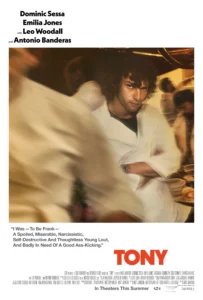
 Starring: Dominic Sessa, Antonio Banderas and Emilia Jones
Directed by: Matt Johnson
Rated: R
Running Time: 106 minutes
A24
Our Score: 4 out of 5 Stars
It felt like only a matter of time before Hollywood churned out a biopic about the bad boy of the culinary world, Anthony Bourdain. Although, even that description feels inadequate. Chef. Writer. TV host. Traveler. Bourdain became one of those people who was difficult to define by a single job title because his greatest talent may have simply been his curiosity about other people.
He treated street food and Michelin-star restaurants with the same reverence, respecting the passion of whoever put the plate in front of him. Bourdain could be larger than life without making anyone around him feel smaller. So, a biographical film would certainly be able to encapsulate the magic of that persona, right? Well, “Tony” isn’t particularly interested in doing that.
Set during the summer of 1979, “Tony” introduces us to a young Anthony Bourdain, or Tony (Dominic Sessa), as he tells everyone to call him. He aspires to be a writer. The only problem is, he really isn’t. We never see him write, he fails to secure a much-needed writing fellowship, and he seems more preoccupied with what’s going on in Nancy’s (Emilia Jones) pants than putting pen to paper.
Lost in life and seemingly without focus, a series of mistakes leads Tony to the Flagship, a lobster roll joint run by a mysterious head chef played by Antonio Banderas. The Flagship is made up of other lost souls and former criminals who take Tony in like a stray. It’s there that a young man who seems destined for greatness begins to realize he isn’t particularly great at anything.
If you’re expecting an eye-opening look at young Anthony Bourdain that fully reveals the man he would eventually become, this ain’t it. But that isn’t necessarily a knock on the movie. While Bourdain eventually became larger than life, he never seemed particularly interested in filling the enormous shoes people handed him. In that regard, he’d probably appreciate the toned-down nature of “Tony.” Strip away the Bourdain name and what remains is a solid, funny and surprisingly universal coming-of-age story about a young man trying on different versions of himself to see which one fits.
Sessa is terrific at portraying that uncertainty. His dialogue frequently represents the false persona Tony wants everyone else to see, while his eyes tell us something completely different. He talks like he’s destined to become the next Ernest Hemingway, but after a while, those declarations begin to sound less like ambition and more like something he’s decided an interesting person should say. Around Nancy, he projects confidence while looking completely out of his depth. In the kitchen, where he claims to have experience, his curiosity slowly betrays just how little he actually knows. Banderas’ chef recognizes all of this almost immediately.
Instead of humiliating Tony for his bullshit, he gives him somewhere safe to fail. Tony says he’s a writer, so the chef asks why he never sees him write. Tony claims to know his way around a kitchen, and the chef clearly knows he doesn’t. He teaches Tony the tools necessary to survive the Flagship, allows him to screw up, corrects him, and waits for him to stop making the same mistakes. More importantly, he recognizes the curiosity building in Tony’s eyes before Tony does. That’s where “Tony” begins to find the Bourdain we recognize.
He’s still not much of a writer. He’s not particularly good at cooking. His attempts at flirting with Nancy are painful enough to occupy half the movie. But Tony watches. He listens. He asks questions. He engages with people without immediately placing himself above them. Gradually, the film reveals that his greatest talent may not be creating something himself, but recognizing passion in someone else.
The relationship with Banderas’ chef beautifully reflects that idea. While the chef helps Tony discover a potential purpose, Tony begins to reignite something the older man has lost in himself. Tony does this with others throughout the film as well. He recognizes passion and elevates it, even when it isn’t his own. That’s the Anthony Bourdain people eventually tuned in to watch on “No Reservations” and read in “Kitchen Confidential.” Bourdain certainly developed a distinct voice as a writer, television host and lover of all things food, but his real gift was frequently knowing when to shut up and let someone else share theirs.
“Tony” doesn’t treat every meal like a prophetic moment leading toward “Kitchen Confidential,” nor does it pretend its young protagonist already possesses the wisdom of the man he’ll eventually become. Sometimes he’s full of shit. Sometimes he’s selfish. Sometimes he’s lost. Most of the time, he doesn’t know what he’s doing. He’s 20-something. Who does?
That’s ultimately both the limitation and charm of “Tony.” I’m not convinced it taught me much about Anthony Bourdain, but I’m convinced it understood something about him. Food found Tony when he needed somewhere to go. Then Tony found food when he finally started paying attention. Neither immediately transformed him into Anthony Bourdain. They simply gave him somewhere to put the person he was already becoming.