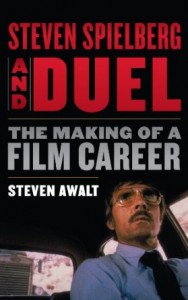


Here’s a trick question for you? Where did film director Steven Spielberg go when he wanted some information about…Steven Spielberg? The answer was an amazing web site known to fans all over the word as SpielbergFilms.com. Created and maintained by Steven Awalt, the site lasted for seven years, only closing down because of Awalt’s various projects. One of those projects, the well reviewed book “Steven Spielberg and DUEL: The Making of a Film Career,” will be released on March 26.
With a Master’s degree in Cinema Studies from DePaul University, Awalt is more than qualified to discuss the most successful filmmaker of his generation. While awaiting the release of his book, Awalt took the time to speak with me about everything Spielberg.
Mike Smith: What is it about Steven Spielberg that made you follow his career so carefully that you created a web site dedicated to his work?
Steven Awalt: He and George Lucas were really the first two “filmmakers” I knew when I was growing up. Of course, when I was younger I was a big fan of the Disney films but when “Close Encounters of the Third Kind” came out it really knocked me on my young butt. The scope of it was just amazing for a little boy. And then as I got older and looked at his films, I think it was his sense of humanity that really appealed to me. I don’t think he gets enough credit for his work with characters. Going back to “Close Encounters,” people focus on the spaceships and the aliens but, at the center of that film, you have a very emotional story about a family falling apart. Even in “Jaws,” you had the Brody family and, of course, the dynamic between the three men. “Duel” is really a great portrait of a man losing his mind. It’s all about paranoia.
MS: Do you remember the first Spielberg film you ever saw in a theatre?
SA: It was “Close Encounters.” I had just turned five, so he caught me at a very young age. Between that and “Star Wars” from earlier in the summer, it was the perfect age to be.
MS: I was sixteen. Trust me, it was a great summer to be sixteen as well!
SA: (laughs) I wish to God I had been older. You got to experience “Jaws.” I first saw it when it aired on television (November 1979). The funny thing was that it didn’t at first stick with me…not like “Close Encounters” or “Raiders of the Lost Ark” because it scared the hell out of me! Now it’s one of my favorite films but back when I was younger…I wish I had born in the same generation as yours because it must have been really great to be there.
MS: Of all the films that Steven Spielberg is known for, why did you choose to highlight “Duel?”
SA: Originally I had wanted to write about “Close Encounters” because it’s such an important film to me. I had been deeply researching it for years while I ran the old SpielbergFilms web site. At the time someone else had just come out with a very strong book about the film, independently written, and I was so upset because someone else had gone after it. I still plan to get to that “Close Encounters” book but when I thought about it, I realized that Steven’s work before “Jaws,” namely “Duel” and “Sugarland Express,” hadn’t really gotten their due. I thought it was fertile ground and I hope I’ve been able to start what I hope will be a series of books about his work. “Duel” and “Sugarland” are great films but they really kind of got buried by the success of “Jaws,” “Raiders,” E.T.” ….everything.
MS: Do you have a favorite Spielberg film?
SA: I definitely have a favorite. And, like most people, my favorite film is different then what I consider his best film. His best film is actually too hard a question, but my favorite film of his, from a personal perspective, is “E.T.” That film came along in my life…when I needed it most. It probably sounds funny to say that about a movie but I’m sure, at the same time, many fans can relate to that. I had a pretty rough childhood. My father was an alcoholic…he just wasn’t there for me. He died when I was a kid. So the film really spoke to me. A lonely young boy who misses his father…again, it’s the heart of the film that makes it so beautiful. Even to this day it’s a very important film in my life. And it comes from a very personal space in Steven because of the divorce of his parents. The scene in the garage where Elliot and Michael are looking for things for E.T. to build his communicator with…finding their dad’s old shirt and smelling the cologne on it…that’s the one thing I love about his work so much, that it’s so relatable.
MS: I’m paraphrasing this comment from the late director Sydney Pollack, who in 1984 told TIME magazine that he felt Spielberg would never win an Oscar until his films “grow up.” I actually met Pollack at a retro screening of “They Shoot Horses, Don’t They?” and asked him about his comments. He maintained to me that Spielberg needed to focus more on adult material. Do you think that he intentionally changed the kind of films he was doing because of that thinking? (NOTE: Spielberg’s next film after “E.T.” was the critically acclaimed, very grown up “The Color Purple.” The film received a total of eleven Academy Award nominations though, surprisingly, not one for Spielberg’s direction. This film, and 1977’s “The Turning Point,” share the record for most Academy Award nominations without a single win. Ironically, the winner of the Best Director Oscar that year was Sydney Pollack).
SA: Only Steven himself could answer that question accurately. But I think that, having started out making films in his early 20’s, Steven grew up with his films. I would imagine he was looking for different kinds of entertainment…not entertainment, per se’, but different kinds of stories about human beings. “The Color Purple” is an interesting film. I’m not a huge fan of it, but it’s definitely a turning point. To me the film that signals a new Spielberg on the screen isn’t “The Color Purple,” it’s “Empire of the Sun.” A certain weight comes with the film that I don’t think “The Color Purple” has. To me “Empire of the Sun” is a signpost for people who were so surprised by “Schindler’s List” and the films that followed. I really think you can start to see that in “Empire of the Sun,” which he made when he was in his late 30’s. So I imagine it was just a normal maturing. I guess the only person who can really answer that question is Steven.
MS: You’ve hinted that you’re working on a book going behind the scenes of “Sugarland Express.” Is it going to be in the same vein as this one?
SA: Absolutely. I like to think of it as a continuation of the “Duel” book. To me I’m writing one big book, but this one will have a different approach. It’s obviously a different story but it will show the expansion of Steven’s talent and his growth as a filmmaker.
MS: Are you hoping to maybe one day be able to document all of his films?
SA: I’m hoping to at least get through Steven’s films from the 1970s at least, because that’s my favorite period. I’d like to write about a lot of filmmakers from that era. I’m a big fan of George Romero. I’d love to write about Martin Scorsese. Brian DePalma would be fun to write on as well. But yes, I hope to at least cover the 1970s and his four masterpieces from that era.