
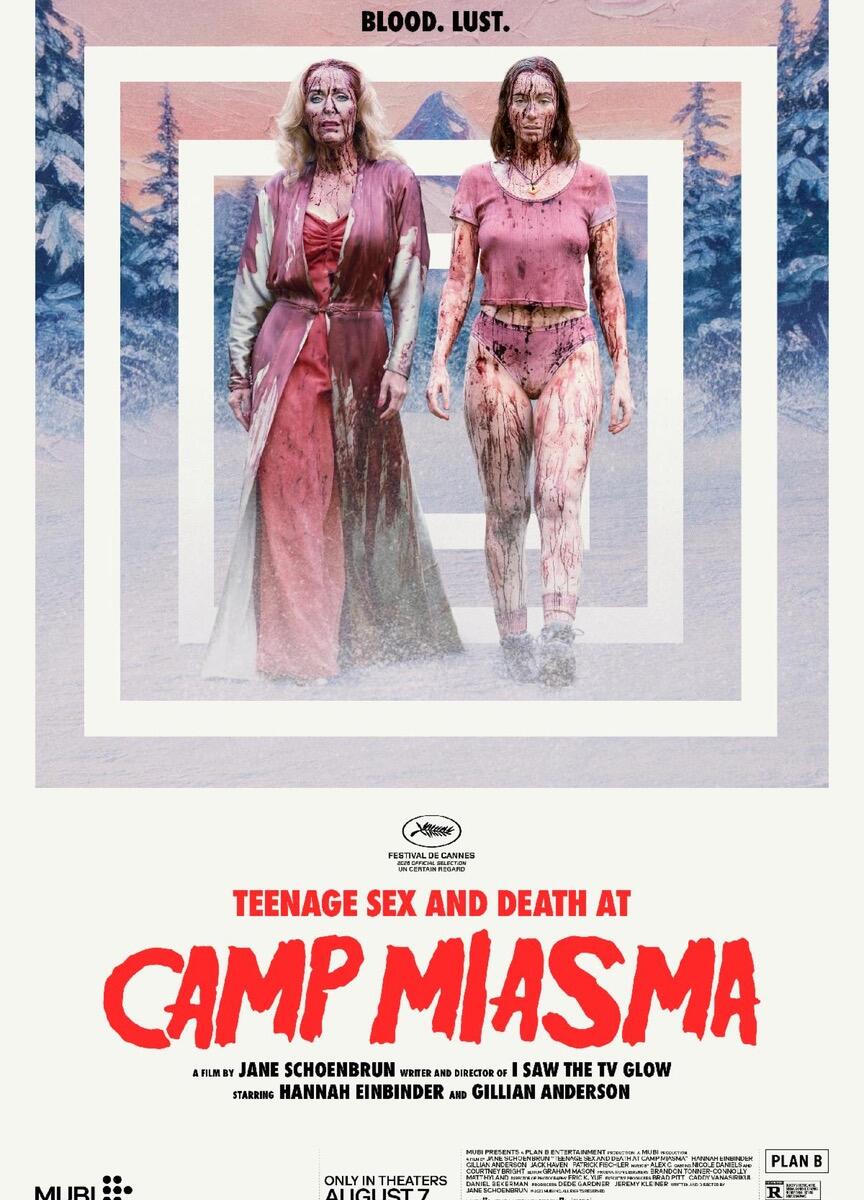
 Starring: Hannah Einbinder, Gillian Anderson and Jack Haven
Directed by: Jane Schoenbrun
Rated: R
Running Time: 112 minutes
Mubi
Our Score: 4.5 out of 5 Stars
What can you say about a meta film that mocks its own meta nature, points out when it’s being meta, and then features a film within the film that’s also being meta? I might as well get all the metas out of the way because it’s the perfect word to describe “Teenage Sex and Death at Camp Miasma.” It’s also a winking love letter to the slasher genre, an intentionally campy comedy, a self-reflective dunk on the clashes between studios and artists, and it’s all wrapped up in a coming-of-age sex story. It’s a lot to unpack. Even if it doesn’t scare you or make you wince, it’ll stick like blood-red gum in your brain.
Up-and-coming filmmaker Kris (Hannah Einbinder) is tasked with rebooting, remaking, reimagining, or whatever we’re calling it these days, the in-film slasher franchise “Camp Miasma,” featuring the aptly named serial killer Little Death. That’s not the first on-the-nose nod to the sexually charged nature of the film, and it certainly isn’t the last.
Kris loves the much-maligned franchise, including the sequels everyone else seems perfectly comfortable dismissing as garbage. That obsession leads her to Billy (Gillian Anderson), the original final girl of “Camp Miasma.” Billy left the franchise behind professionally, but never quite escaped it personally, now living at the resort camp where the original film was shot. Kris traverses mountains and enough snow to wander into “The Shining” just to meet the mysterious recluse.
Obvious sparks fly, but something more interesting is happening beneath their witchy flirting and academic debates over sex, LGBTQ+ themes, misogyny, murder and horror. Kris and Billy are almost the Mulder and Scully of slasher analysis. They can stare at the same thing from completely different perspectives while still loving what they’re looking at. Kris intellectualizes the hell out of “Camp Miasma,” but never seems to get closer to understanding why it speaks to her. Billy is more mature and comfortable with those ideas, but she’s also spent years isolated from the genre, the industry and much of society itself. Billy helps Kris understand something about herself beyond all the analysis, while Kris reminds Billy why something inherently silly can still be incredibly important.
Maybe that’s what loving movies is. Kris doesn’t pretend every “Camp Miasma” sequel is some misunderstood masterpiece. She sees the bad CGI, ridiculous violence, terrible music and all the other reasons someone might dismiss a crappy sequel. She just sees something beyond those things that still connects her to what she loved in the first place.
I get it. There was a time when I thought “Seed of Chucky” was awful. Now that I’m older, have watched thousands more movies and am hopefully at least marginally wiser, I appreciate it far more than I did then. “Seed of Chucky” didn’t change. I did.
Much like director Jane Schoenbrun’s prior films, “I Saw the TV Glow” and “We’re All Going to the World’s Fair,” what’s beneath the surface is what “Camp Miasma” is really about. Schoenbrun leaves enough interpretive space that people will walk away with wildly different readings, and the movie almost seems to welcome the disagreement like a stand-up comedian waiting for someone in the audience to heckle them.
My biggest takeaway is the thin line between sex and horror, something the genre has been exploring forever. Horror has long turned desire, bodies, penetration, shame, pleasure, pain and vulnerability into sources of terror. “Hellraiser” practically built a mythology out of kink. Slashers spent decades turning virginity and sex into matters of life and death. “Teeth” made sexual anxiety horrifyingly physical. “Camp Miasma” knows that history and gleefully screws around with it.
Einbinder lives and breathes Kris, making a character who could easily become exhausting feel vulnerable, funny and increasingly unhinged. When we meet her, she’s neurotic and desperate to explain what these movies mean. Once she encounters Billy, that shell begins to crack. She becomes wilder, more vulnerable and even more verbose, sometimes pointing out the very tropes the movie she’s currently occupying is using.
Anderson initially plays Billy like another mystery Kris needs to solve. She speaks with the confidence of a Southern Socrates, seemingly possessing an answer for everything while revealing almost nothing about herself. Only after Kris gets through does Anderson allow the vulnerabilities, fears and passions underneath to emerge. The more they open themselves to one another, the more we understand what “Camp Miasma” itself is doing.
I don’t really view Schoenbrun’s films as horror as much as theses on life written using the language of horror. “Teenage Sex and Death at Camp Miasma” may be the filmmaker’s most playful version of that idea yet, accessible enough for a regular audience to enjoy the sex, blood, comedy and absurdity while allowing crazier fanatics to dig endlessly through everything underneath. And boy, does this film have a nostalgic, fresh style to dig into. Painted backgrounds give way to establishing shots that could make Wes Anderson scribble a few notes, while moments of fantastical sexuality spill across the screen through CGI and practical effects. Even the fountains of blood look like Rorschach splatter art.
There’s a certain mix of Edgar Wright and Quentin Tarantino in the film’s pure cinephile energy. “Camp Miasma” borders on parody at times, but its constant genre-mixing keeps its head above water. At 112 minutes, it does begin to drag in spots, and I’ll maintain that any horror movie crossing the 100-minute mark better have a damn good reason for doing so. “Camp Miasma” mostly does. Mostly. Shave five or 10 minutes off and I might not have noticed at all. The soundtrack certainly helps, creating moments of unexpected joy even when Little Death finally starts killing. There’s something bizarrely beautiful about watching a speaker-boxed killer go on a rampage while melancholy alternative rock muffles the screams and sounds of blades hitting flesh. It’s possibly one of my favorite scenes of the year, right alongside Ralph Fiennes dancing like a madman to Iron Maiden in “28 Years Later: The Bone Temple.”
At a certain point, I wondered whether “Teenage Sex and Death at Camp Miasma” was a great horror movie or simply a great movie. By the end, I’m not sure the distinction matters. The film plays out like a self-fulfilling prophecy about how good and bad movies alike can occupy special places in our lives. They shape us, mold us and sometimes wait years for us to become the person capable of seeing something in them we couldn’t see before.
Maybe “Camp Miasma” is trash. Maybe it’s art. Maybe it’s both. Kris can spend her entire life trying to figure out what those movies are saying to her. Billy can spend hers trying to understand why they still matter. And idiots like me can write thousands of words trying to explain why a movie about people talking about another movie made us feel something.
But sometimes what a movie says matters less than why we needed to hear it. The movie doesn’t necessarily change. We do.